David Vaněček, Dana Dobrovská (2023). Virtual Reality to Improve Technical Teacher Presenting and Speaking Skills. In: Human Interaction and Emerging Technologies (IHIET-AI 2023): Artificial Intelligence and Future Applications. AHFE Open Access, vol. 70, pp. 214–222. https://doi.org/10.54941/ahfe1002946
ContextFear of public speaking (glossophobia) is one form of anxiety. People may struggle to speak in a classroom, meeting, and in other group settings. This can make it very difficult for sufferers to communicate verbally to express their knowledge and thoughts. As a result, glossophobia may hamper the sufferer’s ability to further own academic, social or career opportunities.Purpose/approachThe aim of our study was to share experience with a teaching program based on VR to help future teachers improve their presentation and speaking skills. Our study followed a descriptive mixed research design. Participants of 5 groups, each of 5 members went through the regular course of speaking and presentation skills or through a course based on VR. Several characteristics of an individual speech were measured by VR: eye contact, speed of speech, use of crutch words, speech pausing, clarity, loudness, monotony and word repetition. Reduction of glossophobia was measured by a questionnaire and through personal interviews.Actual research outcomes -Interviews with teachers (6 trainers)Pros: high motivation, visible progress, more self-assurance, better performanceCons: cost of equipment, need of technical support-Interviews with course participants (25 future teachers)Pros: felt like being in „real“ classroom and with „real“ students, enjoyment, new experience, emotions, enthusiasm, fun, loss of fear,Cons: made me tired, had to share the equipment with other students, lost my concentration-QuestionnairesClear reduction of glossophobia as measured by self-report of future teachersConclusions VR is eligible to be used in different environments, and many applications successfully apply it to improve learning. Our findings indicate that VR applications are more likely to lead to certain benefits such as increased motivation of users.
Augmented and virtual reality (AR, VR) are unique instructional media, affording educators opportunities to create, customize and scale authentic, student-centered, interactive learning experiences (Diegman, 2015). Moreo- ver, those learning environments allow each student to have a unique path of discovery through real-life symbiosis between technology and learning (Bacca-Accosta, 2014). AR and VR applications engage students with com- plex problem solving and educational environments, and many applications successfully apply it to improve different types of learning and training. They provide new possibilities for different spheres of education, although these environments are not yet investigated in their entirety (Akçayir, M., Akçayir, G., 2016).
Virtual and augmented reality can promote new experiences with classw- ork, encourage collaboration between students, improve motivation, and increase learning gains (Dobrovská, Vanˇeˇcek 2021A, 2021B). These benefits rely on effectively implementing them into the class. When integrated poorly, they can face several limits, including too much focus on virtual information and intrusion of the technology onto actual learning gains. In recent years, there has been an increasing interest in applying AR and VR to create uni- que educational settings as many excellent examples in education worldwide can be observed. Ability to connect reality and digital content has been ste- adily improving, opening more options for teachers and students. However, there is still a lack of review studies with focus on investigating factors such
Virtual Reality to Improve Technical Teacher Presenting and Speaking Skills 215
as: the uses, advantages, limitations, effectiveness, challenges and features of AR and VR in educational settings. Anyway, 14 different benefits of VR are named in our source literature of which two (Improved Learning Curve and Increased Motivation) account for more than 20 % of all benefits mentioned (Diegman, 2015).
Virtual reality is well known for teaching hard skills and offering rea- listic simulations, such as for airplane pilots or equipment maintenance. The PwC 2022 Us Metaverse Survey found that 51 % of companies are either in the process of integrating VR into strategy, or have already built VR into at least one dedicated line of business. www.pwc.com/us/en/tech- effect/emerging-tech/virtual-reality-study.html, 2022.
VR can also perform as a training tool for soft skills. Selected learners from 12 different locations took the same training in one of three learning modalities: classroom, e-learn and v-learn (VR). Study shows that learners in VR courses can be trained up to four times faster, are more confident in applying what they’re taught, they are more emotionally connected to VR content and more focused as there are no interruptions and no opti- ons to multitask. VR-learners were also up to four times more focused during training than their e-learning peers and 1.5 times more focused than their classroom colleagues. When learners are immersed in a VR experie- nce, they tend to get more out of the training and have better outcomes. In the past, VR was believed too expensive, complicated and challenging to deploy outside of a small group. Currently, the cost of an enterprise head- set ecosystem is a one-time fee of less than $1,000, and these units can be managed like any other enterprise mobile device and can be used repeatedly to deliver training. www.pwc.com/us/en/tech-effect/emerging-tech/virtual- reality-study.html, 2022.
VR and Other Technologies at Secondary Technical Schools Currently, as the digital transformation of education has also become a challenge to the educational system in many countries, the introduction of modern digital learning technologies and tools, in particular, the tools of augmented and virtual reality, is among the most crucial issues. Using objects of these technologies allows the teacher quickly and affordably to explain a large amount of theoretical material, and students to learn effectively. It develops in them a creative thinking and enhances the motivation to learn. Using digital technologies to support innovation in learning and teaching can result in changes to what teachers do and how they do it. Innovation is not constrained by physical spaces – it depends on pedagogy and practice.
Prestigious technical schools are expected to provide a curriculum that makes the most of advanced technologies to meet the needs of their learners. Nevertheless, there are still some limits for many educational institutions to have benefit from AR and VR equipment due to its cost.
In order to get more insight on the use of advanced technology at tech- nical schools, we participated in 2022 in a survey when a short question- naire was sent to 72 secondary technical schools of the Czech Republic asking the management to report experience with advanced technologies
216 Dobrovská and Vanˇeˇcek
Table 1. What technologies does your school use for teaching and learning purpose?
Table available in the original PDF paper.
What technological acquisition do you plan for 2023-2025?.
used at technical schools for teaching purpose (Dobrovska and Vanˇeˇcek, unpublished, Patoˇcková, 2022).
65 responses were gained and 5 technologies were reported: bee bot (the highest frequency), 3D printer, ozobot, virtual reality and augmented rea- lity (the lowest frequency). But when management of schools reported about considered purchase of technologies in 2023–2025, virtual reality was con- sidered the most probable school acquisition, followed by ozobot, bee bot, 3D printer and augmented reality. The use of VR was planned for variety of courses.
Results show there might be some changes in near future as 23 % of scho- ols plan to acquire equipment for VR (less in case of AR). As both augmented and virtual reality probably become more accessible on ordinary devices, more educators will explore the potential of these tools.
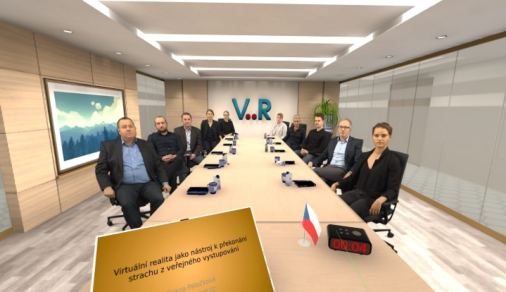
VR and Presentation/Speech Training VR can immerse a user in a variety of rooms to suit their needs and improve speech and presentation skills for the correct type of event. The more adju- sted the environment, the more comfortable the person feels. With VR, it is possible to spend time in a similar room to where teachers (and other spea- kers) will be delivering their presentations. They will be able to practice with a realistic audience, sound (audience and environmental), lighting distracti- ons and even audio feedback like they’d get with a microphone. There are many types of presentation rooms offered by designers: classroom, meeting rooms, conference rooms, media styled rooms, networking room, occasions rooms, etc. As many speakers may struggle to speak in front of an audience and they may be nervous to do a presentation - VR offers them a realistic environment to practice their public speaking safely.
VR and Effective Communication in the Classroom Effective communication can encourage building and fostering a safe learning environment where students can thrive, prosper and learn. Communication is both expressive and receptive and future teachers of technical subjects should be skilled in listening and understanding in thoughts and ideas of their students and elaborating things clearly.
Virtual Reality to Improve Technical Teacher Presenting and Speaking Skills 217
Figure 1: Virtual reality (a fictive conference room) as a tool to overcome fear of public speaking.
A successful teacher blends both verbal and nonverbal communication skills in establishing good rapport with students and this has a direct correlation to student achievement. The VR learn program we used in our research offered control over some factors of the user’s nonverbal communication.
Nonverbal communication is defined as communication without words. It includes apparent behaviors such as facial expressions, eye contact, touching, and tone of voice, as well as less obvious messages such as dress, posture and spatial distance between two or more people.
Some of these characteristics of an individual speech were measured by VR program we used:
Eye contact: by looking students directly in the eyes, teachers encou- rage them to pay attention. Good eye contact shows that teachers have confidence in themselves.
Speed of speech: the speed of teacher’s speech may interfere with a stu- dent’s comprehension of the task if it is too fast or too slow. But variating the speed of speech the student attention can be maintained.
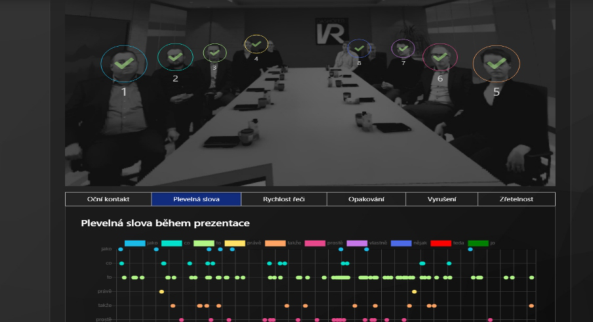
Use of crutch words: the most popular crutch words in English are actually, obviously, honestly, like, basically, literally, definitely, so, well, but they differ in other languages. In speech, they’re filler words that give speakers more time to think about their response. In writing, they’re words and phrases authors picked up or used for a particular reason, but ended up overusing them. Teachers and students should minimize the use of crutch words.
Speech pausing: it is an interval of silence in speaking, speech disfluencies, breaks, irregularities, or vocal interrupters that occur within the flow of otherwise fluent speech. In public speaking, a pause is an interval of sile- nce. When used effectively in teaching, pauses can enhance information delivery.
Clarity: Speech clarity concerns the quality of speech transfer to the liste- ners. In a room with disturbing background noise, it can be difficult to
218 Dobrovská and Vanˇeˇcek
Figure 2: Crutchwords measured during presentation.
pick up the teacher’s speech. The sound that reaches the students first is the direct sound that is followed by early reflections.
Loudness: Speech loudness is the perception of how intense sounds appear to be to the listeners. Voice problems are common among teachers. This is most likely due to the heavy vocal load of their profession.
Speech monotony: When teachers speak in a monotone, their voices do not vary at all in tone or loudness and so it is not interesting for students to listen to.
Word repetition: Repetition is when a single word or phrase is used multiple times in short succession for effect. It can help emphasise a point.
EXPERIENCE WITH VR IN PRESENTATION AND SPEAKING SKILLS TRAINING OF TEACHERS OF TECHNICAL SUBJECTS Research Objectives
The aim of our study was to gain insights into to v-learning from the perspective of teachers and students. Our paper sets out discursive issues sur- rounding student performance in non-verbal communication training, level of glossophobia – fear of public speaking, and opinions of participants - students and teachers - regarding pros and cons of VR.
Research Methodology Our research followed a mixed method strategy combining qualitative appro- aches to data collection and the ensuing discussions.
We used following methods:
student essay analysis (opinions on achievements in nonverbal communi- cation training measured by VR program)
self-reporting of participants on fear of public speaking-glossophobia
semi-structured interviews with teachers/trainers of VR program
Virtual Reality to Improve Technical Teacher Presenting and Speaking Skills 219
Research Participants 25 bachelor students-future teachers of technical subjects, aged 22-26, enrol- led in the course Speech and Presentation Skills participated in our research. For the first 9 weeks of the 15-week class, the students were delivered traditi- onal lectures on verbal and nonverbal communication, including traditional training for successful teaching. Then they were divided into 5 groups of 5 students each and they were trained in the VR program in 4 sessions. After each session, results in 8 categories of non-verbal communication were mea- sured by VR program. At the end of the semester, students were asked to write a 1 page essay on their experience with the VR program and assess its effectiveness in all 8 categories. At the start of the semester, students also self- reported the level their fear of public speaking on the scale 1–10 (10 being the highest level of fear) and were asked to compare it after their VR trai- ning. At the end of the semester we also held semi-structured interviews with 6 teachers – supervisors of the training.
RESEARCH OUTCOMES
1) Students essays (25 pre-service teachers of technical subjects)
- experience with VR program Students reflected their experience with the VR program as highly moti- vating and amusing, but also tiring. Improvements and confidence were mentioned in all 8 aspects of nonverbal communication, (see Table 2), but results seem to vary. Eye contact frequency increased in almost all reports and students found the control over it easier compared to some other aspe- cts. Nonverbal characteristics of speech - speed, pausing, loudness, clarity and monotony seemed more difficult to be under continual control and required more practice. Use of crutchwords also seemed resistant to changes in short time. Although student enthusiasm for VR-learn was expressed in all essays, it should not replace traditional teaching and learning practices but enhance them. Still yet, students believed VR learn had its purpose by making training meaningful. Some of their comments: “…people can forget what they write, can also forget what they listen to, but do not easily forget what they live and enjoy….”, “…. VR can help think positively and not give up, push a trainee outside of his comfort zone…”, there should be the need to work through challenging situations…, “it is nice that we can practise in a simulated situa- tion before being with real students… “. Some limitations were expressed by some students though as they were concerned about a saturation effect: “…I don’t think that it will work... people might also get bored if they use it all the time…”.
When to summarize the pros and cons expressed in most essays, they would be as follows:
feeling like being in a real classroom and with real students, enjoyment, new experience, emotions, enthusiasm, fun, loss of fear,
fatigue and discomfort working with 3D glasses, loss of concentration after certain time.
220 Dobrovská and Vanˇeˇcek
Table 2. Student self assessment of improvements in nonverbal communication.
Table 3. Level of glossophobia-student self-report at the start and at the end of the semester.
Table available in the original PDF paper.
Level of glossophobia (1-10) Student self-report at the Student self-report at start of the semester the end of the semester 1–2 1 1 3–4 3 4 5–6 9 10 7–8 8 8 9–10 4 2 Students - total 25 25
fear of public speaking (glossophobia) At the start of the semester, 12 students of 25 scored 7–10 on the scale which was interpreted as high level fear of public speaking, Nine of them described their fear as a long-lasting problem during their studies. At the end of the semester, most students reported mild or considerable reduction of fear, see Table 3.
2) Semi-structered interviews with teachers/trainers According to the opinions of teachers who were both giving traditional lectu- res on communication skills and were at the same time trainers of the VR program, students significantly improved their verbal presentation perfor- mance over the semester. The student’s performance showed that VR helped the students in learning better. The results revealed that there was a positive impact of VR environment on the development of presentation and spea- king skills among the students. (“…The use of VR tools enabled students to improve their speaking skills to a great extent.” “Speaking performance and nonverbal communication improved with the use of VR tools in the classroom...”).
When asked to summarize the pros and cons of VR-learn these were prevalent opinions as expressed by teachers: Plus: high motivation, visible progress, more confidence, better performa- nce of students,
Virtual Reality to Improve Technical Teacher Presenting and Speaking Skills 221
Minus: cost of equipment, need to divide the students into small groups, need of technical support
CONCLUSION
Our study confirmed VR had the ability to engage pre-service teachers to train the speech and communication skills as VR learning environment ten- ded to provide an effective supporter of traditional education. It was more likely to lead to certain benefits such as increased motivation of learners. However, the platform we used cannot be used as a one size fits all model. That is, educators have to have a clear sense of how these platforms add but critically, do not replace traditional teaching and learning practices but enha- nce them. Thus, there are factors to consider with this platform as well as with the learners themselves when incorporating this technology for pre-service teachers.
ACKNOWLEDGMENT
The authors would like to acknowledge to CTU MIAS for providing admi- nistrative and technical support and to the students who contributed to the purpose of the study.
The authors received financial funding from the project Erasmus+ KA220- ADU-2BF13E10 Building Digital Resilience by Making Digital Wellbeing and Security Accessible to All (DigiWELL)
REFERENCES
Akçayir, M., Akçayir, G. (2016), Advantages and challenges associated with AR for education: A systematic review of the literature. http://dx.doi.org10.1016/j.edur ev.2013.11.002. Andres, P., Dobrovská, D., Vanˇeˇcek, D. (2020). The Role of ICT in Mature Age Stu-
dents’ Distant Education. In: Edulearn20 Proceedings. Valencia: IATED Academy, p. 7337–7342. ISSN 2340–1117. ISBN 978-84-09-17979-4. Bacca-Accosta, J. et al. (2014), Augmented Reality Trends in Education: A Systematic Review of Research and Applications. Educational Technology and Society 17 (4): 133–149. De Pape, A. et al. Students’ Experiences in Higher Education With Virtual
and Augmented Reality: A Qualitative Systematic Review. Available from: https://www.researchgate.net/publication/336605098_Students’_Experiences_in _Higher_Education_With_Virtual_and_Augmented_Reality_A_Qualitative_Sys tematic_Review [accessed Jan 31 2023]. Dobrovská, D., Vanˇeˇcek, D. (2021A). Implementation of Augmented Reality into Student Practical Skills Training. D. Russo et al. (Eds.): IHSI 2021. AISC 1322. pp. 212–217. Dobrovská, D.; Vanˇeˇcek, D. (2021B). Technical Skills Training Backed by Augmented
Reality In: Proceedings of the 3rd World Conference on Research in Education. Vilnius: Diamond Scientific Publishing, 2021. ISBN 978-609-485-189-6. Dobrovská, D.; Vanˇeˇcek, D. (2021C). New Trends in Training Methodologies. In: Edulearn21
222 Dobrovská and Vanˇeˇcek
Proceedings - 13th International Conference on Education and New Learning Technologies. Valencia: IATED Academy, 2021. p. 899–904. ISSN 2340-1117. ISBN 978-84-09-31267-2. Patoˇcková, T. (2022). Schools and Virtual Reality: Pros, Cons and Practical Tips. In:
www.vr-trenér.cz Radu, I. (2012), Why should my students use AR? A comparative review of the educational impacts of augmented reality. Conference: Mixed and Augmented Reality (ISMAR), 2012 DOI: 10.1109/ISMAR.2012.6402590 IEEE. Shorey, S. et al. (2020). Communication Skills Training Using Virtual Rea-
lity: A Descriptive Qualitative Study. Nurse Education Today, Vol. 94, https://doi.org/10.1016/nedt.2020. Veteška, J.; Kursch, M. (2020). Adult Education 2020 – Reflection, Reality and Potential of the Virtual World: proceedings of the 10 th International Adult Education Conference, Prague, 334 p. 2020. ISBN 978-80-907809-7-2. ISSN 2571-385X.
LISTED IN THE AHFE DIGITAL BOOKSTORE CATALOGUE
Explore the complete digital volume
Human Interaction and Emerging Technologies (IHIET-AI 2023): Artificial Intelligence and Future Applications
Read this individual research paper free through the original publisher, or explore the full digital proceedings book.
ISBN 978-1-958651-46-9
Explore this ISBN in the AHFE Bookstore ↗Listed in the July 2026 bookstore catalogue; search by ISBN to confirm current availability · Digital book purchase optional