Alma Maria Jenifer Gutierrez (2023). LIDDIY: Remodeling Water Bottle Lids to Improve Its Usage and Maintenance. In: Affective and Pleasurable Design. AHFE Open Access, vol. 71, pp. 222–231. https://doi.org/10.54941/ahfe1003262
Francisco Antonio Climent, Janelle Kisha Filamor, Margarita Sofia, Manalo, Timothy Lawrence Tan, and Erin Miguel Vergara, Department of Industrial and Systems Engineering, De La Salle University, Manila, Philippines ↗
This study evaluated the current design of water bottle lids concerning ease of use and leakage preventive measures. Naturalistic observations, empathy map, and needs analysis were pursued to ensure that the proposed design would align with the users' needs and wants. It can be observed that there are only two main types of lids: twist-to-open and pull-to-open lids, available in the current market, and both types can be difficult to open, especially for elders. The first house of quality (HOQ1) was utilized to translate the customer needs to the technical requirements, which will be incorporated into the design of the product while HOQ2 was used to generate the initial design. Various design alternatives were also generated and passed through a concept scoring matrix. 3D fabrication was also utilized to create a prototype of the design. The product concept was able to fulfill the customer requirements identified: ease of use, ease of cleaning, convenience, and leakage-free. However, certain challenges were encountered during the prototype testing due to material constraints. Recommendations for improvement to better assess the product include utilizing a different fabrication method as well as a food-grade silicone gasket.
BACKGROUND OF THE STUDY With the rise of environmental issues in the world today, a percentage of peo- ple tend to adjust their lifestyles to alleviate the negative impact they make on the environment. This includes the adaptation of using reusable water bottles instead of single-use plastics. Water bottles are an essential item that almost everyone carries with them, whether they are at home or they are out and about doing their daily activities. Its purpose is to hold water or other liquids and keep them cold, hot, or whatever the user prefers. Since it is such an essential item and is vital to countless people worldwide, water bot- tles should be convenient, dependable, durable, and easy to use. Nowadays, most water bottles are made from two walls of stainless steel and are vacuum insulated to keep the liquid at the users’ desired temperature for long periods and durability. However, most of these styles of water bottles have varying types of water bottle lids. In this case, not all covers have the same process, quality, and features. Specific caps may negate the features and functionality
LIDDIY: Remodeling Water Bottle Lids to Improve Its Usage and Maintenance 223
of the water bottle itself due to poor build quality and functionality, which may cause leaking issues, temperature loss, and overall inconveniences to the user. The proposed product, LIDDIY, aims to fill this subpar water bottle lids market gap.
Problem Identification There are many existing water bottle lids currently available. The problems with the existing styles of water bottle lids are that they can be challenging to open, especially for elders or those with disabilities, and they are usually not airtight, which means that they are not leak-free. These problems can cause many issues for people, especially since water bottles are typically taken on the go. The goal of the proposed product, LIDDIY, is to eliminate the possibility of these issues occurring with water bottles by developing a water bottle lid that is effective, consistent and easy to use. People should not have to worry about their water bottles encountering problems as they go about their daily activities, especially since water bottles are an essential item.
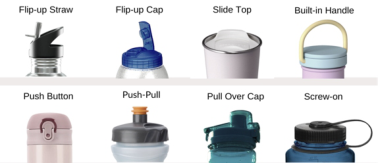
Existing Water Bottle Lids Commonly sold in the market are different kinds of lids with differing fea- tures for drinking, such as flip/slide caps, flip-up straws, push-pull caps, and push buttons. Other standard lid features are shown in Figure 1 (Mertes, 2020).
Figure 1: Common lid features.
Nevertheless, it can be observed that there are only two main types of lids in terms of opening or closing the bottle’s mouth to refill the bottle’s contents. The two main types are twist-to-open and pull-to-open lids.
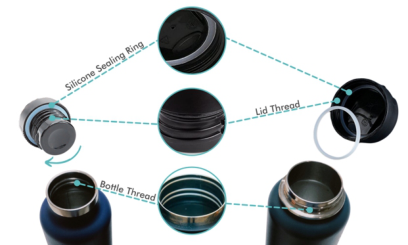
As its name suggests, twist-to-open lids function by twisting the cover counterclockwise to open the bottle and clockwise to close it. As shown in Figure 2, the cover consists of a thread similar to a screw on its inner or outer chute. This is then swiveled onto the corresponding thread on the neck of the bottle to close the bottle securely. A food-grade silicone sealing ring is also usually inserted at the inner or outer chute of the bottle lid, depen- ding on the placement of the lid thread. This provides bottles with an airtight seal, preserving freshness and avoiding water leakage once the lid is closed correctly.
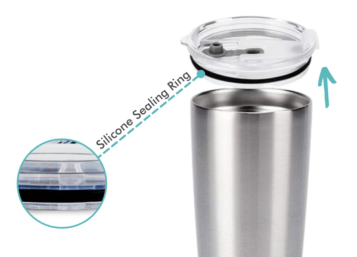
On the other hand, pull-to-open lids require pulling the cap away from the bottle to open and pushing towards the bottle to close. This kind of lid
Figure 2: Twist-to-open bottle lid.
usually only utilizes a silicone sealing ring to enable the cover to grip onto the water bottle’s opening (see Figure 3). Specifically, it can seal the bottle solely through the tight fit of the silicone ring inside its mouth.
Figure 3: Pull-to-open bottle lid.
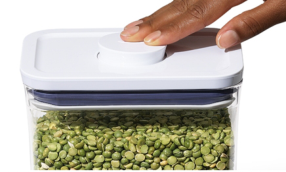
Product Inspiration The inspiration for the proposed product is based on the existing airtight pop- lid containers used for storing dry food. According to a company that creates pop containers, specifically the OXO POPTM Containers, this type of lid requires simply pressing the button to open or close the cover (see Figure 4).
Figure 4: OXO POPTM container ([design of OXO POP containers], 2019).
LIDDIY: Remodeling Water Bottle Lids to Improve Its Usage and Maintenance 225
Moreover, it was proven and tested that the seal resembles the refrigerator door (“How to pop containers,” 2020). A web mechanism was built into the lid that enables the attached silicone seal to perform similarly to a refrigerator door seal. When the button is pressed to close the top, the web expands, thus pushing the silicone seal toward the inner sides of the container, creating a wall capable of suppressing air. On the other hand, pressing the button again would enable the web mechanism to allow the silicone to contract for the lid to open.
Scope and Limitations The study’s scope focuses solely on improving water bottle lids and not the entire water bottle. Due to the nature of the research and the availability of resources, the study will be based mainly on qualitative observation and quantitative data gathered from a sample size of 100 participants. More- over, the study’s methodology will only include the concept development and the testing of the product prototype and will not have the execution of the final product. The proposed product cannot accommodate water bottles with the thread inside the neck of the bottle due to the grooves preventing the push lid mechanism from working. Furthermore, the product prototype measurements are based on Hydro Flask’s wide-mouth water bottle. Material selection for prototyping is limited by material availability and compatibility with the prototype production process.
METHODOLOGY
To understand the different user needs and lid requirements, the attitude and behavior of users were assessed. First, based on the researchers’ observations and perceptions of existing water bottle lids, an empathy map was created to gain a deeper insight into the customers. After this, the problems identi- fied in the map were translated into the interpreted user needs, which will be used as the basis for the survey. The sample size was calculated, and a survey was disseminated online. Following this, the lid requirements based on the responses were used as the basis for the customer needs in the first house of quality. The technical requirements were also identified and will serve as a guide for product development. The product concept (alpha prototype) was then generated through the computer-aided design software SolidWorks. The idea was then selected among the alternatives based on the concept scoring matrix and underwent a failure mode and effects analysis. In addition, a beta prototype was produced using 3D printing. This was then subject to specific testing procedures determining whether it could fulfill the identified custo- mer requirements. Lastly, a cost-benefit analysis was performed to guide the decision-making about its production.
RESULTS
User Survey From the 100 participants who answered the survey, results showed that a majority of the respondents are female, comprising 67%, and males com- prising 33%. Moreover, the respondents were mainly in the age ranges of
21 to 40 and 41 to 60, specifically students and the working population. Results showed that 42 respondents are from ages 41 to 60, 37 from ages 21 to 40, 15 from ages 20 and below, and six from ages 61 years old and above. Regarding their current situation, 69% of the respondents use stain- less steel insulated water bottles, 18% use plastic bottles, 10% use aluminum, and 3% use glass water bottles. Moreover, 35% use the brand Hydro Flask, followed by 16% who use Klean Kanteen, 13% use Lock & Lock, 6% use Thermos, and 30% use other brands. Regarding the type of lid used for refil- ling water, 88% have twist-to-open covers, while the remaining 12% use pull-to-open caps. Users use water bottles while working or studying (69%), going on trips (52%), exercising (42%), and eating (32%). Furthermore, respondents use this at home (70%), in the office (43%), for transport (43%), at school (23%), and in the mall (13%).
From the results, the lid handle is considered the most crucial feature by most participants (59%), ranking it as number 1. Following this is the flip or slide top, which received the highest votes as second in rank with 44%. Considered the least important feature out of the three is the straw hole, receiving the highest percentage (73%), thus third in rank.
In the survey, the participants were also asked about the require- ments for water bottle lids. The participants were given choices and an option to input other possible requirements they may deem necessary. This is to identify which of the potential user requirements should be prioritized.
The requirement with the highest count was lids that can prevent leakages with a total of 88, followed by easy-to-open lids or lids that require little to no effort to open with a count of 70, lids with handle with a count of 57, and easy to close lids with a count of 53. Some participants also considered the following: easy to clean, lightweight, covered drinking spout, and durable lids. These have the lowest counts ranging from 1 to 3. Thus, these have the most minor importance.
However, for the proposed product, the durability and covered spout will not be considered. Due to limited access to measurement devices, durability may be challenging to assess. Regarding the spout, this does not apply to the proposed product, thus, was not counted in the list of customer needs. With this, the final user needs were then classified and given an average rating (as shown in Table 1).
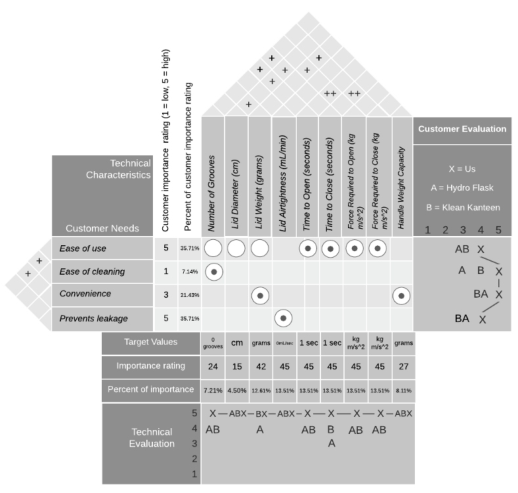
House of Quality 1 The first house of quality was utilized to translate the customer needs to the technical requirements, which will be incorporated into the product’s design. Following this, the customer needs and technical requirements were incor- porated into the HOQ1, and the relationships and correlations between the factors were determined. This can be seen in the figure below.
The matrix in the figure’s center shows the relationship between customer needs and technical characteristics. In terms of the correlations between the technical requirements, this is shown on the left-hand side of the figure, while the correlations between the customer needs are shown on its upper part or
LIDDIY: Remodeling Water Bottle Lids to Improve Its Usage and Maintenance 227
Table 1. Category of needs and weighted rating.
Table available in the original PDF paper.
Interpreted Need Rating Need No. Category
Category of Need Average Rating
5 1 Ease of use 4
The lid is easy to open (requires little to no effort).
3
The cover is easy to close (requires little to no action).
The lid is easy to clean. 1 2 Ease of cleaning 1 The lid is lightweight 1 3 Convenience 3 The lid includes a built-in handle 4
The lid prevents leakage 5 4 Prevents leakage 5
Figure 5: House of quality 1.
also perceived as the roof of the house of quality. Regarding the importa- nce ratings, this was computed by multiplying the customer need importance rating by each relationship value and getting its total. Based on the figure, lid airtightness, time to open/close, and force required to open/close obtained the highest ratings. Thus, these should be the priority in the development of the product. This is followed by lid weight, shape, and diameter, respectively.
The customer evaluation of two competitors assessed in the study was based on how customers perceive their lid after purchasing it. Since Hydro Flask and Klean Kanteen were the respondents’ top two water bottle brands, these were the two competitors assessed. Customer reviews for each need and corresponding ratings (1 to 5) were collected. After that, the average ratings
based on the customer reviews were obtained and used to determine the com- petitors’ status in terms of the different customer needs. The quality of the proposed product was also considered based on how it is perceived.
For the technical evaluation, both competitors and the proposed product are tied at the first rank for diameter, airtightness, and handle weight capa- city since all three exhibit almost equal diameters, an airtight feature, and include a handle to support the weight of the lid and bottle. For lid weight, it can be seen that Hydro Flask’s lid is ranked below Klean Kanteen’s and LIDDIY’s. This is because it is a little heavier than the two lids. For the time and force required to open and close the lid, it can be seen that the proposed product is ranked first while the two competitors are ranked below. This is because the offered product is perceived as more straightforward than the other competitors’ lids.
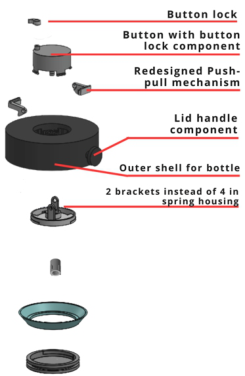
Product Improvement The proposed product comprises nine parts with six modifications to the existing lid. Specifically, these are further highlighted in Figure 6.
Figure 6: 3D-model of product improvement.
One main difference between the existing and proposed products is that LIDDIY offers a button lock to ensure no accidental pressing occurs. Adding this feature would then slightly modify the button as it now includes the lock component attachment. Moreover, the push-pull mechanism is redesigned, given the space constraints. Since this is attached to the spring housing, two bolt, and nut pairs are needed to keep it in place. As for the lid, there is an additional component where the lid handle is attached, as well as an outer shell to cover the external grooves of a water bottle for hygienic purposes. Lastly, the spring house of LIDDIY has two brackets instead of the initial four brackets. Nevertheless, this can ensure that the spring is secured and can provide the button with an upward force.
LIDDIY: Remodeling Water Bottle Lids to Improve Its Usage and Maintenance 229
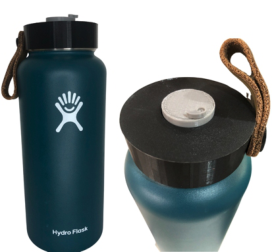
Figure 7 shows that the beta prototype fits the Hydro Flask wide-mouth bottle. It also includes a “pop” sound that can be heard when pressed, which may provide users with assurance and satisfaction that the lid is opened or closed correctly. Thus, this contributes to the affective design, which Jiao et al. (2007) highlighted as a competitive advantage, and Bodker et al. (2003) acknowledged as what society prefers.
Figure 7: Beta prototype of LIDDIY.
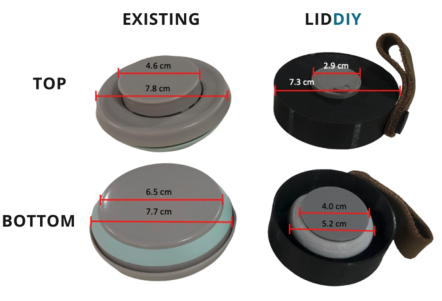
Figure 8 compares the existing lid and LIDDIY (beta prototype) side-by- side comparison. Moreover, the measurements are indicated to show further the size considerations accounted for to fit the Hydro Flask water bottle.
Figure 8: Comparison of existing lid and beta prototype.
CONCLUSION AND RECOMMENDATIONS The product concept addressed the current user problems with using water bottle lids. Translating the initial pop lid container to fit a wide-mouth Hydro Flask bottle lid was much more convenient. Moreover, the product concept fulfilled the customer requirements, specifically, ease of use, clea- ning, convenience, and leakage-free. Nevertheless, specific challenges were faced in testing the beta prototype due to material and method constraints.
Recommendations for further improvement include using a different fabrica- tion method to capture the 3D model parts better. In addition, a food-grade silicone gasket is also recommended compared to TPU, as this provides more rigidity to push against the walls of the water bottle: a more precise fabrication and the usage of proper materials to assess the proposed design accurately.
REFERENCES
Bødker, Mads & Christensen, Martin & Jørgensen, Anker Helms. (2003). Understanding affective design from a late-modernity perspective. 136–137. 10.1145/782896.782931. Design of Oxo Pop Containers. (2019). [Photograph]. OXO. https://www.oxo.com/ blog/behind-the-scenes/behind-the-design-pop-containers/. Grames, E. (2021, January 9). TPU Filament: Best brands in 2021 – buyer’s guide.
All3DP Pro. Retrieved September 12, 2021, from https://all3dp.com/2/tpu-filame nt-explained-and-compared/ Jiao, R. J., Xu, Q., Du, J., Zhang, Y., Helander, M., Khalid, H. M., ... & Ni, C. (2007).
Analytical affective design with ambient intelligence for mass customization and personalization. International Journal of Flexible Manufacturing Systems, 19(4), 570–595. Ka’roly Ja’nos, B., A’kos, J., & Ka’roly, B. (2010). Force measurement of hand and fingers. Biomechanica Hungarica, 3(1). Khalid, H. M. (2006). Embracing diversity in user needs for effective design. Applied
ergonomics, 37(4), 409–418. Kiran, D. R. (2017). Total Quality Management: An Overview. In Total Quality Management (pp.1–14). Butterworth-Heinemann. How to pop containers seal and keep food fresher for longer. OXO. (2020, February 7). https://www.oxo.com/blog/behind-the-scenes/how-oxo-pop -containers-seal/. Mastrisiswadi, H. Amalia (2017). THE PRODUCT DESIGN OF WATER BOT-
TLED FOR ADULTS ACCORDING TO CUSTOMER NEEDS USING QUA- LITY FUNCTION DEPLOYMENT (QFD) METHOD’, IJIRAE:: International Journal of Innovative Research in Advanced Engineering, 4, 13–20 Mertes, A. (2020, July 23). What are the different types of water bottles? https: //www.qualitylogoproducts.com/. https://www.qualitylogoproducts.com/promo- university/di different-types-of-water-bottles.ht Philippine Statistics Authority. (2021, July 23). Highlights of the Population Den-
sity of the Philippines 2020 Census of Population and Housing (2020 CPH). https://psa.gov.ph/population-and-housing/node/164857. Puffin, C. (2020, November 16). About biodegradable tpu. Puffin Swim. Retrieved September 12, 2021, from https://www.puffinswim.co.uk/about-biodegradable-t pu/. Royte, E. (2006, August 1). Corn plastic to the rescue. Smithsonian.com. Retrieved
September 12, 2021, from https://www.smithsonianmag.com/science-nature/corn -plas tic-to-the-rescue-126404720/. Schneir, J. (2021, August 25). Average profit margin by industry: Business profit margins. Camino Financial. Retrieved: September 12, 2021, from https://www.ca minofinancial.com/profit-margin-by-industr y/. Silicone Rubber. AZO Materials. (2001, September 25). Retrieved September 12,
2021, from https://www.azom.com/article.aspx?ArticleID=920.
LIDDIY: Remodeling Water Bottle Lids to Improve Its Usage and Maintenance 231
VA-Home Airtight Food Storage Container. Lazada. n.d. https://www.lazada.c om.ph/products/va-home-airtight-food -storage-container-bpa-free-plastic-for- keeping-food-dry-a mpampamp-fresh-i403634585-s962742767.html?spm=a2o 4l.searchlist.list.3.424f2400sp9g8D&search=1 V, C. (2021, April 15). Is PLA filament biodegradable? 3Dnatives. Retrieved Septem-
ber 12, 2021, from https://www.3dnatives.com/en/pla-filament-230720194/. Xu, X., & Lin, C. A. (2018). Effects of cognitive, affective, and behavioral factors on college students’ bottled water purchase intentions. Communication Research Reports, 35(3), 245–255.
LISTED IN THE AHFE DIGITAL BOOKSTORE CATALOGUE
Explore the complete digital volume
Affective and Pleasurable Design
Read this individual research paper free through the original publisher, or explore the full digital proceedings book.
ISBN 978-1-958651-47-6
Explore this ISBN in the AHFE Bookstore ↗Listed in the July 2026 bookstore catalogue; search by ISBN to confirm current availability · Digital book purchase optional