Mritunjay Kumar, Satyaki Roy, Ahmed Sameer, Amit Kundal (2023). Examining the effects of near and far cues on creativity. In: Creativity, Innovation and Entrepreneurship. AHFE Open Access, vol. 74, pp. 153–160. https://doi.org/10.54941/ahfe1003317
During the creative problem-solving, creators frequently encounter external stimuli. As a result of the context in which the problem exists, these stimuli can be near or far. Various theories in the past have supported the role of analogical cues to overcome impasses and generate new ideas. The use of analogous cues ensures successful transfer between the source and the target, depending on the degree of superficial similarity and complexity between them. However, some studies have shown that exposure to analogous cues can result in creative fixation rather than the development of new solutions. Furthermore, there has not been extensive research on the analysis of the combination of both the near and far cues on creativity as compared to the near and far analogies alone. This study investigates the effect of near and far cues in the creative process. This study aims to fill this gap by exploring the impact of combining near and far analogies on creativity and its impact on the flexibility, fluency, and originality of the ideas produced.
The cognitive process of analogy has been acknowledged as a valuable tool in the acquisition of new knowledge and facilitation of learning (Hofstadter, 2001; Holyoak and Thagard, 1997). Analogical reasoning allows indivi- duals to comprehend unfamiliar situations by drawing parallels to familiar ones, thereby serving as a mechanism for reconceptualization and promoting a change in the perception and evaluation of existing data. The utilization of analogy as a method in creative thinking allows for the identification, mapping, and transfer of structural information from a well-known situa- tion, referred to as the source, to a situation in need of clarification and explanation, referred to as the target (Holyoak and Thagard, 1996). The establishment of an analogy occurs when a correspondence is identified betw- een the known relationships between entities in the source and the possible relationships between entities in the target (Bearman et al., 2007).
The use of analogies has been shown to play a significant role in the stimulation of creative thinking. By providing context and meaning to a given situation, as well as presenting potential solutions and strategies to
address challenges, analogies can effectively facilitate the creative process (Chakrabarti et al., 2005). Holyoak and Thagard (1996) argue that analo- gical thinking is a form of mental mapping where similarities between two different domains are used to generate new insights and solutions. Similarly, Gentner (1983) found that analogies can be used to structure and integrate new information, allowing individuals to transfer knowledge and skills from one domain to another.
The impact of semantic distance on creative thinking has been extensi- vely studied in the context of four-term verbal analogy problems (Green et al., 2012). These problems involve two pairs of terms, where the task is to identify the relationship between the terms within each pair and then compare the relationships between the two pairs. The researchers found that problems with distant semantic relationships (i.e., far-analogies), such as furnace:coal::stomach:food, are perceived to be more creative than those with closer semantic relationships (near-analogies), such as fur- nace:coal::woodstove:wood, and exhibit a greater enhancement in response to prompts to engage in more creative thinking.
Analogical distance is a crucial factor to consider when making analo- gies. It represents the relationship between the source and target domains being compared. Analogical distance ranges from far-field (disparate pro- blem domains) to near-field (similar or identical problem domains). Analogies located at the far-field end of the analogical distance spectrum are characteri- zed by limited surface-level similarities and can pose difficulties in retrieving semantic meaning from one’s memory with the target domain. Conversely, near-field analogies possess a substantial number of surface-level similari- ties. There is evidence to suggest that when the source and target domains being compared are significantly dissimilar (far-field analogies), creative insi- ghts are greatest where there is the greatest chance of developing novel ideas (Wilson et al., 2010; Gentner & Markman, 1997). However, the other view presents some reservations about the utilization of far-field analogies (Wei- sberg, 2018; Dunbar, 1997). Far or distant analogies may be viewed as being inadequate in terms of their relevance to creative problems, and their retrieval from memory may pose cognitive challenges (Gick & Holyoak, 1980; For- bus et al., 1995). The cognitive effort required for retrieving such analogies can make the process of solving creative problems more difficult, reducing the efficacy of far-field analogies as a tool for creative problem-solving.
Aim of the Study While the importance of near-field and far-field analogies has been establi- shed in the literature on creativity and design, the effects of combining these two types of analogies on the creative process remain unclear. Previous rese- arch has mainly focused on either near-field or far-field analogies, leaving a gap in our understanding of the impact of their combination. This study aims to fill this gap by exploring the impact of combining near and far analogies on creativity. The research questions being addressed in this study are:
a) Is there a difference in the effectiveness of far-field analogies compared to near-field analogies in the creative process?
Examining the Effects of Near and Far Cues on creativity 155
b) Does combining near and far analogies result in a change in the flexi- bility, fluency, and originality of creative ideas, compared to using only near or far analogies separately?
METHOD
Participants Eighty healthy participants were randomly selected for this study. Partici- pants were randomly assigned to one of four groups (the analogical cue category condition). The description of the participants is presented in Table 1. All of them were postgraduates studying at a premier institute in India. Willingness to participate during the course of experimentation was the inclusion criterion. This study was approved by the Institute Ethics Com- mittee of the Indian Institute of Technology Kanpur, and Informed consent was taken from all the participants. All the participants were monetarily compensated for their participation.
Analogical Cues Category Condition Four cues categories were decided based on the literature review. These cues categories were:
1. Near cues: Near cues refer to analogies that are found in the same or similar domains (Fu et al., 2013). 2. Far Cues: Far cues generally mean analogies that it is found in different domains (Fu et al., 2013). 3. Both condition cues: This means the combination of near and far analogies. 4. No Cues: Refers to the group that received no cues.
Selection of Analogical Cues A total of 37 examples were generated by five Ph.D. students in the near and far categories. Researchers were free to choose or develop any analogies that they believed would serve as near or far analogies. Solutions were genera- ted in both pictorial and textual formats. Three external raters assessed the relevance of the solutions based on near and far criteria. Solutions that were
Table 1. For each of the four groups, a description of the sample size (Mean and SD) is presented based on the cue condition.
Table available in the original PDF paper.
Equations and mathematical formulas are available in the original paper PDF.
considered as not being directly related to resolving the tension between India and Pakistan were deemed as far-field cues criteria, while those that were judged to be directly related to solving the tension were considered near-field solutions. The inter-rater agreement was high (84%), and all disagreements were resolved through discussion. Based on the rater’s feedback, 10 exam- ples from each category (near and far) that seemed to be very relevant were selected to be presented to students during the problem-solving process.
Creativity Task Based on the work of Rastogi and Sharma (2010), the relationship problem was chosen and provided to the participants. The problem statement was as follows:
“As an initiative toward confidence-building measures, the Government of your country has called upon certain social groups to discuss the prevalent tension between India and Pakistan. You have been asked to be a member of one such group and suggest creative measures to enhance the friendly ties between India and Pakistan”.
The creative problem selected for this exercise was intentionally crafted to elicit both meaning and challenge for the participants. The chosen problem pertains to the ongoing tension between India and Pakistan, which is a highly relevant and topical issue. The inclusion of this problem serves to foster enga- gement among the students. Additionally, the problem is challenging in that there is currently no dominant or accepted solution, thus requiring the parti- cipants to exercise critical and creative thinking skills. While the problem was complex, it was carefully considered so as not to necessitate the involvement of a large creative team and a prolonged analysis of the task.
Experimental Procedure After obtaining the consent forms from the participants, each participant was called for the experiment in the psychology lab at the Indian Institute of Technology Kanpur. The participants were provided with an introductory page outlining the creative problem, a blank sheet for presenting their ske- tches, and printed images of the source material. Participants were provided with example cues depending on the treatment group. In the near and far treatment groups, participants received 10 examples of near and 10 exam- ples of far cues, respectively. In both condition treatment groups, participants received 5 examples of near and 5 examples of far cues. The control group did not receive any cues.
Participants were asked to read the question paper and were free to navi- gate through the cues provided to them. They were asked to provide the solution on paper and explain the reasons for their selection of the cues (if any), and then present their design. The participants were instructed that they were not limited to specific, formal criteria when selecting their source material and were free to express their actual reasoning behind their choice. Participants were not provided with any further details regarding design-by- analogy but were encouraged to use the sources as a tool to aid their creative process. They were asked to generate a single solution and to record all initial
Examining the Effects of Near and Far Cues on creativity 157
and refined concepts on the same sheet of paper. The total time to complete the task was 15 minutes.
Ratings of the Outputs Produced by the Participants Upon completion of the experiments, the fluency (total number of ideas) and flexibility (no of different ideas produced) were quantified for each partici- pant by the principal investigator. Three independent expert raters assessed the solutions in terms of originality (the novelty of each idea) using a 10-point Likert scale, where 1 indicated a lack of novelty, 5 represented an average level of novelty, and 10 indicated a very high degree of novelty.
RESULTS
To determine the significance of differences in performance, based on the out- put scores in the three categories (fluency, flexibility, and originality) among different analogical cues groups, mean ratings of output scores were taken (see table 2), and one-way ANOVA was conducted.
A one-way ANOVA demonstrated that the effect of the combination of both- conditions (near + far) was more significant for achieving better fle- xibility scores as compared to far, F(3, 76) = 16.57, p = 0.000, near, F(3, 76) = 16.57, p = 0.002, and no cues group, F(3, 76) = 16.57, p = 0.000. The results of the study indicated the absence of a statistically significant dif- ference between the conditions of near and far analogies alone with regard to the flexibility of the outcomes.
For the fluency scores, the effect of both-cues condition helped the students to come up with more number of solutions as compared to the far cues, F(3, 76) = 30.96, p = 0.000, near cues, F(3, 76) = 30.96, p = 0.001, and the no cues condition, F(3, 76) = 30.96, p = 0.000. Additionally, the near cue
Table 2. Descriptive statistics of the output scores for different analogical cue condition groups. G1 = near condition group, G2 = far condition group, G3 = near+far condition group, and G4 = no cue condition group.
Table available in the original PDF paper.
Output Scores Mean SD N Group 1_Fluency 3.9 1.071 20 Group 2_Fluency 3.00 0.648 20 Group 3_Fluency 5.15 1.460 20 Group 4_Fluency 2.15 0.745 20 Group 1_Flexibility 2.35 0.587 20 Group 2_Flexibility 1.91 0.718 20 Group 3_Flexibility 3.35 1.268 20 Group 4_Flexibility 1.55 0.686 20 Group 1_Originality 7.23 0.406 20 Group 2_Originality 7.19 1.044 20 Group 3_Originality 8.19 0.513 20 Group 4_Originality 5.50 0.491 20
condition participants performed significantly better in producing multiple variations, F(3, 76) = 30.96, p = 0.036 as compared to the far cue condition participants. However, the far, F(3, 76) = 30.96, p = 0.053, and near condi- tion group, F(3, 76) = 30.96, p = 0.000, performed better than the no cue condition group in producing multiple outputs.
Both-cues condition group performed significantly well in producing origi- nal outcomes as compared to the far cues condition group, F(3, 76) = 56.50, p = 0.000, near cues condition, F(3, 76) = 56.50, p = 0.000, and the no- cue condition group, F(3, 76) = 56.50, p = 0.000. Additionally, the far, F(3, 76) = 56.50, p = 0.000, and near cues condition, F(3, 76) = 56.50, p = 0.000, the group performed significantly well as compared to the no-cue condition group. However, there was no significant difference between the near and far groups on the originality of the outcomes.
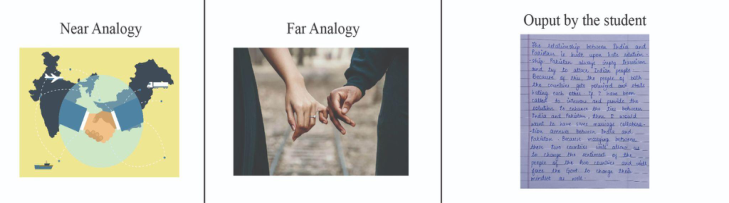
DISCUSSION AND CONCLUSION The present study aimed to investigate the effect of near, far, and the combi- nation of near and far analogies on the fluency, flexibility, and originality of creative ideas. Results from the one-way ANOVA revealed that the combina- tion of both near and far analogies (both-cues condition) was more effective in scoring high originality scores as compared to the far cues, near cues, and no cues condition. The high semantic similarity of near analogies enabled effi- cient memory retrieval, which in turn provided a facilitative context for the cognitive processing of far analogies as well, which involved greater semantic distance. For example, Participant 05 from this group selected one near ana- logy (trading relationship between India and Pakistan represented through infographics) and one far analogy (a visual representation of a romantic relationship between a man and woman) to come up with the solution (see figure 1). This participant wrote that “When it comes to this idea, I got this from the first analogy, which has a visual of two hands meeting together with some additional visuals of transport mediums. After looking at the first image which had two individuals shaking hands with some visuals of tran- sport. I got an idea about transporting the goods or have trading partnership with Pakistan, but when I also looked at the second image of a couple hol- ding hands, somehow I thought about instead of trading partnership why not have a relationship partnership and why not marry people or can have online
Figure 1: An example of the near analogy (left visual), far analogy (middle visual), and the output produced by a participant based on both these analogies.
Examining the Effects of Near and Far Cues on creativity 159
dating through an app that will help us achieve a good relationship”.This interplay between near and far analogies offered a rich semantic landscape that allowed the participants to engage in diverse information processing stra- tegies, thereby generating a range of innovative ideas. Moreover, both the far and near-cue conditions produced significantly more original outcomes than the no-cue condition, consistent with previous research (Ozkan & Dogan, 2013). As far as the quantity of ideas production is concerned, both condition groups produced a more number of ideas as compared to the other groups. This can be attributed to the cognitive ease of retrieving from memory, with which participants are able to identify semantic relationships between see- mingly dissimilar things when utilizing near analogies. As a result, the use of near analogies contributes to the effectiveness of far analogies in the ideation process, allowing for the identification of new connections and associations that might otherwise not have been apparent. This can lead to the generation of more ideas and solutions, as the mind is able to make connections and draw upon prior knowledge in a more efficient manner. Additionally, the near analogy condition group elicited a higher quantity of ideas compared to the far and no condition groups. This outcome can be attributed to the ease of memory retrieval and the enhanced recognition of semantic relationships, and the economical use of time as compared to the utilization of far analogies alone.
When producing different outcomes, both cue condition groups achieved better scores than the far, near, and no cue condition groups alone. The combined (near and far) analogy condition group enabled participants to change their cognitive patterns, which resulted in a reduction of cognitive fixedness and the formation of new associations between concepts that led to the development of new ideas.
Based on the results of the study, the following conclusions can be drawn in response to the research questions posed: a) The difference in the effectiveness of far-field analogies compared to near- field analogies in the creative process: The results showed that near cues performed well on fluency scores, whereas the combination of near and far cues performed well on flexibility scores and originality scores. The results suggest that the efficacy of far-field analogies may be contingent upon the particular aspects of the creative process under examination. b) The impact of combining near and far analogies on the flexibility, flu- ency, and originality of creative ideas: The results showed that the combination of near and far cues performed well on flexibility scores and originality scores, and near cues performed well on fluency scores. This suggests that combining near and far analogies can lead to impro- ved scores on certain aspects of the creative process, compared to using only near or far analogies separately.
In general, these results provide insight into the effectiveness of diffe- rent types of analogies in the creative process and the potential benefits of combining near and far analogies.
REFERENCES
Bearman, C. R., Ball, L. J., & Ormerod, T. C. (2007). The structure and function of spontaneous analogising in domain-based problem solving. Thinking &Amp; Reasoning, 13(3), 273–294. https://doi.org/10.1080/13546780600989686 Chakrabarti, A., Sarkar, P., Leelavathama, B., & Nataraju, B. (2005). A functio-
nal representation for aiding biomimetic and artificial inspiration of new ideas. Artificial Intelligence for Engineering Design, Analysis and Manufacturing, 19(2), 113–132. https://doi.org/10.1017/S0890060405050109 Dunbar, K. (1997). How scientists think: On-line creativity and conceptual change in science. In T. B. Ward, S. M. Smith, & J. Vaid (Eds.), Creative thought: An investigation of conceptual structures and processes (pp. 461–493). American Psychological Association. https://doi.org/10.1037/10227-017 Forbus, K. D., Gentner, D., & Law, K. (1995). MAC/FAC: A model of similarity-
based retrieval. Cognitive science, 19(2), 141–205. https://doi.org/10.1016/0364- 0213(95)90016-0 Fu, K., Chan, J., Cagan, J., Kotovsky, K., Schunn, C., & Wood, K. (2013). The Meaning of “Near” and “Far”: The Impact of Structuring Design Databases and the Effect of Distance of Analogy on Design Output. Journal of Mechanical Design, 135(2). https://doi.org/10.1115/1.4023158 Gentner, D. (1983). Structure-Mapping: A Theoretical Framework for Analogy*.
Cognitive Science, 7(2), 155–170. https://doi.org/10.1207/s15516709cog0702_3 Gentner, D., & Markman, A. B. (1997). Structure mapping in analogy and similarity. American Psychologist, 52(1), 45–56. https://doi.org/10.1037/0003- 066X.52.1.45 Gick, M. L., & Holyoak, K. J. (1980). Analogical problem solving. Cognitive
Psychology, 12(3), 306–355. https://doi.org/10.1016/0010-0285(80)90013-4 Green, A. E., Kraemer, D. J. M., Fugelsang, J. A., Gray, J. R., & Dunbar, K. N. (2012). Neural correlates of creativity in analogical reasoning. Journal of Experimental Psychology: Learning, Memory, and Cognition, 38(2), 264–272. https://doi.org/10.1037/a0025764 Hofstadter, D. R. 2001. Epilogue: Analogy as the core of cognition. In The Analogical
Mind: Perspectives from Cognitive Science, D. Gentner, K. L. Holyoak, and B. N. Kokinov, Eds. MIT Press, Cambridge, MA, 499–538. Holyoak, K. J., & Thagard, P. (1996). Mental Leaps: Analogy in Creative Thought.
Amsterdam University Press. Holyoak, K. J., & Thagard, P. (1997). The analogical mind. American Psychologist, 52(1), 35–44. https://doi.org/10.1037/0003-066X.52.1.35 Ozkan, O., & Dogan, F. (2013). Cognitive strategies of analogical reasoning in
design: Differences between expert and novice designers. Design Studies, 34(2), 161–192. https://doi.org/10.1016/j.destud.2012.11.006 Rastogi, D., & Sharma, N. K. (2010). Creativity under concurrent and sequential task conditions. Creativity Research Journal, 22(2), 139–150. https://doi.org/10.1080/10400419.2010.481490 Weisberg, R. W. (2018). Expertise and structured imagination in creative thinking: Reconsideration of an old question. In K. A. Ericsson, R. R. Hof- fman, A. Kozbelt, & A. M. Williams (Eds.), The Cambridge handbook of expertise and expert performance (pp. 812–834). Cambridge University Press. https://doi.org/10.1017/9781316480748.041 Wilson, J. O., Rosen, D., Nelson, B. A., & Yen, J. (2010). The effects of biological examples in idea generation. Design Studies, 31(2), 169–186. https://doi.org/10.1016/j.destud.2009.10.003
LISTED IN THE AHFE DIGITAL BOOKSTORE CATALOGUE
Explore the complete digital volume
Creativity, Innovation and Entrepreneurship
Read this individual research paper free through the original publisher, or explore the full digital proceedings book.
ISBN 978-1-958651-50-6
Explore this ISBN in the AHFE Bookstore ↗Listed in the July 2026 bookstore catalogue; search by ISBN to confirm current availability · Digital book purchase optional