Mritunjay Kumar, Braj Bhushan, Ahmed Sameer, Amit Kundal (2023). Laterality in Gesture-Based Video Games. In: Human Factors in Virtual Environments and Game Design. AHFE Open Access, vol. 96, pp. 21–29. https://doi.org/10.54941/ahfe1003863
Brain lateralization refers to hemispheric dominance for different tasks. Lateralization of the brain and body has been consistently reported in the literature. An extreme right-hand preference has been reported among most people throughout the world. However, gesture control involves coordination among the eye, hand, and foot, and the lateralization pattern of all three is expected to influence such gestures. This study examines the effect of lateral bias in gesture-based video games. The experiment involved 23 students playing a gesture- based game on an Xbox console to determine the interplay of hand-foot lateralization in gesture-based games. The findings are discussed in light of game design and lateral bias in gesture-based games.
In the last few years, gaming technologies have improved enormously with the development of enhanced human-machine interfaces. The novel intera- ction methods are comparatively cheaper since the invention of low-cost sensors, such as Microsoft Kinect, have been popularized in the field of com- puter vision (Izadi et al., 2011; Ikram & Liu, 2018). However, as with any technology, there are potential biases and limitations that should be conside- red. In the context of gesture-based games, one area of concern is the potential bias in terms of dominance or preference for using one hand over the other. Brain lateralization refers to hemispheric dominance for different tasks and the preferential use of one side of the body (Bhushan, 2006; Michel, 2021; Yin et al., 2022).
To play a gesture-based game, the player must use both hands and feet (sometimes both at the same time), depending on the nature and level of complexity of the game. It is, therefore, necessary to take brain lateraliza- tion into consideration when designing gesture-based games. Laterality can impact performance in gesture-based games, with some individuals potenti- ally having an advantage due to their handedness or footedness. This raises
questions about the fairness of these games and whether they provide equal opportunities for all players. Additionally, the design of the games may con- tribute to biases, with some gestures or movements being more difficult or intuitive for certain groups of people than others. These limitations have implications for the design and development of gesture-based games, as well as the overall user experience.
To the best of our knowledge, no prior research has explored the rela- tionship between lateralization and gesture-based video games, making this study the first to delve into this topic. Thus, this study takes an exploratory approach to examine the relationship between hand-foot late- ralization and performance in gesture-based video games. The results of this research provide valuable insights for game designers and developers and has broader implications for technology in promoting inclusivity and equity.
METHOD
Participants Twenty-three healthy participants (14 males and 9 females) were randomly selected for this study. The mean age of the male and female participants were 24.33 years (SD = 1.11) and 23.5 years (SD = 1.08), respectively. All of them were postgraduates studying at a premier engineering institute in India. Intact upper and lower limbs, normal or corrected to normal vision, and willingness to play during the course of experimentation were the inclusion criteria. Bodily anomaly restricting interaction with the gesture-based game was the exclusion criteria. This study was approved by the Institute Ethics Committee of the Indian Institute of Technology Kanpur. All the participants were monetarily compensated for their participation. Informed consent was taken from all the participants before the experiment.
Procedure All the participants were called to the room equipped with the Xbox gaming console with Kinect and a TV screen. Participants were explained the pur- pose of the research, the procedure, and were informed about the anonymity of the data, thus ensuring confidentiality. In the first stage, the participants responded to the Sidedness Bias Schedule (Mandal et al., 1992). The sche- dule assesses handedness using a 22-item checklist wherein the participants indicated their usage of the right and the left hands on a 5-point Likert scale (1= never, 5= always). The items used to assess handedness included writing, eating, throwing a ball, lifting a bucket full of water, using a spoon to stir, keying the lock, winding the lock, using scissors, painting, threading needles, combing, sweeping, screwing a nut, hammering a nail, opening the tap, swi- tching the light, lighting a matchstick, tooth brushing, sorting cards, using knife, using racket for games, and unscrewing the jar. 5-items each measured footedness and eyedness, respectively. The items assessing footedness were
Laterality in Gesture-Based Video Games 23
kicking a ball, foot extended to climb on a bus, foot on which body wei- ght rested in standing posture, foot extended to ride a bicycle/vehicle, and foot extended in long jump). The items assessing earedness included hearing telephone when both hands are free, hearing a pocket-radio, matching musi- cal tune, sensing tick movement in wrist watch, and hearing a low voice). The items assessing eyedness were seeing through a telescope, snapping pho- tograph by camera, gun shooting, seeing through a keyhole, and preferred eye to wink. With a robust test-retest reliability of.88, this schedule has been used by many researchers in India (Bhushan et al., 2000; Mandal et al., 2000). Laterality quotient (LQ) was calculated using the formula LQ = (MR/ ML)/4, where MR= mean scores for the right side, ML= mean scores for the left side, and 4 is the possible range of the scores, from 1 to 5. Thus, the participants were classified as right (LQ > 0), left (LQ < 0), and ambidextrous (LQ = 0).
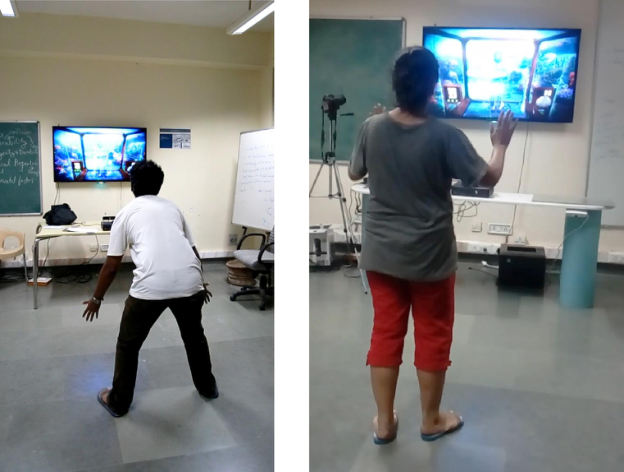
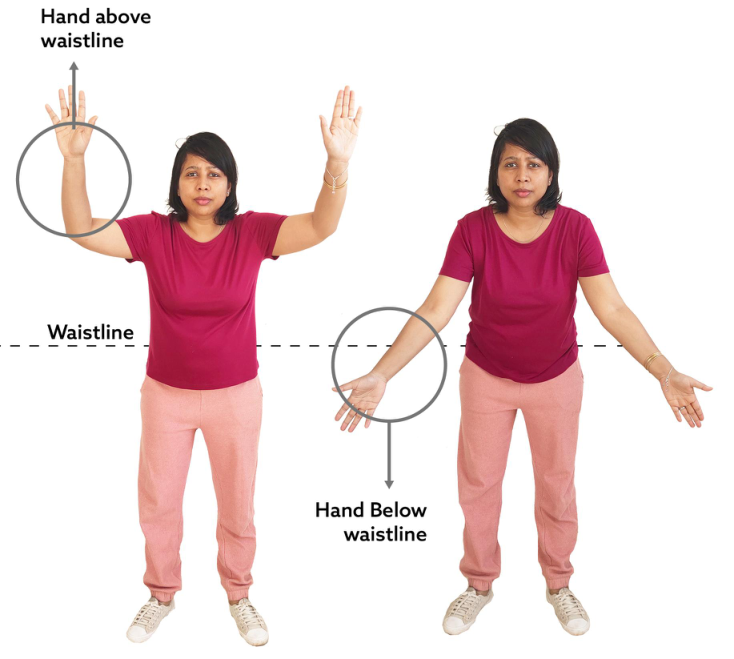
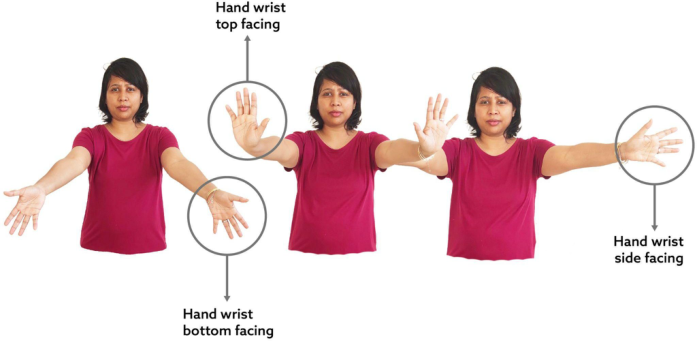
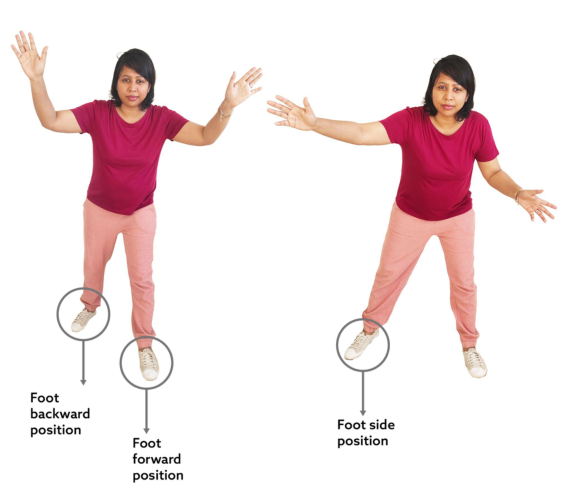
In the second stage, the participants were asked to play a mini-Xbox game named Leaks Ahoy (20000 leaks). Two video cameras were placed in the front and back to capture the video of the participants while playing the game for the purpose of quantification of the gestures (see figure 1). The mean time taken by each participant to play the game was approximately 130 to 180 seconds. Following the experiment, the recorded videos were coded according to the hands and feet in action that were used to plug the hole. Hand and foot in action mean a self-initiated sequence of movements, usually with respect to plugging the hole in the game. Figures 2, 3, and 4 illustrate the hand-foot positions as defined for the purpose of this study.
Figure 1: Participants playing the game (20000 leaks) on the Xbox console with kinect.Figure 2: Handedness coding (represented visually).Figure 3: Handedness coding wrist positions (represented visually).
The scores of the sidedness bias schedule was used to compute lateraliza- tion quotients (LQ) respectively for hand, foot, and eye. 21 participants were right handed and only two were left handed. Fourteen participants were right footed while six were left footed. Three had anomalous dominance. This pat- tern was opposite for eye dominance with eight participants having right eye dominance and twelve having left eye dominance. Table 1 summarizes the cross tabulation of lateralization of the upper and lower limbs as well as the eyes.
The nature of the task demanded the participants to plug the hole either using the upper or the lower limb. This demands coordination among hand- foot and eye. Hence, we examined the correlation between their LQs and the performance indices. Positive correlation was observed between LQs of hand and foot (r = 0.529, p <0.01). The LQ eye was neither significantly correlated with the hand nor with the foot.
Table 1. Cross tabulation summarizing distribution of hand, foot, and eye lateralization.
Table available in the original PDF paper.
Left Footed Right Footed Left Eyed Right Eyed Left Eyed Right Eyed
Left Handed 0 2 1 0 Right Handed 3 1 9 7
As the primary performance indicators were the hand and foot used to plug the hole, the gestures adopted by the participants while playing the game were classified into following components– hand below and above the waistline, wrist direction (top, bottom, and side facing), and foot direction (forward, backward, and side). Table 2 summarizes the mean of these parameters and the mean difference between the left and right limbs for these parameters.
With respect to the usage of upper limb, the mean of left hand below and above the waistline, and left wrist facing top and bottom were significantly higher than that of the right hand. This indicates the left hand being promi- nent in action irrespective of the hand lateralization. This is further endorsed by the significantly higher mean value of the left hand used to plug the holes. In a complimentary fashion, the right foot was more in action during the game. The mean of the right foot forward is significantly higher than the left foot. Further, the mean of the right foot used to plug the hole is significantly higher. As plugging the holes successfully is an indicator of better performa- nce in the gesture-based game used in this study, it seems that the upper and lower limbs maintain a complementary balance to execute the task.
The significant correlation between the upper and lower limbs and their complimentary association during the game prompted us to see the correla- tion between the hand-foot lateralization and other indices of performance. Table 3 summarizes the findings.
As far as performance indices are concerned, there was a negative corre- lation between LQ hand and the left hand below the waistline (r = −0.493, p <0.01). Furthermore, the game scores were positively correlated with the
Table 2. Descriptive statistics and t-test of the handedness and footedness parameters.
Table available in the original PDF paper.
p Parameters Mean SD t (df = 44) Left Hand below waistline 6.652 0.647 15.842 0.000 Right Hand below waistline 3.438 0.727 Left Hand above waistline 10.391 0.891 3.679 0.000 Right Hand above waistline 9.347 1.027 Left Hand Wrist Top Facing 8.434 1.902 5.256 0.000 Right Hand Wrist Top Facing 6.826 1.585 Left Hand Wrist Side Facing 4.087 1.311 1.284 NS Right Hand Wrist Side Facing 3.565 1.440 Left Hand Wrist Bottom Facing 4.217 0.998 5.256 0.000 Right Hand Wrist Bottom Facing 2.608 1.076 Total Left Hand Hole Plugged 17.043 1.260 10.658 0.000 Total Right Hand Hole Plugged 12.782 1.444 Left Foot Forward 1.739 0.448 -6.361 0.000 Right Foot Forward 3.173 0.984 Left Foot Backward 1.043 0.474 -0.837 NS Right Foot Backward 1.173 0.576 Left Foot Side 1.260 0.540 1.830 NS Right Foot Side 0.913 0.733 Total Left Foot Hole Plugged 4.043 0.767 -4.064 0.000 Total Right Foot Hole Plugged 5.260 1.214
Laterality in Gesture-Based Video Games 27
Table 3. Correlation between hand, foot, eye lateralization and performance indices..
Table available in the original PDF paper.
Variable 1 Variable 2 r p LQ Hand LQ Foot 0.529 < 0.01 Left Hand Below Waistline -0.493 < 0.01 Game Score Right Hand Below Waistline 0.467 < 0.05 Right Hand Wrist Top Facing 0.509 < 0.01 Total Left Hand Hole Plugged 0.432 < 0.05 Total Right Hand Hole Plugged 0.523 < 0.01 Total Right Foot Hole Plugged 0.438 < 0.05 Left Hand Below Waistline Left Foot Backward 0.495 < 0.01 Right Hand Below Waistline Right Foot Side 0.415 < 0.05 Left Hand Above Waistline Right Foot Side 0.472 < 0.05 Right Hand Above Waistline Left Foot Backward 0.434 < 0.05 Right Hand Wrist Top Facing Right Foot Side 0.534 < 0.01 Total Right Foot Hole Plugged 0.473 < 0.05
right hand below waistline (r = 0.467 0.467, p <0.05), right hand wrist top facing position (r = 0.509, p <0.01), total of left hand used to plug the hole (r = 0.432, p <0.05), total of right hand used to plug the hole (r = 0.523, p <0.01) and total of right foot used to plug the hole (r = 0.438, p <0.05). We also observed a positive correlation between the right hand below the wai- stline and left foot forward (r = 0.495, p <0.01). Furthermore, there was a positive correlation between the right foot side and the right hand below the waistline (r = 0.415, p <0.05). There were also positive correlations betw- een the left hand above the waistline and the right foot side (r = 0.472, p <0.05)as well as the right hand above the waistline and the left foot backw- ard (r = 0.434, p <0.05). The right hand wrist top facing positions were positively correlated with the right foot side (r = 0.534, p <0.01) and total of right foot used to plug the hole (r = 0.473, p <0.05).
Overall, the findings of the study, as summarized in Tables 1, 2, and 3, suggest the significance of lateralization in gesture-based games.
DISCUSSION AND CONCLUSION This is the first study to explore the significance of hand-foot lateralization while playing a gesture-based video game. The findings show significant rela- tionships between hand and foot lateralization and performance indices. The positive correlation between the laterality quotients of hand and foot indi- cates that players with a dominant upper limb also have a dominant lower limb, and they act in a complementary fashion. It merits mention that the foot has a dual responsibility, and the lateralization effect can be seen with respect to the foot used for stabilizing the body and the manipulating foot (i.e., the foot used for performing the needed action). As the left hand and right foot were predominant for action in this study, it seems that the upper and lower limbs act in a complementary fashion.
The differential pattern of usage of the left hand in terms of its position (above and below the waistline) and orientation (top, bottom, or side) also
suggests the fine ability of the body towards postural balance while being in action. Although we did not find a significant correlation between the limb (hand-foot) and eye lateralization, the participants were predominantly left- eyed. The anticipatory movements of both the upper and lower limbs are likely to depend on the visual cue, and hence eye lateralization should have its significance.
The findings of this study are of significance for game designers who aim at inclusive products. The peripheral indicators of lateralization have been intensely researched in behavioral science, and accommodating it in game design will augment the cognitive ergonomics of the product. Further, besides recreational usage, it may be used as an intervention for those with motor function issues and amputated limb(s).
CONCLUSION
In conclusion, this study shows the significant role of hand-foot-eye coordi- nation and limb lateralization in playing the gesture-based game. The results of the study highlight the crucial role of considering lateralization in optimi- zing performance, where the impact of specific challenges within the game can have an effect on the overall outcome. The results offer valuable infor- mation for game designers and developers to create games that are inclusive and do not provide an advantage to a specific group of people. These insights can help to ensure that the design of games is more inclusive and equitable, promoting equal opportunities for performance improvement.
LIMITATIONS AND FUTURE RESEARCH The study is limited by its focus on only one specific game and the small sample size. Further validation of the findings could be achieved through additional experiments involving multiple gesture-based games, as well as a larger sample size. Another avenue for exploration could be to examine the relationship between left-handed, right-handed, and ambidextrous individu- als in gesture-based games to gain a deeper understanding of the dynamics of lateralization in these types of games. These avenues for future research can help validate the findings and provide more comprehensive insights into the topic.
REFERENCES
Bhushan, B., & Khan, S. M. (2006). Laterality and accident pro- neness: a study of locomotive drivers. Laterality, 11(5), 395–404. https://doi.org/10.1080/13576500500457458 Bhushan, B., Dwivedi, C. B., Mishra, R., & Mandal, M. K. (2000). Performance on a Mirror-Drawing Task by Non-Right-Handers. The Journal of General Psychology, 127(3), 271–277. https://doi.org/10.1080/00221300009598585 Ibañez, R., Soria, L., Teyseyre, A., & Campo, M. (2014). Easy gesture recognition for Kinect. Advances in Engineering Software, 76, 171–180. https://doi.org/10.1016/j.advengsoft.2014.07.005 Izadi, S., Kim, D., Hilliges, O., Molyneaux, D., Newcombe, R., Kohli, P., Shotton,
J., Hodges, S., Freeman, D., Davison, A., & Fitzgibbon, A. (2011). KinectFusion.
Laterality in Gesture-Based Video Games 29
Proceedings of the 24th Annual ACM Symposium on User Interface Software and Technology. https://doi.org/10.1145/2047196.2047270 Mandal, M. K., Pandey, G., Singh, S. K., & Asthana, H. S. (1992). Hand Preference in India. International Journal of Psychology, 27(6), 433–442. https://doi.org/10.1080/00207599208246907 Mandal, M. K., Bhushan, B., Kumar, A., & Gupta, P. (2000). Side-bias in alcohol and heroin addicts. Alcohol and Alcoholism, 35(4), 381–383. https://doi.org/10.1093/alcalc/35.4.381 Michel, G. F. (2021). Handedness development: A model for investigating the
development of hemispheric specialization and interhemispheric coordination. Symmetry, 13(6). https://doi.org/10.3390/sym13060992 Yin, J., Yu, G., Zhang, J., & Li, J. (2022). Behavioral laterality is correlated with problem-solving performance in a songbird. In Animal Cognition. Springer Science and Business Media LLC. https://doi.org/10.1007/s10071-022-01724-3
LISTED IN THE AHFE DIGITAL BOOKSTORE CATALOGUE
Explore the complete digital volume
Human Factors in Virtual Environments and Game Design
Read this individual research paper free through the original publisher, or explore the full digital proceedings book.
ISBN 978-1-958651-72-8
Explore this ISBN in the AHFE Bookstore ↗Listed in the July 2026 bookstore catalogue; search by ISBN to confirm current availability · Digital book purchase optional