Yanyu Liu, Hong Chen (2023). Design of Children's Wearable Moxibustion Instrument Based on Emotional Design Theory. In: Healthcare and Medical Devices. AHFE Open Access, vol. 79, pp. 67–75. https://doi.org/10.54941/ahfe1003474
Research For children, the excessive use of antibiotics treatment will damage the liver and kidney functions of children, produce drug resistance, affect the health of children, and traditional Chinese medicine has the characteristics of safety, effective and green, among which children moxibustion application has been widely recognized, and the family traditional Chinese medicine health equipment for children is of great significance. Current studies believe that moxibustion plays the function of dredging meridians and regulating the whole body through three aspects: thermal action, near infrared action and biochemical action. But for children, the skin is delicate, and the nerve is weak. The traditional diagnosis and treatment method of moxibustion has some problems, such as heavy smoke smell, difficult time and temperature control, and complex operation. Besides, the quality of electronic moxibustion products on the market is uneven, and children have not been subdivided. The product design of moxibustion instrument that fully considers the physiological and psychological characteristics of users can have good physiotherapy effect and user experience.Research objective: Emotional design has three different dimensions, namely instinct, behavior and reflection, to study the cognitive response and psychological experience of users to products and apply it in design. This paper aims to explore children as the target user group, focus on the specific situation of home care, summarize and analyze the characteristics and needs of users, design a wearable children's home moxibustion instrument that acts on the body surface and acupoints, and create a good physiotherapy experience for users through visual information and interesting design.Research methods: Based on emotional design, this paper discusses the three-level theory method of products and applies it to the design of wearable children's home moxibustion instrument. This paper mainly from three parts: firstly, population analysis and demand exploration. In this study, the characteristics of children groups are summarized by means of observation and user interview, and the internal needs of related users in the home environment are analyzed. The physical and behavioral characteristics of children are fully considered, the psychological and emotional needs of children are studied, and the three-level theory of emotional design is combined to create an interesting physiotherapy experience. Secondly, summarize the application of pediatric moxibustion in daily health care. Summarize the main health needs of users through preliminary investigation, study the multiple diseases in the childhood stage, and sort out the corresponding treatment methods as the theoretical basis of health care. Thirdly, analyze the transmission mode of information and design visualization. In the design, the wearable sensor and communication equipment are investigated and analyzed, and the user's psychology and interaction scenarios were studied through role-playing, service blueprint and other methods, to design the information interface and product interaction mode.Conclusion: This design starts from the collection of users' physiological signals, receives and transforms them into visual information, puts forward health care plan based on children's moxibustion as a theoretical basis, and adjusts users' physical conditions by applying moxibustion patches in line with children's group characteristics to the surface acupoints. Through the three-level theory of emotional design, users are centered, and emotions are taken as the starting point to analyze the group characteristics and potential needs of users, so as to provide design help for providing positive emotional guidance, creating good experience and satisfying deep needs.
Research Significance The “Healthy Children Action Enhancement Plan (2021-2025)” issued by National Health Commission PRC proposes to strengthen children’s TCM services and promote children’s TCM health care into the community and into families (2021). For children and adolescents with poor constitution and prone to colds, fever, food accumulation, anorexia and other health pro- blems, western medical treatment methods cannot cure completely and are prone to side effects such as bacterial resistance and liver damage after using too many antibiotics, TCM moxibustion has the characteristics of easy reali- zation, obvious effect and no adverse reaction, which effectively strengthens children’s resistance and promotes their growth and development. With the continuous enrichment of technology, consumers’ demand for products that possess personalization and manifest spiritual pleasure and physical comfort is getting stronger (Liu, 2012). Therefore, with children as the target user group, it is of great relevance and commercial value to create moxibustion instrument products that regulate the body and enjoy the use experience, taking into account the physical characteristics and behavioral activities of children in the treatment process.
Research Status (1) Product performance of moxibustion instrument
1. Efficacy of moxibustion therapy: Current studies believe that moxibu- stion has the characteristics of safety, effectiveness and green. It uses moxa sticks to ignite warm and hot stimulation, and the methanol extract of the product from the burning of moxa leaves can regulate the human body through thermal action, near infrared action and biochemical action, so as to dredge the meridian, disperse cold and relieve pain.
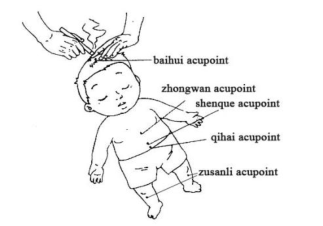
2. Daily conditioning of moxibustion in children: because children’s bodies are relatively tender, they are prone to suffer from diseases in the spleen, stomach, respiratory tract and other tender places, such as wind cold, fever, cough, asthma, abdominal diarrhea, food injury, etc., moxibustion can be used as a means of diagnosis and treatment and daily conditioning (Figure 1).
(2) Comparative study on moxibustion instrument products Moxibustion instrument products mainly use moxa wool, moxa cake, moxa leaf essential oil and other extracts containing “moxa” as the esse- nce of moxibustion. Through electric heating, heat spurs are generated to make moxa leaf stick to the deep skin and stimulate moxa molecules to pene- trate deep into the skin. In this paper, seven popular moxibustion products were selected from Jingdong shopping platform for analysis and comparison from the perspective of heating principle, technology and mobility, as shown in Table 1. The study found that smoke-free, electronic device heating, por- table, wearable are the key factors for users to choose, and the pursuit of modernization, comfort, and good use experience.
Research Purpose Children in the process of growth of some diseases are more suitable for moxibustion physiotherapy compared to Western medicine, but there is no moxibustion instrument products for children on the market, and the existing products are complicated to use, poor user experience, and even impro- per operation with the risk of burns and other problems. In this paper, we take children as the target user group and analyze how to design a wea- rable moxibustion instrument based on emotional theory. It takes into full consideration of users’ physical characteristics and behavioral activities, and aim to bring a pleasant experience of use and service for users.
Intelligent control Mechanical adjustment Radiation ironing moxibustion apparatus
Research Method
1. Literature research method: In this paper, the relevant contents of moxi- bustion instrument products are extensively collected through desk research, and keywords such as emotional design, children’s products and moxibustion instrument are searched and consulted on platforms such as CNKI, web of science and Google Academic, etc., so as to summarize the knowledge needed for research and provide theoretical knowledge guidance for design.
2. Research method: In this paper, the pain points and emotional needs of target users are understood through semi-open interviews and questionnai- res, and the real needs of users are mined through further analysis, so as to provide data for analyzing the use details and experience of products from the perspective of users in the design process and improve the design content.
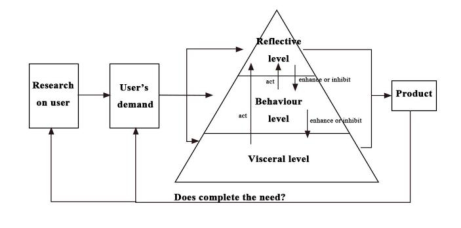
THREE-LEVEL THEORY OF EMOTIONAL DESIGN The three-level theory of emotional design was first proposed by cognitive psychologist Donald Arthur Norman (2015), who divided the design and its goals into three layers according to the depth of experience provided by the product: the instinctive layer, the behavioral layer, and the reflective layer,
70 Liu and Chen
Figure 2: The application of emotional design theory (adapted from Sun, 2008).
as shown in Figure 2. The instinctive layer refers to the initial sensory sti- mulation brought by the product, where the brain directly translates the information received by the sensory channels into first impressions through an instinctive response, corresponding to the product appearance attributes. The behavioral level design refers to the emotions triggered by the user in using the product, and the design should improve the user’s experience in the process of using the product based on the basic functions. The behavioral level of activity can be enhanced or inhibited by the reflective level, which in turn can also enhance or inhibit the instinctive level (Ding et al., 2010). The reflective level, unlike the immediate experience, is the highest level of brain processing. It is influenced by instinctive and behavioral levels, and is intertwined with individual emotions, consciousness, understanding, perso- nal experience, cultural background, and many other factors (Peng, 2021), and can be designed to give users emotional enrichment and meaning to their lives over time.
DESIGN PRACTICE User Study
The research object of the design contains children and parents. This paper will summarize the physiological and psychological characteristics of chil- dren, and analyze the behavior and needs of users in the process of moxibu- stion activities, and base on the research to discover the problems, to better meet the functional and emotional needs of users.
(1) Summary of child user characteristics. Physiological characteristics : children’s physiology is in a state of constant change and development, and children under 12 years of age have similar height and weight development (Liu, 2012), with basically no gender gap (see Table 2).
Psychological traits: children’s personality and psychology is developing, including cognitive level traits, personality traits and emotional aspect. The cognitive traits include observation memory and thinking in childhood; Per- sonality traits include the development of social awareness of self, worldview formation, and personal interest abilities; And emotional traits include the
Design of Children’s Wearable Moxibustion Instrument 71
Table 2. Physiological characteristics of children in different age groups (author drawing).
Table available in the original PDF paper.
Age/year Height/cm Neck Shoulder Extremities Longer upper limbs and greater dorsal curvature 3–4 95–105 Neck tilted forward, Tilt angle occurs Shoulders protrude outward, Widening of the chest
4–6 105–125 Head to body ratio of 5.2
reduced shoulder thickness
slender body shape, Smaller belly 6–12 125–155 Clear neck Wider shoulders Gap between men and women
content of emotions, expression of emotions, and self-control emotions (He, 2022). (2) Analysis of the process of moxibustion activities When children feel unwell, they are naturally irritable and resistant to treatment by their parents and doctors. The use of comfortable and fun moxi- bustion products in the familiar environment of the home can help children relieve their physical problems and shape the activity of moxibustion into a fun and pleasantly memorable behavior, and the behavioral analysis is shown in Table 3.
Demand Analysis of Moxibustion Instrument Based on Emotional Three-Level Theory In this thesis, users’ needs are discovered through the method of questionnaire interview, and their emotional needs for moxibustion instrument products are analyzed by combining the three levels of emotional theory (see Table 4). And according the analysis, good products can be created to bring good physical therapy effect and user experience to users.
1. Instinctual level: The design of instinctive level is to directly feel the product through the user’s senses, leaving a good first impression so as to stimulate the user’s positive emotions. For children with weak cognitive abi- lity, instinctive stimulation can play an important role in receiving products and generating interest and goodwill. Studies have shown that children’s perception of color is weak, but colors with changes in brightness and satu- ration can bring more emotional responses (Song, 2019). Modeling should
Table 3. Analysis of children and parents moxibustion activity process (author drawing).
Table available in the original PDF paper.
Use process Children behaviour Parents behaviour before Explain the illness and calm the emotions Prepare the environment, calm the child, and determine the treatment plan during Actively cooperate with moxibustion activities
Use the product correctly and accompany After Protecting, helping to collection
Storing products, settling children, and protecting after treatment
72 Liu and Chen
Table 4. Emotional needs analysis of users (author drawing).
Table available in the original PDF paper.
Three levels Children users Parents users Instinctual level Fun, friendly Clean, safe, simple Behaviour level Interactive, comfortable, unlimited
Convenient and easy to operate, effective and efficient Reflective level Exploratory, rewarding Long-term persistence, accompany
also take full account of children’s psychological needs and aesthetic abi- lity, from the perspective of children to increase the aesthetic flavor of the design.
2. Behaviour level: After the communication and interaction between the user and the product, the emotional experience of the behavioral layer comes from the product’s functionality, ease of use and feeling of use. On the basis of providing the basic functions of moxibustion, users’ experience and details in the process of use should be considered, so that the operation mode of the product conforms to users’ habits and man-machine, and the utility, conveni- ence and other characteristics of moxibustion instrument can be satisfied, so as to meet the emotional needs of users’ behavioral level and produce pleasant user experience.
3. Reflective level: The demand for reflection comes from users’ thin- king about moxibustion after using the product, and gives meaning to life. It mainly produces the value of education for children, cultivates their health awareness and inherits the traditional Chinese medicine culture. Thus it can arouse users’ sense of achievement in obtaining a healthy body and enhancing their confidence in the Chinese national culture.
Emotional Design Practice of Wearable Children’s Home Moxibustion Instrument In the process of product design, solution analysis is carried out based on the emotional needs of the product in the early stage (see Table 5). And the design combines user’s emotion and behavior to improve the way of thinking of users and their external situations, so as to bring pleasant experience to users.
(1) Instinctual layer design Product composition: Moxibustion instrument consists of moxibustion patch and host. The patch is made of medical-grade adhesive sponge, embed- ded sensor equipment and replaceable permeable drugs. The main engine has a display device and an energy storage function, and the two are connected by wires.
Appearance: The color is red and blue with high brightness, which are pre- ferred by children. Bright colors with large color blocks can produce visual stimulation for children users. The shape has the characteristics of thin, sim- ple, the overall use of “square, round” elements, to bring a warm and soft impression to the user. And the material is better made of plastic and rubber, with mild touch and fine friction texture.
Design of Children’s Wearable Moxibustion Instrument 73
Table 5. Design and analysis of emotional needs of children moxibustion instrument products (author drawing).
Table available in the original PDF paper.
Criterion layer Sub-criterion layer Requirement analysis Design scheme Instinctual Level appearance color Soft and kind Curved rounded element Simple and comfortable
clean High brightness
Material plastic smooth temperature Sound effect interface
affinity anthropomorphism
associable Cartoon characters are abstract in color function Easy to use
Clear and modern Flat unity
Rich guidance Multiple response cue Easy to understand feel
Patch moxibustion
intimacy Cartoon cute association Behaviour Level educational Sense of achievement
Electric heat can moxibustion
Fault-tolerant safety Protection mechanism
Display scheme Interface sound display interest appearance color Wearable device
Visual, auditory and tactile interaction function Easy to use
Immersion experience
Unconscious use In line with man-machine, psychological Easy to understand feel
Knowledge popularization
Moxibustion principle independence Life independent care for health Reflective Level educational Harvest satisfaction Get results, reward mechanism Sense of achievement cultural confidence Cultural inheritance interest exploratory gamification
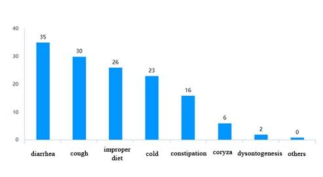
(2) Behavior layer design Basic function: Through the questionnaire research found that in the chil- dren’s stage (Figure 3), diarrhea, cough, food injury, cold, constipation and stunted growth and other health problems are more frequent, and suitable for moxibustion means of physical therapy. Such as wind chill cold can use moxibustion at DaZhi, FengMen, and Feiyu three points for 15 minutes, 1–2
74 Liu and Chen
Figure 3: Types of diseases that children are susceptible to (author drawing).
times a day, adhere to the effective results. Thus the moxibustion treatment content of the above diseases is the main function of the product.
Wearable portable use: The flexible strain sensor equipment with good stretchability and considerate attachment is used as the moxibustion patch, which is directly attached to the user’s skin. And there are multifunctional signs sensors accurately monitor the individual, and receive and transmit the data of the detection device to the host through the low-power Blueto- oth wireless communication technology. And it can present the user’s health status and moxibustion treatment and health care plan visually.
Interaction design: For the children’s group, intelligence and judgment are in the process of development, it is necessary to establish an intelligent system for real-time monitoring, set temperature thresholds and operating limits, strengthen instructions and timely feedback, and improve the safety and fault tolerance rate of the product. Interface design for different infor- mation content using color system which consistent with life experience and psychological subconscious. And sound effects is better using cartoon anthropomorphic communication, so that the product resonates with the user.
(3) Reflective layer design Cultural knowledge popularization: The display interface presents the development of the traditional culture of moxibustion health care, popu- larizes science for children users easy to encounter health problems in life and physiotherapy programs. So as to enhance the awareness of health care while inheriting Chinese culture, strengthen pride, and gradually improve the physical quality, promote the use of products.
Gamification fun design: Combining moxibustion activities with game mechanism, users can play interface games while moxibustion, and get gold coins and other rewards upon completion of physical therapy. Feedback design brings “like” and “interesting” experience to users, and brings certain encouragement and process feedback to users, so as to form a good cycle and promote users to adhere to long-term use.
CONCLUSION
As an important achievement of Chinese medicine in China, “moxibustion” is of great significance to modern people’s life and medical development. Nowadays, in the environment of epidemic, people generally pay more atten- tion to health, especially for children, the development of new era of Chinese
Design of Children’s Wearable Moxibustion Instrument 75
medicine physical therapy products can effectively improve the national phy- sical quality of the new generation of young people. The design should be based on emotional design, dedicate to attracting users through operation, experience and content, so it can bring people a more comfortable, conveni- ent and pleasant use experience, and satisfy children’s need to look outward for communication, love and respect.
ACKNOWLEDGMENT
The paper I will submit is the result of my independent research and writing under the guidance of my advisor, Professor Hong Chen, and it is suppor- ted by Shanghai Summit Discipline in Design. The text and research results of others quoted in the paper, no matter how they are published, will be explained in the paper.
REFERENCES
Ding, J. et al. (2010) Theory, method, and trend of emotional design. Journal of Engineering Design, 17(1), pp. 12–18. He, Z. Y. (2022) Research on the design strategy of living space based on the physiological and psychological characteristics of special chil- dren (Master’s thesis, Guangdong University of Technology). Master’s e-journal, doi: 10.27206/d.cnki.ggsgu.2022.001284. Available at: https: //kns-cnki-net-s.sslvpn.ecust.edu.cn:8118/KCMS/detail/detail.aspx?dbname=C MFDTEMP&filename=1022698650.nh (Accessed: 1 February 2023). Liu, G. (2012) On the emotional trends in modern product design. Des. Res, 2(2),
pp. 100–104. Liu, B. W. (2012) Research on children’s furniture growability design (Master’s thesis, Jiangnan University). Master’s e-journal, 07. Available at: https://kns-cnki-net-s.sslvpn.ecust.edu.cn:8118/KCMS/detail/detail.aspx?dbna me=CMFD2012&filename=1012329629.nh (Accessed: 30 January 2023). Norman, D. A., (2015) Emotional Design. Translated from the Chinese by X. M. He., Q. X. Ou. Beijing: Citic Press. National Health Commission, PRC. (2021) Healthy Children Action Enhancement
Plan (2021-2025). TCM health preservation, 12 (7), p. 2. Peng, H. J. (2021) Research on interactive design of popular science exhibition system based on emotional three levels (Master’s thesis, Guangdong University of Technology). Master’s e-journal, 08. doi: 10.27029/d.cnki.ggdgu.2021.000492. Song, W. W. (2019) A study on the Chinese cognition of the tones. Design, 32(24),
pp. 105–108. Shan, G. M. (2014) ChanGuiMin moxibustion in addition to all diseases. Changchun: Jilin Science and Technology Press. Sun, W. and Sun, P. (2008) The research on emotional design. IEEE, pp. 105–108.
doi: 10.1109/CAIDCD.2008.4730529. Zhao, Y. H. (2021) Young people increasingly favor traditional Chinese medicine health into a popular track. Economic Information Daily, 13 October. p. 006.
LISTED IN THE AHFE DIGITAL BOOKSTORE CATALOGUE
Explore the complete digital volume
Healthcare and Medical Devices
Read this individual research paper free through the original publisher, or explore the full digital proceedings book.
ISBN 978-1-958651-55-1
Explore this ISBN in the AHFE Bookstore ↗Listed in the July 2026 bookstore catalogue; search by ISBN to confirm current availability · Digital book purchase optional