Kat Thiel, Susan Postlethwaite (2023). Human-centric research of skills and decision-making capacity in fashion garment manufacturing to support robotic design tool development. In: Human Aspects of Advanced Manufacturing. AHFE Open Access, vol. 80, pp. 20–30. https://doi.org/10.54941/ahfe1003505
This paper examines the findings of research combining Human Factors methods with Fashion Design Practice Research to identify existing skills levels of UK sewing machinists, assessing the interest in integrating robotic tooling into low-volume high-value fashion design workflows to help an upskilling and onshoring agenda for UK SME fashion manufacturing. Despite its international reputation for creative design and contributing £32.3 billion to the UK economy (Oxford Economics, 2018), the UK’s fashion industry's levels of automation are much lower than other sectors. Amongst young people who might enter the industry a lack of interest in manufacturing, anxieties about modern-day slavery, poor working conditions, precarity in the jobs market, low levels of pay and training are exacerbating the situation. The challenges of integrating automation, robotics and engineering into a highly creative UK fashion sector with a need for very high levels of agility in micro-production processes can be addressed through joint research from Human Factors and design-led research. This project explored skills levels in garment manufacturing, to inform the steps in research of new tooling concerned with identifying tasks that can be performed by robots, or those needing to remain performed by skilled human makers - importantly identifying requirements for promoting worker satisfaction via new technology and automation. The research evidences sewing machinists’ need for better work fulfilment and personal reward. Currently, the UK fashion manufacturing sector lacks systems that support the application of transferable skills to rejuvenate the jobs market with opportunities that can inspire and entice a young workforce to enter what could be a dynamic field. In a mixed methods study, researchers used questionnaires, desk research, eye-tracking and heart-rate monitoring to evidence cognitive decision-making and tacit/tactile knowledge of sewing machinists. Participants of the questionnaire and eye-tracking trials stressed a sense of reward as one of the main drivers for fulfilment during a sewing project. Investigating the development of new tooling in the context of creatively rewarding activity is therefore a critical next step in design research with Human Factors. This study has delivered perspectives on ways to increase collaboration capability between social science and fashion design research to innovate within manufacturing processes amidst a growing skills shortage in the UK. This tightly limited scope study has been an ideal way of demonstrating the value in this area of research as a platform for a larger collaborative piece of work in the future with a focus on co-investigating, with micro and SME fashion design and robotics businesses, what kind of small-scale tools might need to be designed to enable new forms of on-shored production, leading naturally to a new design aesthetic. These cobot systems could support decision-making for fabrication sequencing. There is already potential for interactive robots to be mobile on desktops as well as self-assembling swarms - concepts that can help to address further development aims for garment manufacturing.
Human-Centric Research of Skills and Decision-Making Capacity 21
INTRODUCTION
The UK’s fashion industry has an international reputation for creative design and contributes £32.3 billion to the UK economy (Oxford Economics, 2018). However, this is a field which is seeing limited impact of digital technology in manufacture and which has seen much of its production being moved offshore. The UK imports vast quantities of low-value, high-volume fashion goods from international suppliers which are produced in largely automated factories. Advances in machinery and new tooling are happening very rapidly but often involve the deskilling of the workforce. Machines are often designed to carry out a single process with a technician feeding textile into frames to be stitched automatically. Multiple factors are hampering the integration of automated systems that could support the successful reshoring of UK fashion manufacture. The UK fashion industry relies on high levels of skilled human input during assembly, the lack of routine tasks during these micro-processes presents a known challenge to automation (Ajewole et al. 2023). Wider economic and societal changes are creating skills shortages and making the skills challenge more acute. New trade policies and the UK’s exit from the European Union have reduced the supply of workers from mem- ber states and potentially increased the need for the country to train its own workers, particularly in sectors such as hospitality, transport and storage, manufacturing and construction (Casadei et al. 2020).
Investment in R&D and an understanding of the Human Factors involved in high-end production is needed to develop appropriately agile tooling to support small-scale business needs. RSA’s report ‘From Design Thinking to Systems Change: How to Invest in Innovation for Social Impact’ (Conway et al. 2017) suggests a need for a human-centred industrial strategy. To transform markets and orientate investment toward empowering innovation, innovators will need to build on human-centred design methods and augment them with systems thinking.
Researchers at the Manchester Fashion Institute worked with colleagues from the Psychology and Human Factors Group in the Centre for Structures, Assembly and Intelligent Automation at Cranfield University and their exper- tise in Hierarchical Task Analysis and eye-tracking tools for retrospective analysis and motion capture, enabled an understanding of the decision- making stages, the physical requirements, cognitive skills, and evaluative steps that are taken by expert makers. As an exploratory study developing a new methodology, the project is based in Human Factors and Fashion Practice Research. The latter is an evolving field which has traditionally inter- rogated fashion practice from a humanities perspective deploying a canon of practice-based methods and reflections on form giving processes, often from an individual’s perspective. Equally, theoretical frameworks for wider design practice research exist (Frayling 1993; Gaver, 2012; Vear, 2021) but often deliberately exclude engineering and social sciences (Koskinen et al. 2011). Consolidating some of these positionings is Vaughan’s idea of the designer-practitioner-researcher which invites technological enquiry aimed at transforming existing systems in need of re-evaluation through design (Vau- ghan, 2019). Building on this, we are proposing a Fashion Practice Research based in design anthropology (Gunn, 2020) for applied manufacturing to
22 Thiel and Postlethwaite
harness the emic insight fashion practitioner-researchers can offer to moder- nise the very systems practitioners operate in and therefore challenge its Programmatic Tradition (Krogh et al. 2022). As such our work as designer- researchers is concerned with identifying requirements for promoting worker satisfaction via new technology and automation, particularly involving cobo- tics. This paper maps the first collaborative steps aimed at understanding the Human Factors methods that can support the design of a micro-scale digitised fashion industry in which garment manufacturers collaborate with robotic technologies, encompassing agility of production and scaled manufacturing models whilst also considering the future of work, meaningful employment and upskilling of workforces in place-based manufacture. Part 1 presents the desk-based research undertaken to map the skills shortage of garment makers in the UK. Part 2 describes and reflects on eye-tracking tests performed with a small sample group to explore cognitive decision-making processes during assembly tasks, followed by a discussion of the findings, implications and further steps.
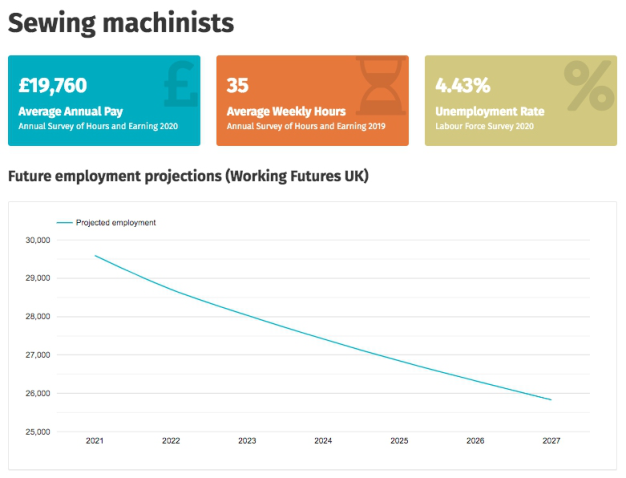
PART 1. DESK-BASED SKILLS RESEARCH OF THE TECHNICAL WORKFORCE IN UK FASHION GARMENT MANUFACTURING Manufacturing is one of 5 priority sectors to which the government appoin- ted a ‘sector delivery lead’ in autumn 2021. The future of manufacturing can be more flexible and need not necessarily be tied to major cities, hel- ping to shorten supply chains and lead to more localised production for local markets. Many recent fashion industry reports have focused on the circular economy and sustainability concerning textiles or retail, but the moderni- sation of garment manufacturing is considered to be beyond the remit of the reporting. Despite multiple low-level training offers in the UK, recent reports suggest the fashion industry suffers from a rapidly declining skilled workforce (Alliance Project, 2015; Reshoring UK Garment Manufacturing with Automation. Recommendations for Government, 2022; UK Textiles Manufacturing: Opportunities and Challenges for the UK and Midlands, 2022; Let’s Talk Real Skills Report, 2021; The Environmental Audit Commit- tee. Fixing Fashion Report: Clothing Consumption and Sustainability, 2019; Business of Fashion. Textiles and Technology: Mapping the UK Fashion Tex- tiles and Technology Ecosystem, 2021). This is aggravated by continuous skills shortages and problems in recruiting new talent. Reasons for slow recruiting are multiple including a lack of incentive for young people to work in the industry as anything other than creative director, manager or designer. Insufficient training option and the general low pay structures have drained the sector of new talent. Input Youth estimates experienced sewing machinists earn between £8.50 and £14.00 an hour, depending on the area of specialism whilst a typical work week lies between 38–40 hours. Work is carried out either in a factory, a workshop or at home. Conditions are noisy and work is generally repetitive, and deadline driven. Piecework is still common for sewing machinists especially in the luxury sector, contributing to irregular income that cannot be easily planned for. The National Career Service esti- mates annual salaries for sewing machinists of £15,500 - £21,000 - from
Human-Centric Research of Skills and Decision-Making Capacity 23
starter to experienced worker, while progression routes are sparse and invo- lve further training. To counter the skills shortage and revive manufacturing for young people, innovative solutions for advanced manufacturing processes are needed and have to form part of young people’s education and training.
Reports from Fashion Industry Journal Business of Fashion (Business of Fashion, McKinsey & Company, 2016) showed that students entering the jobs market were lacking knowledge specific to new technologies resulting in impaired ability to challenge current practice or develop new design-led roles. If the UK government continues to support the development of an advanced manufacturing sector and the reshoring of the UK manufacturing industry then UK fashion education can rise to meet this challenge by developing the way fashion is taught, engaging more fully with Industry 4.0. UK fashion stu- dents have often been trained to become micro businesses and then Small to Medium Size Enterprises (SME’s) and UK Government research funding has targeted small-scale enterprises through research with UK universities like the Creative Clusters Programme. This strategy looks as if it may pay signi- ficant dividends in the new post-pandemic business environment. McKinsey & Company/ Business of Fashion (2019) recognised a new role for small players where they might support R&D for larger brands in in-house labs or attached to universities as Learning Factories designed as a simulation to enable experiential learning as happens in European technical universities. Fashion thinking for advanced manufacturing encourages work that radi- cally reimagines making processes, machines and systems from a designer-led perspective within the context of Industry 4.0 (Postlethwaite, 2021). Degro- wth and just-in-time economic models, agility in manufacturing, scalability and adaptability, R technologies (Stahel 2017) and reverse logistics can be developed here.
The report ‘Designing a Future Economy - Developing Skills for Produ- ctivity and Innovation’ (Design Council, 2018) suggests that design skills are the fusion of creativity with technical ability and interpersonal compe- tencies. They highlight moving from STEM to STEAM+D - that is, Science, Technology, Engineering, Art and Maths, to include D, the Design element, to ensure a resilient economy in the longer term. In the ‘Leading Business by Design: High Value Manufacturing’ (2015) report the Design Council’s policy recommendation was that young people at all stages of education require exposure to the multidisciplinary mix of science, technology, arts, humanities and enterprise that should underpin both creative and manufacturing success in the UK. They go on to say that government should provide incentives to universities to deliver an increased range of multidisciplinary design courses in partnership with expert bodies to enable engagement with the fourth indu- strial revolution. The LEO data (Department for Education, 2019) supports the proposition that it is through a mixed and interdisciplinary training, par- ticularly an undergraduate degree in science and engineering, married to a post-graduate design degree that enables graduate earnings to substantially increase.
The basic principle of Industry 4.0 is that by connecting machines, work practices and systems, businesses are creating intelligent networks along the entire value chain that can control each other autonomously. Economic
24 Thiel and Postlethwaite
models are informing new thinking about manufacturing. Industry 5.0 brings the human back to the centre of the value chain. Well-being, meaningful work and a living wage are central points of this agenda supported by upskil- ling, retraining, and lifelong learning agendas. In order to equip a future workforce with the research skills needed to explore and critically examine Industry 4.0, we propose they will need both hard and soft skills. Skills that include an understanding of technologies, digital tools and engineering, married to critical thinking, collaboration and interdisciplinary working. To fully exploit Industry 4.0+ there is a need to take a Socio-Technical per- spective, in which the social impacts and benefits are given equal weight to the technical. We have therefore identified a people-centred approach to robotics and automation through project based in Human Factors and Fashion Practice Research as a crucial component in developing this nascent field.
PART 2 – DETECTING THE DECISION-MAKING CAPACITY AMONG SEWING MACHINISTS A limited study to understand what Human Factors tools exist to enable an analysis of the skills levels held by garment technicians/machinists was undertaken. Eye-tracking and biomarker data were collected by the team of researchers to explore cognitive / decision-making activity during task performance.
Procedure The overall goal of the task was the fabrication of a standard sleeve pla- cket on an industrial sewing machine without the use of a pressing iron in between sub-tasks. The trials were conducted without a specific hypothe- sis in mind. Rather, they were a vehicle to understand the value of specific quantitative methods in an environment that could not be fully control- led. Working within changing conditions and with a variety of materials challenges the collection of data and it’s analysis would demand flexibility and a nuanced approach. Crucially, dealing with such fluctuations is in the nature of design research where infinite varieties frequently occur and shif- ting attitudes to approaches dictated by the material are the norm (Vaughan, 2019; Krogh et al. 2022). The research teams brought both emic and etic perspectives to the trials, acting as design anthropologists, and deploying a reflective practice during the progress of the project. Unstructured interviews with the machinists were held after task completion to further interrogate the unusual patterns in the datasets to enable a more granular analysis of the decisions taken. Participants were presented with playbacks of their per- formance as captured by the eye-tracking device to collect rationales for decisions made during task performance. The interviews shed further light on participants’ overall perception of the eye-tracking accuracy which became a crucial element in evaluating how inaccuracies in the quantitative mea- suring devices spark more useful qualitative insight into the subject of the study.
Human-Centric Research of Skills and Decision-Making Capacity 25
Participants Participants of the trial sample were all trained sewing machinists working in academic and technician roles at major UK universities. Initially, 4 parti- cipants were recruited, with one trial failing to return usable data, leaving 3 participants’ data sets. Those three participants were female, spectacle wea- rers, between 30 and 45 years old and equipped with an eye-tracking device by SensoMotoric Instruments and the Empatica E4 wristband to capture heart rate and electrodermal activity during task performance.
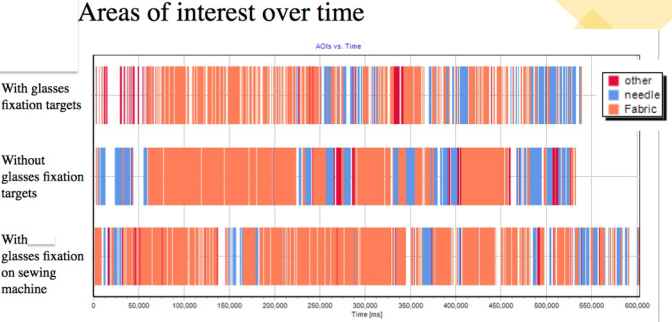
Analysis Areas of interest identified by an analysis of the eye-tracking data indicate two strong focal points, as seen in Figure 1. Participant three’s main focal
Table 1. Participant’s conditions compared.
Table available in the original PDF paper.
Eye-tracking fixation shifts
Machine Fabric Location Prescription lenses during task
Cross markers used for calibration yes Participant 1 1 Blue shirting RCA yes Consistently off focus
yes Participant 2 2 Blue shirting RCA no Occasionally off focus yes Participant 3 3 Calico MMU/MFI yes Frequent erratic flares
yes Participant 3 3 Calico MMU/MFI no Occasionally off focus no Participant 3 3 Dark shirting MMU/MFI yes Frequent erratic flares
Figure 1: Union learn - careers directory sewing machinist (accessed Jan 2023).
26 Thiel and Postlethwaite
Figure 2: Areas of interest over time, three plackets sewn by participant 3 with and without prescription glasses and varying fabrics.
point during all three trials is the fabric on the sewing machine table, handled either directly in front of the foot of the sewing machine or just to the left of it. The second focal point is the needle at the base of the presser foot close to the moving part of the needle.
Orange areas indicate activities related to visual inspection and manual manipulations of the fabric in preparation for the next seam. These handling tasks can be a combination of any of the following: unpicking a seam, pin- ning and unpinning, trimming, cutting, folding, turning, aligning, marking and measuring the fabric. All of these sub-tasks are carried out directly on the sewing machine table to save time and ensure efficiency. Fabric handling activities and are the most time consuming in comparison. Blue areas indicate shorter bursts of sewing activity.
The analysis of the trials was done by first applying a Hierarchical Task Analysis followed by reflective interviews to uncover why and where parti- cipants applied individual techniques to complete the task. The overall goal to fabricate a standard sleeve placket follows five basic tasks: placing the placket, securing the placket, opening and turning the placket, inner placket construction and outer placket construction.
Cognitive Decision-Making Interviews with participants revealed how different approaches and techni- ques were applied during placket construction they made decisions to add sub-tasks and handle the fabric slightly differently in order to arrive at the same result. The high level of skill demonstrated, and decisions made prior to and during task performance were heavily influenced by previous experie- nce with the material properties informing the machinist’s tactile knowledge (Tallis, 2003) and haptic perceptions about the speed and functions of the machines they used (Magnenat-Thalmann et al. 2008). These factors as well as personal preferences for particular techniques then informed the indivi- dual steps added by each machinist that provided them with the confidence to fulfil the task successfully and to a high standard.
Human-Centric Research of Skills and Decision-Making Capacity 27
Task Variations During interviews, participants described how the 5 hierarchical tasks of a standard placket were followed and where individual sub-tasks were added. Not only did the sub-tasks differ in order and action, participant one used one step more than participant two and three to complete the placket. It is worth noting that decisions were made predominantly with one of two goals in mind. Either to make the task at hand easier or to increase the overall qua- lity of the outcome. Often the machinist assesses the steps needed depending on familiarity with the machine and according to the properties of the fabric in relation to task complexity. By detailing their actions and intentions, they highlighted their tacit and tactile knowledge and evidenced the haptic skills (Smith, 2012) needed to complete the task. Fabricating the placket without pressing the fabric during construction, led participant two to pre-press the edges of the inner and outer placket before sewing, participant three fol- ded the edges by creasing the fabric with her fingernails, whereas participant one decided to add a stay stitch to ease the folding of the fabric during task completion.
Eye-Tracking and Prescription Glasses All participants depended on prescription glasses which challenged the eye- tracking device to capture pupil movement consistently. Overall, the eye- tracking device performed better and more consistently when not obstructed by a pair of prescription lenses. In participant one’s footage with prescription glasses, the tracked focal point is off the actual focus point for almost the enti- rety of the video, as confirmed during the playback with the tracker visible on the recording. During participant three’s first and last trial the eye tracker can be observed to shift erratically to the top left corner, we propose this glitch occurs due to lens flares hindering an unobstructed view of the pupil. However, removing the correctives during participant two’s trial and partici- pant three’s second trial led to better performance of the eye-tracking device but in turn decreased stitch accuracy and the overall quality of the placket as minor inconsistencies have a significant impact on the overall quality of the completed placket. Combinations of lens flares and varying light conditions of both natural and artificial light on and around the sewing machines were observed during trials which might have affected the consistent capture of eye-tracking data, these light sources are however an essential requirement in factories relying on human machinist.
CONCLUSION
This study has delivered perspectives on ways to test and ultimately increase collaboration capability between social science methods and Fashion Pra- ctice Research to innovate within emerging manufacturing processes amidst a growing skills shortage in the UK. In an acknowledgement of increasin- gly integrated manufacturing business models, our future research in this field will encompass working with engineers, product designers and Human Factors researchers in tandem and build on initial conversations with robotics
28 Thiel and Postlethwaite
systems integrators on the development of agile tooling for fashion manufa- cturing which warrant further research carried out by a multi-stakeholder research group.
We have found evidence that workers strive for better work fulfilment, personal reward and want to contribute to innovation creatively. The UK fashion manufacturing sector currently lacks systems to apply tran- sferable skills to rejuvenate the job market with opportunities that can inspire and entice a young workforce to enter into what can be a dynamic field.
Having used Human Factors methods during this exploratory study to evidence cognitive decision-making and tacit/tactile knowledge of sewing machinists, we suggest exploring cognitive decision-making with brainw- ave monitors/EEGs in trials with cobotic manufacturing systems as the next step in detecting innovation potential in new tooling. Participants of the eye-tracking trials stressed a sense of reward as one of the main reasons for feeling accomplishment when sewing. Research with functional magnetic resonance imaging or functional MRI (fMRI) into creative problem-solving activities has already revealed critical reward network engagement in the brain during eureka/AHA! Moments (Tik et al. 2018). A sense of reward felt during task completion accounts for reinforced learning, resulting in memory consolidation. Other studies in the same field using EEGs (Ben- jaboonyazit, 2016, Sandkühler et al. 2008) suggest problem solving and AHA! moments were achieved only when study participants were able to overcome their Psychological Inertia (Altshuller, 1998), mental impasse or functional fixedness. Critically, research found that inertia occurs at a higher rate with growing expertise and skill, opening up interesting strands for research into meaningful, rewarding work and tools behaviour. Aligning the development of new tooling to rewarding activity is therefore a criti- cal next step in design research with human factors to address the skills shortage.
Currently, robotics in fashion manufacturing is predominantly deployed in pick and place activities along the assembly lines of huge manufacturing settings. Largely lacking this scale of manufacturing in the UK, the sector is made up of micro and SME businesses who often struggle to automate parts of their operations. Gaining more creative autonomy for on-demand and co- located manufacture is of huge interest to businesses in the UK (Postlethwaite et al. 2022). Developing the systems needed to modernise the UK’s fashion manufacturing sector and populating it with smart, agile and collaborative robotic systems that can ease pressure on recruitment and facilitate more dynamic and creatively rewarding work during production processes suggests huge potential for the future of joint Human Factors and Fashion Practice Research.
ACKNOWLEDGMENT
The authors would like to acknowledge Dr. Sarah Fletcher and Dr. Iveta Eimontaite at Cranfield University for their support in the continuing deve- lopment of this transdisciplinary methodological approach.
Human-Centric Research of Skills and Decision-Making Capacity 29
REFERENCES
Ajewole, Femi. Kelkar, Ani. Moore, Dylan. Shao, Emily and Thirtha, Manju (2023) Unlocking the industrial potential of robotics and automation. McKinsey & Company Industrials & Electronics Practice report. Altshuller, G., Zlotin, B., Zusman, A. and V. Philatov (1998) “ARIZ,” in Tools of
Classical TRIZ. Ideation International Inc., ch. 2, pp. 20–68. Benjaboonyazit T. (2016) Triz Based Insight Problem Solving And Brainwave Analysis Using EEG During Aha! Moment. Business of Fashion, McKinsey & Company (2016) State of Fashion 2017. Industry
Report. Business of Fashion, McKinsey & Company (2018) State of Fashion 2019. Industry Report. Casadei, P. and Iammarino, S. (2020) Trade policy shocks in the UK textile and appa-
rel value chain: Firm perceptions of Brexit uncertainty. In Journal of International Business Policy. Conway, R., Masters, J. and Thorold J. (2017) From Design Thinking to Systems Change. How to invest in innovation for social impact. Action and Research Cen- tre. The RSA - Royal Society for the encouragement of Arts, Manufactures and Commerce. Department for Education (24 Jan 2023) Longitudinal Education Outcomes
(LEO) https://explore-education-statistics.service.gov.uk/find-statistics/graduate- outcomes-leo/2018-19 Design Council (2015) Leading Business by Design: High value manufacturing.
Report. Design Council (2018) Designing a Future Economy - Developing Skills for Productivity and Innovation. Report. Frayling, C. (1993) Research in Art and Design. Royal College of Art Research
Papers. Gaver, W. (2012) What should we expect from research through design? Proceedings of the 2012 ACM Annual Conference on Human Factors in Computing Systems - CHI ‘12, 937–946. Gunn, W. (2020) Design Anthropology in Europe. In Oxford Research Encyclopedia
of Anthropology Oxford University Press. Harris, J., Begum, L. and Vecchi, A. (2021) Business of Fashion, Textiles & Technology: Mapping the UK Fashion, Textiles and Technology Ecosystem, University of the Arts London. Hooper, L., Lack, M., Carney, L. and Postlethwaite, S. (2022) UK Textiles Manufa-
cturing: Opportunities and Challenges for the UK and Midlands. Industry report. Loughborough University. Input Youth (24 Jan 2023) https://www.inputyouth.co.uk/jobguides/job-sewingmac hinist.html Kawamura, Y. (2020) Doing Research in Fashion and Dress: An Introduction to
Qualitative Methods, Bloomsbury Publishing USA. Koskinen, I, Zimmerman, J, Binder, T, Redstrom, J, & Wensveen, S. (2011) Design Research Through Practice: From the Lab, Field, and Showroom, Elsevier Science & Technology, San Francisco. Krogh, PG., Koskinen, I. (2022) How Constructive Design Researchers Drift: Four
Epistemologies. Design Issues; 38 (2): 33–46. Magnenat-Thalmann, N. and Bonanni, U. (2008) Haptic sensing of virtual textiles.
Human Haptic Perception: Basics and Applications, 513–523.
30 Thiel and Postlethwaite
National Career Service (24 Jan 2023) https://nationalcareers.service.gov.uk/jobprofiles/sewing-machinist Oxford Economics (2018) British Fashion Council. https://www. britishfashioncouncil.co.uk/uploads/files/1/News/newLondon%20Fashion% 20Week%20September%202018%20Facts%20and%20Figures[1].pdf Postlethwaite, S. (2021) “Design Culture (of) Making: Investigating Creative Pro-
cesses and Pedagogy as Fashion Thinking”. Conference paper. Cumulus. 9 June 2021. Rome, Italy. Postlethwaite, S., Thiel, K. and Atkinson, D. (2022). Reshoring UK Garment Manufacturing with Automation. Recommendations for Government. Research Report. KTN Made Smarter. Sandkühler S, Bhattacharya J. (2008) Deconstructing insight: EEG correlates of
insightful problem solving. PLoS One. Smith, K. (2012). Sensing design and workmanship: The haptic skills of shoppers in eighteenth- century London. Journal of Design History, 25(1), 1–10. Stahel, W. L. (2017) Circular Industrial Economy in Designing for the Circular
Economy. Edited by Martin Charter 12–20. Oxford: Routledge. Tallis, R. (2003) The hand: A philosophical inquiry into human being. Edinburgh, Scotland: Edinburgh University. The Alliance Project Team (2015) Repatriation of UK Textiles Manufacture. The Environmental Audit Committee (2019) Fixing Fashion: Clothing Consumption
and Sustainability. Sixteenth Report of Session 2017–19. House of Commons. Tik, M., Sladky R., Luft CDB., Willinger D., Hoffmann A., Banissy MJ., Bhattacharya J. and Windischberger C. (2018) Ultra-high-field fMRI insights on insight: Neural correlates of the Aha!-moment. Hum Brain Mapp. Union Learn (24 Jan 2023) https://www.unionlearn.org.uk/careers/sewing-machini
sts Vaughan, L. (2019) Designer/Practitioner/Researcher. In. Practice-Based Design Research. Edited by Laurene Vaughan, 9–17. London: Bloomsbury Visual Arts. Vear, C. (Ed.). (2021) The Routledge International Handbook of Practice-Based
Research (1st ed.). Routledge. West Yorkshire Combined Authority (2021) Let’s Talk Real Skills. Engineering and Advanced Manufacturing Skills Plans. Report Commissioned by Calderdale College.
LISTED IN THE AHFE DIGITAL BOOKSTORE CATALOGUE
Explore the complete digital volume
Human Aspects of Advanced Manufacturing
Read this individual research paper free through the original publisher, or explore the full digital proceedings book.
ISBN 978-1-958651-56-8
Explore this ISBN in the AHFE Bookstore ↗Listed in the July 2026 bookstore catalogue; search by ISBN to confirm current availability · Digital book purchase optional