Suad Alramouni, Reem Hassounah (2023). A Data retrieval Model for Distributed Heterogeneous Pharmacy Information Sources. In: Human Factors in Software and Systems Engineering. AHFE Open Access, vol. 94, pp. 44–53. https://doi.org/10.54941/ahfe1003769
The need for sharing data in various domains has increased significantly over the past decades and has become the focus of many theoretical works as numerous data-related problems remain unsolved. Hospitals exemplify this notion given that they are complex institutions with constantly evolving patient-related services and ever-growing data stored on heterogeneous data sources. The purpose of this research is to solve the patients’ issue in checking drug availability in pharmacies in their vicinity, specifically for pharmacies in Saudi Arabia.A qualitative study was conducted to obtain a comprehensive view from two hospitals in Riyadh, KSA about their HIS implementation and the integration approaches used. To address the data integration challenges faced by these hospitals, a data retrieval model to integrate data from heterogeneous sources has been developed and tested.Various reasons affect the successful implementation and adoption of HIS. The main reason for the lack of HIS adoption in Saudi Arabia is due to the lack of expertise in systems integration and weak integration planning and architecting. This thesis looked at integration approaches and found that there is no single optimal integration approach for solving complex integration issues. A combination of multiple integration approaches should be utilized to leverage the advantages of the various approaches. One of the main components of the HIS is the Pharmacy Information system (PIS) which is responsible for storing and managing medication-related data, however, PISs in pharmacies are considered heterogeneous and not integrated, therefore users cannot conduct searches for medication availability across multiple pharmacies. A data Retrieval Model has been designed to integrate heterogeneous data sources and has been validated by implementing a mockup E-Pharmacy mobile application that helps the user search for medications in pharmacies in Saudi Arabia. This data retrieval model can be applied in many fields and benefit various organizations in their data integration initiatives.
The healthcare industry is one of the largest and most complex industries. Patient care services have continuously evolved over years with exponential growth in patient and health related data being stored on multiple hetero- genous systems (Ajami, 2012). The concept of Health Information Systems
A Data Retrieval Model for Distributed Heterogeneous Pharmacy Information Sources 45
(HIS) was born describing the integrated group of underpinning systems and technologies that access heterogeneous data sources containing all kinds of health-related information. The need to integrate these systems for various use cases has become increasingly critical to provide patient services with better quality and accuracy. One critical use case has to do with the ability of users to inquire about the availability of mediations from several hete- rogeneous Pharmacy Information Systems (PIS) in Riyadh, KSA through a mobile application with ease and in minimal steps. This raises an impor- tant question which is: “How do we develop a Data Model for retrieving data from heterogonous sources to provide drug availability information for Riyadh’s citizens?”. In this paper, we discuss the importance and challenges of integrating heterogeneous pharmacy information systems for pharma- cies in Riyadh, KSA to provide accurate results for medication searches through mobile applications using middleware technology. The challenge of effectively integrating heterogeneous data sources to retrieve accurate infor- mation is a widespread challenge facing the healthcare industries especially in Riyadh, Saudi Arabia. The PISs in hospitals are built on various platforms, database management systems, and operating systems, but require exchange of data. As discussed in the literature review, this challenge impacted the abi- lity to effectively and systematically inquire about medication availability in pharmacies in Riyadh. The objective is to develop a data retrieval model that can be implemented to solve the identified problem of providing medication availability information from heterogeneous pharmacy information system sources.
LITERATURE REVIEW
The introduction of Hospital Information Systems (HIS) addressed the chal- lenges arising from managing large volumes of data and complex intercon- nected services in disparate systems spanning multiple patient healthcare domains (Khalifa and Alswailem, 2015). A HIS manages all the required information processing in a given hospital. HISs are usually heterogeneous in that the tools and information within the system could be computer-based or paper-based including electronic patient records, clinical workstations, paper-based documentation systems, telephones, e-mail-systems, etc. The computer-based part of a HIS in a hospital is typically a complex structure consisting of many components including different workstations, servers, and applications running on multiple networks through various communication interfaces and other functions (Ammenwerth et al. 2000). Hospitals are beco- ming increasingly reliant on HISs’ capabilities to assist them in effectively managing critical functions and in delivering improved patient-care services and practices (Ajami, 2012).
Modern HISs are comprehensive, specialized, and integrated information systems designed to manage the various aspects of hospitals and healthcare facilities including (but not limited to) administrative, financial and clinical aspects (Khalifa and Alswailem, 2015). The importance of HISs emerges from their ability to manage such comprehensive medical data/information. HISs
46 Alramouni and Hassounah
are considered a critical part of the overall healthcare management system in hospitals and various healthcare organizations (Khalifa, 2014).
To understand the structure and components of the HIS, it’s important to know the HIS stakeholders, which are categorized into internal and external. Internal customers include physicians, nurses, laboratory techni- cians, pharmacists, quality engineers, receptionists, and others that apply the essential internal processes within a healthcare organization. Exter- nal customers include patients and their families, insurance service provi- ders, medical suppliers, health services researchers, (Ajami, 2012). Accor- ding to Biomedical Informatics Ltd. the components serving those custo- mers consist of two or more of the following components (Ismail et al. 2020):
Clinical Information System (CIS)
Financial Information System (FIS)
Laboratory Information System (LIS)
Nursing Information Systems (NIS)
Pharmacy Information System (PIS)
Picture Archiving Communication System (PACS)
Radiology Information System (RIS) This research will describe two HIS components which are the CIS and the PIS. The CIS is a subsystem of the HIS, the main purposes of the CIS include capturing, storing, processing, and transferring the right information to clinical decision makers to support them in making rapid and accurate decisions (Islam et al. 2018). An effective CIS can easily import data from different sources such as vital signs monitors, ventilators, infusion devices, etc. then securely storing that data and displaying them in specific formats. CISs can potentially reduce medical errors, enhance legibility, significantly save on healthcare costs, and improve the quality of healthcare services. One critical advantage of systems such as the CIS is the ability to integrate with other systems or subsystems in the hospital including the systems stated ear- lier. (Islam et al. 2018). The Pharmacy Information System (PIS) is another sub-system of the HIS which is designed to assist pharmacists in effectively managing the processes related to medication. (Alanazi, 2018). The most vital role for the PIS however lies in its ability to help in monitoring criti- cal and complex factors including drug to drug interactions, potential drug allergies, and different types of drug-related complications (Islam et al. 2018). However, hospitals’ utilization of HISs is still considered low despite all the evidence of its realized benefits (Khalifa and Alswailem, 2015). This has to do with the fact that HIS execution is complex and its adoption presents many challenges, and this is evident for many hospitals around the world.
Challenges in HIS execution are more evident in most developing coun- tries, as implementation of HIS is not planned properly and is continuously facing many challenges and barriers that are different in nature from the chal- lenges faced in developed countries (Khalifa, 2014). For example, in Saudi Arabia the level and extent of HIS utilization is still poor and much less than expected.
A Data Retrieval Model for Distributed Heterogeneous Pharmacy Information Sources 47
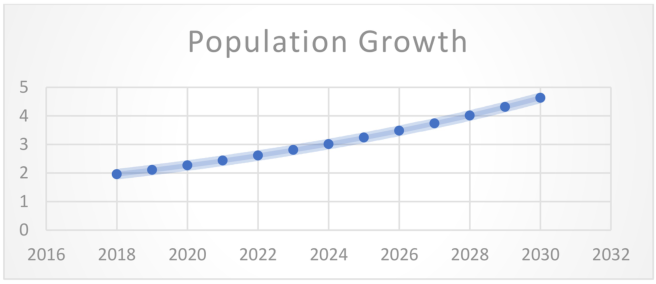
In general, HISs implementations are costly, time consuming, and intro- duce complex system and integration problems. However, the HIS implemen- tation challenges and issues can be significantly minimized if an appropriate HIS implementation plan and framework are developed. Thus, a structu- red and phased HIS implementation approach is required to ensure that the system is implemented systematically and efficiently in the hospitals (Ismail et al. 2020). In the case of Saudi Arabia, a major transformation is required in the healthcare system to address challenges pertaining to healthcare services that face the country, especially as the population of the Kingdom continues to grow and age as well. The KSA population is expected to rise from 33.5 million in mid-2018 to 39.5 million by mid-2030. The elderly population (ages 60 to 79) is expected to grow from 1.96 million in mid-2018 to 4.63 million by mid-2030 as depicted in Figure 1.
The Ministry of Health (MoH) has been tasked with developing the health- care transformation strategy as part of “Vision 2030” for the Kingdom. This transformation has various critical objectives, the most relevant ones as far as this research is concerned which have a direct impact on HIS implementation, integration, and adoption in KSA are:
Harness technology, the internet and mobile telephony, computational power and interoperability, big data and analysis to improve patient access, education and involvement in protecting and promoting their health, to drive quality and efficiency gains and to build a learning health system.
Develop the information systems, distributed governance systems, accoun- ting systems, and the professional, employment and communication practices that will enable the MoH and the health system to be more responsive to current and future pressures.” (MOH, 2020).
Data Integration Approaches Data integration is a complex domain and can be defined in many ways. A comprehensive definition according to Gartner is: “Data integration com- prises the practices, architectural techniques and tools that ingest, transform,
Figure 1: Elderly population (60-79) growth from 2018 to 2030.
48 Alramouni and Hassounah
combine and provision data across the spectrum of information types — both inside the enterprise and beyond — to meet the data consumption require- ments of all applications and business processes. Data integration enables data structures that were designed independently to be leveraged together” (Zaidi et al., 2017) There are various data integration approaches. This research will focus on evaluating two existing data integration approaches:
Extract Transform Load (ETL)
Middleware The ETL approach fulfills the core function of data integration by exe- cuting three steps: Extract (obtain data from source system), Transform (modifying the data to a compatible format), and Load (importing the data into the destination system). Although the steps are straightforward from a conceptual view, there are several technology solutions with different tools that implement these steps. The ETL approach is commonly used for moving and converting large batches of data, which is why it’s widely applied as the information integration approach for data warehousing, given that data warehouses provide an integrated and consolidated view of data from multiple sources for reporting and analytical purposes (Reeve, 2013).
Middleware on the other hand, is software that achieves data integration via connecting heterogeneous applications into a single user interface. Midd- leware is also used to integrate legacy systems and emerging technologies that have been developed using different solution designs, data models, and architectures. The majority of internet services have been integrated utilizing middleware solutions and frameworks. Middleware has existed for some time and is prevalent in large, complex enterprise applications in various industries including the retail and financial industries. (Voltz and DM, 2015) (Emmerich et al., 2007) Other data integration approaches are gaining traction including data virtualization and message-oriented data movement, which are being used alongside ETL and middleware tools and technologies to fulfill varying SLAs across different use cases.
A narrow portfolio or a single type of data delivery — such as bulk or batch extraction, transformation and loading (ETL) alone — is no longer sufficient. Data virtualization, data replication or synchronization, message-oriented data movement and stream data integration are becoming increasingly essen- tial to an overall data integration tool portfolio (Pay, 2012) (Zaidi et al., 2017).
RESEARCH METHODOLOGY AND DESIGN Only two major hospitals in Riyadh, KSA have implemented the HIS (Al- Habib and National Guard) which is why the study only covered those two. Both hospitals have implemented PISs within their HIS environment and have been questioned to have a better understanding on their current situation and challenges. The relevant Data was collected using a self-structured question- naire and through interviews with HIS representatives in the hospitals. A qualitative study was conducted afterwards, the results of which are in the following section. The questionnaire consists of three parts: The first part
A Data Retrieval Model for Distributed Heterogeneous Pharmacy Information Sources 49
deals with general information about the participants, which includes two closed questions on their position and job experience. The second part of the questionnaire deals with the implementation of the PIS and the existing inte- gration challenges with the HIS using five closed and semi-open questions. Finally, the third part investigates the challenges and obstacles the patients and pharmacists face while checking the availability of medication. Descri- ptive statistics have been utilized to analyze the results. All participants have been informed about the purpose and objectives of this questionnaire. The participants have also been assured that all collected data will be kept confi- dential. The interviews have been conducted face to face. The findings have been documented in word format and sent to the participants for their review and validation.
RESULTS
Table 1 shows the Demographic information pertaining to the respondents: The findings from the interviews were categorized into three main themes:
1. HIS System Development 2. Integration 3. Medication Availability Challenges.
HIS System Development Both hospitals stated that their foundational HIS system was based on a Commercial off-the-shelf (COTS) solution with limited components. As the hospitals’ services evolved based on increasing demand to fulfil new busi- ness requirements and functions, the need to implement additional system components (e.g., PIS) became necessary. These additional components were different systems with different data sources and provided by different ven- dors. This ultimately led to an HIS environment composed of heterogeneous data sources which strongly warranted for the integration between those data sources to provide better quality services. According to the responses, the HIS of both hospitals are already fully integrated, Table 2 above provides further details on their integrated HIS solutions.
Table 1. Demographic characteristics of participants.
Table available in the original PDF paper.
Respondent Characteristics Response Years of practice: More than 3 months Yes Area of practice: IT related occupation Yes
Integration Regarding the high-level integration architecture, both hospitals confirmed that they applied the Service Oriented Architecture (SOA) for its advantages including its “plug-and-play” approach on existing legacy software systems. The SOA approach enabled the hospitals to extract the necessary functio- nalities and features from the legacy system and extend them as part of an integrated application landscape (Voltz and DM, 2015).
Multiple integration approaches have been applied to overcome the challenges of integrating heterogeneous HIS systems including Middleware Message-Oriented Middleware (MOM) based on the Health Level 7 (HL7) messages and ETL. HL7 is a comprehensive framework and standards for the exchange, sharing, integration, and retrieval of electronic health related infor- mation that supports the management and delivery of health services and clinical practices. (Voltz and DM, 2015). All integration approaches populate a centralized data warehouse. For more information on data warehousing, please refer to section 2.2.
The integration challenges presented by the respondents are summarized in Table 3.
Medication Availability Challenges
Table 4 lists the challenges pertaining to the availability of medications.
Design Based on the in-depth analysis conducted through the literature review (inclu- ding data integration approaches), interviews, and qualitative studies, the research methodology that will be followed to develop the data retrieval model for pharmacy information dissimilation will be applied through the Software Development Lifecycle (SDLC), specifically the prototype. The prototype model started with the functional and non-functional require- ments analysis, the Software Requirements Specification (SRS) was developed accordingly, further details on the SRS can be found in. Security requirements are not within the scope of this paper. We then proceed to designing the data retrieval model, then build the prototype. The necessary test cases to vali- date the prototype were developed for user evaluation and the prototype was refined based on the evaluation, and is ready to proceed to implementation.
Data Retrieval Model Design The Software Requirements Specification document was developed to iden- tify the functional and non-functional requirements. The next step was to
Table 3. Respondent HIS integration challenges.
Table available in the original PDF paper.
Hospital Integration Challenge Al-Habib Non-functional: Lack of High availability due to the absence of redundant servers. National Guard Complexity of HL7 implementation that leads to increased development and maintenance costs.
A Data Retrieval Model for Distributed Heterogeneous Pharmacy Information Sources 51
Database server availability for the medication data reposi- tory
Actual medication availability in the market National Guard
System stability issues due to: – Frequent releases and deployments causing undetected errors – Database scalability issues leading to constant manual data expansions
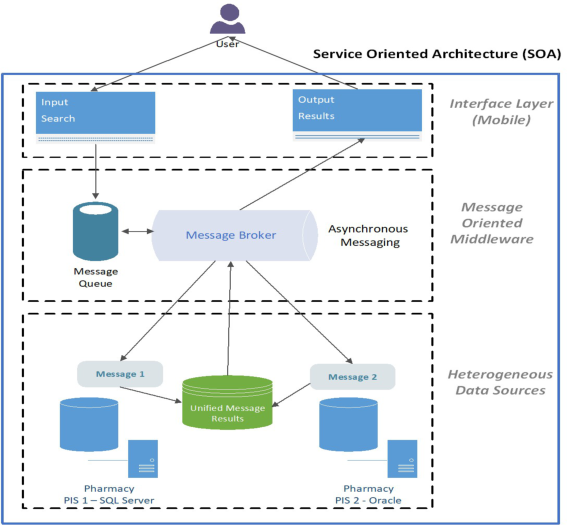
develop a data retrieval model for distributed heterogeneous PISs in Riyadh leveraging the insights and outcomes from the research findings and SRS. Based on the research findings, the ideal integration approach identified will be the message-oriented middleware approach. Middleware was sele- cted since it effectively solves the heterogeneity and distribution problems. Message-oriented middleware is one of the widely adopted solutions and ideal since it allows various types of applications to exchange data and com- municate via messages (Batra et al., 2011). The proposed architecture is based on the Service Oriented Architecture (SOA). SOA is a multi-tier archite- cture with service-oriented design principles and was selected because it’s the
Figure 2: Data retrieval model for pharmacy information dissimilation.
52 Alramouni and Hassounah
Table 5. Data retrieval model layers.
Table available in the original PDF paper.
Layer Role SOA The overarching architecture for the data retrieval model Mobile Interfaces
Represents the front-end interface the user will be utilized to search for medication, view list of pharmacies with the available medication, select the pharmacy, and view pharmacy related information Message Oriented Middleware
This layer receives the messages from the interface layer and routes them to the PISs to retrieve the requested data. The results are then consolidated in unified datasets and returned as outputs to the user and viewed through the interface layer. Heterogeneous Data Sources
This is the data layer which contains the heterogeneous data sources that store the PIS data
suitable architecture when different components need to be integrated and distributed applications are in place, SOA is not suitable in a homogenous application environment [SOA]. SOA supports a variety of design patterns including: Asynchronous Messaging, Conversation, Orchestration, Proces- s/Workflow, and Endpoint patters. Messaging is considered the backbone of SOA (Batra et al., 2011). The proposed retrieval model is based on the asynchronous messaging design pattern, which enables information interch- ange via message exchanges between various applications and components, in addition to louse coupling capabilities. The messaging design pattern can be applied to address the PIS heterogeneity in a distributed scenario through the exchange of asynchronous messages. The proposed data model is shown in the diagram in Figure 2.
Each layer in the proposed model serves certain roles to achieve the messa- ging design pattern within the SOA. Table 5 briefly describes the role of each layer.
CONCLUSION
In conclusion, the data retrieval model designed for this study is capable in addressing various complex data integration scenarios. This model can potentially improve health related services and significantly increase relia- bility in retrieving information from heterogeneous data sources. The key benefit of our model is that it leverages message-oriented middleware to ulti- mately display medication availability information to Saudi citizens through a mobile application.
The proposed data retrieval model can be applied as is for various similar use cases. However, to harvest the true benefits of the proposed model, pro- per and methodical planning and designing must take place to mitigate the challenges and potential pitfalls during the implementation of such systems. Additionally, organizations should strongly consider leveraging multiple inte- gration approaches as data integration scenarios become more complex. Perfecting data integration a continuous journey that has to keep up with the constantly evolving services in healthcare and all other industries.
A Data Retrieval Model for Distributed Heterogeneous Pharmacy Information Sources 53
REFERENCES
Alanazi, F. Al Rabiah, H. Gadi, M. Househ, and B. Al Dosari, “Factors influencing pharmacists’ intentions to use Pharmacy Information Systems,” Informatics Med. Unlocked, vol. 11, pp. 1–8, Jan. 2018. Batra, Usha, and Saurabh Mukherjee. “Software Design Patterns for Message Dri-
ven Service Oriented Integration of Stovepipe Applications in Healthcare Enter- prise.” 10th WSEAS International Conference on Applied Computer and Applied Computational Science, ACACOS’11, 2011, pp. 211–16. D. Pay, “What you need to know,” Aust. J. Pharm., vol. 93, no. 1106, p. 12, 2012. E. Ammenwerth, R. Haux, P. Knaup, and U. Pohl, “Computer-based documentation systems and their integration into hospital information systems,” Methods Inf. Med., no. January, 2000. E. Zaidi, E. Thoo, and T. Friedman, “Modernize Your Data Integration Architecture
for Digital Business by Combining Data Delivery Styles,” no. September, 2017. M. Khalifa and O. Alswailem, “Hospital information systems (HIS) acceptance and satisfaction: A case study of a Tertiary Care Hospital,” Procedia Comput. Sci., vol. 63, no. Icth, pp. 198–204, 2015. M. Khalifa, “Technical and Human Challenges of Implementing Hospital Informa-
tion Systems in Saudi Arabia,” J. Heal. Informatics Dev. Ctries. www.jhidc.org, vol. 8, no. 1, 2014. M. M. Islam, T. N. Poly, and Y. C. J. Li, “Recent Advancement of Clinical Information Systems: Opportunities and Challenges,” Yearb. Med. Inform., vol. 27, no. 1, pp. 83–90, 2018. MOH, “Health Sector Transformation Strategy.” N. I. Ismail, N. H. Abdullah, U. Tun, H. Onn Malaysia, P. Raja, and B. Pahat,
“Implementation and Acceptance of Hospital Information System.” Reeve, Managing Data in Motion: Data Integration Best Practice Techniques and Technologies. S. Ajami, “Training and its Impact on Hospital Information System (HIS) Success,”
J. Inf. Technol. Softw. Eng., vol. 02, no. 05, 2012. Voltz and D. M, “Connecting the Disparate: Middleware’s Role in Solving Healthcare’s EHR Interoperability Problems,” J. AHIMA, vol. 86, no. 5, pp. 28–33, 2015. W. Emmerich, M. Aoyama, and J. Sventek, “The impact of research on middleware
Read this individual research paper free through the original publisher, or explore the full digital proceedings book.
ISBN 978-1-958651-70-4
Explore this ISBN in the AHFE Bookstore ↗Listed in the July 2026 bookstore catalogue; search by ISBN to confirm current availability · Digital book purchase optional