Jiajun Wei, Shiyi Zhou, Yan Gan (2023). User experience based acute death prevention monitoring system and emergency product design. In: Usability and User Experience. AHFE Open Access, vol. 110, pp. 319–326. https://doi.org/10.54941/ahfe1003205
Acute death is known as sudden death. In recent years, the number of sudden deaths in China increasing, and the proportion of deaths outside hospitals and at home is as high as 80 %. The purpose of this paper is to study how to effectively deal with the occurrence of sudden death and ensure the timeliness of rescue, so as to better protect the life and health of the elderly and sub-healthy people. The literature research method was used to study the current design trends and shortcomings of monitoring products and first aid products. From the perspective of user experience, the elderly and people living alone are the main objects of the study, and user interviews and empathy maps are used to construct role portraits, and behavioral analysis is applied to analyze user needs and provide guidance for the subsequent design. Based on the above approach, a community AED emergency system was proposed to serve mainly apartment houses in the community. Finally, user affective feedback was assessed through the Self-Assessment Model (SAM). This study concludes that a deeper understanding of the underlying user needs can be gained from a user experience perspective, and user-approved solutions can be designed accordingly.
Acute death, also commonly referred to as sudden death, is a sudden, rapid, unanticipated, and natural death. The danger of sudden death is that it cau- ses ventricular fibrillation which can take a person’s life in a very short period. Automated external defibrillator (AED) devices can eliminate ven- tricular fibrillation through electric shocks, but coverage in China remains low. And 65%-80% of out-of-hospital cardiac arrest (OHCA) cases occur at home (Sanna, 2006), so AEDs established in public spaces do not work promptly.
Most of the current research related to AED first aid products is: (1) Optimization of the original product or rescue process, such as the improvement and optimization of the workflow of cardiac products using the ESIA method by S. Shi, which reduces the amount of workflow (S. Shi, 2021).
(2) Design of first aid robots combining artificial intelligence, ambulance, and rescue guidance, such as Krishnakumar et al. who combined AED intelligent robots with ambulances to build connections through wireless networks (Krishnakumar, 2019).
The existing research on AED covers system optimization and functional enhancement, but lacks design considerations from the user’s perspective. Most AED robotic services are still focused on large public spaces, with low coverage in residential spaces such as communities (M.M. Zhu and W.L. Yan, 2020), leaving a gap in access to the rescue for people living alone. According to the China Statistical Yearbook 2020, “one-person households”account for more than 25% of the population and are composed of two main groups: older single-person households and middle-aged and young single-person households.
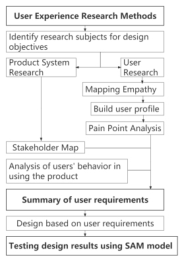
This study proposes a design method (Figure 1), which aims to verify the rationality and feasibility of this design method from the perspective of user experience by reorganizing and summarizing user needs, finding feasi- ble design breakthrough points, supplementing and optimizing the existing first aid system, and applying the SAM method to evaluate and test the users emotional feedback (Y. S. Zheng, 2020).
Figure 1: User Research Methodology.
RESEARCH PROCESS User Role Construction
Since most people are not familiar with AED products, this study focused on understanding the life safety issues that elderly people and people living alone may encounter in their lives through field interviews, and exploring design opportunities and users’ expectations of first aid products. The inte- rviews were conducted in the campus community, and a total of seven people were interviewed, including four elderly people and three young people. The outline and results of the interviews are shown in the table (Table 1).
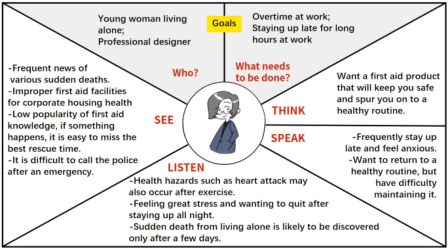
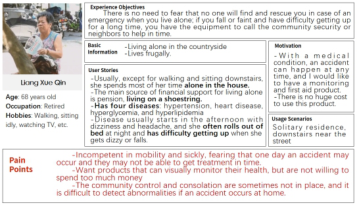
Based on the above findings, a user empathy map was drawn (Figure 2), and a user profile was created from it (Figure 3). The relevant characteristics of the research subjects were felt and described through the stakeholder’s
User Experience-Based Acute Death Prevention Monitoring System 321
Table 1. Interview outline and results.
Table available in the original PDF paper.
Interview Outline Interview Results Do you usually live alone? Most have lived alone and usually for a long time. Thoughts about living alone? The elderly will gradually adapt, but not very convenient; young people feel very free. What are the financial resources of living alone?
Older people rely on pensions and alimony, and younger people rely on personal wages. What is your physical condition when you live alone?
The elderly will have chronic diseases, the effects of aging functions, and even dizziness and falls; young people mostly feel weak due to poor work habits such as overtime and late nights. What are the difficulties of living alone?
The elderly: sometimes have mobility problems and physical pain, but no one to take care of them; the young: with financial constraints, often stay up late and worry about their health. Have you encountered any unexpected situations?
Able to warn in time and arrive quickly; not too costly.
The elderly occasionally encounters it, and although they can be treated promptly, they often feel worried about it. If there was a first aid product to assist with treatment, what would your expectations be?
Figure 2: Empathy Map.Figure 3: User Profiling.
perspective to understand the potential needs of users more deeply (Ferreira, 2015). And a summary of the pain points in Table 2 was derived.
Table 2. Summary of pain points.
Table available in the original PDF paper.
Aspects Pain points Physiology It is difficult to detect and rescue people living alone in a time when they encounter sudden conditions such as heart attack or fainting. Psychological Stress and anxiety due to frequent concerns about their safety. Economy The elderly usually have very limited financial resources and do not spend a lot of money on monitoring first aid products that are unused in most cases. Living Environment
Some community monitoring and control efforts are not in place, there is a high risk of accidents at home but difficult to detect the situation.
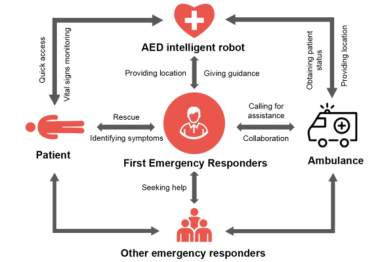
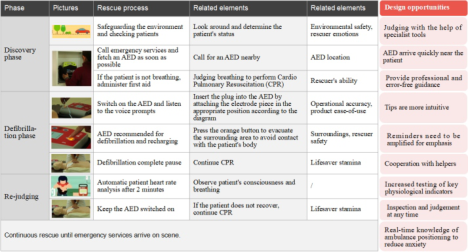
User Needs Analysis Observe the first aid process and the use process of AED products, draw a stakeholder map of the first aid process (Figure 4) and a behavior analysis diagram (Figure 5), analyze the multiple contacts of the use process of first aid products in detail, anticipate and list the possible problems in the whole service process and solve them and design a service system to meet the needs of users (S. C.Shi, 2020).
User Experience-Based Acute Death Prevention Monitoring System 323
Table 3. Demand Summary.
Table available in the original PDF paper.
User Stage Demand Patients Before the accident Real-time health data monitoring to prevent emergencies in advance. At the time of the accident
Quickly alert and send signals to the outside world. After the accident Early Warning Stage Ability to immediately call the police and first responders in case of patient accidents.
Get feedback on the cause of illness and convalescence advice to avoid the next accident. First Emergency Responders Discovery Phase The ability to reach the patient quickly. Defibrillation phase First aid products provide professional and intuitive guidance, lowering the threshold of use. Patient transport
Real-time ambulance positioning awareness to reduce anxiety. Ambulance Receive alarms Interconnect with the AED that received the patient’s signal to quickly locate the patient’s position. Rushing to the scene
Real-time access to patient sign information for advance judgment.
Through the above analysis, the user’s demand points for the emergency system and AED (Table 3) are summarized as the overall guidance for the follow-up design practice.
RESEARCH RESULTS Design Practice
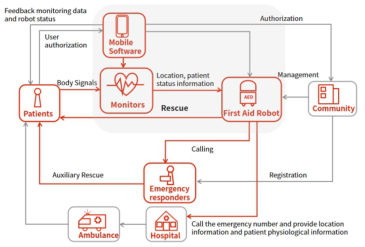
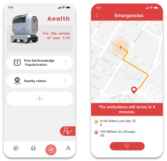
Based on the results of the above user study, the main design goal was sum- marized: to achieve sudden death detection and rescue through a wearable monitor in collaboration with a community AED robot, focusing the appli- cation scenario on sudden indoor situations. According to this, a set of system workflow is designed (Figure 6). The main components are divided into mobile application software, wearable detection equipment and AED emergency robot (Figure 7), and the use of radio frequency identification technology (RFID) to achieve multi-device collaborative work in the Inter- net of Things environment (C. Liu, 2011). The main process of the product system is: (1) The patient wears a wearable monitor and makes user authorization on the mobile terminal. (2) The monitor will read the user’s body signal in real-time. (3) When the signal is abnormal, the monitor provides the location informa- tion to the emergency robot, and the robot receives the signal and starts to go to the user’s side, while calling the user’s emergency responders for rescue.
Figure 6: System Flow.Figure 7: Product effects, (A) mobile interface design; (B) AED first aid robot; (C) wearable heart rate detection device.
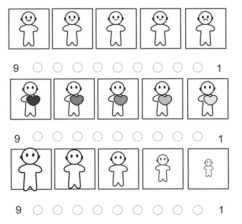
User Feedback Analysis To analyze user acceptance and satisfaction with the design results, the SAM model is used to analyze user emotional responses. The SAM model is a user experience evaluation method using image narratives, based on a legend lan- guage approach to assessing three dimensions in an individual’s emotional response to a given environment or event (Gervasi 2023):
(1) Pleasure, which determines whether the user feels pleasant or negative about a given thing. (2) Arousal, which is used to determine whether something has a stimu- lating effect on the user, whether caused by a pleasant or negative sensation. (3) Dominance is used to describe how much control the user has over the current thing.
To make the legend cards used for judgment easier to understand, the cards were redrawn (Figure 8) and the SAM model was presented to the user in the form of a nine-level scale.
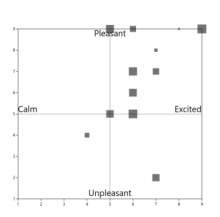
The subjects of this test are young and middle-aged groups aged 18-48, with a number of 21 people. In the three dimensions of pleasure, arousal and dominance, the spatial coordinate system is established in two dimen- sions (Figure 9) to analyze the corresponding relationship of user emotional response. The quadrant location and cumulative area of the test result distri- bution provide a visual representation of the user’s emotional response to the system designed for this study (Morris, 1995).
User Experience-Based Acute Death Prevention Monitoring System 325
Figure 8: Self-Assessment Model.Figure 9: Analysis of SAM test results. (A) Pleasure-Arousal; (B) Arousal-Dominance; (C) Pleasure-Dominance.
Based on the test results, it can be seen that the users have a more pleasant acceptance of the AED first aid system and show that it has more positive stimulation for the users, which shows that the performance of the system can meet the needs and preferences of the users and proves that the solution idea proposed in this study can be recognized by the users and has received positive feedback. Given the complex composition of the personnel involved in the rescue system, some users expressed a neutral attitude in terms of dominance when they first encountered the system, representing that they expected a more streamlined process performance from the system.
CONCLUSION
To design a first aid system that meets the expectations of the users, this study used user interviews, empathy maps and other methods to analyze and sum- marize user needs and propose a community AED first aid system, taking young and middle-aged people living alone and elderly people with repor- ted heart disease as the target subjects of this study. The system is based on the urban community as a space that works in concert with wearable monitors and sums up multiple stakeholders for purposes such as real-time monitoring and rapid response. Finally, the SAM model was used to test and analyze users’ emotional responses, and it was concluded that the product system design based on user experience could gain greater acceptance and more positive emotional feedback from users.
The AED first aid system proposed in this study is based on the design of urban community space, which is subject to many constraints and the target audience of the study is concentrated, so the design results are based on a smaller scope to solve the problem. Future research should focus on how to solve the problem of the public medical emergency system in a broader dimension and consider it for a larger population.
REFERENCES
C. Liu, X. H. Jing, et al. (2011). Introduction to the technical characteristics of the Internet of Things and its wide application [J], Scientific Consulting, (09), 86. Ferreira B, Silva W, Oliveira E, et al. (2015). Designing personas with empathy maps
[C]. SEKE, 2015. Gervasi, Riccardo & Capponi, Matteo & Mastrogiacomo, Luca & Franceschini, Fiorenzo. (2023). Manual assembly and Human–Robot Collaboration in repe- titive assembly processes: a structured comparison based on human-centered performances. The International Journal of Advanced Manufacturing Technology. 1–19. 10.1007/s00170-023-11197-4. Krishnakumar K, Prakash S. (2019). Robotic Automated External Defibrillator
Ambulance for Emergency Medical Service in Smart Cities [P]: IN20184104 9759-A. M. M. Zhu, W. L. Yan. (2020). How to configure “life-saving” AEDs--Evaluation of AED facility coverage in Hangzhou based on cell phone signaling data. Zhejiang Economic (02), 41–43. Morris, J. D. (1995). Observations: SAM: The Self-Assessment Manikin An Efficient
Cross-Cultural Measurement Of Emotional Response 1. Journal of Advertising Research. S. C. Shi, Y. S. Jiang, Y. Li. (2020). Research on health fat reduction service design[J].
Industrial design, 164(03): 82–83. S. Shi. (2021). Research on the design of household cardiovascular emergency products based on ESIA method. Development and innovation of electromechanical products (02), 42–44. Sanna T, Fedele F, Genuini I, Puglisi A, Azzolini P, Altamura G, Lobianco F, Ruzzolini
M, Perna F, Micò M, et al. (2006). Home defibrillation: A feasibility study in myo- cardial infarction survivors at intermediate risk of sudden death. The American Heart Journal 152(4): 685.e1-7. Y. S. Zheng, Y. W. Zhu and H. C. Wang. (2020). Current development of user experience research, research models and evaluation methods. Packaging Engineering (06), 43–49.
LISTED IN THE AHFE DIGITAL BOOKSTORE CATALOGUE
Explore the complete digital volume
Usability and User Experience
Read this individual research paper free through the original publisher, or explore the full digital proceedings book.
ISBN 978-1-958651-86-5
Explore this ISBN in the AHFE Bookstore ↗Listed in the July 2026 bookstore catalogue; search by ISBN to confirm current availability · Digital book purchase optional