Mimeng Zhang (2023). A Bibliometrics-Based Study of Visualizing Design Narratives. In: Usability and User Experience. AHFE Open Access, vol. 110, pp. 335–344. https://doi.org/10.54941/ahfe1003207
The context of digital transformation has brought new opportunities and challenges to design education. This paper aims to grasp the current research hotspots and theoretical foundations of design narrative and to explore new trends in future development based on the current research hotspots. Using the literature related to design narratives collected in Web of Science as the data source, the scientific bibliometric method to create a scientific knowledge map in terms of the distribution of literature by year of output, author, reference co-citation and keyword clustering, and conduct a visual analysis to sort out the research. The results show that the overall number of literature within the search area is rising, with research hotspots mainly focused on design education, narrative design, serious games, and narrativity.
Design narrative, the use of “narratology” as an alternative approach to analyzing, understanding, and creating products, examines the connections between the intrinsic properties of products, stylistic structures, semantic order, and strategies for effectively constructing the sociocultural meaning of products (Bal, 2009), the introduction of “narratology” can be said to be the original concept of design narrative (Todorov, 1973), and in recent years the terms “design” and “ The concept of “narrative” has expanded from sim- ple “storytelling” to basic human modes of interpretation and cognition, and various cultural domains including design (Todorov, 1973). The concepts of “storytelling” and “narrative” have expanded beyond simple “storytelling” to basic human modes of interpretation and cognition and various cultu- ral domains, including design (He Xiuchuan, Bai Leiqiang, Yang Xiaoyang, 2022). In the 20 years since 2002, the research literature in this field has been voluminous, with diverse and complex fields of knowledge. It is diffi- cult to accurately and objectively analyze and grasp the research hotspots and evolutionary trends in this field, and even more difficult to accurately grasp the specific impact of the theoretical approach to design narratives on design activities simply by reviewing and summarising the traditional literature and making qualitative comparisons (Chen et al., 2022). Therefore, in order to explore the current situation, research trends, and hotspots of design narra- tives in greater depth, this study uses the Web of Science (WOS) database
as a data source and applies quantitative tools to visualize and discuss the literature to provide a more objective and credible overview of the research in this field, which in turn provides a reference for subsequent researchers in the field.
Materials and Methods
As high-quality scientific literature is subject to rigorous peer review and scrutiny by publishing journals, its findings are more representative of the discipline (McDonald & Levine-Clark, 2017). The journal literature in the WOS core database was used as the data source for the econometric analy- sis. The search strategy was set to TS=(“Design”) and TS=(“Narrative”). This study used bibliometric analysis as the key method for designing narra- tive literature. VOSviewer and CiteSpace, two software packages, were used to calculate and present the bibliometric visualization of the literature data on design narratives. The annual distribution of publications, country and institution distribution, journal distribution, author collaboration networks, research hotspots, research hotspot evolution, reference co-citation clustering networks, and highly cited papers were analyzed.
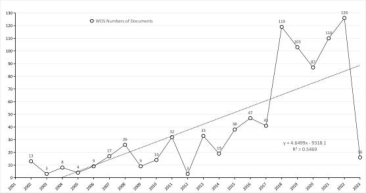
Basic Features The pattern of output change in the development of academic literature over time is an essential measure of trends in research topics. It can be used to assess the research dynamics of the discipline effectively. The retrieved narra- tive design data was cleaned and de-weighted for field extraction and the annual distribution of articles published in the design narrative literature (Figure 1). The WOS publication profile shows that the first article within the search was published in 2002. The development of narrative design research has undergone three stages: the beginning, the development, and the boom. The period 2002–2006 was the start-up phase of the field, with an annual average of about 7 articles and a slow growth rate; the period 2007–2019 was the development phase of the field, when the literature output began to accelerate significantly and fluctuate, with an overall upward trend and an annual average of 39 articles; the period 2020-2023, the field enters a boom period, with an average annual output reaching as many as 85 articles and peaking at 126 articles in 2022. Since 2002-2023, the number of annual arti- cles published has increased from 13 in 2002 to 126 in 2022. Overall, the literature output reflects, to some extent, the evolving research theme of the design narrative, which indicates the growing academic interest in the design narrative.
Performance of Journals A total of 128 active journals were included in the search, listing the top 10 most prolific journals in terms of number of articles published from 2002– 2023 and their respective 5-year IF (Impact Factor), which accounted for 19% of the total number of articles published (Table 1). The No. 1 journal in terms of volume is Teachers College Record, with 74 articles, 648 cita- tions, and an impact factor of 1.553. In contrast, the No. 2 journal is the
A Bibliometrics-Based Study of Visualizing Design Narratives 337
Figure 1: The annual publication volume of design narrative literature. (Author, 2023).
International Journal of Art & Design Education, with 14 articles, 42 cita- tions, and an impact factor of 0.842. The Teachers College Record is the No. 1 journal regarding output and citations, reflecting its influence in design narrative research and its position as a core journal. The distribution of litera- ture sources shows that journal articles are the primary vehicle for narrative design research, and design narrative journals are relatively diverse, cove- ring different directions and disciplines such as design education, narrative design, cultural heritage preservation, games, film, computer graphics, and sustainability, fully reflecting the interdisciplinary nature of design narrative research. Regarding the distribution of highly productive journals, professi- onal art, and design journals are essential for promoting the development of design narrative research. Table 1. Top 10 distribution of design narrative high-yield journals.
Table 1. Top 10 distribution of design narrative high-yield journals.
Table available in the original PDF paper.
5-YIF Journal Title Countries Documents Citations Avg. citations
England 14 42 3 0.842
Teachers College Record USA 74 648 8.757 1.553 International Journal of Art & Design Education USA 12 179 14.917 2.577 Acm Journal on Computing and Cultural Heritage
Australia 12 156 13 4.358
Educational Technology & Society
USA 10 766 76.6 5.370
Games and Culture USA 12 123 10.250 2.312 Ieee Transactions on Visualization and Computer Graphics England 10 57 5.7 4.491 Interactive Learning Environments
England 9 56 6.222 1.908
International Journal of Heritage Studies Taiwan,
7 61 8.714 2.411
Sustainability Switzerland 9 52 5.778 4.089 International Journal of Design
China
338 Zhang
Performance of Authors Authors are the smallest unit of literature output and direct contributors to design narrative research. Author co-citations were studied through VOSvi- ewer to identify the more active scholars in the field worldwide. Through a preliminary analysis of author names, disambiguation of authors, and co-citation analysis, the largest sub-network of author outputs and colla- borations in affective design research was extracted from 2213 authors and 118 collaborative pairs, i.e., a co-authorship map consisting of 118 nodes and 135 links, with the size of a node indicating the number of articles published by that author. The length of links between nodes The length of the nodes is inversely proportional to the frequency of author-pair collaboration. The statistics reveal few highly productive authors; the ten most active authors are Koenitz and Hartmut. (University of Amsterdam, 16 articles, 107 total citations), Roth, Christian (Utrecht University of the Arts, Hong Kong, seven articles, 39 total citations), Arnab, Sylvester (Coventry University, 6 articles, 23 total citations), Daiute, Co. 23), Daiute, Colette (City University of New York, 5, total citations 7), Dubbelman, Teun (University of Applied Scie- nces, Evans, 5, total citations 17), Kreminski, Max (Santa Clara University, 5, total citations 12), Wardrip-Fruin, Noah (, 5, total citations 12), Eladh- ari, Mirjam Palosaari (Stockholm University, 4 articles, total citations 20), Hargood, Charlie (Bournemouth University, 4 articles, total citations 18), Katifori, Akrivi (National Kapodistrian University of Athens, 4 articles, total citations 31). The total citations of the above authors are among the highest in the world, and they can be considered the core authors in the academy’s design narrative research field.
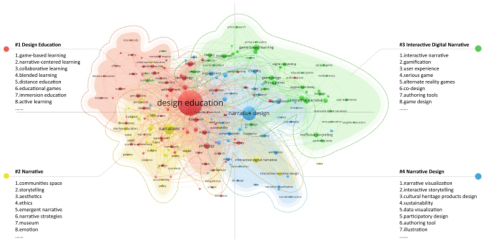
Keywords and Co-Words Analyses The literature keywords greatly distill the authors’ research results, usually including the research object, perspective, and method. The high-frequency co-occurrence of keywords reflects the long-term research hotspots of design narratives. The WOS data was imported into VOSviewer, and the keyword co-occurrence analysis was conducted on 879 papers with a co-occurrence frequency of 4 or more. The keyword co-occurrence clusters of design nar- ratives were obtained by combining and cleaning the synonymous keywords (Figure 2).
The keyword co-occurrence map has 203 nodes and 1,741 lines. based on this, the top-ranked design narrative keyword co-occurrence clusters were grouped into four hot clusters: #1 Design education - narrative-centred edu- cation, #2 Narrative narrative -the theoretical basis of design narrative, #3 Interactive digital narrative - the media presentation of design Narrative, and #4 Narrative design - the ways and means of design narrative. analyzing these four thematic co-occurrence clusters provides insight into the hotspots of design narrative research. The literature is mainly distributed on the themes of “design education” and “narrative-centered education,” combining design narratives with teaching methods, innovation, and reform; in the process of practical application, the application paths are mainly focused on narra- tive design in museums and public spaces; In terms of practical application,
A Bibliometrics-Based Study of Visualizing Design Narratives 339
the main paths of application are in the design of narratives in museums and public spaces, while the media of design are more diverse, covering the design of intangible cultural heritage, participatory design, interactive narratives, as well as collaborative design and digital narratives.
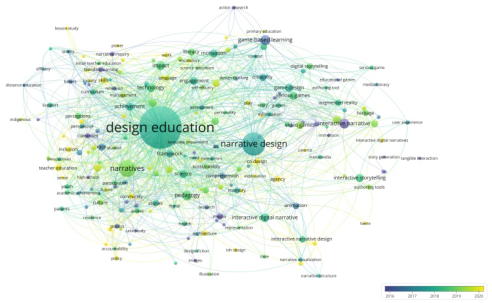
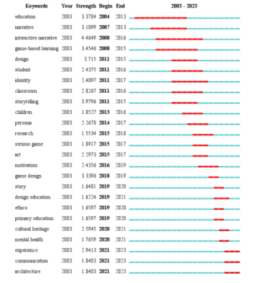
Analysis of the Evolution of Research Hotspots and Cutting-Edge Trends To further explore the cutting-edge development trend of design narrative research, CiteSpace’s BurstTerm mapping (Figure 3) is synthesized in the study, in which the darker part indicates the years with relatively promi- nent keyword citation frequency of papers, reflecting the changing trend of research. This paper categorizes design narrative research into 3 phases: the theory-building period (2003-2016), the practice application period (2017- 2020), and the cross-border exploration period (2021). The top 25 keywords in terms of emergent intensity are listed (Figure 4), and the keywords that emerge in chronological order are Education, Game-based, Serious Game, Interactive, and Ethics. The clustered overlay diagram can be seen that the future research content of design narrative focuses on design education and interactive digital narrative. The research trend shows that the research con- tent is refined and deepened. Different keywords are more closely related to each other better to play the pushing power of the design narrative. In addition to some early research content in this field, such as narrative-based design, education-game-based design is still a hot spot for research. In con- trast, for the modality of design narratives, interactive digital narratives are the focus of future research.
In terms of keyword evolution, in 2003, early research on design narrati- ves was conducted based on narrative theory, such as proposing educational approaches based on narrative theory and storytelling as the leading relevant narrative theory. Since 2017, the research perspective and focus have gradu- ally shifted to research on the practical application of narrative design, such as play-centered narrative education, serious games, and game design. At the same time, the research objects have also shown a trend of expanding from a single children’s education to a more comprehensive primary education, and design education has evolved towards more diversified hybrid teaching and
learning; from 2021 onwards, based on the disciplinary From 2021 onw- ards, design narratives are being explored in a more interdisciplinary way, for example, through design narratives for the preservation of intangible cultural heritage and in conjunction with experiential design. The keyword co-occurrence clustering overlay combined with Burst”s high-density emer- gent terms suggests that future research will focus on design education, with digital interactive narratives, serious games, narrative structural change, and the integration of intangible cultural heritage and narrative design as the main paths to be explored.
Analysis of High-Impact Literature A total of 31,796 valid references from 2,213 scholars were cited in the 879 documents within the search. As some references were cited in pairs, co- citation relationships were formed, and the entire collection of references formed a co-citation network. The co-citation network shows the evolu- tion of design narrative research at a fundamental knowledge level. The co-citation network was constructed by extracting references with a citation
A Bibliometrics-Based Study of Visualizing Design Narratives 341
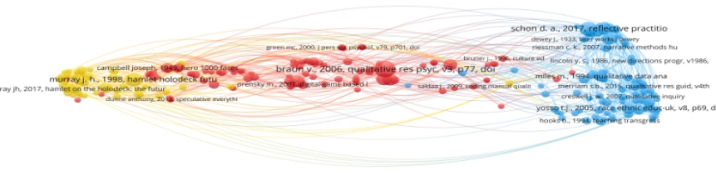
frequency of no less than 5 from 2002 to 2023. The LLR text mining algori- thm generated a document co-citation clustering network of 228 references and 1964 co-citation relationships (Figure 5).
The clustering network shows the authors and publication dates of docu- ments with a citation frequency of no less than 5. The numerous nodes form three main clusters: #1 (yellow) - represented by F. Michael Connelly and D. Jean Clandinin, Ontario Institute for Studies in Education, Toronto, Canada (red) - interdisciplinary research on theoretical approaches to “nar- rative inquiry”; #2 (red) - research on the application of contextual learning in “design education,” represented by Professor Jean Lave and independent researcher Etienne Wenger of the University of California, Berkeley, USA; #3 (red) - research on the application of “narrative inquiry” in “design educa- tion.” (in blue) on the application of “digital narrative design” by Koenitz, Hartmut. of the University of Amsterdam. The KM-CDR-related literature within the search area was ranked according to the total number of citati- ons. Of these highly cited documents, two conference papers were from the International Conference on Interactive Digital Storytelling, two monogra- phs were from MIT Press, and one-third were from books on education and narrative.
Numbers 4,9,13 belong to #1 (yellow cluster), an interdisciplinary study of theoretical approaches to “narrative inquiry.” Number 4, D. Jean Clandinin (2006) provides an overview of narrative inquiry’s historical development and philosophical foundations and describes different forms of narrative inquiry (Clandinin, 2006). No. 9 Chatman, Seymour Benjamin (1980) descri- bes the structuralist theoretical foundations on which classical narratology constructs its conceptual framework, using fiction and film works as refere- nces, and suggests that event and narrative should be the most foundational concepts of modern broad narratology (Chatman, 1980). No. 13 H Koenitz & Kun-Ju Chen (2012) explored the combination of child counseling techni- ques and digital interactive narrative tools, using a combination of “narrative play therapy” to research and analyze children in therapy in order to guide and structure the process (Koenitz & Chen. 2012).
Of the highly cited papers, numbers 1, 2, 3, 5, 10, and 12,15 are in clu- ster #2 (red cluster), i.e., research on the application of contextual learning in Design Education. Lev Vygotsky (2011), number 1, explores the importa- nce of building zones of proximal development (ZPD) to enhance cognition
342 Zhang
and socialization and how to influence learning by creating new opportuni- ties and challenges to promote optimal growth and development (Vygotsky, 2011). No. 2 Jean Lave & Etienne Wenger (1991) studied contextual lear- ning from an anthropological perspective by examining practitioner learning and proposed “Legitimate Peripheral Participation” (LPP), which states that learning should begin with the creation of new opportunities and challenges. (1991), which suggests that learning should be narrativized by engaging in actual activities (Lave & Wenger, 1991). JAMES PAUL GEE, no. 3, propo- ses a way of combining narrative and game learning from the perspective of the game experience (Gee, 2003). No. 5 (Connelly & Clandinin (1990) surveyed forms of narrative inquiry in educational research, outlining the criteria, methods, and forms of writing for designing narratives in educa- tion (Connelly & Clandinin, 1990). No. 10 Michele D. Dickey provides a brief overview of game genres and the role of narrative in the design of popular adventure games and analyses how narrative can support problem- solving in adventure games and design heuristics for constructing narratives for educational purposes (Dickey, 2006). D Charles & M McAlister, no. 12, propose a multimodal, distributed framework for using modern digital games to engage effectively and immerse students in the educational process (Charles & McAlister, 2004). Number 15, Yu Zhonggen used meta-analysis to identify the various factors that influence the effectiveness of challenging games in aiding learning and new developments in using serious games in edu- cation (Zhonggen, 2019). The highly cited literature in this cluster is of great relevance and impetus to developing and refining design narrative research methods and brings many insights to subsequent research.
Numbers 6, 7, 8, 11, and 14 belong to cluster #3 (blue cluster), i.e., “digital narrative design”applied research. Number 6, H Koenitz, presents Interactive Digital Narrative Theory (IDN), providing a broad overview of current issues and future directions in this multidisciplinary field, including humanistic and computational perspectives (Koenitz, 2015). No. 7 Janet H. Murray propo- ses video games as a new form of representation after fiction, drama, and film, exploring interactive storytelling, more generic structures, the story as a game, and games as story themes (Murray, 2017). Number 8 Teun Dub- belman explores the concept of narrative gaming mechanics, revealing how narrative game mechanics invite game agents, including players, to perform actions that support players in constructing fascinating stories and fictional worlds in their materialized minds (Dubbelman, 2016). Eric Zimmerman, no. 11, suggests that games follow “Artificial conflict >Basesonrules > Quantifi- able outcome.” The quantifiable outcome” distinguishes games from “play” and “game-like behavior” and guides the process of user learning and cogni- tion (Tekinbas & Zimmerman, 2003). Zimmerman, 2003). Elizabeth B.-N. et al. (No. 14) suggest that the co-design model suffers from a double flaw of qualitative and quantitative research that ignores the dynamics of qua- lity evaluation and attempts to refine the model in terms of mathematical statistics and stochastic processes (Sanders & Stappers, 2008).
CONCLUSION
This study systematically reviews the literature output in design narrative research in the last 20 years. Sylvester, Daiute, Colette and, Dubbelman,
A Bibliometrics-Based Study of Visualizing Design Narratives 343
Teun are the core authors in the academic community, and design narrati- ves are the main focus of research in the US and UK at leading institutions in engineering-related disciplines. The keyword clustering shows that the hot research themes in design narratives are stable and diverse, as evidenced by the fact that the research themes are generally consistent and form four main research clusters, namely #1 Design Education, #2 Narrative, #3 Interactive digital narrative, #4 Narrative Design. The keyword clustering analysis reve- als that current research emphasizes design education, the learner experience, and a robust interdisciplinary approach. From the keyword co-occurrence clustering overlay network and BurstTerm 2 dimensions, it is concluded that future research on design narrative focuses on design education, with inte- ractive digital narrative, serious games, narrative structural change, and the combination of intangible cultural heritage and narrative design as its main exploration paths. Therefore, the future must continue to strengthen the integration of digital technology and design education, which is the main limitation of design narrative research at this stage. The analysis of the refe- rence co-citation network reveals that design narrative research is still in the developmental exploration stage. In the long development process, the design narrative has drawn on much knowledge from interdisciplinary fields and produced several classical pieces of literature. The research methods include methodological research at the sociology, aesthetics, and philosophy level, as well as theoretical research in engineering techniques such as interaction design, collaborative design, and experience design.
However, this study could only cover some relevant publications worl- dwide and was limited to the WOS core database. This may have led to a need for more selected papers and an under-representation of the literature (Zhonggen, 2019). Some studies of design narrative have been concerned with understanding narrative concepts and terminology, mainly by draw- ing on and referring to narratological theories based on the level of textual analysis. At the same time, less attention has been paid to the claims and mechanisms of narrative ideas and the study of multiple directions. More attention has been paid to the application of design narrative regularity.
REFERENCES
Bal, M. (2009). Narratology: Introduction to the Theory of Narrative (Vol. 1): University of Toronto Press, Scholarly Publishing Division. Charles, D., & McAlister, M. (2004). Integrating ideas about invisible playgrounds
from play theory into online educational digital games. Paper presented at the Entertainment Computing–ICEC 2004: Third International Conference, Eindho- ven, The Netherlands, September 1-3, 2004. Proceedings 3. Chatman, S. B. (1980). Story and discourse: Narrative structure in fiction and film: Cornell university press. Chen, C. (2006). CiteSpace II: Detecting and visualizing emerging trends and
transient patterns in scientific literature. Journal of the American Society for information Science and Technology, 57(3), 359–377. Chen, Y. K., Jiang, Y. H., He, R. K., & Wu, X. T. (2022). Progress, hotspots and trend analysis of bibliometrics-based emotional design research. Packaging Engineering, 43(06), 32–40. doi: 10.19554/j.cnki.1001–3563.2022.06.004.
344 Zhang
Clandinin, D. J. (2006). Handbook of narrative inquiry: Mapping a methodology: Sage Publications. Connelly, F. M., & Clandinin, D. J. (1990). Stories of experience and narrative
inquiry. Educational researcher, 19(5), 2–14. Dickey, M. D. (2006). Game design narrative for learning: Appropriating adventure game design narrative devices and techniques for the design of interactive learning environments. Educational technology research and development, 245–263. Dubbelman, T. (2016). Narrative game mechanics. Paper presented at the Intera-
ctive Storytelling: 9th International Conference on Interactive Digital Storytelling, ICIDS 2016, Los Angeles, CA, USA, November 15–18, 2016, Proceedings 9. Gee, J. P. (2003). What video games have to teach us about learning and literacy.
Computers in entertainment (CIE), 1(1), 20–20. He Xiu Chuan, Bai Leiqiang, & Yang Xiaoyang. (2022). A bibliometric visual analysis of CNKI design narrative research. Packaging Engineering, 1-13. Retrieved from https://kns.cnki.net/kcms/detail/50.1094. TB.20221109.1038.002.html Koenitz, H. (2015). Towards a specific theory of interactive digital narrative. In
Interactive digital narrative (pp.91–105): Routledge. Koenitz, H., & Chen, K.-J. (2012). Genres, structures and strategies in interactive digital narratives–analyzing a body of works created in ASAPS. Paper presen- ted at the Interactive Storytelling: 5th International Conference, ICIDS 2012, San Sebastián, Spain, November 12-15, 2012. Proceedings 5. Lave, J., & Wenger, E. (1991). Situated learning: Legitimate peripheral participation:
Cambridge university press. McDonald, J. D., & Levine-Clark, M. (2017). Encyclopedia of Library and Information Sciences: CRC Press. Murray, J. H. (2017). Hamlet on the Holodeck, updated edition: The Future of
Narrative in Cyberspace: MIT press. Sanders, E. B.-N., & Stappers, P. J. (2008). Co-creation and the new landscapes of design. Co-design, 4(1), 5–18. Tekinbas, K. S., & Zimmerman, E. (2003). Rules of play: Game design fundamentals:
MIT press. Todorov, T. (1973). Gramática del Decamerón (Vol. 1): Taller de Ediciones, Josefina Betancor. Van Eck, N., & Waltman, L. (2010). Software survey: VOSviewer, a computer
program for bibliometric mapping. scientometrics, 84(2), 523–538. Vygotsky, L. (2011). Interaction between learning and development: Linköpings universitet. Zhonggen, Y. (2019). A meta-analysis of use of serious games in education over a
decade. International Journal of Computer Games Technology, 2019.
LISTED IN THE AHFE DIGITAL BOOKSTORE CATALOGUE
Explore the complete digital volume
Usability and User Experience
Read this individual research paper free through the original publisher, or explore the full digital proceedings book.
ISBN 978-1-958651-86-5
Explore this ISBN in the AHFE Bookstore ↗Listed in the July 2026 bookstore catalogue; search by ISBN to confirm current availability · Digital book purchase optional