Yue Cao (2023). The application of co-design in service design: a bibliometric analysis of 2018-2022. In: Usability and User Experience. AHFE Open Access, vol. 110, pp. 598–607. https://doi.org/10.54941/ahfe1003236
In recent years, a substantial body of literature has emerged due to the widespread application of Co-design in Service Design Research (hereafter referred to as Co-SDR). However, there is currently no comprehensive literature review on Co-SDR. To further promote the development of service design and Co-design as a tool for innovation, it is crucial to comprehensively summarize and analyse the relevant research, particularly its current state over the past five years. Furthermore, the existing research literature in the field of Co-SDR is extensive, spanning across diverse disciplines and fields of knowledge, and the research content and perspectives are complex. As such, traditional methods of literature review may not be adequate in capturing the current research hotspots and development dynamics. The search strategy of using TS= ((co-design OR collaborative design) AND (service design)) in the Web of Science (WOS) core database was adopted in this study. The three major citation indexes commonly used in the WOS database, namely the Social Sciences Citation Index (SSCI), the Science Citation Index (SCI), and the Arts and Humanities Citation Index (A&HCI), were chosen as the search sources. The search spanned from 2018 to 2022 to examine the development dynamics and current status of research in the last five years. To avoid the loss of interdisciplinary literature, the sources were not streamlined. A total of 880 articles were selected and used for further quantitative analysis. To obtain more rigorous and comprehensive data indicators, the study employed VOSviewer, a bibliometric visualization software that uses a scientific bibliometric approach to empirically analyse the retrieved data. Bibliometrics refers to the quantitative analysis of various types of bibliographic data to identify potential patterns and information in the vast amount of bibliographic data available. This approach was first proposed by Pritchard in 1969. The analysis reveals that Co-SDR research output has increased significantly in the past two years. Few countries/regions, institutions, and scholars demonstrate high productivity, and research collaborations tend to be institutionally dominated and fragmented.The keyword clustering analysis shows that Co-SDR research is comprehensive and multidisciplinary, with four primary categories: #1 Healthcare Design, #2 Research Methodology, #3 Participatory Design of Public Services, and #4 Design Assessment. Together, these clusters form the hotspots of Co-SDR research, including service design methods and evaluation, user interaction, experience and co-design processes, reflecting a strong inclusive character and emphasising "user-centredness."The reference co-citation network analysis reveals that Co-SDR research is relatively mature, and the field has produced a body of classic literature. The research methodology is primarily a user-centred participatory approach, using specific quantitative evaluation metrics for service design, with the aim of improving services through co-design. Research theories include value co-creation, experience-based co-design, technical co-design, and planning studies, which have played an essential role in driving the development of subsequent research on Co-SDR.
The term Service Design (SD) first appeared in 1991 in the book “Total Design”by Bill and Mrs Hollins on design management (Xin and Cao, 2014). Service design is an activity that aims to enhance user experience and service quality by strategically planning and coordinating the various components involved in a service, including people, facilities, communication, materials, and processes (Wang et al., 2021). In the field of design, various concepts such as Collaborative Design, Co-design, and Participatory Design are commonly employed and can be collectively referred to as ‘co-design’ for the purposes of this discussion. Co-design places emphasis on a novel interpretation of the concept of ‘human-centred’ design, wherein the focus shifts from ‘designing for the user’ to ‘designing with the user’. The user is no longer considered
The Application of Co-Design in Service Design: A Bibliometric Analysis of 2018-2022 599
solely as an object to be studied but instead becomes actively involved in the decision-making process of a product or service, in a role similar to that of a designer (Xin and Wang, 2018).
In the design process of service design, designers often encounter numerous challenges that cannot be resolved by the design profession alone and may need to involve researchers from diverse disciplines in co-design workshops to collaboratively address issues arising from service innovation. Co-design can therefore be utilized as a design methodology to enhance the feasibility and effectiveness of service design.
In recent years, a substantial body of literature has emerged due to the widespread application of Co-design in Service Design Research (hereafter referred to as Co-SDR). However, there is currently no comprehensive lite- rature review on Co-SDR. To further promote the development of service design and Co-design as a tool for innovation, it is crucial to comprehensively summarize and analyse the relevant research, particularly its current state over the past five years. Furthermore, the existing research literature in the field of Co-SDR is extensive, spanning across diverse disciplines and fields of knowledge, and the research content and perspectives are complex. As such, traditional methods of literature review may not be adequate in capturing the current research hotspots and development dynamics. To address this, quantitative analysis of the existing literature through scientific bibliometric methods can provide a more accurate understanding of the current state of research in Co-SDR, objectively analyse the patterns and connections underl- ying the literature data in this field and provide a comprehensive reference for scholars researching in this field.
STUDY DESIGN
DATA SOURCES As high-quality scientific literature is subject to rigorous peer review and scrutiny by published journals, its findings are more representative of the discipline. Therefore, the search strategy of using TS = ((co-design OR collaborative design) AND (service design)) in the Web of Science (WOS) core database was adopted in this study. The three major citation indexes commonly used in the WOS database, namely the Social Sciences Citation Index (SSCI), the Science Citation Index (SCI), and the Arts and Humanities Citation Index (A&HCI), were chosen as the search sources. The search span- ned from 2018 to 2022 to examine the development dynamics and current status of research in the last five years. To avoid the loss of interdiscipli- nary literature, the sources were not streamlined. The search results were exported as txt files in the format of “full records with cited references.” Subsequently, articles that did not pertain to the research topic, lacked crucial field information such as time, keywords, authors, and other key informa- tion, or contained duplicate data were excluded. A total of 880 articles were selected and used for further quantitative analysis.
RESEARCH METHODOLOGY To obtain more rigorous and comprehensive data indicators, the study emplo- yed VOSviewer, a bibliometric visualization software that uses a scientific
600 Cao
bibliometric approach to empirically analyse the retrieved data. Bibliometrics refers to the quantitative analysis of various types of bibliographic data to identify potential patterns and information in the vast amount of bibliogra- phic data available. This approach was first proposed by Pritchard in 1969 (Chen et al., 2022). VOSviewer is a citation analysis JAVA program that combines database and analysis software to derive key points, establish rela- tionships between units of knowledge in the literature and illustrate areas of scientifically mapped knowledge (Tan et al., 2021). VOSviewer has advanced graphical representation capabilities and is well-suited for locating the focus and hotspots of research topics in large-scale data (Van Eck and Waltman, 2010).
LITERATURE MEASUREMENT RESULTS AND ANALYSIS
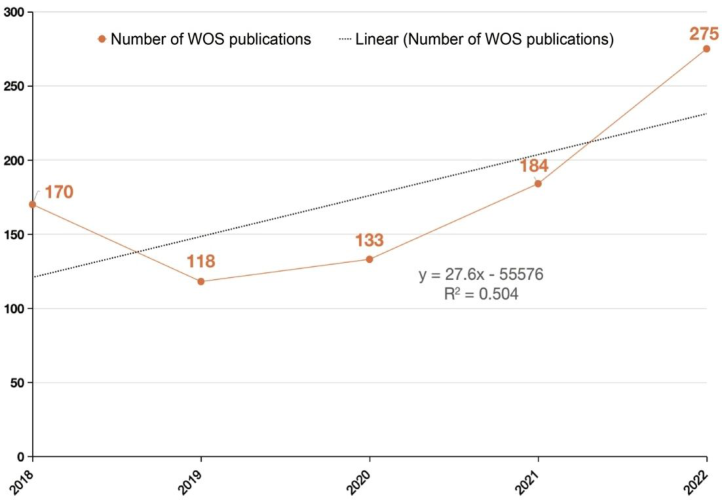
ANALYSIS OF THE VOLUME OF ARTICLES PUBLISHED The pattern of change in statistical academic literature output over time is a crucial method for measuring trends in research topics and can effectively assess the research dynamics of the discipline (Li et al., 2019). The retrieved data were cleaned and de-duplicated, and the fields were extracted to obtain Figure 1. As seen from the volume curve and trends in Figure 1, global resea- rch on Co-SDR decreased in 2018–2019 but showed a steady upward trend from 2019-2022, with the peak yet to appear. This indicates that the research field has not yet reached maturity. From 2018-2022, the average annual out- put of literature on Co-SDR in the research field was 176 articles/year, with
Figure 1: A distribution map of the annual publication volume of Co-SDR literature. (Self-illustrated by author).
The Application of Co-Design in Service Design: A Bibliometric Analysis of 2018-2022 601
the output of literature in the last two years being higher, reaching 184 article- s/year in 2021 and exceeding 200 articles in 2022, reaching 275 articles/year, with a fast growth rate. This indicates that the research in this field is still in the development period, and the enthusiasm of domestic and international academics for this research topic will continue to grow in the future. Furth- ermore, the attention given to this research field will continue to increase, leading to an increase in the number of articles published.
DISTRIBUTION OF LITERATURE BY COUNTRY AND RESEARCH INSTITUTION The dataset provides valuable insights into the distribution of publications and citations by country/region, shedding light on the high-producing coun- tries in the research field and their impact. The data indicates that a total of 104 countries/regions across the globe are contributing to this research area, with the top 10 countries accounting for over 69.01% of the total number of publications.
Australia has emerged as the leading country in Co-SDR research, contri- buting 284 publications, which represents 20.6% of the total publications in this field. Australia and the UK stand out among the top 10 countries in terms of volume, with both exceeding 200 articles. The research collabo- ration network highlights Australia and the UK as the leading countries in terms of both publications and citations, and thus, they can be regarded as the primary contributors in this research area.
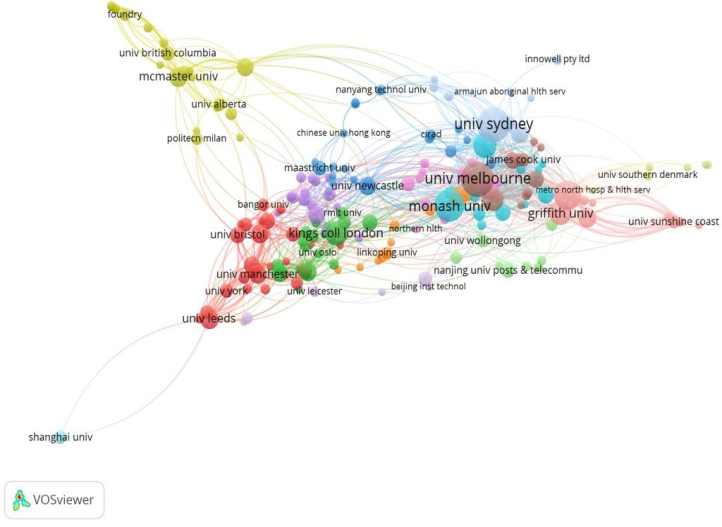
Figure 2: Cooperative institutions co-occurrence network. (Self-illustrated by author).
602 Cao
The dataset also highlights that 1,716 research institutions worldwide are actively engaged in the application of co-design in service design from 2018-2022. In order to obtain a collaborative network of organizations, the VOSviewer software was employed. Specifically, the “Organizations” option was selected, and the node threshold was set to 3. As a result, the generated network consisted of 197 nodes, which represent distinct organizations, and 1432 partnerships, reflecting the collaborative relationships between them. These findings are illustrated in Figure 2. Notably, the international colla- boration on the application of co-design in service design is relatively close, with the University of Melbourne, King’s College London, and McMasters University being the primary institutions. These high-impact research insti- tutions form three large collaborative subgroups within the search, with the University of Melbourne leading the ranking with 49 articles, followed by the University of Sydney with 48 articles, Monash University with 41 articles, the University of Queensland with 34 articles, and the University of New South Wales with 25 articles.
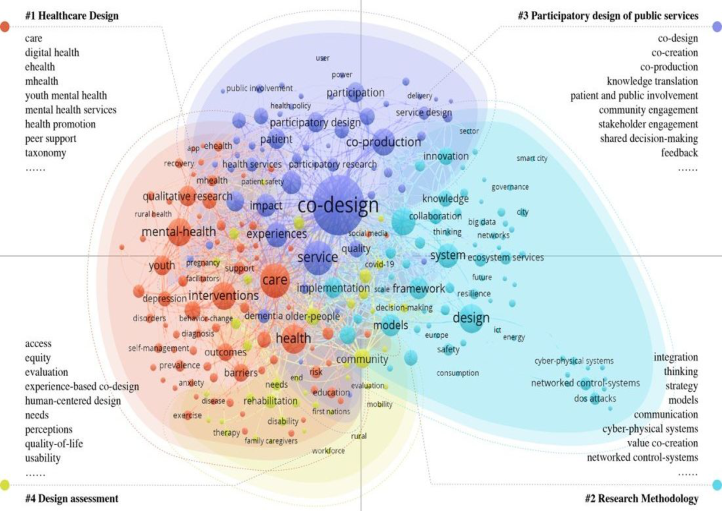
ANALYSIS OF RESEARCH HOTSPOTS AND FRONTIER TRENDS Within the designated search area, a total of 880 documents were analysed, yielding 4839 distinct keywords. In order to identify clusters of related keyw- ords, a frequency threshold of 5 was applied to the dataset using Vosviewer software. Following the filtering and merging of synonymous keywords, a total of 245 distinct keyword clusters were identified and visualized in Figure 3. Notably, keywords sharing the same colour denote membership within the same cluster, with four overarching clusters being discernible. These clusters include: #1 Healthcare Design, #2 Research Methodology, #3 Participatory Design of Public Services, and #4 Design Assessment.
Cluster #1 - Healthcare Design comprises a total of 78 members, pre- dominantly in the areas of digital health, ehealth, mhealth, mental health services, care, youth, women, child, aboriginal, and gamification. By com- bining the high-frequency keywords, the research hotspot of Cluster 1 is centred on the application of co-design in healthcare service design. The pluralistic design objects of women, adolescents, children, and aboriginal groups present a strong inclusive perspective. To implement person-centred care in health and social care services, stakeholders must be involved in join- tly designing a robust, secure, and scalable digital solution that can provide more efficient and integrated care solutions for older people (Sanz et al., 2021). Co-design is a crucial step in improving user-centred interventions, and e-health interventions co-designed by children and young people, such as computer games for children’s anxiety and self-monitoring apps for young people’s stress, can make interventions more engaging, satisfying, and use- ful (Thabrew et al., 2018). Experience-based co-design puts the voice of the service user at the heart of improving healthcare and can be effective in impro- ving mental health services through collaborative redesign between service users and staff (Cooper et al., 2016). The COVID-19 pandemic has seve- rely impacted traditional face-to-face co-design activities, and in this context, gamification has been proposed as a promising approach to facilitate online
The Application of Co-Design in Service Design: A Bibliometric Analysis of 2018-2022 603
Figure 3: Keywords co-occurrence clustering network. (Self-illustrated by author).
co-design activities in an enjoyable, relaxing, and creative way (Zhang et al., 2022). Cluster #2 - Research Methodology comprises a total of 70 clusters, mainly consisting of big data, collaboration, communication, value co-creation, inte- gration, and smart city. The rise of big data and data science has prompted a focus on data and its representation through co-design. This has enabled professionals outside the fields of computing and data science to under- stand and think critically about data and data availability in design (Seidelin et al., 2020). The human-centred co-design approach repositions service design from the developmental stage as an approach to service innovation that centres on understanding and engaging with the client’s own value- creating practices. This enables the co-creation of value in the design process (Wetter-Edman et al., 2014). Smart city is broadly defined as exploring the ways in which urban spaces are being recreated as a result of new techno- logies and/or digital intrusions are re-made in a way that engages the public in the study of smart cities. The co-design approach has been found to be effective in stimulating users’ concerns, needs, and ideas for new information systems (Bell et al., 2018).
Cluster #3 - Participatory Design of Public Services comprises a total of 56 clusters, mainly containing co-design, participatory design, co-production, design thinking, public-services, and stakeholder engagement. Co-design is often used as an umbrella term for participatory, co-creative and open design processes (Wang et al., 2021). Participatory design (PD) is rooted in the
604 Cao
Scandina-style approach to systems design and is often categorised as ‘colla- borative design’, emphasising the role of designers and users in improving the quality of life at work (Halskov and Hansen, 2015). The value of involving users and different stakeholders in the design process is further understood and valued as collaborative design and participatory design processes are increasingly being used with success in different fields (Kerr et al., 2022). Design thinking, one of the high-frequency words in this cluster, is recognised as a way of thinking and a process for design, business innovation, and vari- ous complex problem-solving tasks (Kim and Park, 2021). Co-production is understood as the process by which “citizens can play an active role in producing public goods and services that affect them” (Ostrom, 1996). Co-production and co-design practices are increasingly being promoted for the development of user-centred public services (Farr, 2018).
Cluster #4 - Design assessment contains a total of 41 cluster mem- bers, mainly containing access, equity, human-centred design, needs, quality-of-life, scoping review, service delivery, usability, etc. Most of the high-frequency words in this cluster belong to design evaluation criteria in the service design research system, such as needs, service delivery, quality-of-life, usability, etc. Therefore, this cluster can be characterized as design asses- sment in service design. In design research, human-centered approaches have been linked to participatory co-design, which supports and enhances human skills while focusing on human values in iterative design and implementation (Holeman and Kane, 2020). To reflect human-centered, experience-based design solutions, specific quantitative assessment metrics are used to co- design with users, based on statistical analysis of their experiences and needs for services.
THEORETICAL FOUNDATIONS OF THE CO-SDR STUDY In terms of theoretical foundations, the Co-SDR study identified 38,103 valid references from 28,520 scholars among the 880 documents searched. These references were used to construct a co-citation network, which demon- strates the evolution of Co-SDR research at the basic knowledge level. VOSviewer was used to generate a co-citation network of 240 references and 4,968 co-citation relationships, which were extracted from references with a citation frequency of no less than 5 in 2018-2022. The top 10 co-cited clas- sics, as shown in Table 1, form the most significant knowledge base for the Co-SDR study.
The most frequently cited article in the literature is the 2006 work by Paul Bate and Glenn Robert. This article focuses on the emerging discipline of design sciences and experience-based design, proposing that the integration of users into the design process and attention to their movement through and interaction with the various parts of a service can achieve the common goal of making services ‘more comfortable’ for users (Bate and Robert, 2006). The paper argues that users should move from being passive recipients to active participants in the improvement and innovation process. This article has had a significant impact on subsequent research into user participatory design.
The Application of Co-Design in Service Design: A Bibliometric Analysis of 2018-2022 605
Table 1. A total of the top 10 classical literature cited (Note: Tls = Total link strength; TC = Total Citations.).
Table available in the original PDF paper.
No. Title Sources Time Tls TC Qual Saf Health Care 2006 335 46 1 Experience-based design: from redesigning the system around the patient to co-designing services with the patient
The Design Journal 2015 389 44
2 Experience-based Co-design and Healthcare Improvement: Realizing Participatory Design in the Public Sector
2008 246 37
3 Co-creation and the new landscapes of design CoDesign: International Journal of CoCreation in Design and the Arts King’s College London 2014 315 35 4 Using Experience-based Co-design (EBCD) to improve the quality of healthcare: mapping where we are now and establishing future directions
The Milbank Quarterly 2016 212 31
5 Achieving Research Impact Through Co-creation in Community-Based Health Services: Literature Review and Case Study
2011 229 28
6 Benefits of Co-design in Service Design Projects International Journal of Design
2012 211 26
7 Improving healthcare through the use of co-design
THE NEW ZEALAND MEDICAL JOURNAL CRC Press 2007 173 24
8 Organizing for Quality: The Improvement Journeys of Leading Hospitals in Europe and the United States
2018 238 24
MEDICAL HUMANITIES
9 The Participatory Zeitgeist: an explanatory theoretical model of change in an era of coproduction and codesign in healthcare improvement
2015 224 24
10 Patients and staff as codesigners of healthcare services
BMJ-BRITISH MEDICAL JOURNAL
The second most cited article is by Sara Donetto et al. published in The Design Journal in 2015. This article discusses the strengths and challenges of experience-based co-design (EBCD) as a participatory research method applied to healthcare delivery. The co-design process becomes part of a reconfiguration of power relations between citizens and public services, allo- wing healthcare professionals and patients to renegotiate their roles and expectations in the co-design process (Donetto et al., 2015).
The third most cited is Elizabeth et al’s 2008 publication ‘Co-creation and the new landscapes of design’, which refers to the scale or complexity of the human-centred design approach that began in the 1970s as a failure to address the challenges faced today. Design research has evolved from a user-centred approach to co-design. The evolution of design research has cre- ated a new field of co-creation, where ‘users’ can be co-designers throughout the design process. The level of expertise, enthusiasm, and creativity of the ‘user’ determines whether or not everyone can be a designer. This evolution has changed the face of design practice, and new landscapes of design and research are constantly changing in space and time (Sanders and Stappers, 2008). The bulk of the remaining top ten highly cited works expound about co-design within the domain of healthcare delivery systems, including but not
606 Cao
limited to experience-based co-design (EBCD) and mental health co-design (MH ECO). A meticulous examination of these concepts and relevant case studies indicates that, in healthcare settings, co-design connotes the colla- borative efforts of patients and caregivers with healthcare professionals to enhance services. It is incumbent upon patients to engage in more protracted and direct involvement in identifying, executing, and assessing improvements in healthcare services (Robert et al., 2015).
CONCLUSION AND DISCUSSION The analysis reveals that Co-SDR research output has increased significan- tly in the past two years. Few countries/regions, institutions, and scho- lars demonstrate high productivity, and research collaborations tend to be institutionally dominated and fragmented.
The keyword clustering analysis shows that Co-SDR research is compre- hensive and multidisciplinary, with four primary categories: #1 Healthcare Design, #2 Research Methodology, #3 Participatory Design of Public Servi- ces, and #4 Design Assessment. Together, these clusters form the hotspots of Co-SDR research, including service design methods and evaluation, user interaction, experience and co-design processes, reflecting a strong inclusive character and emphasising “user-centredness.”
The reference co-citation network analysis reveals that Co-SDR research is relatively mature, and the field has produced a body of classic literature. The research methodology is primarily a user-centred participatory appro- ach, using specific quantitative evaluation metrics for service design, with the aim of improving services through co-design. Research theories include value co-creation, experience-based co-design, technical co-design, and plan- ning studies, which have played an essential role in driving the development of subsequent research on Co-SDR.
ACKNOWLEDGMENT
The author sends thanks to the guest editors and all anonymous reviewers for valuable comments and suggestions.
REFERENCES
Bate, P. & Robert, G. 2006. Experience-based design: from redesigning the system around the patient to co-designing services with the patient. BMJ quality & safety, 15, 307–310. Bell, S., Benatti, F., Edwards, N. R., Laney, R., Morse, D. R., Piccolo, L. & Zanetti,
O. 2018. Smart cities and M 3: Rapid research, meaningful metrics and co-design. Systemic Practice and Action Research, 31, 27–53. Chen, Y., Jiang, Y., He, R. & Wu, X. 2022. Emotional Design Trends and Research Progress: A Scientometric Analysis-Based Study. PACKAGING ENGINEERING, 43, 32–40. Cooper, K., Gillmore, C. & Hogg, L. 2016. Experience-based co-design in an adult
psychological therapies service. Journal of Mental Health, 25, 36–40.
The Application of Co-Design in Service Design: A Bibliometric Analysis of 2018-2022 607
Donetto, S., Pierri, P., Tsianakas, V. & Robert, G. 2015. Experience-based co-design and healthcare improvement: realizing participatory design in the public sector. The Design Journal, 18, 227–248. Farr, M. 2018. Power dynamics and collaborative mechanisms in co-production and
co-design processes. Critical Social Policy, 38, 623–644. Halskov, K. & HANSEN, N. B. 2015. The diversity of participatory design research practice at PDC 2002–2012. International Journal of Human-Computer Studies, 74, 81–92. Holeman, I. & Kane, D. 2020. Human-centered design for global health equity.
Information technology for development, 26, 477–505. Kerr, J., Whelan, M., Zelenko, O., Harper-Hill, K. & Villalba, C. 2022. Integrated co-design: A model for co-designing with multiple stakeholder groups from the ‘fuzzy’front-end to beyond project delivery. International Journal of Design, 16, 75–90. Kim, Y. S. & Park, J. A. 2021. Design thinking in the framework of visual thinking
and characterization of service design ideation methods using visual reasoning model. The Design Journal, 24, 931–953. Li, J., Liu, J., Wang, J. & Feng, C. 2019. Academic map of fire safety science based on the Fire Safety Journal. Fire Science and Technology, 38, 1760–1765. Ostrom, E. 1996. Crossing the great divide: coproduction, synergy, and development.
World development, 24, 1073–1087. Robert, G., Cornwell, J., Locock, L., Purushotham, A., Sturmey, G. & Gager, M.
2015. Patients and staff as codesigners of healthcare services. Bmj, 350. Sanders, E. B.-N. & Stappers, P. J. 2008. Co-creation and the new landscapes of design. Co-design, 4, 5–18. Sanz, M. F., Acha, B. V. & GarcÍA, M. F. 2021. Co-design for people-centred care
digital solutions: a literature review. International Journal of Integrated Care, 21. Seidelin, C., Dittrich, Y. & Grönvall, E. 2020. Foregrounding data in co-design–An exploration of how data may become an object of design. International Journal of Human-Computer Studies, 143, 102505. Tan, H., Sun, J., Wenjia, W. & Zhu, C. 2021. User experience & usability of driving:
A bibliometric analysis of 2000–2019. International Journal of Human–Computer Interaction, 37, 297–307. Thabrew, H., Fleming, T., Hetrick, S. & Merry, S. 2018. Co-design of eHealth interventions with children and young people. Frontiers in psychiatry, 9, 481. Van Eck, N. & Waltman, L. 2010. Software survey: VOSviewer, a computer program
for bibliometric mapping. scientometrics, 84, 523–538. Wang, Y., Xin, X., Yu, H. & Luo, J. 2021. Visualization analysis of service design literature metrology. Journal of Nanjing Arts Institute (Fine Arts & Design), 99–105. Wetter-Edman, K., Sangiorgi, D., Edvardsson, B., Holmlid, S., Grönroos, C. &
Mattelmäki, T. 2014. Design for value co-creation: Exploring synergies between design for service and service logic. Service Science, 6, 106–121. Xin, X. & Cao, J. 2014. Service design drives public affairs management and organizational innovation. DESIGN, 124–128. Xin, X. & Wang, X. 2018. Co-Creation and Uncertainties of Experiences in Service
Design. ZHUANGSHI, 74–76. Zhang, Z., Patricio, R., Carella, G. & Zurlo, F. 2022. Supporting a sustainable and engaging online transition for Co-design through gamification. Sustainability, 14, 6716.
LISTED IN THE AHFE DIGITAL BOOKSTORE CATALOGUE
Explore the complete digital volume
Usability and User Experience
Read this individual research paper free through the original publisher, or explore the full digital proceedings book.
ISBN 978-1-958651-86-5
Explore this ISBN in the AHFE Bookstore ↗Listed in the July 2026 bookstore catalogue; search by ISBN to confirm current availability · Digital book purchase optional