Qianfei Chen, Mengxiu Wang, Jingwen Xie (2023). The influence of button size on operation performance in long - term closed and isolated environment. In: Human Systems Engineering and Design (IHSED 2023): Future Trends and Applications. AHFE Open Access, vol. 112, pp. 127–132. https://doi.org/10.54941/ahfe1004122
Long-term isolation in a closed environment will lead to fluctuations in users' cognition and operation to a certain extent. As the basic controls of touch control system, the size of the button also has a significant impact on operation performance. In view of the special operation environment of long-term isolation and sealing, this study conducted a study on the influence of button size on operation performance in the long-term isolation and sealing environment. Seven buttons of different sizes were selected, and under a long-term closed isolation environment, with 12 days as an experimental cycle, 7 consecutive ergonomic experiments were carried out, with task performance as the main indicator. The experimental results show that in the long-term airtight isolation scenario, the minimum recommended size of the touch screen interface button is 16mm. The larger the button size, the better the operation performance, and there is no significant relationship with the airtight isolation time. The conclusion of this study can provide scientific support for the size design of touch control interface in long-term closed and isolated environment.
Long-term isolation and airtight special operating environment will lead to a certain degree of fluctuations in users’ cognition and operation (Shi, Y et al., 2018). As the basic control of the touch control system, the size factor of the button also has a significant impact on the operation performance. Many scholars have studied the relationship between control size and performance. Wang Wenlin et al., found that control size has a significant impact on the accuracy of click operations (Wenlin Wang et al., 2011). Zhang Bei et al.’s, research shows that the minimum recommended size of interface controls in touch devices is 6.25mm, and the larger the control size is, the higher the operation performance is (Bei Zhang et al., 2020).
In order to improve the efficiency of personnel operating the touch con- trol system in a long-term closed isolation environment, combined with the
above research results, for the long-term isolation and closed operation envi- ronment, a study on the impact of button size on the operation performance in a long-term isolation and closed environment was carried out. Controls are the research object, and ergonomic experiments are carried out to study the relationship between button size and operational performance in a long-term airtight and isolated environment, and provide scientific support for the size design of touch controls on the interface in a long-term airtight and isolated environment.
EXPERIMENTAL METHOD Experimental Environment and Equipment
The experiment was carried out in a closed isolation laboratory, using a computer to control the stimulus presentation and recording of the subjects’ responses. The display was a liquid crystal touch screen display (resolution of 1920*1080, refresh rate of 60Hz) and a viewing distance of 60cm.
Experimental Variable Design The variable in this experiment is the size of the button. A total of 9 dif- ferent sizes of 6.25mm, 9.5mm, 12.75mm, 16mm, 19.25mm, 22.5mm and 25.75mm were selected. The dependent variables of the experiment are the correct click rate and correct click time of the subjects.
The control variables of the experiment include lighting, display resolution, control display range, color and shape of the control, etc.
Subject and Experiment Period Six male subjects were selected for this study. None of them had color blind- ness or color weakness, visual acuity or corrected visual acuity above 5.0, and all of them were right-handed. The experiment was conducted every 12 days for a total of seven times.
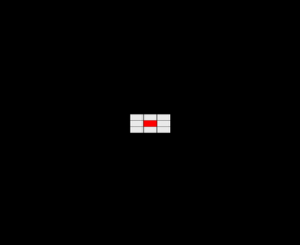
Experiment Content and Task The experimental operation area is displayed in full screen, the background color is dark gray (20.20.20), the button color is light gray (230.230.230), and the target button color is red (255.0.0). In the experiment, the program will present a group of buttons in the central area of the screen. The number of buttons is 9, which are closely arranged in the form of 3 rows and 3 columns. The button size is a random one of the 9 control sizes described in Section 1.2. The target button is a random one of the 9 buttons. Throughout the experiment, each size button is guaranteed to appear twice in total at any position in the 9-grid.
After each click of the test subject, all the buttons on the screen are cleared, and the “Next” button is clicked to start the next experimental operation (see Figure 1).
The Influence of Button Size on Operation Performance 129
Figure 1: Experimental interface diagram.
The task of the subject is to touch and click the required target button as soon as possible under the premise of ensuring the correctness according to the experimental process and requirements.
Experiment Process After the subjects entered the laboratory, they first adjusted the sitting posi- tion, and adjusted the seat height to keep the operator’s eye height at about 105cm and the sight distance at 60cm. At the beginning of the experiment, the instruction language is first dis- played in the middle of the screen, and the subjects fill in the relevant information according to the experimental requirements. Then, under the requirements of the experimental instruction manual, they conduct 7 practice experiments according to the experimental requirements. Try to be famil- iar with the experimental process, and enter the formal experiment after the practice is completed.
In the formal experiment, the operator responded with the index finger of the right hand, and the subjects completed the task according to the prompts. The experiment was carried out every 12 days. In the whole experiment, each subject completed a total of 126 judgments (7 days * 18 times).
EXPERIMENTAL RESULTS React Time on Click of Buttons of Different Sizes
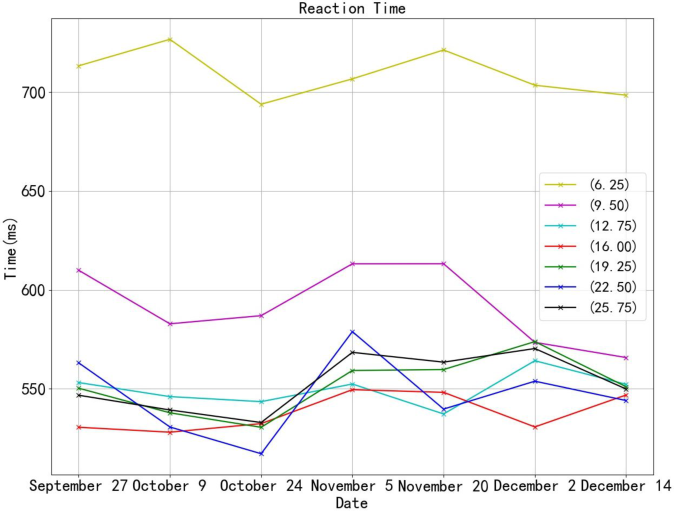
The experimental results show that the length of closed isolation time has no significant influence on the response time of button clicking of various sizes (F = 0.16, P = 0.98) (see Figure 2).
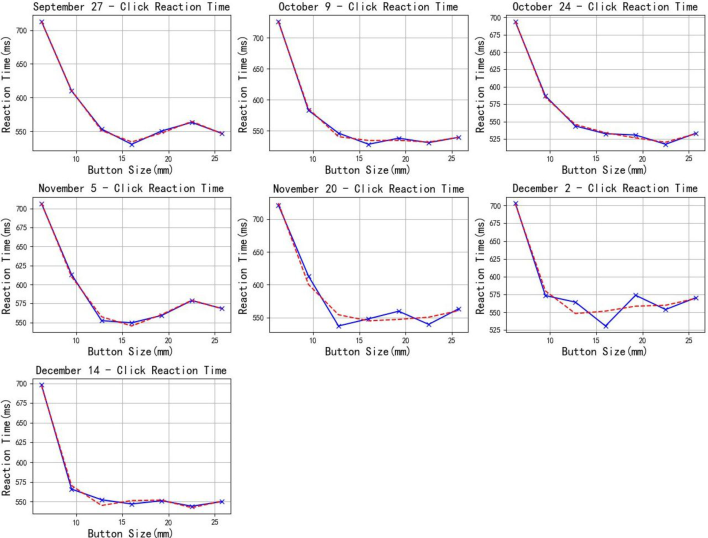
On the same date, the click response time of buttons of different sizes is analyzed. The experimental results show that the response time of the control is the longest when the size of the control is 6.25mm, and then the response time of the control operation basically shows a trend of decreasing with the increase of the size of the control. One-way analysis of variance was per- formed on the click responses of icons of different sizes in each time period. The results showed that the main effect was significant. Combined with the analysis of goodness of fit, it was concluded that after the size was 16 mm, the difference gradually became smaller (see Figure 3).
Figure 2: React time on click of buttons of different sizes.Figure 3: Click reaction time of different buttons on the same date.
The Influence of Button Size on Operation Performance 131
Table 1. Sample human systems integration test parameters.
Table available in the original PDF paper.
Date Fitting Equation R2 F P September 27 y = −0.004906 x4 + 0.2195 x3 −1.526 x2 − 38.9 x + 969.7 0.9988 79.50 <0.01
October 9 y = 0.008661 x4 −0.6571 x3 + 18.45 x2 − 227.4 x + 1574 0.9970 60.30 <0.01 October 24 y = 0.007457 x4 −0.5404 x3 + 14.61 x2 − 177.1 x + 1351 0.9983 77.65 <0.01
November 5 y = −0.00374 x4 + 0.1498 x3 −0.1178 x2 − 48.59 x + 984.6 0.9971 105.36 <0.01 November 20 y = 0.005761 x4 −0.4551 x3 + 13.47 x2 − 176.1 x + 1401 0.9711 73.88 <0.01
December 2 y = 0.008569 x4 - 0.648 x3 + 18.01 x2 − 216.5 x + 1497 0.9461 102.14 <0.01 December 14 y = 0.01223 x4 - 0.8841 x3 + 23.26 x2 − 263.5 x + 1633 0.9948 99.07 <0.01
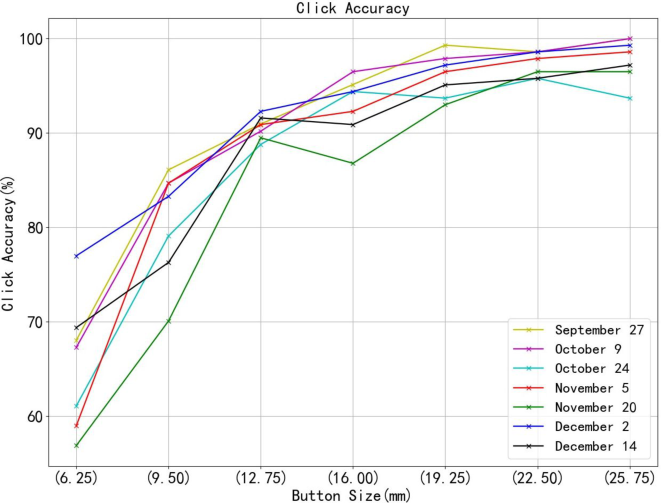
Experimental Environment and Equipment The click correct rate of different button sizes is analyzed, and the experi- mental results show that the click correct rate of the seven controls has little difference at all time points, and does not show a decrease with the increase of airtight isolation time; within the same time point, When the size of the control is 6.25mm, the accuracy rate is the lowest, and then the click accu- racy rate of the control shows a rising trend with the increase of the size. After 16mm, the accuracy rate tends to be stable (see Figure 4).
Figure 4: Click accuracy of buttons of different sizes.
DISCUSSION
The results of this experiment show that the length of the airtight isolation time has no significant effect on the click response of each size button, and the response curve tends to be stable when the control size is above 16mm, indicating that 16mm is a dividing line, and the operation performance is poor if it is smaller than 16mm, and greater than or equal to 16mm is the acceptable range of performance, and the control operation response basi- cally shows a decreasing trend with the increase of the control size, that is, the larger the control size, the larger the operation area, and the higher the operation performance.
In terms of correct rate, the correct rate of clicks for all sizes of controls did not show a decrease with the increase of airtight isolation time, which may be caused by less content on the interface, relatively simple test tasks, and low complexity. In addition, the click accuracy rate of controls shows a trend of increasing gradually with the increase of size. After 16mm, the accuracy rate tends to be stable.
CONCLUSION
According to the experimental results, in a closed and isolated environment for a long time, the minimum size of the touch screen control is recommended to be 16mm. If the control has high requirements on operation efficiency and security, the control size can be increased according to actual service requirements to meet the actual requirements.
ACKNOWLEDGMENT
This study was supported by the projects with No. 509120201054.
REFERENCES
Bei Zhang, Ning Li, Yingwei Zhou. (2020). Study on The Influence of Touch Screen Button Size on Operation Performance. Man-Machine-Environment System Engi- neering, Springer, Singapore. pp. 637–643. Shi, Y. Jing, X. Tong, F. Hu, Y. Sun, H. & Tian, L. et al. (2018). Research on adaptive
process of crew’s affect and cognition during 4-person 180-day celss integrated experiment. Space Medicine & Medical Engineering. Wenlin Wang. (2011). The influence of the button size and spacing of the touch screen phone keyboard on the operation accuracy. National Taiwan University of Science and Technology Design Institute. Xiaoyan Zhang, Hongjun Xue, Yuggang Zhang (2011). Research on Contact Motion
and Interactive Interface Button Design. Computer Engineering and Applications. pp. 83–85. Yue Wang, Shanguang Chen, Bin Wu, et al. (2013). Psychological problems of astronauts during long-term space missions. Psychological Technology and Application. Zhang, Y. Liu, X. Li, Z. Wu, B. Fang, L. & Jing, X. et al. (2009). Combined Effects
of Sleep Deprivation, Narrow Space, Social Isolation and High Cognitive Work- load on Cognitive Ability of Chinese Operators. International Conference on Foundations of Augmented Cognition. Springer, Berlin, Heidelberg.
LISTED IN THE AHFE DIGITAL BOOKSTORE CATALOGUE
Explore the complete digital volume
Human Systems Engineering and Design (IHSED 2023): Future Trends and Applications
Read this individual research paper free through the original publisher, or explore the full digital proceedings book.
ISBN 978-1-958651-88-9
Explore this ISBN in the AHFE Bookstore ↗Listed in the July 2026 bookstore catalogue; search by ISBN to confirm current availability · Digital book purchase optional