Yu-ren Lai, Hsi-Jen Chen, Chia-han Yang (2023). Exploring the Impact of Generative Artificial Intelligence on the Design Process: Opportunities, Challenges, and Insights. In: Artificial Intelligence, Social Computing and Wearable Technologies. AHFE Open Access, vol. 113, pp. 49–59. https://doi.org/10.54941/ahfe1004178
Generative artificial intelligence (GAI) created a whirlwind in late 2022 and emerged as a transformative technology with the potential to revolutionize various industries, including design. Its feasibility and applicability have been extensively explored and studied by scholars. Previous research has investigated the potential of AI in different domains, such as aiding data collection and analysis or serving as a source of creative inspiration. Many design practitioners have also begun utilizing GAI as a design tool, stimulating creativity, integrating data more rapidly, and facilitating iterative design processes. However, excessive reliance on GAI in design may lead to losing the uniqueness emphasized in the field and raise concerns regarding ethical implications, biased information, user acceptance, and the preservation of human-centered approaches. Therefore, this study employs the double-diamond design process model as a framework to examine the impact of GAI on the design process. The double diamond model comprises four distinct stages: discover, define, develop, and deliver, highlighting the crucial interplay between divergence, convergence, and iteration. This research focuses on GAI applications' integration, timing, and challenges within these stages.A qualitative approach is adopted in this study to comprehensively explore the potential functionalities and limitations of generative AI at each stage of the design process. Firstly, we conducted an extensive literature review of recent advancements and technological innovations in generative artificial intelligence. Subsequently, we participated in lectures and workshops and invited experts from various domains to gather insights into the functionality and impact of generative AI. Later, we interviewed design professionals experienced in utilizing generative AI in their workflow. Data triangulation and complementary methods like focus groups are employed for data analysis to ensure robustness and reliability in the findings related to the functionality of generative AI.The findings of this study demonstrate that generative AI holds significant potential for optimizing the design process. In the discovery stage, generative AI can assist designers in generating diverse ideas and concepts. During the definition stage, generative AI aids in data analysis and user research, providing valuable insights to designers, such as engaging in ideation by addressing "How might we" questions, thereby enhancing decision-making quality. In the development stage, generative AI enables designers to rapidly explore and refine design solutions. Lastly, in the delivery stage, generative AI can help generate design concept documentation and produce rendered design visuals, enhancing the efficiency of iterative processes.This study contributes to a better understanding of how generative artificial intelligence can reshape the existing framework of the design process and provides practical insights and recommendations for contemporary and future designers.
According to a survey conducted by McKinsey in 2022, the adoption of Artificial Intelligence (AI) has doubled in the past five years, and gener- ative artificial intelligence (Generative AI, GAI) tools like ChatGPT and DALL-E are gradually transforming people’s lifestyles (Chui, 2022). Chat- GPT not only engages in realistic conversations with people but also can create new content such as poetry, stories, and novels(Tlili et al., 2023). Simultaneously, since 2021, the discussion surrounding text-to-image gen- eration systems has become a popular means for creating digital images and artworks (Crowson et al., 2022; Rombach et al., 2022).
Many design practitioners have also begun utilizing Generative AI as a design tool, stimulating creativity(Koch et al., 2019), overcoming obsticles more rapidly (Liao et al., 2020), and facilitating iterative design processes (Zeng et al., 2019). However, excessive reliance on Generative AI in design
may lead to losing the uniqueness emphasized in the field and raise con- cerns regarding ethical implications(Robinson et al., biased information (King, 2022), user acceptance, and the preservation of human-centered approaches.
However, with the increasing power of generative artificial intelligence tools, there hasn’t been comprehensive research to fully understand gener- ative the impact, applications, and existing limitations of generative AI tools on the design process. Therefore, this study employs the double-diamond design process model as a framework to examine the impact of Generative AI on the design process.
LITERATURE REVIEWS Generative Artificial Intelligence (Generative AI)
Due to advancements in Generative Models and Deep Learning (DL), Gen- erative Artificial Intelligence can now generate diverse content on a large scale using existing media such as text, images, music, and videos(Gui et al., 2020). Existing literature has defined two main types of Generative Artificial Intelligence (GAI): Generative Pre-trained Transformer (GPT) and Generative Adversarial Networks (GANs)(Jovanovi´c and Campbell, 2022).
The Generative Pre-trained Transformer (GPT) generates text in various languages. It can create human-like words, sentences, and paragraphs for any topic and writing style (Jovanovi´c and Campbell, 2022). In November 2022, OpenAI’s AI research laboratory introduced a chatbot called ChatGPT. ChatGPT is a conversational AI powered by Natural Language Processing (NLP) that interacts convincingly.
Since the inception of Generative Adversarial Networks (GAN) in 2014, deep learning for text and image generation has significantly progressed (Goodfellow et al., 2014). In January 2021, OpenAI released the Con- trastive Language-Image Pre-training (CLIP), which marked a significant breakthrough in Text-to-Image Generation (Radford et al., 2021). CLIP is a contrastive language-visual model designed for image classification tasks by providing names of visual categories to recognize (Zhou et al., 2022). After CLIP’s release, AI enthusiasts created systems that combine GAN with CLIP for digital art generation, leading to the development of systems like “Big Sleep” (Colton et al., 2021) and Style-GAN (Gal et al., 2021) with CLIP integration. These combinations have taken text-to-image art to a new level and become standard techniques in the field (Oppenlaender, 2022). Nowadays, users have a range of text-to-image generation systems to choose from, with diffusion models being the most advanced, including Stable Dif- fusion(Rombach et al., 2022), DALL-E (Ramesh et al., 2022), Midjourney, and Imagen (Saharia et al., 2022).
Design Process The design process represents the path from problem exploration (starting point) to solution implementation (end point), encompassing actions, meth- ods, thinking, and their combinations. Design processes can take various
Exploring the Impact of Generative Artificial Intelligence on the Design Process 51
forms, with the most common being Design Thinking developed by IDEO and Stanford University and the Double Diamond or 4D process proposed by the Design Council in the UK in 2005(Howard et al., 2008). All design pro- cesses involve the concepts of divergence, convergence, and iteration, which are essential in the design process.
Integrating AI Into Design Early machine learning applications included image search assistance and AI-assisted drawing tools, which showed promising results in enhancing the design process (Cutting et al., 1992; Fogarty, Forlizzi and Hudson, 2001; Oh et al., 2018). AI has been found to facilitate inspiration and provide “unex- pected design references” (Chen et al., 2019). AI has also been applied to the ideation phase, predicting design barriers and offering guidance to overcome them (Liao et al., 2020).
Looking at the design process as a whole, AI has enhanced the process by introducing diversity to user inputs, allowing designers to rapidly expand their solution space while maintaining the iterative cycle of creation and reflection (Zeng et al., 2019). Integrating AI into design processes poses two main challenges: AI capabilities’ uncertainty and AI outputs’ complexity (Yang et al., 2020).
METHODS
In order to comprehensively explore the potential applications and lim- itations of generative AI, the researchers participated in interdisciplinary conferences and seminars. Insights and perspectives were collected regard- ing the potential applications and threats of generative AI from different domains. Then, interviews were conducted with design professionals with extensive experience utilizing generative AI in their workflow.
Conferences and Seminars The researchers attended conferences and lectures organized by a compre- hensive university to explore generative artificial intelligence. These events invited experts and scholars from fields such as law and psychology, as well as information engineering researchers and experts with more than ten years of experience in artificial intelligence.
Interviews This study employed a semi-structured interview approach to delve into the depth and breadth of relevant topics (Tashakkori and Teddlie, 2010). Inter- views were conducted in person or online via Google Meet, and all interviews were recorded. The interviews covered the potential applications and chal- lenges of generative AI tools in the design process and the competencies required for utilizing AI tools.
Interviewees Four experts were selected for interviews in this study. Considering the relative novelty of generative AI tools (such as ChatGPT and Midjour- ney version 4, released on November, 2022), professionals with more than
six months of experience using generative AI tools and practical expe- rience throughout the complete product development process (including all four stages of the Double Diamond model) were chosen as experts (see Table 1).
Table 1. General description of interviewees.
Table available in the original PDF paper.
Interviewee Background Tool used Experience level
6 months
E1 Design Department Faculty
ChatGPT, Midjourney
6 + months
E2 Design Department Faculty
ChatGPT, Midjourney, Stable Diffusion
6 +months
E3 Ph.D. Candidate in Industrial Design
ChatGPT, Midjourney, TensorFlow
6 +months
E4 Ph.D. Candidate in Industrial Design
ChatGPT, Midjourney, TensorFlow
Analysis This study transcribed the recorded interviews verbatim using the vocal.ai speech collaboration platform. The transcriptions were reviewed and edited by the researchers to eliminate any errors in the text. The edited tran- scriptions were then imported into the free qualitative analysis software, Taguette for analysis. The data was coded by the researchers conducting the interviews to ensure familiarity with the data and understanding of the tex- tual themes (Thomas, 2006). Additionally, triangulation was conducted by cross-checking with the other researchers to validate the interpretation of generative AI applications.
Since utilizing generative AI for design assistance is a relatively new paradigm, predetermined coding schemes could limit the researchers’ inven- tory of generative AI functionalities. Therefore, the researchers adopted a “bottom-up” approach to thematic coding during the coding process (Silver- man, 1998), rather than having predetermined coding schemes before the coding process.
RESULTS
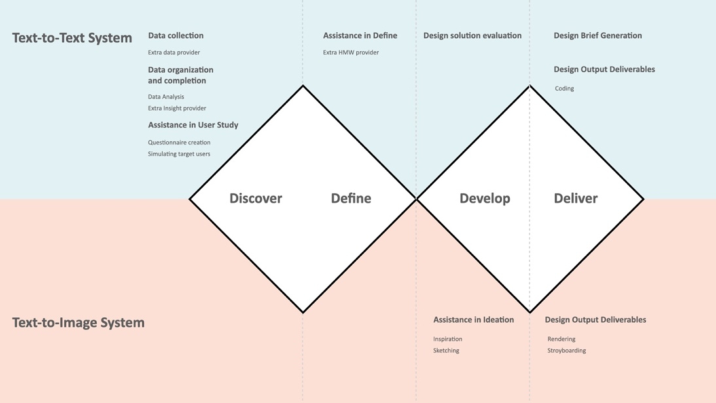
In this study, the statements of the interviewees in applying generative AI were categorized and summarized into advantages, limitations, and appli- cations within the four stages of the Double Diamond model (see Table 2). We also organize the functions of GAI in the Double Diamond model (see Figure 1). In this section, we have edited the interview quotes by remov- ing pauses, fragmented sentences, and repetitions to facilitate the integration and presentation of the interview findings to make them more cohesive and coherent.
Exploring the Impact of Generative Artificial Intelligence on the Design Process 53
Table 2. Themes organization.
Table available in the original PDF paper.
Theme Class & Categories Description Advantages Creating Breadth Providing Designers with More Diverse and Extensive Information Improving Efficiency Reducing the Time and Effort Designers Spend on Data Analysis, Rendering Outputs, Sketching, and Other Design Activities Enhancing Communication
Facilitating Designers in Communicating Concepts and Ideas Limitations Decision-Making Impairment Augmenting Data Sources
Serves as a Reference Only. Final Decision Rests with Humans Discover Phase
Augmenting Data Sources Assisting with Data Analysis Organizing and Analyzing Information or Issues. Additionally, Generating Content to Fill Gaps When Data is Insufficient Assisting with User Research
Assisting in Questionnaire Design. Simulating User Behavior, Needs, and Feedback Define Phase
Assisting with Problem Definition
Assisting in Transforming Problems into Clear Definitions Develop Phase
Assisting in Ideation Generating Reference Images to Inspire Designers. Assisting in Sketching and Brainstorming Assisting in Evaluating Solutions Assisting in Design Concepts and Copywriting
Assisting in Evaluating the Feasibility and Value of Various Solutions Deliver Phase
Assisting in Design Brief Generating Design Deliverables
Transforming Design Concepts into Final Product Renderings or Interactive Designs, etc
Figure 1: The functionality of GAI in the double diamond model.
Applications in the Discover Phase “Text-to-text generation systems can help us (designers) collect data from different countries and regions...” (E3), assisting designers in quickly and extensively gathering relevant information during the discover phase. Addi- tionally, generative AI tools can raise designers’ awareness of marginalized issues. For example, “Using Midjourney to present less attention-grabbing topics can make designers realize that there are different perspectives...” (E4), helping designers gain a more comprehensive insight.
Secondly, Generative AI can organize and analyze vast amounts of infor- mation and help make sense of messy data. “In qualitative research, we usually have transcripts with much information. Previously, it required human effort to interpret and extract key points. That is why we needed grounded theory to explore its insights. However, ChatGPT can efficiently extract key points from an article or something someone said that was not clear”(E2). Furthermore, when designers encounter data scarcity or gaps, generative AI can leverage existing data and background knowledge. “...AI-generated content can supplement the insufficiencies of professionally- generated content and user-generated content “(E1), providing designers with more comprehensive information to support decision-making.
Lastly, Text-to-text generation systems can assist in user research, such as “using ChatGPT in the questionnaire design process to help designers write questions, select appropriate question types, and validate the logic and flow of the questionnaire” (E2). Additionally, “(Chat)GPT may have the potential to partially replace some user research work in design because it can also simulate user behavior, needs, and feedback as additional sources of user research data” (E1), helping designers gain a deeper understanding of user expectations and needs or providing unexpected ideas.
Applications in the Define Phase The define stage aims to converge the information gathered in the discovery phase and define the problem, pain points, or opportunity points. In this stage, generative AI can provide designers with problem definitions from different perspectives, helping to broaden their thinking and explore more potential design directions. “The quality of decisions sometimes depends on whether you have sufficient options. In the past, due to limited options, we could only choose one from six ‘How might we’ statements. However, now with generative design tools, we can have twenty ‘How might we’ statements to choose from, which increases the chances of selecting better questions” (E1).
Applications in the Develop Phase In the develop phase, Text-to-image generation systems “can materialize the wild ideas in designers’ minds; generate reference images quickly, inspiring designers” (E4). “It can also compensate for the lack of visual experience in designers and achieve what we call ‘designing with your mouth.’ By inputting a few prompts, designers can quickly and abundantly generate sketches” (E2).
Exploring the Impact of Generative Artificial Intelligence on the Design Process 55
Text-to-text generation systems can help designers evaluate the feasibil- ity and value of various solutions, prompting the team to choose the most promising one. “Throughout the (design) process, We usually use ChatGPT in the middle stages. We do not rely on it to generate ideas or creativity. How- ever, we might not be certain which is best or most feasible. That is when we ask ChatGPT to help us assess the pros and cons of these solutions, and then we make the final implementation decision” (E1).
Applications in the Deliver Phase In the deliver phase, designers are responsible for completing the final design and development work, such as producing the final product or service. Dur- ing this stage, generative AI tools can assist designers in generating design brief and final design deliverables.
“ChatGPT can assist in the final stages of design, especially during presen- tations. If we want better storytelling and elaboration, we can let ChatGPT help us refine and improve the content” (E4). This effectively helps designers communicate design intent, value propositions, and product features. Fur- thermore, text-to-text generation systems can assist designers in coding or modifying code when it comes to game or interaction design. “…We tested the programming capabilities of ChatGPT 4.0 version, which has an accuracy rate of up to 90%. This makes it very effective in assisting us with program- ming tasks, especially in creating Unity games or Arduino interactions, as it greatly enhances efficiency” (E3).
Text-to-image generation systems’ high-quality rendering techniques can transform design concepts into finalized visuals. “In the past design process, it often involved sketching, followed by 2D or 3D rendering, creating con- textual images or scenarios, and then using software like Photoshop or Illus- trator for compositing. However, with current generative AI tools, designers can directly generate contextual images based on prompts, eliminating the tedious steps...” (E2).
DISCUSSION
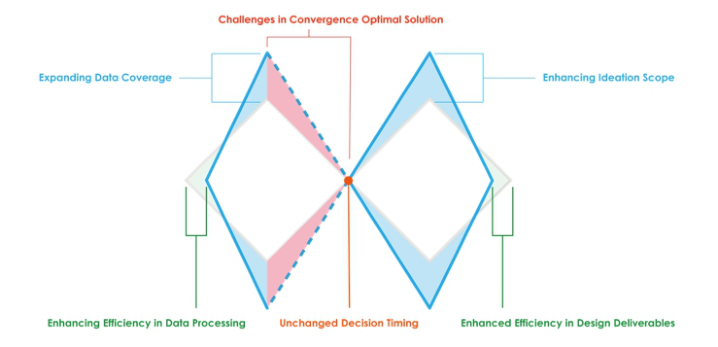
The generative AI tool will change the existing Double Diamond design process model, significantly increasing the divergent part’s breadth and the convergent part’s efficiency (see Figure 2).
Zeng et al., (2019) argued that AI allows designers to expand the solution space rapidly. The results of this study is similar. The feature of genera- tive AI to generate text and graphic content in large quantities and quickly can provide a large number of reference sources to expand the required knowledge, information, and experience needed for the dispersal of tempo- ral moments in Double Diamond, which promotes the designers to come up with unexpected inspirations (Chen et al., 2019), e.g., “the text-to-speech system can provide more insights in the Discover stage” (E1), and “the text-to-image system can enhance the designer’s visual experience in the Develop stage” (E2), which can also fulfil similar functions as the past AI models-providing the designer with a large number of reference sources (Koch et al., 2019), aids to drawing (Oh et al., 2018)-and even more powerful.
Generative AI tools can also significantly improve the efficiency with which designers conduct their designs. In the first Diamond (problem space), a text-to-text system can be “utilized to speed up the review of data in order to extract the key points of the data quickly.” (E2); in the second Diamond (solu- tion space), AI can help designers to quickly execute the design results (Zeng, Sun, & Liao, 2019), and in the Develop stage, “by giving many instructions quickly, the text-to-image system can help designers to do thumb sketches” (E2), which assists designers to think creatively, and “help designers to do thumb sketches” (E2) when they are in a chaotic state of mind. When con- fused, it can also “help designers visualize their wild ideas” (E4). In Deliver stage (solution space), “Rendering the finished drawing through Midjour- ney reduces the time and effort needed to utilize computer-assisted design rendering software and saves the money needed to conduct commercial photography.” (E2).
However, in this new model, the midpoint of the model (i.e., the crit- ical point between the problem space and solution space) and the point of the divergent part and convergent part remain unchanged from the original two-diamond design model because “the generative AI tool only acts as an (information provider), the decision-making task is still on the human.” (E3).
Existing generative AI models can only assist designers in decision-making and “help evaluate solutions” (E3), which can “help to improve the quality of decision-making” (E1). However, while text-to-text systems are suspected of generating misinformation, text-to-image systems are suspected of gener- ating bias problems (King, 2022). Therefore, “the interpretation of the AI generated content becomes very important. The designer should need to have a considerable degree of knowledge about the generated content so as not to be misled by it” (E4), and it is also possible to “utilize multi-party double- checking to determine the authenticity of the generated content.” (E2), and it is also important for designers to “use generative AI from a benign starting point.” (E2).
Exploring the Impact of Generative Artificial Intelligence on the Design Process 57
“There is no single or standardized answer to the convergent part of design, so we cannot be sure which is the best solution, and today’s generative AI tools cannot tell designers the best solution” (E1). This is also a major short- coming of today’s generative AI tools. In addition, since generative AI can provide more sources and perspectives, will it make decision-making more difficult due to more choices? This may be an opportunity for future research to explore in more depth.
LIMITATION In previous studies, AI collaborative design tools have been shown to actively engage in the design process by inspiring designers (Fu and Zhou, 2020) and proactively predicting and assisting designers when encountering dif- ficulties (Liao et al., 2020). However, current generative AI tools rely on user-controlled instructions through prompts, creating a passive collabora- tion mode. This may result in suboptimal utilization and effectiveness if designers fail to identify appropriate usage timing or make appropriate judg- ments. Furthermore, this study only focuses on mainstream text-to-text and text-to-image generation systems, excluding other generative AI tools such as generative AI for modelling assistance(Liu et al., 2022). Future research could explore how these generative AI tools can provide more diverse assistance in the design process.
CONCLUSION
This study indicated that generative AI tools significantly aid the existing Double Diamond model. Generative AI can expand the breadth of possibil- ities, providing designers with more versatile and diverse references while accelerating the design process’s efficiency. It expedites data collection and organization and speeds up the production of design outcomes. However, because design decisions ultimately rest with humans, this study also identi- fied challenges in the convergence phase of generative AI. Furthermore, the researchers found that interpreting the authenticity and bias issues in the con- tent generated by generative AI tools depends on the ethical awareness and judgment of the designers using these tools.
ACKNOWLEDGEMENTS
This work was supported by the Research Support Scheme of the Taiwan Design Research Institute, grant no. B112-F559, and National Cheng Kung University, grant no. D112–G2719.
REFERENCES
Chen, L. et al. (2019) ‘An artificial intelligence based data-driven approach for design ideation’, Journal of Visual Communication and Image Representation, 61, pp. 10–22. Available at: https://doi.org/10.1016/j.jvcir.2019.02.009. Chui, M. (2022) What is ChatGPT, DALL-E, and generative AI? McKinsey
Colton, S. et al. (2021) ‘Generative Search Engines: Initial Experiments’. Crowson, K.et al. (2022) ‘VQGAN-CLIP: Open Domain Image Generation and Editing with Natural Language Guidance’, in S. Avidan et al. (eds) Computer Vision – ECCV 2022. Cham: Springer Nature Switzerland (Lecture Notes in Computer Science), pp. 88–105. Cutting, D. R. et al. (1992) ‘Scatter/Gather: a cluster-based approach to browsing
large document collections’, in Proceedings of the 15th annual international ACM SIGIR conference on Research and development in information retrieval. New York, NY, USA: Association for Computing Machinery (SIGIR ‘92), pp. 318–329. Fogarty, J., Forlizzi, J. and Hudson, S. E. (2001) ‘Aesthetic information collages: generating decorative displays that contain information’, in Proceedings of the 14th annual ACM symposium on User interface software and technology. New York, NY, USA: Association for Computing Machinery (UIST ‘01), pp. 141–150. Fu, Z. and Zhou, Y. (2020) ‘Research on human–AI co-creation based on reflective
design practice’, CCF Transactions on Pervasive Computing and Interaction, 2(1), pp. 33–41. Goodfellow, I. J. et al. (2014) ‘Generative Adversarial Networks’. Gui, J. et al. (2020) ‘A Review on Generative Adversarial Networks: Algorithms, Theory, and Applications’. Howard, T. J., Culley, S. J. and Dekoninck, E. (2008) ‘Describing the creative
design process by the integration of engineering design and cognitive psychology literature’, Design Studies, 29(2), pp. 160–180. Jovanovi´c, M. and Campbell, M. (2022) ‘Generative Artificial Intelligence: Trends and Prospects’, Computer, 55(10), pp. 107–112. King, M. (2022) ‘Harmful biases in artificial intelligence’, The Lancet Psychiatry,
9(11), p. e48. Koch, J. et al. (2019) ‘May AI? Design Ideation with Cooperative Contextual Bandits’, in Proceedings of the 2019 CHI Conference on Human Factors in Computing Systems. New York, NY, USA: Association for Computing Machinery (CHI ‘19), pp. 1–12. Liao, J., Hansen, P. and Chai, C. (2020) ‘A framework of artificial intelligence aug-
mented design support’, Human–Computer Interaction, 35(5–6), pp. 511–544. Liu, V. et al. (2022) ‘3DALL-E: Integrating Text-to-Image AI in 3D Design Workflows’. Oh, C. et al. (2018) ‘I Lead, You Help but Only with Enough Details: Understanding
User Experience of Co-Creation with Artificial Intelligence’, in Proceedings of the 2018 CHI Conference on Human Factors in Computing Systems. New York, NY, USA: Association for Computing Machinery (CHI ‘18), pp. 1–13. Oppenlaender, J. (2022) ‘The Creativity of Text-to-Image Generation’, in 25th International Academic Mindtrek conference, pp. 192–202. Radford, A. et al. (2021) ‘Learning Transferable Visual Models From Natural
Language Supervision’. Ramesh, A. et al. (2022) ‘Hierarchical Text-Conditional Image Generation with CLIP Latents’. Robinson, W. R., Renson, A. and Naimi, A. I. (2020) ‘Teaching yourself about
structural racism will improve your machine learning’, Biostatistics, 21(2), pp. 339–344. Rombach, R. et al. (2022) ‘High-Resolution Image Synthesis with Latent Diffusion Models’. arXiv. Available at: https://doi.org/10.48550/arXiv.2112.10752. Saharia, C. et al. (2022) ‘Photorealistic Text-to-Image Diffusion Models with Deep
Language Understanding’.
Exploring the Impact of Generative Artificial Intelligence on the Design Process 59
Silverman, D. (1998) Harvey Sacks: social science and conversation analy- sis. New York: Oxford University (Key contemporary thinkers (Cambridge, England)). Tashakkori, A. and Teddlie, C. (2010) SAGE Handbook of Mixed Methods in Social & Behavioral Research. SAGE Publications, Inc. Thomas, D. (2006) ‘A General Inductive Approach for Analyzing Qualitative Evalu-
ation Data’, American Journal of Evaluation, 27, pp. 237–246. Tlili, A. et al. (2023) ‘What if the devil is my guardian angel: ChatGPT as a case study of using chatbots in education’, Smart Learning Environments, 10(1), p. 15. Yang, Q. et al. (2020) ‘Re-examining Whether, Why, and How Human-AI Interac-
tion Is Uniquely Difficult to Design’, in Proceedings of the 2020 CHI Conference on Human Factors in Computing Systems. New York, NY, USA: Association for Computing Machinery (CHI ‘20), pp. 1–13. Zeng, Z., Sun, X. and Liao, X. (2019) ‘Artificial Intelligence Augments Design Creativity: A Typeface Family Design Experiment’, in A. Marcus and W. Wang (eds) Design, User Experience, and Usability. User Experience in Advanced Techno- logical Environments. Cham: Springer International Publishing (Lecture Notes in Computer Science), pp. 400–411. Zhou, K. et al. (2022) ‘Learning to Prompt for Vision-Language Models’, Interna-
tional Journal of Computer Vision, 130(9), pp. 2337–2348.
LISTED IN THE AHFE DIGITAL BOOKSTORE CATALOGUE
Explore the complete digital volume
Artificial Intelligence, Social Computing and Wearable Technologies
Read this individual research paper free through the original publisher, or explore the full digital proceedings book.
ISBN 978-1-958651-89-6
Explore this ISBN in the AHFE Bookstore ↗Listed in the July 2026 bookstore catalogue; search by ISBN to confirm current availability · Digital book purchase optional