Huma Imran, Mohamed Salama, Colin Turner (2023). Oil and Gas Sector: A Systematic Literature Review of Digitalization, Cybersecurity, and Human Factors in the Post COVID World. In: Human-Centered Design and User Experience. AHFE Open Access, vol. 114, pp. 349–359. https://doi.org/10.54941/ahfe1004253
Digitization and cybersecurity are intertwined. The surge in digitization has made the cyber threat landscape complex and real, allowing cybercriminals to target nations' critical infrastructure, especially oil and gas. Recent high-profile incidents demonstrate the quickly evolving and intensifying threat landscape. Oil and gas producers must protect themselves from these stealthy adversaries, which necessitates a thorough understanding of the relationship between digitization, risk management, and cybersecurity. Academics and industry practitioners have been digitizing the oil and gas industry for decades to make it more cost-effective and resilient. However, managerial progress is slow and traditional methods are still used. Cybersecurity was largely neglected during digitization. This paper chronicles the growth of smart factories and cyber risk management practices through different digitization strategies, and identifies gaps in digitization and risk management. A systematic literature review of the petroleum industry was conducted using four databases (AAPG, SCOPUS, ProQuest and Web of Science). 56 papers were shortlisted after a comprehensive research. The paper examines the publication, source and goal of digitization models and their use in the oil and gas industry. It also integrates digitization, cybersecurity and risk management in the petroleum sector. In the past, cyber-attacks were responded to after they occurred, and digitization has outpaced cybersecurity management. . This poses a real challenge in the world of oil and gas sector, where billions of dollars are at stake due to this knowledge gap. With the passage of time cyber security has become an integral part of the digitization programs, and recently, the proposed models have integrated cybersecurity as an essential element of digitization frameworks, however much needs to be explored and studied at project level as these models require further validation and updating.
The world is currently undergoing fourth industrial revolution, an era of rapid technological transformation and disruptive technologies. With the advent of the fourth Industrial Revolution, boundaries between the physical, digital, and biological realms have become blurred, bringing new challenges and opportunities. This has shaped all aspects of our life, including big data, cloud computing and artificial intelligence. Integration of physical assets, including machines, and digital systems can provide accurate insights, enable businesses to respond to challenges in real time, and makes them more effi- cient (Aramco, 2022). A real impact of digitalization, however, requires full integration across all aspects of an organization. Nevertheless, full digital transformation of the oil and gas industry will revolutionize the way energy is supplied to the world. It will further enhanced the operational efficiency and safety at workplace, while minimizing the environmental footprint of the company (Aramco, 2022). However, on the other hand it is increas- ing the complexities of cyberthreat landscape (Radler, 2011). Therefore, this study aims to conduct a systematic literature review (SLR) to chronologically trace the history of digital transformation, cybersecurity and the ever-present human factor in the oil and gas sector. It further elaborates the current state of digital advancements, cybersecurity and human involvement; and identi- fies the best practices that can be employed and explore the opportunities for future work.
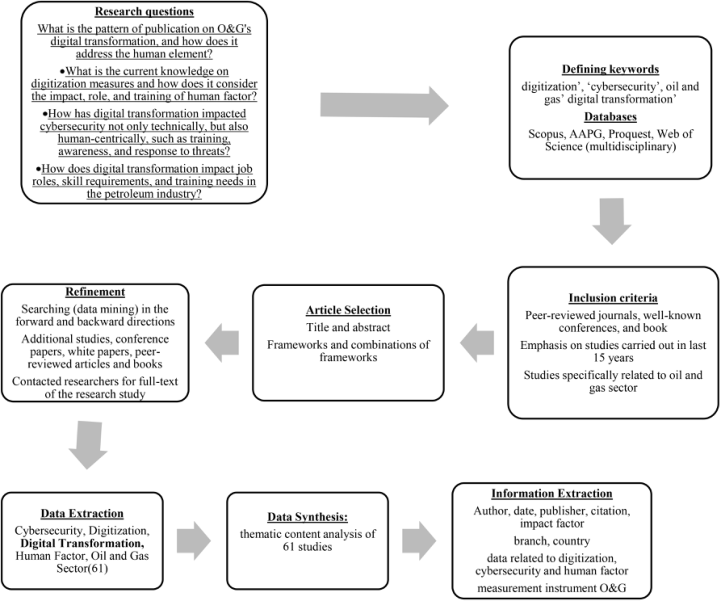
Figure 1: Systematic review process.
Oil and Gas Sector: A Systematic Literature Review 351
METHODOLOGY
This study aims to conduct a systematic literature review (SLR) guided by the research of various scholars (Webster and Watson, 2002); Brereton et al., (2006); Kitchenham (2004); White and Schmid (2005); (Petticrew and Roberts, 2006); Mullen and Ramirez (2006); Moher et al., (2008); Rousseau et al., (2008); Okoli and Schabram (2010); Pickering and Byrne (2013); Siddaway (2013); Frank and Hatak (2014); Boell and Cecez-Kecmanovic (2015); Okoli (2015); Cooper et al., (2018); Fink, 2019; Al-Tabbaa et al., 2019). The detailed process along with investigated research questions has been shown in Figure 1. The scope of the shortlisted studies is oil and gas sector. SLR methodology allowed to assess and map the litera- ture in a systematic manner and helped in the synthesizing the findings qualitatively (Snyder, 2019). This study adopted the qualitative analysis (the- matic literature analysis) (Cronin et al., 2008). Meta-analysis was extremely challenging due to the variety of methodological designs used in selected studies.
OIL AND GAS INDUSTRY DIGITAL TRANSFORMATION As an industrial system, petrochemicals have become the largest industry of the modern age over the past several decades, and it has played a vital role in the economic development of the world, improving the lives of people. The size of the global economy has increased dramatically in recent years due to the growth of the petrochemical industry and the evolution of indus- trial pattern (Kadambur & Kotecha, 2015). Regions like North America, Asia Pacific and Middle East has played a significant role in this devel- opment. Almost every day, the structure of the product is reforming and there is production of more and more highly performed, and high-valued specific chemicals (Li et al., 2015). The technological revolution has acceler- ated the growth of petrochemical industries and it will benefit the industry in a rapid manner (Khosravi et al., 2015) (Ramteke & Srinivasan, 2011). The effects of combination of operation technology, information technology and manufacturing technology on production, operations, and distribu- tion are profound and influences how petrochemical companies produce (Sa’idia et al., 2014).
The concept of Industry 4.0 was launched at the Hannover Messe in Germany in April 2013, following the steam engine era (Industry 1.0), the electrification era (Industry 2.0), and the information era (Industry 3.0) (Yin et al., 2018). The main goal of Industry 4.0 is to promote industrial change through information technology, also known as the intel- ligent era (Ahamed & Vignesh, 2022). Oil and gas industry is living in the dawn of a technological revolution, and the next decade promises to be a golden period for technology in the sector (Lahti et al., 2018). The technology in the petroleum sector has rapidly developed in the world, and every decade has experienced earth-shaking transformation (Yang et al., 2016).
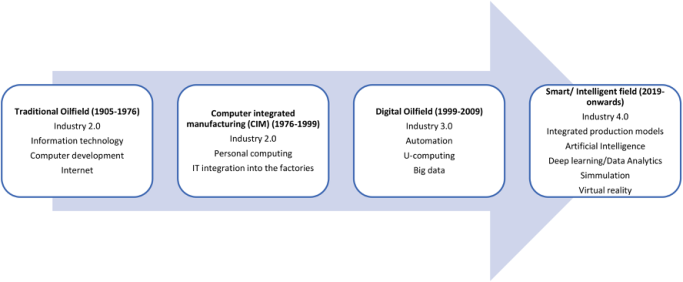
Figure 2: Development of smart oilfield model collated from (Korovin & Tkachenko, 2016) (Yin et al., 2018).
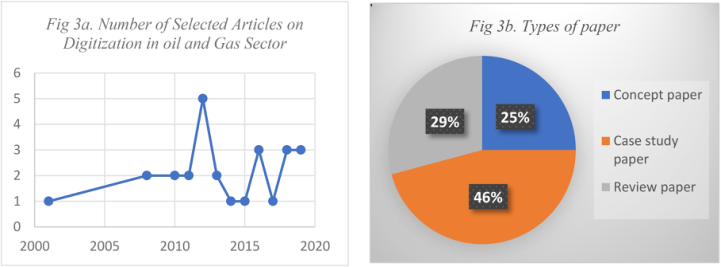
THE STATE OF ‘DIGITIZATION’ RESEARCH To evaluate the current state of digitization research, metadata was extracted, that is, title, year, publication type, affiliation, journal’s impact factor, and number of references and citations. The selected papers were categorized into three groups: concept paper, (theoretical and simulation-based articles); case study paper; and review paper (Fig. 3b).
Figure 3: a) Number of selected articles on digitization in oil and gas sector, b) Types of paper.
This study identifies various theoretical frameworks chronologically, that were developed during the digital transformation of the petroleum industry. Figure 3a illustrates the publication pattern over the past years. The digital transformation publication started gaining prominence during 2000 experi- encing peak in 2012. This is due to the fact that at that time various cyber risk management models were born.
DISCUSSION
With the emergence of information technology and computing, oil and gas sector started integrating these technologies in its production and supply chain process. Sophisticated technology is involved in the production and
Oil and Gas Sector: A Systematic Literature Review 353
distribution process at different levels, that is, upstream, midstream, and downstream. Upstream plays a vital role in the petroleum industry. The aim of all the strategies studied and implemented is to further enhance the produc- tion process. Most are designed at improving the drilling process (upstream). This section discusses the outcomes of the review and qualitative analysis of shortlisted that highlighted some interesting developments discussed below: Oil and Gas Development Model
Due to the COVID-19 pandemic and rising volatility in the market, the O&G industry has seen a recent downturn. In addition, a long-term decline in demand and consumption for the industry is expected to be seen due to the push for carbon taxes, cleaner, greener, and more sustainable energy, globally (Fonseca & Azevedo, 2020) (Benayoune, 2021). In order to make the O&G industry more competitive, it is important to determine the chal- lenges of integrating state of the art technology in the conventional O&G sector and researching more efficient ways to make the sector competitive (Benayoune, 2021).
The Industrial Revolution 4.0 is based on the integration of industrializa- tion and information technology. Figure 1(a) shows the Industry 4.0 strategic framework (Hankel & Rexroth, 2015), which consists of four major themes, including, smart factories, smart production, smart services and smart logistics (Kagermann et al., 2013).
Prior to the development of the digital age, oil and gas exploration was car- ried out by manual labor, based on geological surveys, and primitive drilling methods. In the United States, for example, horizontal drilling and fracking technology have led to significant industry growth. Throughout the U.S., oil and gas exploration and development were primarily driven by human exper- tise and decision-making (Hsu et al., 2017). The brief history of the evolution of smart factory has been given below: Early Digitization- Computer Integrated Manufacturing (1970s-1980s)
Petroleum sector was revolutionized by computerization during the 1970s and 1980s. The introduction of Computer Integrated Manufacturing (CIM) was the first wave of technological integration into factories that revolu- tionised operations humans (Wu et al., 2001). However, this technological shift was not seamless. On the one hand, it posed challenges for the work- force to adapt to technology through training and development. While on the other hand, it instilled the fear of job loss in the employees (Zuehlke, 2010).
Rise of Smart Technologies-Smart Wells (1990s-2000s) In the 1990s and 2000s, smart technologies emerged, including Smart Wells and Integrated Operations. The decade witnessed the rise of the discussion revolving around “smart factory” both in academic and business spheres (Lucke et al., 2008; Radziwon et al., 2014). Different terminologies have been introduced to elaborate the notion of smart factory. For example, Ubiq- uitous Factory (U-factory) proposed by Yoon et al. (2011) and Factory of Things (FoT) by Zkule (2011) attempts to explain the same concept of smart
factories. Moreover, the Smart Process Manufacturing is also related to smart factory. (Li et al., 2015). In mid 2000s, intelligent digital oilfields (IDF) were introduced. The purpose of IDF was to create a platform where collabora- tively informed decisions can be made using real time data integrated with the asset models. It uses AI (neural networks, data mining tool and proxy models) (Vanish et al., 2013).
As a result of these advances, the human operator has been transformed from an executor into a supervisor. It has become necessary to train and upskill continuously. This further resulted in human-centric challenges, such as resistance to change, distrust in automation, and concerns about job security (Ang & Utomo, 2017; Rob et al., 2016).
Era of Connectivity and Collaboration-Industry 4.0 (2010s) The recent era has witnessed the rise of fourth generation of computing. A number of innovative technologies have affected the workforce in the 2010s, including Industry 4.0, and blockchain. This has blurred the lines between oil and gas operations and IT, making interdisciplinary collaboration increasingly important. Recently, the concept of “exponential organization” has come to light that elaborates the process of making and managing the smart organizations in the future (Ismail, 2019). Currently, humans play a central role in the interpretation of data, making decisions, and formulat- ing strategies. However, this has led to the rise of new challenges such as cybersecurity awareness, psychological effects of remote operations, and the necessity of continuous training (J. Crandal, n.d.).
Digitization, Cybersecurity and Human Factor in the Oil and Gas Supply Chain The digitization process has been mainly directed at upstream section of the oil and gas industry i.e., exploration and production. Though the first inte- gration of technology, didn’t turn out as expected and made the production process costlier and more cumbersome (Zuehlke, 2010). Upstream has been majorly studied in the literature as upstream is the most significant part of oil and gas life cycle, while least importance has been paid to midstream.
The analysis indicates that managerial processes had been initially ignored. The focus was on integration of sophisticated technology, while ignoring the security and managerial aspect of the assets and organization. Therefore, creating a gap between adoption of technology, cybersecurity measures and training and awareness of workers (Imran et al., 2022). Moreover, companies adopted defensive mechanism to cyberattacks rather than having preven- tive strategies to address the vulnerabilities leading to cybercrimes. Recently cybersecurity measures and human development has become integral part of the digitization programs, however, a lot needs to be done (Lu et al., 2019) (Imran et al., 2021).
The shift from technology happened with the introduction of lean pro- duction which focused more on organization rather than technology. It emphasized the need for network, dynamicity, self -collaborating teams, and personal responsibilities rather than hierarchies and monotonous assembly
Oil and Gas Sector: A Systematic Literature Review 355
lines (Womack et al., 2010). Later in the decade, security started gaining prominence beside digitization and human development with the advent of Factory-of-Things (FoT) (Zuehlke, 2010). FoT focused on four dimensions: technology, framework, security and human-integrating all four impor- tant aspects of digitization process. DOF, another important development intended to optimize the production by developing advanced analytic collab- orative model, through which experts onshore can collaborate with offshore personnel using real time data (Reddick et al., 2008).
Throughout the oil and gas value chain, the production and operation personnel need to monitor various measurements for temperature, pres- sure, flowrates, vibration, power, etc. The Digital Oil Fields (DOF) enables the implementation of highly sophisticated technology to the sensors, data analytics, communication, collaboration and decision making, making the process more human centric (BP, 2019; Dashti et al., 2012; Carvajal et al., 2018b). Later, blockchain technologies directly focused on cybersecurity along with improving the production process (Cann, 2017).
This represents an important trend that most of the organizational models used to manage the changing technology and issues related to it have become redundant and there is a need to adopt and study the new management mod- els created considering the human centric and cybersecurity challenges of integration of new technology in the production and management system (Imran et al., 2021). During the past decades, Industrie 4.0, block chain tech- nology and agile management has tried to bridge this gap in the academia and industry. They emphasize on collaboration, teamwork, decision making and increased user involvement in each stage of production (Priyanka, 2016; Lu et al., 2019).
It was further found that the pace of digitization is more than the cyber- security development. It is believed that in the future, due to exponential advancement in technology, cybersecurity would also incorporate artificial intelligence and machine learning to identify and analyze threats. The smart CS would be able to take counter measures to resolve the issues and recover the systems (Kim et al., 2018). On the other hand, these innovative tech- nologies would also lead to development of cyber-attacks that could affect or disable the functioning of CS countermeasures. These malicious codes would have the ability to detect cyberspace environment, identify the vulnerabilities itself and conduct a cyber-attack (Kim et al., 2018).
Oil and gas organizations are a vulnerable target for hackers due to their enterprise structure, such as, the complex production process and operating systems, little overlap between information technology (IT) and operation technology (OT), firewall causing real time system delays, inconsistent net- work standards between departments, vendors’ security systems that are not updated on time and historical legacy problems (Mittal et al., 2017). The intelligent sensors are considered to be the most vulnerable segment of the enterprise network. They can provide the real time information about the offshore oil field operations (Carvajal et al., 2018a). Blockchain technol- ogy can be potentially helpful in combating these cyberattacks. (Cann, 2017) (Koeppen et al., 2017). It can play an important role in revolutionizing four important aspects of petroleum sector, that is, supervision, trading, decision
making and management, and cybersecurity. It is an important technology especially with respect to big data (Kadir, 2017). Blockchain technology can be used to secure data, increase transaction transparency, and provide track- ing services for goods or equipment in the petroleum sector (Kadir, 2017). Despite the many advantages of blockchain technology, the current operat- ing system is yet to reach its full potential, and there are many risks associated with it (Surujnath, 2017) (Walch, 2015).
CONCLUSION
This paper is a systematic review of digitization, cybersecurity and human factor in the oil and gas sector in a chronological manner and aims to integrate the development of cybersecurity, management practices and indus- trialization centrally placing humans in the process. It is evident from the review that the petroleum sector started to integrate new technologies into its supply chain and production system with the emergence of industrializa- tion. The focus was mostly on the introduction of sophisticated technology in the production system (that is, the upstream section), in order to reduce cost and increase productivity.
Initially the cyber-security and human aspects of oil and gas organiza- tion were relatively ignored. The primary emphasis was on introduction of latest technology and later the improvement in management systems, human factor and cybersecurity were emphasized. Consequently, the pace of digitization has been more than the advances in other aspects of digitization process creating a knowledge gap that needs to be studied further.
In the oil and gas sector due to transformation from manual to digital operations, the human factor has become increasingly important. In spite of the technological revolution, the role of humans (from laborers to decision- makers) remain central to the digitization and cybersecurity process. As the petroleum industry continues to advance and grow, in addition to addressing digitization and cybersecurity, human challenges remains crucial.
Different studies have been conducted in the past on individual aspects of digitization, cybersecurity and human involvement, however, they failed to study their interrelationship in the oil and gas projects. Cybersecurity has recently been incorporated as an essential component of digitization in the proposed models. Still, it is required to explore it further at project level (Imran et al., 2022).
In summary, the gaps in literature were identified and it was established that blockchain has excellent potential to be used in cybersecurity and man- agement practices, however, it has its own challenges, opportunities, and risks. Blockchain technology is still in its experimental stage, and many peo- ple in the sector do not have enough understanding. Blockchain technology can help in reducing costs and enhanced accountability, however, the techni- cal and regulatory issues surrounding the technology need to be addressed. Moreover, as the sector continues to evolve, it will be imperative to strike a balance between technological advancements and the human factor, so the human factor will not be lost in the relentless march of progress.
Oil and Gas Sector: A Systematic Literature Review 357
REFERENCES
Al-Tabbaa, O., Ankrah, S., & Zahoor, N. (2019). Systematic Literature Review in Management and Business Studies: A Case Study on University–Industry Collaboration. https://doi.org/10.4135/9781526467263 Ang, C. K. G., & Utomo, N. P. (2017, October). Cyber Security in the Energy World.
2017 Asian Conference on Energy, Power and Transportation Electrification (ACEPT). Aramco, S. (2022). Digitalization. https://www.aramco.com/en/creating-value/techn ology-development/in-house-developed-technologies/digitalization Benayoune, D. A. (2021). Factors Influencing Industry 4.0 Implementation in Oil
and Gas Sector: Empirical Study from a Developing Economy. Academy of Strategic Management Journal. https://www.abacademies.org/abstract/factors-inf luencing-industry-40-implementation-in-oil-and-gas-sector-empirical-study-fro m-a-developing-economy-13224.html BP. (2019). Bp Energy Outlook 2019. Ocean News & Technology; Palm City, 26–27. Cann, G. (2017). Blockchain: Overview of the potential applications for the oil and gas market and the related taxation implications. Deloitte. https://www2.deloitte.com/content/dam/Deloitte/global/Documents/Energy- and-Resources/gx-oil-gas-blockchain-article.pdf Carvajal, G., Maucec, M., & Cullick, S. (2018a). Chapter Nine—The Future Digital Oil Field. In G. Carvajal, M. Maucec, & S. Cullick (Eds.), Intelligent Digital Oil and Gas Fields (pp. 321–350). Gulf Professional Publishing. https://doi.org/10. 1016/B978-0-12-804642-5.00009-8 Carvajal, G., Maucec, M., & Cullick, S. (2018b). Introduction to Digital Oil and
Gas Field Systems—ScienceDirect. https://www-sciencedirect-com.ezproxy1.hw .ac.uk/science/article/pii/B9780128046425000013 J. Crandal. (n.d.). Cybersecurity and Offshore Oil: The Next Big Threat. Dashti, Q., Al-Jasmi, A. K., Qaoud, B. N. A., Ali, Z., & Bonilla, J. C. G. (2012).
Digital Oilfield Implementation in High Pressure High Temperature Sour Gas Environment: Kuwait Oil Company Challenges & Guidelines. SPE Intelligent Energy International. https://www.academia.edu/7353915/Digital_Oilfield_Imp lementation_in_High_Pressure_High_Temperature_Sour_Gas_Environment_K uwait_Oil_Company_Challenges_and_Guidelines Fink, A. (2019). Conducting Research Literature Reviews: From the Internet to Paper. SAGE Publications. Fonseca, L., & Azevedo, A. (2020). COVID- 19: Outcomes for Global Supply Chains.
Management & Marketing: Challenges for the Knowledge Society, 15, 424. https://doi.org/10.2478/mmcks-2020-0025 Hsu, K.-C., Wright, M., & Zhu, Z. (2017). What motivates merger and acquisition activities in the upstream oil & gas sectors in the U. S.? Energy Economics, 65, 240–250. https://doi.org/10.1016/j.eneco.2017.04.028 Imran, H., Salama, M., & Turner, C. (2021). A Systematic Literature Review on
the Technical and Non-Technical Cyber Risk Management Models in the Ol and Gas Sector. https://www.proquest.com/openview/f792d5098b65548389e8a 459207b270d/1?pq-origsite=gscholar&cbl=2033472 Imran, H., Salama, M., Turner, C., & Fattah, S. (2022). Cybersecurity Risk Management Frameworks in the Oil and Gas Sector: A Systematic Literature Review. In K. Arai (Ed.), Advances in Information and Communication (pp. 871–894). Springer International Publishing. https://doi.org/10.1007/978-3-030-98015-3_59 Ismail, S. (2019). Exponential Organizations: Why new organizations are ten times better, faster, and cheaper than yours - PDF Drive. https://www.pdfdrive.com/exponential-organizations-why-new-organizatio ns-are-ten-times-better-faster-and-cheaper-than-yours-d175887062.html
Kadambur, R., & Kotecha, P. (2015). Multi-level production planning in a petrochemical industry using elitist Teaching–Learning-Based-Optimization. Expert Systems with Applications, 42(1), 628–641. https://doi.org/10.1016/j.eswa.2014. 08.006 Kadir, B. A. (2017). The Nine Pillars of Industry 4.0—Technological Advance-
ment. https://www.4thpost.com/single-post/2017/07/23/The-nine-pillars-of-Indu stry-40 Khosravi, R., Khosravi, A., Nahavandi, S., & Hajabdollahi, H. (2015). Effectiveness of evolutionary algorithms for optimization of heat exchangers. Energy Conver- sion and Management, 89, 281–288. https://doi.org/10.1016/j.enconman.2014. 09.039 Kim, N. Y., Shailendra, R., Jung, H. R., Jin, H. P., & Jong, H. P. (2018). A Survey
on Cyber Physical System Security for IoT: Issues, Challenges, Threats, Solutions. Journal of Information Processing Systems, 14(6), 1361–1384. https://doi.org/10. 3745/JIPS.03.0105 Koeppen, M., Shrier, D., & Bazilian, M. (2017). Is Blockchain’s Future in Oil and Gas Transformative or Transient? 11. Korovin, I. S., & Tkachenko, M. G. (2016). Intelligent Oilfield Model. Procedia
Computer Science, 101, 300–303. https://doi.org/10.1016/j.procs.2016.11.035 Lahti, T., Saurus, L., & Hellgren, N. (2018). Industry 4.0 in the oil and gas business.
Hydrocarbon Processing; Houston, 75–78. Li, D., Jiang, B., Suo, H., & Guo, Y. (2015). Overview of Smart Factory Studies in Petrochemical Industry. In Computer Aided Chemical Engineer- ing (Vol. 37, pp. 71–76). Elsevier. https://linkinghub.elsevier.com/retrieve/pii/B 9780444635785500098 Lu, H., Huang, K., Azimi, M., & Guo, L. (2019). Blockchain Technology in the
Oil and Gas Industry: A Review of Applications, Opportunities, Challenges, and Risks. IEEE Access, 7, 41426–41444. https://doi.org/10.1109/ACCESS.2019. 2907695 Lucke, D., Constantinescu, C., & Westkämper, E. (2008). Smart Factory—A Step towards the Next Generation of Manufacturing. In M. Mitsuishi, K. Ueda, & F. Kimura (Eds.), Manufacturing Systems and Technologies for the New Frontier (pp. 115–118). Springer. https://doi.org/10.1007/978-1-84800-267-8_23 Mittal, A., Slaughter, A., & Zonneveld, P. (2017). Protecting the connected barrels:
Cybersecurity for upstream oil and gas. Deloitte University Press, 24. Priyanka. (2016). Critical Evaluation of Prince2 and Agile Project Management Methodologies for a complex project. International Journal of Engineering and Computer Science, 5(10), Article 10. https://www.ijecs.in/index.php/ijecs/article/v iew/2726 Radler, M. (2011). Addressing cyber threats. Oil and Gas Journal, 109(17), 22. Radziwon, A., Bilberg, A., Bogers, M., & Madsen, E. S. (2014). The Smart Factory:
Exploring Adaptive and Flexible Manufacturing Solutions. Procedia Engineering, 69, 1184–1190. https://doi.org/10.1016/j.proeng.2014.03.108 Ramteke, M., & Srinivasan, R. (2011). Integrating Graph-based Representation and Genetic Algorithm for Large-Scale Optimization: Refinery Crude Oil Schedul- ing. In Computer Aided Chemical Engineering (Vol. 29, pp. 567–571). Elsevier. https://doi.org/10.1016/B978-0-444-53711-9.50114-0 Rob, R., McLorn, G. W., Tural, T., Hassan, A., & Sheikh, A. (2016, December).
Addressing cyber security for the oil, gas and energy sector. 2016 Saudi Arabia Smart Grid (SASG).
Oil and Gas Sector: A Systematic Literature Review 359
Sa’idia, E., Anvaripoura, B., Jaderiab, F., & Nabhania, N. (2014, July). Fuzzy risk modeling of process operations in the oil and gas refineries— ScienceDirect. https://www-sciencedirect-com.ezproxy1.hw.ac.uk/science/article /pii/S0950423014000540 Surujnath, R. (2017). Off The Chain! A Guide to Blockchain Derivatives Markets and the Implications on Systemic Risk. 22(2), 49. Vanish, D., Betancourt, D., MdAdnan, S., Wang, F., Cullick, A. S., Al-Jasmi, A. K.,
Villamizar, M., Nasr, H., Carvajal, G. A., Urrutia, K., & Velasquez, G. (2013). Enabling Numerical Simulation and Real-Time Production Data to Monitor Waterflooding Indicators. SPE Digital Energy Conference. SPE Digital Energy Conference, The Woodlands, Texas, USA. https://doi.org/10.2118/163811-MS Walch, A. (2015). The Bitcoin Blockchain as Financial Market Infrastructure: A Consideration of Operational Risk. Legislation and Public Policy, 58. Womack, J. P., Jones, D. T., & Roos, D. (1990). The Machine That Changed the
World: Based on the Massachusetts Institute of Technology 5-Million-Dollar 5-Year Study on the Future of the Automobile by James P. Womack - PDF Drive. https://www.pdfdrive.com/the-machine-that-changed-the-world-based-on-the -massachusetts-institute-of-technology-5-million-dollar-5-year-study-on-the-fu ture-of-the-automobile-e187847675.html Wu, C., Yushun, F., & Deyun, X. (2001). Handbook of Industrial Engineering—PDF Drive. https://www.pdfdrive.com/handbook-of-industrial-en gineering-d39673459.html Yang, L., Cao, X., & Li, J. (2016). A new cyber security risk evaluation method for oil and gas SCADA based on factor state space. Chaos, Solitons & Fractals, 89, 203–209. https://doi.org/10.1016/j.chaos.2015.10.030 Yin, Y., Stecke, K. E., & Li, D. (2018). The evolution of production systems from
Industry 2.0 through Industry 4.0. International Journal of Production Research, 56(1–2), 848–861. https://doi.org/10.1080/00207543.2017.1403664 Zuehlke, D. (2010, February). SmartFactory—Towards a factory-of-things— ScienceDirect. https://www-sciencedirect-com.ezproxy1.hw.ac.uk/science/article /pii/S1367578810000143
LISTED IN THE AHFE DIGITAL BOOKSTORE CATALOGUE
Explore the complete digital volume
Human-Centered Design and User Experience
Read this individual research paper free through the original publisher, or explore the full digital proceedings book.
ISBN 978-1-958651-90-2
Explore this ISBN in the AHFE Bookstore ↗Listed in the July 2026 bookstore catalogue; search by ISBN to confirm current availability · Digital book purchase optional