Chiayin Yang, Shin-yu Tsai, Weng-io Chan, Michelle Lin, Hsien-Hui Tang (2023). Speculate the future roles of design with the changes in the economy, technology, and user generation. In: Human-Centered Design and User Experience. AHFE Open Access, vol. 114, pp. 466–477. https://doi.org/10.54941/ahfe1004265
The recent advancements in technology have significantly impacted the direction of technological innovation. The present-day international community is witnessing the coexistence of five different generations with varying values, consumption habits, and behaviors, leading to ongoing shifts in market demand. Moreover, the global economy has transformed from a product-oriented approach to a service- and experience-oriented one, signifying the onset of the experience economy and the proliferation of diverse business models. Designers must reassess the future impact of design in the industry. The study aims to examine the future significance of design and its impact on the industry, providing the necessary skills and abilities for design professionals to improve their understanding of future trends and the influence of design in their field. The study used qualitative methods to examine the roles of design, including investigating local service design in Taiwan and international cutting-edge experience design cases, conducting interviews with design experts to gain insights into the present comprehension of design and prospective opportunities among design practitioners, and analyzing trends in social, technology, and economics to determine future roles and capabilities. This comprehensive research incorporates a total of 17 trend data, 18 cases, and insights from 12 industry experts, spanning design, users, technology, and business domains. The study encompasses perspectives from Taiwan, Eastern regions, and Western regions, aiming to thoroughly analyze the impact of design within the industry.This study has three main results after a comprehensive analysis of the above data. Firstly, we designed an analysis framework that takes into account user, business, and technological changes to help us analyze the role of design. Secondly, we sort out 12 future roles of design and describe their related resources and abilities. Thirdly, this study provides a framework for examining the future roles of design, which can further analyze the changes in design capabilities, help designers think about their own combination of capabilities, empower design education and industrial talent cultivation, and establish a more suitable education method for the future. Additionally, companies may utilize the research to inform their talent development strategies, job descriptions, and overall business direction. Government and educational institutions can also benefit from this study by understanding how to allocate resources for design training.
The rapidly changing environment has led to a need for a re-evaluation of the role of design. IDEO, a globally recognized design and innovation firm known for its substantial contributions to design thinking, has intro- duced a concept of 3 innovation lenses: viability, feasibility, and desirability (Et and Ideo, 2011). Business viability, technological feasibility, and human desirability changes are key factors impacting design in recent years.
Firstly, the transition of the global economy from a product-oriented to a service and experience-oriented approach has marked the advent of the experience economy and the proliferation of diverse business models, requir- ing designers to consider the consumer experience in addition to product functionality (Lai, Huang, and Joseph Pine, 2022). Secondly, technologi- cal advancements such as Immersive technologies, blockchain, and artificial intelligence(Panetta, 2018; Gartner, 2021), have significantly influenced the direction of technological innovation and gradually altered the capabilities
Speculate the Future Roles of Design With the Changes 467
required of designers. Finally, due to the critical impact of technology, the coexistence of five distinct generational cohorts with diverse values, con- sumption habits, and behaviors is leading to ongoing shifts in market demand (Dimock, 2019). Moreover, the dominant force in consumption is shifting from Generation Y to Generation Z, which is just entering the workforce and has significant consumption potential (Critical, 2016; Dorsey and Villa, 2020). As the professionals balancing user needs (desirability), technological fea- sibility, and commercial viability, designers must proactively anticipate the future and adapt their skills accordingly. This study seeks to provide insights into the future impact of design on industry innovation, the changing roles and responsibilities of designers, and the necessary capabilities for success in the field. The expected contributions of this work include proposing a framework for research on design impact, investigating the role and required capabilities of future designers, and providing a framework for designers to assess their capabilities.
The paper is organized as follows. Firstly, it describes the study process and methods employed. Subsequently, we expound upon the results, which encompass insights integrated from expert interviews and analyses of genera- tional cohorts, technological advancements, and economic trends. Finally, we address the contribution of our work and its limitations and identify potential areas for future research.
STUDY PROCESS AND METHODS This section outlines the methodology employed in the study, presenting a comprehensive overview of the research methods and analytical framework utilized to investigate the impact of design. This study adopts three qualitative research methodologies: case studies, interviews, and trend data analysis.
Case Study Research and Secondary Research—The study focuses on two distinct categories of design cases: 6 local service design cases from Taiwan and 12 international cutting-edge experience design cases. The examina- tion of service design cases from The Design Information Thinking Lab (DITL), renowned for its extensive expertise in both user experience and service design, aims to gain insights into the prevailing state of design in Taiwan. We conducted interviews with the project implementers to investigate the roles of the designer in the project. Additionally, this study analyzed the experience design cases sourced from The World Experience Organization (WXO) in order to make informed speculations concerning the future development trajectory of the Taiwanese design field, as well as the associated design roles and capabilities.
The expert interviews—The expert interviews were conducted to gain insights into the perceptions of design held by industry practitioners, along with their prospective predictions. The study entailed interviews with design directors from Taiwan’s benchmark industry, as well as Taiwanese designers positioned across the global landscape. To ensure comprehen- sive coverage of diverse design fields, the selection of interviewees was
intentionally carried out across various industries and organizational cat- egories, encompassing software development, product manufacturing, brand management, consulting firms, and others. It is noteworthy that the participants represent distinguished multinational corporations, includ- ing Microsoft, Frog, Indeed, Asus, and BenQ. Moreover, two notable organizations featured among the respondents are 104 Corporation, Tai- wan’s largest online job bank, and TANG, the most extensive experience consulting service design company in China (see Table 1). The inter- views were conducted either in person (offline) or via online platforms. Despite the interviews being conducted in the Chinese language, the selected experts possess a profound global outlook. By comprehend- ing the perspectives of designers working worldwide, this study aims to gain deeper insights into how Taiwanese designers adeptly integrate diverse cultural elements to foster innovation and bring forth new creative energies.
Table 1. The catalog of expert interviews.
Table available in the original PDF paper.
Company Job Title Code Name 104 corporation Chief Design Officer P1 Microsoft Principal Design Manager P2 X Thinking Institute Dean P3 TANG Experience Strategist P4 frog Former executive Design Director P5 BenQ Corporation Chief Designer P6 TANG Strategy Executive Director P7 Indeed UX Designer P8 ASUS Design Center Sr. Design Project Manager P9 HTC Creative Labs Former User Research Director P10 Vivo Smartphone Former general manager, of Hangzhou Design P11 Alibaba Alibaba Design University Principal User Experience Architect P12
Trend Data Analysis—To study the roles of design in the future, this study analyzed the results of future-oriented business reports and profes- sional research trends. This study analyzes 11 reports about the impact of Generation Z and 6 technological trends on design roles and deduces how roles of design and capabilities will be different. This study col- lected reports on Generation Z from Google, Nielsen, Deloitte, McK- insey, TalkingData, dentsu, etc., extracted the main points of the text, and summarized the analysis framework. On the other hand, this sec- tion mines the possible future design roles from the Gartner technology trend report. Gartner is the world’s most authoritative IT research and consulting firm in the technology industry and publishes major tech- nology predictions every year. Therefore, this study uses its past trend reports as an analysis context, trying to understand trends’ evolution and design’s applicability. Taking the Gartner reports as the core, it attempts to deduce possible design capabilities from definitions or example applications.
Speculate the Future Roles of Design With the Changes 469
RESULTS
After cross-analyzing expert interviews with technology trends and gen- erational transitions, this study produced two main contributions: four prospective stages and twelve future roles for design.
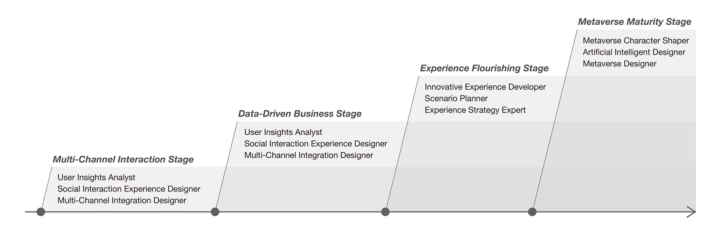
Four Prospective Stages in the Future of the Design Industry Based on the results of integrated case studies, expert interviews, and trend research, this study identified 12 design roles spanning four stages of industry transformation from a design perspective (see Figure 1).
Figure 1: Four prospective stages and 12 roles of design.
Multi-Channel Interaction Stage—This period identifies the design roles required in the context of the booming development of social media platforms and the increasing diversity of virtual and physical channels.
Data-Driven Business Stage—As society changes and technology matures, cutting-edge technologies will become more prevalent in commercial applications. Modular programming and generative artificial intelligence make interpreting and using data more critical. Industry experts suggest that designers should have the business acumen to have a greater impact in an economy focused on service and experience.
Experience Flourishing Stage—As the economic system shifts from the early stage of a product-based economy to a service and experience econ- omy, people’s satisfaction with a product’s functionality alone is no longer sufficient. In recent years, the experience and services provided along- side the product have become the key differentiating factors. Therefore, the abilities of designers will become different to face the challenges of a full-fledged experience economy.
Metaverse Maturity Stage—Although the metaverse is still nascent, many enterprises have already invested significant resources in this field. There- fore, it can be seen that designers will play a crucial role in the metaverse as it gradually matures. At this stage, artificial intelligence has also become a mature technology, and designers will need to be able to use AI to assist in the design field, which will become a key skill in the future.
Twelve Potential Design Roles That Could Arise Within Future Industries These 12 design roles were obtained by cross-comparing the three types of data. The first stage-Multi-Channel Interaction Stage-includes 3 roles (see Table 2). Each of these roles is described in detail below.
Table 2. Required competencies for each role in the multi-channel interaction stage.
Table available in the original PDF paper.
Roles Required Competencies User Insights Analyst
the ability to segment personas
the ability to grasp unique brand styles
the ability to understand cross-generational preferences and needs
the ability to social media operations
the ability to design cross-generational products Social Interaction Experience Designer
considering interaction patterns among people
understanding the penetration and dissemination of social media
integrating multiple applications and devices
understanding the sources of brand messages received by Gen Z Multi-Channel Integration Designer
assisting users in completing tasks anytime, anywhere
using appropriate channels to solve customer problems
integrating the capabilities of software and hardware in a single product
1. User Insights Analyst—To cater to the rapidly evolving and intricate needs of Generation Z, who form the core consumer group for the future, designers must comprehend the characteristics and distinctions of various segmented groups. Reports indicate that Generation Z seeks individuality, actively utilizes social media to shape distinct social per- sonalities, and exists as a generation that straddles the virtual and physical realms (Francis and Hoefel, 2018). Their consumption behav- ior serves as a means of self-expression, encompassing brand prefer- ences and corporate values, which also extend their influence to family members from different generations (Dean, Collins and Chen, 2022). Interviewee P9 said that understanding user behavior and thoughts, and skillfully depicting personas is imperative for designers and profession- als in other roles alike. In such a complex world where human behavior, environment, and artifacts intersect, a User Insights Analyst can reveal hidden needs, and understand preferences, and motivations, enabling the analysis of intricate personas and influencing consumer behavior across virtual and physical contexts to meet diverse needs and expectations. 2. Social Interaction Experience Designer—Given the indispensable role that social platforms play in Generation Z’s lives, there is a pronounced
Speculate the Future Roles of Design With the Changes 471
demand within this demographic for fostering social relationships and engaging with multimedia content. Their consumption motivations encompass the desire to socialize, connect with others, and seek self- pleasure (Dean, Collins, and Chen, 2022). To expand their customer base among Generation Z, brands must acquire a comprehensive under- standing of these platforms, recognizing their significance as pivotal con- sumer touchpoints. Social Interaction Experience Designers assume the vital responsibility of comprehending the intricacies of Generation Z’s interaction patterns and devising innovative social interaction modes accordingly. 3. Multi-Channel Integration Designer—Due to the internet and techno- logical advancements, the growing complexity of interaction. To achieve the concept of Anywhere operation, which Gartner’s 2021 report intro- duces, the business model must allow stakeholders to operate from any location (Panetta, 2020). The strategy executive director and the chief designer emphasize the significance of channel construction in brand cre- ation, as it not only enables designers to identify appropriate resources for customers but also enhances development for the integration of software and hardware. Multi-Channel Integration Designers provide a seamless user experience by managing customer journeys in physi- cal spaces, mastering multi-channel devices for remote operations, and strategically applying channels to relevant touchpoints. The roles in the Data-Driven Business Stage include 3 roles which are described in detail below (see Table 3).
Table 3. Required competencies for each role in the data-driven business stage.
Table available in the original PDF paper.
Roles Required competencies
the ability to construct process guidance
Information Visualization Designer
the ability to distinguish and combine functional modules
the ability to integrate information computation into product operation
the ability to visualize information Data Application Designer
utilize data
collect and analyse data
assist with digital transformation
interpret data Business Strategy Designer
the ability to facilitate decision-making
the ability to balance user needs with business strategies
the ability to function as a product manager
the ability to clarify business problems and propose solutions
4. Information Visualization Designer—The role of designers as intermedi- aries to render technology and information into user-friendly formats is increasingly crucial. The prevailing trend of democratization empowers
individuals to proficiently leverage technology and professional knowl- edge without formal training (Panetta, 2020). This endeavor also con- tributes to bolstering organizations’ development capabilities, fostering the application of technology, and propelling industry innovation. Infor- mation Visualization Designers, specifically, play a significant role in visualizing extensive data and information, resulting in the creation of exceptional interface guidance and operational experiences. By mak- ing platforms and technologies user-friendly, they facilitate seamless operation and usage for users. 5. Data Application Designer—Design experts consistently consider that measuring results is important, so designers should have the ability to analyze data. They believe that incorporating the concepts of AI and data can make the design more interesting. In addition, the design is very subjective, so it is necessary to continuously accumulate data to persuade businesses and make the design more objective. International companies use data science to understand how users discuss products in the market and how competitors perceive their products. In the future, more devices will collect behavioral data and provide feedback to users, further changing their behavior. From a business perspective, grasping behavioral data can develop new products and plan appropriate sales models (Panetta, 2020). Data Application Designers can collect data to understand the market and competitors, understand users through data, use data to support design decisions during the design process, and ulti- mately use data to prove the effectiveness of design solutions and make the company believe in the benefits of design. 6. Business Strategy Designer—From design experts’ perspective, design refers to good decision-making, and designers must be able to provide options for product managers to make decisions. As the essence of design is to clarify the essence of the problem, designers must be able to pro- pose methods to solve problems to assist business decisions. In addition to facing user needs, they must also face the company’s strategic needs. A Business Strategy Designer provides options that balance user and business needs during decision-making in a company. They possess both design and business thinking abilities and lead product development during the development cycle. The Innovative Experience Developers, Scenario Planners, and Expe- rience Strategy Experts emerge in Experience Flourishing Stage (see Table 4).
7. Innovative Experience Developer—Immersive and interactive experi- ences that enhance the emotional connection with products or ser- vices can create new business opportunities and values for companies. Entertainment with strong emotional immersion, interactive participa- tion, and group identity has become a part of Generation Z’s daily lives. Through the use of data storage technology and providing users with a sense of accomplishment, the company gives players a deeper sense of belonging and more modes of cooperation and competition
Speculate the Future Roles of Design With the Changes 473
(Squire, 2022b). In addition, utilizing psychology to create innova- tive experiences is also a promising area for research and development (Squire, 2022a). Innovative Experience Developers possess deep knowl- edge of technology or psychology and can develop innovative ways to enhance the immersive and experiential elements of a theme, leaving a lasting impression on consumers and bringing tangible benefits to the company.
Table 4. Required competencies for each role in the experience flourishing stage.
utilizing various technologies to achieve better experiences
designing for all 5 senses
creating experiences through psychology and philosophy
understanding the psychological sensations of consumers experience Scenario Planner
understanding and applying a broader context
considering how objects in a scene are connected
collaborating with the public for innovation
incorporating designed objects into real-life situations Experience Strategy Expert
formulating experience strategies and resource allocation
creating unique experiences
applying curation thinking to the real and virtual world
organizing to enhance the connection between business and users
8. Scenario Planner—The increasing complexity of interconnected prod- ucts poses challenges in terms of control and usability, underscoring the significance of situational planning within the design process. The Gart- ner report shows that the integration of artificial intelligence and Inter- net of Things technology enables products to autonomously carry out tasks (Panetta, 2018). Furthermore, the emergence of human augmenta- tion technology necessitates heightened situational planning expertise (Panetta, 2019). A Scenario Planner specializes in devising plans for product usage and user experience, encompassing the observation, shap- ing, application, and connection of various scenarios. During the initial stages of product design, meticulous planning can encompass all aspects of usage scenarios and the seamless coordination and integration within the smart ecosystem, ensuring products harmoniously blend into users’ lives. 9. Experience Strategy Expert—Following the product and service econ- omy, the consumption trend has transitioned towards the experience economy. Introducing experience strategies into businesses constitutes the initial step towards enhancing competitiveness in this evolving mar- ket. Amidst the pandemic, a London-based immersive entertainment
company rescued the company by innovating new experiential modes and garnering fresh customers and business prospects. Experience strate- gists possess a unique skill set in planning and executing activities, displaying high creativity, and adeptly applying performance think- ing across diverse industries, thereby elevating ordinary experiences to extraordinary heights. The following roles, which could potentially emerge during the Meta- verse Maturity Stage, are elaborated in-depth below (see Table 5).
Table 5. Required competencies for each role in the metaverse maturity stage.
Table available in the original PDF paper.
Roles Required competencies
the ability to depict digital characters
Metaverse Character Shaper
the ability to create virtual personal assistants based on brand settings
the ability to introduce virtual characters through different channels
the ability to design metaverse characters based on culture Artificial Intelligent Designer
the ability to use generative AI to accelerate processes
an understanding of the changes and impacts of AI on humans
the ability to design experiences that integrate with AI
the ability to clarify problems in AI computations through design Metaverse Designer
coordinating online art exhibitions and stage effects
enhancing experiences and remote interactions
providing consumers with privacy-preserving operating modes
creating virtual environments and unique interac- tive experiences
10. Metaverse Character Shaper—As technology continues to advance, user scenarios are progressively shifting towards digital and virtual environ- ments, leading to the creation of characters that facilitate improved user engagement with the virtual world. Virtual Personal Assistants (VPA) exemplify this trend, aiding users in efficiently managing daily tasks, including the prioritization and filtering of crucial email con- tent. The role of the Metaverse Character Shaper lies in understanding consumers’ requirements for both functionality and emotion, enabling a flexible application for the design of intelligent tools and virtual characters. This approach enhances people’s willingness to embrace technology and optimizes their overall user experience.
Speculate the Future Roles of Design With the Changes 475
11. Artificial Intelligent Designer—As decision intelligence and generative AI develop, designers adopt AI to continuously evaluate and optimize decision-making processes and accelerate their workflow or assist in design iteration (Gartner, n.d.). Design experts suggest that designers should consider the changes AI may bring to the environment and how humans will respond, and understand the new environments and cog- nitive processes that may emerge. While AI appears to be a dominant force, humans are not static, and AI may not be able to adapt to human changes in real time. Another expert suggests that design can assist AI engineers in defining problem types, and designers need to cultivate the ability to apply AI in the field. The Artificial Intelligent Designer should be able to use design thinking to anticipate and master the impact of AI, use AI to assist in decision-making on the design end, use genera- tive AI to speed up the product development iteration cycle, and also apply AI to the field to improve the user experience. 12. Metaverse Designer—Although current internet technologies and expe- rience devices are not yet sufficient to fully realize the concept, the metaverse has already been widely applied in the entertainment and art industries over the past two years. Some large music events started building a metaverse to allow visitors worldwide to interact with the music festival in a new way. The pioneers develop immersive social music experiences, allowing our artists and their fans to participate in ways they have never before (Shi, 2022). Metaverse Designers not only have design and art-related backgrounds, but also are familiar with various metaverse concepts and technologies, and are good at col- laborating with engineering teams to create stunning dreamlike virtual experiences.
This study created a framework for research design impact that incorpo- rates the three elements of innovation: technology, business, and people. This integration involves insights from experts in the design industry, analysis of domestic and foreign design cases, and examination of technological trends. The outcome defines four stages that lie ahead and identifies 12 possible design roles. These insights empower designers to chart their future work and capabilities in more specific directions.
CONCLUSION
Future work of design is subject to variation, influenced by changes in tech- nology, demographics, and business landscapes. While the core of design remains people-centric, the methods of execution will inevitably evolve, and the tools employed will undergo significant transformations. Design- ers are not expected to possess all capabilities, but to cultivate their skills strategically.
In order to foster design abilities for future industry development, this study presents clear strategies to address the evolving landscape of design. By characterizing potential stages of future industry development, defining emerging design roles, and describing the skillsets required for these roles,
the study provides valuable educational guidelines for individuals, compa- nies, and government agencies. From a personal standpoint, designers can assess their capabilities and identify the roles they are best suited for. Then, follow the framework of the four stages, anchor their future development direction, and develop learning strategies that align with future trends. From company executives, this study provides valuable insights to facilitate adap- tation to upcoming industry trends and refine job descriptions for future job openings. It is understood that not all designers will possess every ability listed in the tables, but all designers can begin their development journey from some of the abilities mentioned. As a reference for designers’ growth context, this study encourages a gradual expansion of design abilities and prepares individuals for a diverse future.
ACKNOWLEDGMENT
The authors extend their heartfelt gratitude to co-workers for their valuable contributions to this study. Additionally, we express our sincere appreci- ation to the design experts for generously participating in the interview, which greatly enriched this research. Furthermore, the authors would like to acknowledge the Taiwan Design Research Institute for their financial support, which made this research possible.
REFERENCES
Critical, V. (2016). The Everything Guide to Generation Z. [online] Available at: [PDF] katelynpohlmann.com. Dean, C., Collins, A. and Chen, A. (2022). Unlocking Gen Z 2022: A Generation of
Contradictions. dentsu. Dimock, M. (2019). Defining generations: Where Millennials end and Generation Z begins. [online] Pew Research Center. Available at: https://www.pewresearch.org/ short-reads/2019/01/17/where-millennials-end-and-generation-z-begins/. Dorsey, J. R. and Villa, D. (2020). Zconomy : how Gen Z will change the future of
business-and what to do about it. New York, Ny: Harperbusiness. Et, B. and Ideo (2011). Human centered design : toolkit ; HCD. S. L.: Ideo. Francis, T. and Hoefel, F. (2018). True Gen’: Generation Z and its implications for companies. McKinsey & Company. Gartner (2021). Top Strategic Technology Trends for 2022. [online] Gartner. Avail-
able at: https://www.gartner.com/en/information-technology/insights/top-technol ogy-trends. Gartner. (n.d.). Gartner Identifies the Top Strategic Technology Trends for 2022.
[online] Available at: https://www.gartner.com/en/newsroom/press-releases/2021- 10-18-gartner-identifies-the-top-strategic-technology-trends-for-2022. Lai, M., Huang, J. and B Joseph Pine (2022). X thinking : building better brands in the age of experience. Shanghai: X Thinking Institute. Panetta, K. (2018). Gartner Top 10 Strategic Technology Trends For 2019. [online]
Gartner. Available at: https://www.gartner.com/smarterwithgartner/gartner-top -10-strategic-technology-trends-for-2019. Panetta, K. (2019). Gartner Top 10 Strategic Technology Trends for 2020. [online] www.gartner.com. Available at: https://www.gartner.com/smarterwithgartner/gar tner-top-10-strategic-technology-trends-for-2020.
Speculate the Future Roles of Design With the Changes 477
Panetta, K. (2020). Gartner Top Strategic Technology Trends for 2021. [online] www.gartner.com. Available at: https://www.gartner.com/smarterwithgartner/gar tner-top-strategic-technology-trends-for-2021. Shi, Y. (2022). Metaverse Jigsaw Puzzle Series: From ‘niche’ to ‘mass’, the com-
munity power detonated by virtual concerts. [online] FINDIT. Available at: https://findit.org.tw/researchPageV2.aspx?pageId=2039 [Accessed 27 Jul. 2023]. Squire, O. (2022a). Campfires 56 & 57: Trojan Horses And Finding Meaning In Unlikely Places. [online] WXO. Available at: https://worldxo.org/campfire s-56-57-trojan-horses-and-finding-meaning-in-unlikely-places/ [Accessed 27 Jul. 2023]. Squire, O. (2022b). UNCONTAINED: The Next Evolution In Hyper-Immersive VR
Attractions. [online] WXO. Available at: https://worldxo.org/uncontained-the-ne xt-evolution-in-hyper-immersive-vr-attractions/ [Accessed 27 Jul. 2023]. Tang, H.-H. (n.d.). Design Information & Thinking Lab. [online] Design Information & Thinking Lab. Available at: https://www.ditldesign.com/. WXO. (n.d.). WXO — World Experience Organization. [online] Available at: https:
//worldxo.org/ [Accessed 27 Jul. 2023].
LISTED IN THE AHFE DIGITAL BOOKSTORE CATALOGUE
Explore the complete digital volume
Human-Centered Design and User Experience
Read this individual research paper free through the original publisher, or explore the full digital proceedings book.
ISBN 978-1-958651-90-2
Explore this ISBN in the AHFE Bookstore ↗Listed in the July 2026 bookstore catalogue; search by ISBN to confirm current availability · Digital book purchase optional