Weng-io Chan, Hsien-Hui Tang (2024). Bridging Business Challenges: Optimizing Brand Experiences with Experience Strategy-Oriented Design Thinking. In: Human Factors, Business Management and Society. AHFE Open Access, vol. 135, pp. 247–256. https://doi.org/10.54941/ahfe1004951
This paper explores a new approach to help organizations drive value through experience, by combining experience strategy with design thinking to bridge the gap between experience design and business environment. This new process helps designers take a holistic view of the business experience, solving the problem of human-centered design that does not necessarily solve a business challenge or benefit the brand. The result is more efficient and precise experience strategies and solutions to achieve business goals. We implemented this methodology in the leading Taiwanese home furnishing firm, encountering issues with customer attrition and reduced market presence. The company sought to enhance its competitiveness by optimizing its operations and improving customer experience. The results show that combining design thinking with experience strategy allows for a more comprehensive analysis of the business problem and helps to clarify the goals of experience management and innovation, leading to clearer and more feasible solutions. In addition, this approach can help organizations to continue to innovate in the absence of clear user pain points.
In today’s experience-driven economy, the impact of customer experi- ence on business competitiveness is increasingly evident (Aaker, 1991). Consequently, industries prioritize enhancing customer experience to add value (Chevtchouk, Veloutosu, and Paton, 2021). Brand experience, from interactions between companies and consumers, relies on design to trans- late brand values into tangible actions that convey the brand’s essence (Clatworthy, 2012). However, research indicates a gap between organiza- tions’ customer experience strategies and brand foundation, highlighting a disconnect between brand management and customer experience design (Munchbach, 2014). While experiences deepen understanding of consumer behavior and strengthen brand relationships, improving experiences should align with business strategy, not just enhance customer experience (Mager, 2009). Although design thinking helps organizations grasp customer needs
and pain points, mere observation of customers may not suffice to stand out in the industry. With experience strategy becoming crucial, integrating design thinking with business management and strategy development is imperative (Wylant, 2008).
The experience strategy framework proposed by Lai and Tang (2023) high- lights key elements crucial when experience drives business value. This paper advocates combining this framework with design thinking to holistically ana- lyze and craft brand experiences, addressing the gap between experience design and brand strategy. This strategic approach ensures alignment between experience and business objectives and fostering collaboration between brand management and experience development departments. Leveraging design-in-practice research, this paper develops an experience strategy-based approach to brand experience design, demonstrating the benefits of merging the two in a business context.
LITERATURE REVIEW
The relationship between experience design and branding is central to brand value delivery. The interaction between a brand and its customers, i.e. the brand experience, is realized through the design of touchpoint experiences (Berry, 2000). Therefore, design is key in shaping brand value transfer (Abbing, 2017). Scholars have previously proposed many frameworks for brand experience but needed more practical approaches.
In recent years, some scholars have proposed practice-based theories from the perspective of service design, such as Clatworthy (2012), who proposed a process model for transforming brand strategy into service experience in the front-end of new service development (NSD), and Motta Filho, who sug- gested that the application of service design in brand design can be drawn closer with brand experience proposition (2018). These approaches assume precise business objectives between the brand and the target users and drive service design by defining brand elements.
This chapter focuses on the theories that support the research including the key concepts of branding, experience, design thinking, and experience strategy.
BRANDING AND BRAND EXPERIENCE Brand equity starts with customer interactions and evolves through behavior to increase market value. Brand experience emerges from diverse consumer interactions, including perceptions of product benefits, services, and brands. Each interaction forms a unique brand experience, setting it apart (Smith and Wheeler, 2002). However, organizations cannot fully control how customers perceive their brand, as it depends on customer interactions (Berry, 2000). Thus, strategic customer experience management requires systematic design and implementation (Berry, Carbone, & Haeckel, 2002).
Design thinking, a human-centered approach, helps businesses understand consumer needs and create emotionally resonant solutions (Brown, 2008).
Bridging Business Challenges: Optimizing Brand Experiences 249
Despite its intuitive use by some, many organizations have yet to fully adopt design thinking to move beyond traditional problem solving. Barriers include time, cost, and susceptibility to subjective bias. Therefore, more than design thinking is required for systemic business problem-solving. This study sug- gests that by incorporating a strategic framework, subjectivity in design thinking can be mitigated, enhancing brand experience shaping and com- mercial viability. Integrating an experience strategy framework empowers designers to shape brand experiences effectively.
EXPERIENCE ECONOMY AND EXPERIENCE STRATEGY FRAMEWORK Since Pine and Gilmore (1999) introduced the concept of the experience economy, the integration of people, technology, design, and business has strengthened. The Internet’s development and the rise of mobile connectivity have accelerated information sharing via social networks, reshaping indus- tries. The focus has shifted from product design to user experience design and, eventually, to customer experience strategies to maintain competitiveness (Lai and Tang, 2023). Design consulting services have expanded to encom- pass overall service planning for customer journeys and corporate experience development strategies.
Existing frameworks for customer experience often need to pay more attention to the complex issue of brand experience. Lai and Tang (2023) propose an experience strategy framework, emphasizing the relationship between experience, business, and brand. While this framework offers vision, it needs more practical application. This paper suggests an experi- ence strategy-based design thinking process to fill this gap. It outlines the stages and importance of implementation, exploring their coordination to ensure the effectiveness of experiential strategies when combined with design thinking, refining them through practice.
METHODS FOR INTEGRATING EXPERIENCE STRATEGY WITH DESIGN THINKING This chapter describes how to integrate Experience Strategy with Design Thinking and the definition of each stage. To determine the feasibility of the model, the experiential strategy framework and the design thinking pro- cess will be introduced in a company. We will describe the process in the followings.
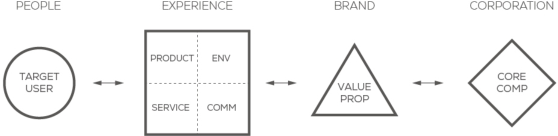
Experience Strategy Framework The experience strategy includes the analysis, positioning, planning, and operation of user, brand, experience, and organizational aspects. The frame- work suggests that it can help companies achieve lasting success through experience-driven transformation (Lai and Tang, 2023). The framework states that brand and experience can act as a bridge between the organization and its customers and influence each other (Figure 1).
While the sequence is not explicitly stated in the original article, the pre- ceding information suggests that developing an experience strategy involves identifying business and user-related concerns and generating knowledge.
250 Chan and Tang
Figure 1: Experience strategy framework (Lai and Tang, 2023).
This knowledge is subsequently applied to formulating strategy and design via branding and experience. The four dimensions of corporation, brand, experience, and people can be analyzed and optimized by designers to gen- erate a practical strategy for the organization. The authors underscored the significance of research in furnishing the rationale, context, insights, and arguments underpinning brand decisions. The following summary out- lines the four most important elements of an experience strategy program implementation (Table 1).
Table 1. Key dimensions, objectives and tasks of the experience strategy framework.
Table available in the original PDF paper.
Key Dimensions Objectives Tasks Corporate Organizational optimization Analyzing organizational competitiveness Brand Brand upgrade Identifying brand value propositions Experience Experience upgrade Identify the essential touchpoints People Precise position Identify target users and their needs.
Design Thinking Process The design thinking process consists of three main principles that can lead to creative organizational strategies and designs (Brown, 2008). This approach emphasizes observing, understanding, and empathizing with the users’ needs and situations and delving into the behaviors, thoughts, and attitudes of all customers (Clark & Smith, 2008) as a basis for design. Design thinking aims to find innovative solutions through a series of organized phases, with continuous iteration and improvement.
There are a variety of design thinking models that can be used to address creativity, Some of the most widely recognized models of design thinking include the 3I model (Brown, 2008), the HCD model (Brown & Wyatt, 2010), the Double Diamond model (Design Council, 2005), the Hasso Plat- tner Institute Design Thinking Model (HPI d-school, 2007), and the Service Design Model (Stickdorn & Schneider, 2010). These models are organized into phases and are usually an overview of the designer’s work (Brown and Wyatt, 2010) rather than having a fixed start and end point. The purpose of these models is to make it easier for businesses and organizations to learn. Designers should be able to flexibly apply different solutions and choose the strategy that best meets the requirements of the situation. Based on the above premise, this paper organizes the processes, corresponding purposes, and methods of the three key stages of design thinking (Table 2).
Bridging Business Challenges: Optimizing Brand Experiences 251
Table 2. Phases, objectives, and methods of design thinking.
Table available in the original PDF paper.
Phase Objective Method Discovery Gathering information, listening to user feedback, studying industry trends, etc. to inspire creativity and innovation.
Research, observation, interviews Definition Generate ideas that are as diverse and challenging as possible without being limited by what is realistically feasible.
Brainstorming, role playing, storyboarding Development Transform concepts into practical solutions for implementation and deployment.
Prototype, user test, gather feedback.
Establishing the Framework Having understood design thinking and experience strategy, we note their respective characteristics. Experience strategy suggests critical dimensions and tasks for experience transformation, while design provides methods and tools for innovative thinking. We attempted to integrate the framework of experience strategy into the design thinking process to better understand the relationship between them. By integrating experiential strategy and design, we have mapped the purpose and approach of each stage to each other, which will be the underlying direction for future case studies (see Table 3).
Table 3. Approaches to integrating experience strategy and design thinking.
Table available in the original PDF paper.
Method
Purpose (Phase)
Experience Strategy (Dimension)
Design Thinking (Phase) Corporate, People Discovery Explore and Analyze the Business and Users Gather corporate information, listen to user feedback and study industry trends. Analyze organizations and users through research, observation, and interviews to discover ways to improve competitiveness. At the same time, identify user orientation. Branding Definition Brand Positioning and Experience Strategy Development
Think about the future of a brand in the context of the organization’s and users’ expectations and needs, identifying what the brand is worth. Provoke possible visions of the brand experience. Experience Develop Experience Design and Program Execution
Transform brand experience concepts into practical solutions based on brand values for implementation and deployment. Prototypes collect feedback and evaluation.
CASE STUDY This chapter presents a case study of a strategic experience-led design for reinventing an organization’s brand experience. It is helpful for this study to understand the process and results of applying the proposed methodology.
252 Chan and Tang
This chapter aims to explore how the experience strategy-oriented design thinking approach can be applied to brand experience reinvention. In order to gain insights, a case study approach has been adopted. The researcher in this study is part of the design team, which helps to provide an insider’s perspective in order to produce results that are relevant to both theory and practice.
A leading company in the home furnishings industry in Taiwan was selected for the case study. With 25 stores, this company has a strong pres- ence in producing and selling home furnishing products. The study aimed at rebranding through an experience strategy to communicate brand value better and bring it closer to consumers. The primary data collection methods include observation, semi-structured interviews, and seminars. 17 meetings and five co-creation seminars were conducted during the 9-month research process. Questions and comments were collected during the collaboration with the companies, and 13 key-person interviews were conducted at the end of the collaboration. The case study utilized these methods to fill in the gaps in implementation methods and rules and demonstrated their usefulness and development potential in the results. After identifying the study’s objec- tives, the researchers began the three-stage of experience strategy-oriented design thinking process by first understanding the business issues through pre-meetings.
Phase 1: Explore and Analyze the Business and Users The purpose of this stage was to clarify business and user issues and posi- tioning. Researchers conducted desktop research initially to grasp the basics. Subsequently, semi-structured interviews were held with organization mem- bers and consumers to elicit their thoughts and expectations regarding the brand. Upon comparing these insights, researchers noted a discrepancy in brand values between organizations and consumers. This divergence con- firmed the need for brand experience reinvention and highlighted imprecise brand targeting, hampering effective value delivery.
In the second step of this phase, a design workshop involving 30 employees from various departments was convened to reaffirm the target audience and their needs and expectations. Utilizing qualitative data from interviews, the team drafted a preliminary customer persona. This persona was presented to six groups of five participants each for individual discussion and revision. Through open discussion and voting, the team identified customer groups aligning with the company’s ethos and capable of delivering business value. Additionally, alongside target customer personas, the team prepared con- sumer and corporate competitiveness analysis reports, offering optimization suggestions to the company and laying the groundwork for the next stage of brand building.
Phase 2: Brand Positioning and Experience Strategy Development In this stage, our focus was on shaping brand and experience strategy by deeply understanding the needs and expectations of target customers. We collected data on customer experiences across various interactions, including
Bridging Business Challenges: Optimizing Brand Experiences 253
with employees, processes, and products. Our goal was to grasp individ- ual interactions, overall impressions, and underlying motivations. We used observation, interviews, and questionnaires to gather insights and needs over different time frames to achieve this. We consolidated this data into reports on Brand Expectations and Experience Requirements through customer journey mapping and analysis.
During Phase 2, we organized a Brand Values Workshop and an Experience Strategy Workshop. In the Brand Values Workshop, we discussed the target customer’s impressions and potential needs regarding our home furnishing brand. We deliberated on brand personality and attributes, refining brand values to ensure organizational alignment. This fosters consistent recognition of brand values throughout the organization, which is vital for establish- ing a strong connection with our target users and evaluating the success of our experience strategy. The phase concluded with a joint discussion on experience strategy development, considering brand values, user needs, and corporate goals. We analyzed target customer behavior and feelings at eight touchpoints using the SPEC framework (Service, Product, Environment, and Communication). Key touchpoints were identified as crucial brand scenes, with our analysis revealing varying customer focuses at different touchpoints. For example, customers prioritized the overall atmosphere in the B area, while functionality and appearance were paramount in the K area. This helped us optimize the experience based on the concerns even when there were no apparent pain points for customers.
We proposed ten principles for the overall brand experience and eight principles for touchpoint experience preferences during design discussions. These principles were refined based on company members’ experiences and data from customer experience reports. They aim to ensure experience strategy alignment with brand values while allowing flexibility for innova- tion in the customer experience. This phase establishes brand values and experience principles, providing a foundation for experience design and execution.
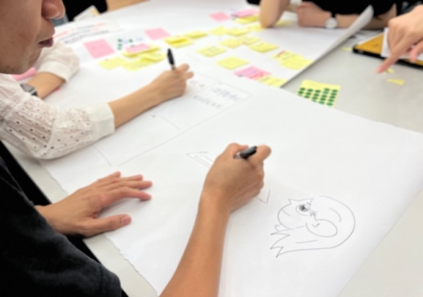
Phase 3: Experience Design and Program Execution This stage aims to translate the brand into an accessible experience across all channels. Before each workshop, we compiled past data into a brief report, ensuring participants were briefed on the current situation and objec- tives. In the final stage, an experience design workshop was conducted to brainstorm new experience ideas. Groups of five members were assigned touchpoints to devise exciting changes to the existing customer experience. These ideas were screened against brand values and experience principles, with the most desirable ones selected for the experience planning phase. Each group then storyboarded the proposed experience and suggested resources to complement the SPEC dimensions. Results were shared through contex- tual presentations, followed by discussion and voting on the most appealing and feasible experience solution, forming the basis for peak experience and further prototyping and planning. This phase yields prototypes of moment
254 Chan and Tang
of truth experience (MOTX), aiding companies in developing experiences aligned with brand value and appeal.
The workshop offers a platform for organizations to innovate experiences internally. However, experience planning necessitates resource planning and prototyping before market launch. Organizations are currently in the plan- ning and implementation phase. While the full value of experience integration is yet to be realized, the relationship between the organization, customer, brand, and experience has become closer and more systematic through the three stages of the experience reinvention process.
Figure 2: Generate ideas for touch points based on experience principles.
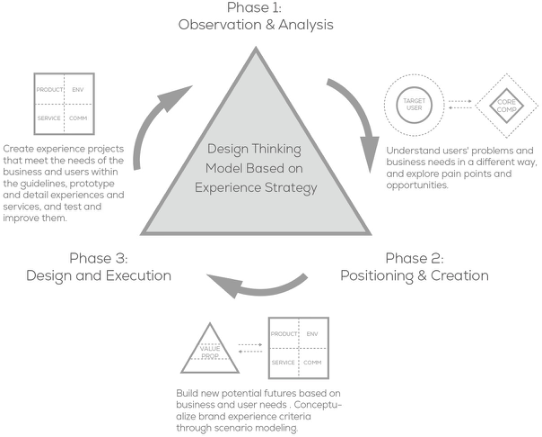
An Iterative Experience Strategy-Oriented Design Thinking Model From our case study, we’ve outlined a process applicable to brand build- ing. This process, an iteration of the experience strategy-oriented design thinking model, aims to clarify steps and goals for each implementa- tion stage (Figure 3). It’s a cyclical framework aiding organizations in brand building across different stages, particularly during transformations. It also serves as a tool to review experience programs, assess feasibility and relevance, meet user and organizational needs, convey brand values, and comply with experience principles. The methodology comprises three stages:
1. Observation & Analysis: Understand users’ problems and business needs differently, exploring pain points and opportunities. 2. Positioning & Creation: Develop potential futures based on business and user needs, conceptualizing brand experience criteria through scenario modeling. 3. Design and Execution: Develop experience projects meeting business and user needs within guidelines, prototype and detail experiences and services, and test and refine them.
Bridging Business Challenges: Optimizing Brand Experiences 255
Figure 3: Design thinking model based on experience strategy.
DISCUSSION
In assessing the effectiveness of integrating experience strategy with design thinking, 13 key organization members were interviewed. Results showed that most believed this approach enhanced brand value and streamlined brand experience execution. This approach facilitates critical decision- making and insights by offering a fresh perspective on problems. It aids organizations in understanding the strategic rationale and making informed decisions within resource constraints, refining execution direction. Addition- ally, it yields systematic results for experience management and evaluation. With a clear experience framework and target consumers, experience man- agement and evaluation can be facilitated through mystery shoppers, super- visor walk-throughs, and in-store self-assessments, enhancing companies’ ability to effectively devise marketing and product strategies.
However, challenges were identified during the interviews. Participants noted the need for quantitative verification to confirm brand experience results and a need for more resources and momentum for implementation due to the absence of a dedicated department for brand experience manage- ment. Less engaged members needed a stronger understanding of results and processes, emphasizing the need for brand education and communication.
CONCLUSION
This study explores merging experience strategy and design thinking in brand practices. Initial findings suggest this approach helps organizations understand their circumstances and respond to challenges in the Experience Economy. Future work may involve quantifying these findings or expanding their application beyond branding.
256 Chan and Tang
At a broader level, the study examines using experience strategy and design thinking beyond product development to balance corporate goals with user needs. This framework improves consistency between brand and consumer experience and reduces uncertainty in design thinking. Brand information collected aids in understanding brand components and implementing solu- tions. Combining design thinking with a strategic perspective offers a method for addressing complex business issues, extending its use across different areas, and promoting business continuity and innovation.
REFERENCES
Aaker, D. A. (1991). Managing Brand Equity: Capitalizing on the Value of a Brand Name. New York: The Free Press. Abbing, E. R. (2017). Brand-driven innovation: strategies for development and
design: required reading range module reader. London: Bloomsbury Visual Arts. Berry, L. L. (2000). Cultivating Service Brand Equity. Journal of the Academy of Marketing Science, 28(1), pp. 128–137. Berry, L. L., Carbone, L. P. and Haeckel, S. H. (2002). Managing the Total Customer
Experience. MIT Sloan Management Review. Brown, T. (2008). Design thinking. Harvard business review, 86(6), 84. Chevtchouk, Y., Veloutsou, C., & Paton, R. A. (2021). The Experience-Economy Revisited: An interdisciplinary perspective and research agenda. Journal of Prod- uct & Brand Management, 30(8), 1288–1324. https://doi.org/10.1108/JPBM-06- 2019-2406 Clatworthy, S. (2012). Bridging the gap between brand strategy and customer
experience. Managing Service Quality: An International Journal, [online] 22(2), pp. 108–127. https://doi.org/10.1108/09604521211218936. Keller, K. L. and Swaminathan, V. (2013). Strategic Brand Management: Building, Measuring, and Managing Brand Equity. 4th ed. Pearson Education. Khan, I. and Rahman, Z. (2016). Retail brand experience: scale development and
validation. Journal of Product & Brand Management, 25(5), pp. 435–451. Lai, M. and Tang, H.-H. (2023). Experience design’s transformation towards experience-driven transformation: a practical perspective. IASDR 2023: Life- Changing Design. https://doi.org/10.21606/iasdr.2023.366. Mager B. (2009). Service design as an emerging field. In: Designing services with
innovative methods. Helsinki: University Of Art And Design, pp. 28–42. Motta Filho, M. A., & Roto, V. (2018). Brand Experience Proposition: Bridging Branding and Service Design. Academic Design Management Conference 2018. International Design Management Research Conference. Munchbach, C. (2014). The convergence of brand, customer experience, and
marketing. Cambridge: Forrester Research. Pine, B. J. and Gilmore, J. H. (1999). The Experience Economy: Work Is Theatre & Every Business a Stage. Boston: Harvard Business School Press. Schmidt, K., & Ludlow, C. (2002).. Inclusive branding: the why and how of a holistic
approach to brands. Houndmills, Basingstoke, Hampshire; New York: Palgrave Macmillan. Smith, S. and Wheeler, J. (2002). Managing the customer experience: turning customers into advocates. Pearson Education. Wylant, B. (2008). Design Thinking and the Experience of Innovation. Design Issues,
24(2), pp. 3–14. https://doi.org/10.1162/desi.2008.24.2.3.
LISTED IN THE AHFE DIGITAL BOOKSTORE CATALOGUE
Explore the complete digital volume
Human Factors, Business Management and Society
Read this individual research paper free through the original publisher, or explore the full digital proceedings book.
ISBN 978-1-964867-11-3
Explore this ISBN in the AHFE Bookstore ↗Listed in the July 2026 bookstore catalogue; search by ISBN to confirm current availability · Digital book purchase optional