Josephine Halama, Manfred Thüring, Stefan Brandenburg (2023). The effects of type of road and driver personality on drivers’ automation use: an on the road study with Tesla’s autopilot. In: Human-Centered Design and User Experience. AHFE Open Access, vol. 114, pp. 589–599. https://doi.org/10.54941/ahfe1004279
Research has shown that drivers are willing to use vehicle automation. However, automated systems can only be beneficial if they are accepted, trusted and used appropriately by the driver. Therefore, the present study investigates drivers' willingness to use vehicle automation as a function of driving situation characteristics and driver personality in an on-road experiment. Firstly, the study investigates whether drivers are more or less likely to use vehicle automation depending on the type of road (rural road or motorway). It will also test whether the type of road affects the driver's in-situ assessment of the automation (e.g., criticality and mental load). Secondly, it examines whether driver personality (Big Five and affinity for technology) is related to the rate of handover, and whether drivers' in-situ assessment of vehicle automation is correlated with the rate of handover.Thirty-eight participants completed a one-hour drive with six measurement intervals and a length of 24 km in the north of Berlin. In general, the results showed that a combined handover of lateral and longitudinal automation was used most frequently, regardless of the type of road. More specifically, the type of road influenced the drivers' handover behavior. Handovers to lateral and longitudinal automation were more likely on motorways than on rural roads. The type of road also influenced in-situ ratings of automation trust, usefulness and appropriateness. Drivers' personality was found to have a significant influence on their handover behavior. Lower neuroticism scores and higher affinity for technology were associated with higher proportions of handovers. The results also show that in-situ ratings correlate with usage behavior. Critical ratings were negatively related to handovers, whereas trust, appropriateness and usefulness were positively related to handovers.Based on the results, we conclude that drivers will use automated driving functions when they have the opportunity to do so. Their usage behavior is influenced by the type of road, their assessment of the situation and aspects of their personality. The study serves as a starting point for future studies, such as naturalistic driving studies. The results also help in the design of vehicle automation and increase the understanding of drivers' use of vehicle automation.
Automated driving fundamentally changes the driving task. Level 2 (L2) automated vehicles control their lateral and longitudinal trajectory for a cer- tain period and specific driving scenarios. However, in contrast to L3, drivers are not allowed to disengage from the driving task and to direct their atten- tion towards other activities (SAE International, 2018). Automated vehicles may offer greater mobility (Casner et al., 2016), are expected to improve road safety and to reduce emissions (Tsugawa et al., 2011). However, they can only satisfy the expectations if they are accepted and applied in traffic. Previous surveys and simulator studies on automation acceptance revealed that drivers’ handovers might depend on situational characteristics, like the type of road, and on driver characteristics, such as driver personality (e.g., Fraedrich et al., 2016; Payre et al., 2014).
Situational Characteristics and Automated Driving Our study investigates the influence of situational characteristics on drivers’ willingness to employ vehicle automation in real traffic (Schott et al., 2018). A survey by Payre et al. (2014) found that 68% of drivers accept L3 auto- mated vehicles with 67% of them preferring to hand over vehicle control for parking maneuvers, 62% on highways, and only 29% in urban areas. In a simulator study by Kuehn et al. (2017), participants were more willing to use vehicle automation on motorways compared to other types of road. Ghazizadeh et al. (2012) developed a technology acceptance model for the use of automated vehicles, which postulates that automation acceptance and use rely, amongst other factors, on the driving situation including the type of road, i.e. rural road or motorway. Therefore, we assume that the handover behavior of drivers and the in-situ assessment depend on the type of road and thus the characteristics of the driving situation.
Driver Characteristics and Automated Driving In combination with situational characteristics, we examine how driver char- acteristics influence automation usage under real traffic conditions. A review by Körber and Bengler (2014) concluded that individual differences in per- sonality traits might affect the drivers’ interaction with automated vehicles. Accordingly, in a survey (Kyriakidis et al., 2015) it was found that the big five personality traits (openness, neuroticism, conscientiousness, agreeable- ness, and extraversion) are related to the ratings of participants regarding their assessment of automated driving. Extraversion was positively related to manual driving. Higher ratings of agreeableness were associated with a higher willingness to transmit information to other traffic participants and institutions, like insurance companies. More neurotic participants scored low on enjoying manual driving. Openness also revealed negative relationships with transmitting information to institutions (Kyriakidis et al., 2015). The affinity for technology, a tendency of people to enjoy technology interac- tion, is another important trait in the context of human-machine-interaction (Franke et al., 2019). In this respect, higher scores are related to more intensive technology usage (Wessel et al., 2019).
The Effects of Type of Road and Driver Personality On Drivers’ Automation Use 591
Yet it has not been examined whether these characteristics affect the drivers’ handover behavior in real driving situations and their assessment of vehicle automation. We assume that the big five personality traits and the affinity for technology impacts drivers’ handover behavior and that differ- ences in behaviour are reflected in subjective assessments of the situation.
Research Questions The present study investigates whether situational characteristics (first research question) and/or driver characteristics (second research question) affect the use of vehicle automation. In contrast to previous studies, it is conducted in real traffic and uses a vehicle of automation level 2 (SAE International, 2018) which provides longitudinal and lateral control.
METHOD
Experimental Design The present study examines drivers’ willingness to use vehicle automation depending on the characteristics of the driving situation and drivers’ person- ality in an on-the-road experiment. For this, a 2 (road type) x 3 (measurement interval) mixed experimental design was applied. The number of handovers, the driver’ in-situ ratings and their personality traits were assessed.
Participants Thirty-eight participants (15 females) with ages ranging from 24 to 54 years (M = 32 years, SD = 6 years) took part in the study. They had been holding a valid driving license for an average of 13 years (SD = 5 years). All partici- pants had a normal or corrected-to-normal vision. Thirty-five of them (92 %) reported having some experience with driver assistance systems as adaptive cruise control or parking assistance, but none had yet used an L2 automated vehicle or Tesla’s autopilot. Most participants (n = 29, 76 %) reported to drive between 8,000 and 20,000 km per year (n = 5, 16%: > 20,000; n = 3, 8 %: < 8.000). Participants received credits for their participation. This research complied with the tenets of the Declaration of Helsinki and was approved by the Insti- tutional Review Board at TU Berlin. Informed consent was obtained from each participant.
Materials
Automated Vehicle: The vehicle was a 2016 Tesla Model S P75D with autopi- lot 2.0 functionality in standard factory settings. Handing over control to the automation was offered as soon as the driving situation permitted it. Two icons in the dashboard indicated the availability of the automation (see Figure 1): a speed sign (for longitudinal control) and a wheel (for lateral control).
Longitudinal control was realized by an adaptive ACC. It was activated by pulling an automation lever on the left-hand side of the steering wheel once. The ACC regulated the speed from zero to a maximum of 150 km/h. If
necessary, it kept a 3 seconds time headway to a lead vehicle. Lateral control was realized by steering assistance. It was activated by pulling the same lever twice. The steering assistance was combined with the adaptive ACC. Thus, activating and deactivating the steering assistance equalled the activation and deactivation of the complete autopilot. Auditory feedback (two single tones following each other) and a change in color of the respective symbols from grey to blue indicated the activation of the automation. When drivers deac- tivated the automation, the same two tones were presented in reversed order and the icons changed from blue to grey. Additionally, several other assistance systems (e.g., lane change assistance, collision-avoidance system, speed assis- tance) were always active independently from the autopilot. During the drive, the experimenters captured on their notepads whether drivers handed over the longitudinal alone or together with the lateral control to the automation (number of handovers). Drivers had to remain attentive and ready to resume the control in case the automation reached its limits.
Figure 1: Automation symbols for the activated longitudinal (left) and lateral control (right).
Figure available in the original PDF paper.
In-situ protocols: At six points in time, experimenters read out aloud five statements including the scale (7-point Likert: 1 = not at all to 7 = com- pletely) and drivers answered a number indicating their amount of agreement to criticality: “The proposal of the system to use it seemed critical to me”, trust: “I could trust the system completely”, usefulness: “I considered the system to be useful”, appropriateness: “I considered the proposal to use the system to be appropriate” and mental workload: “The mental strain was high”.
Questionnaires: The drivers’ personality was assessed by the 10-item short version of the Big Five Inventory (Rammstedt & John, 2007) measuring agreeableness, conscientiousness, neuroticism, openness, and extraversion with two items each (5-point Likert scale: 1 = disagree strongly, 2 = disagree a little, 3 = neither agree nor disagree, 4 = agree a little, 5 = agree strongly). In addition, affinity for technology was measured by the ATI scale (Franke et al., 2019) with 9-items (6-point Likert scale: 1 = completely disagree, 2 = largely disagree, 3 = slightly disagree, 4 = slightly agree, 5 = largely agree, 6 = completely agree).
Procedure The study comprised an introduction phase, a test phase, and an interview phase. The introduction phase included the instruction of the participants (goals of the study, procedure, capabilities and constraints of the auto- mated vehicle) and participants drove the vehicle for about five minutes familiarizing themselves with its acceleration, deceleration, steering and the engagement and disengagement of the automation. The test phase consisted
The Effects of Type of Road and Driver Personality On Drivers’ Automation Use 593
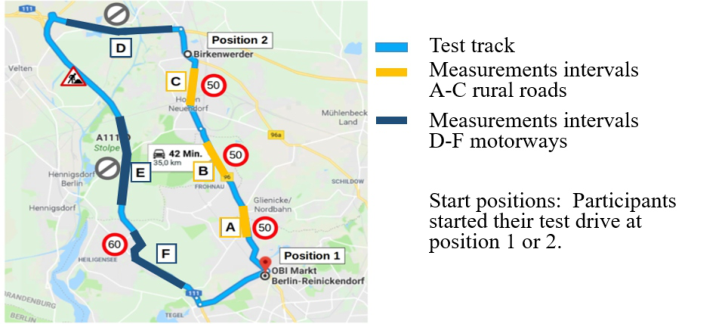
of a 24-km round course in the north of Berlin, Germany. It consisted of 11 km of rural road and 13 km of motorways (Figure 2).
Figure 2: Test track including measurement intervals and start positions.
The drivers started inside the city area (position 1) or outside (position 2) and drove the round course clockwise or anti-clockwise. Starting points and driving direction were balanced across drivers. Drivers were free to use vehi- cle automation whenever they wanted. Experimenters noted whether drivers did use the vehicle automation in the measurement intervals. After each of the six intervals the in-situ measurement was assessed. The intervals lasted for about two minutes (yellow road stretches A-F in Figure 2). They were not communicated to the drivers a priori. In the interview phase, drivers filled in the big five inventory and the ATI scale. A short interview for catching the drivers’ experiences closed the study. The complete procedure lasted for about 2.5 hours per participant.
RESULTS
We screened the data for outliers before calculating the statistics. Outliers were values that deviated from the group mean for more than 3 SD. They were replaced by the group mean +/-3 SD depending on whether the outlier was higher or lower than the group means. Thirteen values were replaced (8 for the criticality ratings, 3 for the appropriateness, and 2 for the usefulness rating).
Situational Characteristics and Automated Driving To evaluate whether the road type (motorways or rural road) affected the number of handovers, it was counted whether or not at least one handover occurred in an interval. Thereby, handovers of longitudinal and handovers of lateral and longitudinal vehicle control were analyzed separately (Table 1). This led to a total sum of 114 possible handovers for the 38 drivers on the motorway and 114 possible handovers on the rural road.
Table 1. The drivers’ use of vehicle automation depending on road type.
Table available in the original PDF paper.
Automation use Motorway Rural road SUM No 6 (5%) 15 (13%) 21 (9%) Longitudinal 21 (19%) 27 (24%) 48 (21%) Lateral and longitudinal 87 (76%) 72 (63%) 159 (70%) SUM 114 (100%) 114 (100%) 228 (100%)
A series of McNemar χ2 tests revealed that non-usage was higher on rural roads compared to motorways, χ2(1) = 86.81, p <.001. In addition, drivers used the longitudinal automation significantly more often on the rural road than on the motorway, χ2(1) = 39.12, p <.001. In contrast, the number of handovers to the longitudinal and lateral automation was significantly higher on the motorway than on the rural road, χ2(1) = 15.01, p <.001.
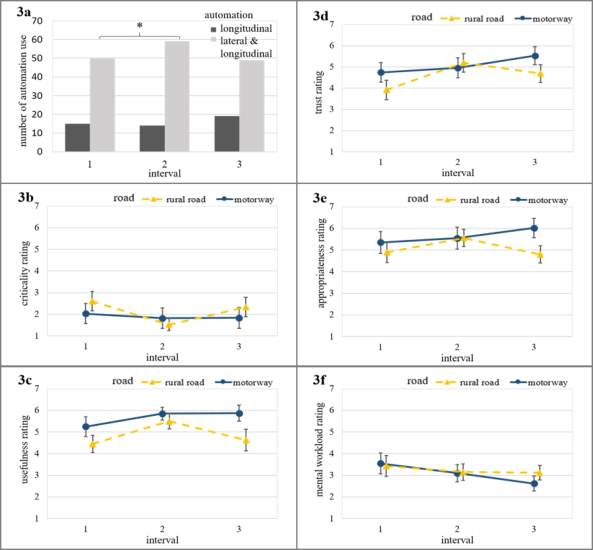
Two multinomial logistic regressions were computed to test whether the automation usage depended on the repeated experience of the automa- tion (Figure 3a). The usage of the longitudinal automation did not change between measurement intervals 1 (n1 = 15) and 2 (n2 = 14; z = 1.91, p = .050, OR = 5.13) and between intervals 1 and 3 (n3 = 19, z = .95, p = .330, OR = 1.74). In contrast, the drivers’ usage of the lateral and longitudinal automation increased significantly between the measurement intervals 1 (n1 = 50) and 2, n2 = 59, z = 2.36, p = .020, OR = 6, but not between 1 and 3, n3 = 49, z = .58, p = .550, OR = 1.34.
Figure 3: 3a) Effects of road type and measurement interval on the number of handovers to the automation and 3b-f) in-situ ratings of drivers. * p < .05.
The Effects of Type of Road and Driver Personality On Drivers’ Automation Use 595
Regarding the participants’ in-situ ratings of the automation (Figure 3b-f), a 2 (road type: motorway or rural road) x 3 (measurement interval: 1, 2, 3) a within-subjects ANOVA examined whether both factors affected the rat- ings. Table 2 shows that road type affected drivers’ ratings regarding trust, usefulness, and appropriateness. Measurement interval affected ratings of criticality, trust, usefulness, and mental load. In addition, interactions were found for trust, usefulness, and appropriateness.
Table 2. The effects of road type and measurement interval on the drivers’ in-situ ratings.
Driver Characteristics and Automated Driving Spearman correlations were calculated to examine whether driver character- istics were related to handovers. We correlated driver ratings on personality and affinity for technology with the proportion of handovers (number of driver handovers / the maximum of 6) because drivers completed both ques- tionnaires only once. Results show that lower neuroticism scores were related to higher proportions of handovers, r = −.40, p = .010. No significant dif- ferences were found for conscientiousness (r = −.17, p = .210), extraversion (r = −.06, p = .670), openness (r = −.05, p = .740), or agreeableness (r = .17, p = .480). In addition, participants had high values for affinity for technol- ogy (M = 5.05, SD = 0.64) and higher scores were associated with higher proportions of handovers (r = .46, p = .002).
Several point-biserial correlations were computed to examine whether drivers’ assessment of the situation was related to their handover behavior in each of the measurement intervals (Table 3). Criticality ratings were nega- tively related to handovers. In contrast, their ratings of trust, appropriateness, and usefulness were positively related to handovers, meaning that drivers were more likely to use the vehicle automation when they thought that it was trustworthy, appropriate to use and useful in a specific driving situation. For mental workload, no significant effect was found. The differentiation by
road type only showed a deviation for criticality as these ratings were only related to the handover behavior on motorways.
Table 3. Relationships of in-situ driver ratings and automation usage.
Table available in the original PDF paper.
In-situ ratings Both road types Motorway Rural road Criticality r = −.21, p = .001* r = −.32, p <.001* r = −.14, p = .130 Trust r = .25, p <.001* r = .29, p = .001* r = .21, p = .020* Usefulness r = .43, p = .010* r = .30, p <.001* r = .47, p <.001* Appropriateness r = .24, p <.001* r = .24, p = .008* r = .21, p = .020* Mental workload r = .00, p > .05 r = −.04, p = .660 r = .05, p = .590
DISCUSSION
Situational Characteristics and Automated Driving The first research question investigated whether the use of automation depended on situational characteristics. Results showed that handovers to the lateral and longitudinal automation were more likely on motorways com- pared to rural roads. This finding is in line with the results of surveys (e.g., Fraedrich et al., 2016; Payre et al., 2014). Drivers might be more willing to delegate complete vehicle control in very monotonous situations and align their handover preferences to their knowledge regarding the limitations of the automation. Today’s automated vehicles can operate smoothly in highly controlled situations, like on motorways or during parking (cf. Gold et al., 2013). Less controlled scenarios, such as rural roads with poorly visible lane markings, construction sites, and road barriers remain a challenge and will continue to be so in the foreseeable future (Campbell et al., 2010). In the present study, drivers were aware of these limitations and might have adjusted their behavior accordingly. However, in everyday traffic not all drivers might realize automation limitations (Dikmen & Burns, 2016). Furthermore, the affinity for technology in the sample was high. Future studies should examine driver interactions with automated vehicles applying more diverse samples including novice and elderly drivers (Körber & Bengler, 2014).
Additionally, automation usage did not differ largely between the begin- ning, middle, and the end of the one-hour test drive. In contrast, research in driving simulators has revealed behavioral adaptation effects with repeated experience of a multi-stage collision warning (Winkler et al., 2018) or in situ- ations in which drivers repeatedly reacted to takeover requests (Roche et al., 2018). However, these studies examined changes in driver behavior after takeover requests. The present study assessed handovers of vehicle controls from the driver to the automation without indications of behavioral adap- tation effects. Maybe these effects will appear if drivers have more time to familiarize themselves with the automation. In addition, drivers experienced an artificial driving situation with two experimenters being in the vehicle ask- ing questions, taking notes, navigating, and disciplining drivers if necessary. This setting likely affected the results by keeping the drivers more alert and cautious than they might have been when driving alone.
The Effects of Type of Road and Driver Personality On Drivers’ Automation Use 597
Driver Characteristics and Automated Driving The second research question investigated whether some drivers are more likely to hand over vehicle control to the automation than others. The present study revealed that higher scores for affinity for technology were related to higher proportions of using vehicle automation. These results align with pre- vious research showing that higher scores are associated with higher intrinsic motivation to use fitness trackers (Attig & Franke, 2019) and lower workload when interacting with new technological artefacts (Attig et al., 2018).
In addition, a negative relationship of neuroticism with the proportion of handovers was found. Drivers scoring higher on this trait get nervous eas- ily and handle stress less well (Rammstedt & John, 2007). Engaging vehicle automation might have led to negative feelings and stress for drivers with higher neuroticism indicating that the design of vehicle automation should reduce stress. Yet, the correlation between neuroticism and the proportion of handovers was only small. Future research should validate it with larger and more diverse samples.
In general, only few significant correlations between driver characteristics and handovers were found. This might be due to the constantly high rates of automation usage in this sample (Table 1) impeding large correlations. High rates of automation usage could indicate a self-selection bias in the sample. The possibility of driving an automated vehicle might have attracted drivers that are more likely to apply the automation. Therefore, missing cor- relations are not necessarily indicators for not existing relationships between personality and handover behavior.
Limitations Firstly, a one-hour drive might have been too short to completely familiar- ize with vehicle automation. A longer driving period could have led to a more realistic use of vehicle automation and in-situ evaluations (Beggiato et al., 2015).
Secondly, ethical and safety concerns demanded very clear instructions about the capabilities and constraints of the automation and a close mon- itoring of the drivers. This may have had the effect that perceived criticality was low overall. If safety permits, future studies should investigate situations that appear as more critical.
Thirdly, we only investigated road type as one characteristic of a driv- ing situation. Research on the interaction of drivers with automated vehicles revealed that other traffic participants (Jamson et al., 2013), road geometry (Brandenburg & Chuang, 2019), and other factors also affect driver behavior. Future studies should examine the effects of these variables on the handover of drivers.
CONCLUSION
The results of the present study suggest that drivers apply automated driv- ing functions when they have the chance to do so. Their usage behavior is influenced by the characteristics of the driving situation and aspects of their personality. The study is a first step to understand the handover behavior of
drivers in real traffic. However, future studies should replicate the findings and validate them in naturalistic driving studies. This research can facili- tate the understanding of the mid- and long-term implications of automated driving regarding traffic safety.
ACKNOWLEDGMENT
We thank Friederice Kuhn and Ronja Schott for their support in data collection. The research was funded by the DFG (German Research Foun- dation – Project-ID 416228727 – CRC 1410).
REFERENCES
Attig, C., & Franke, T. (2019). I track, therefore I walk – Exploring the motivational costs of wearing activity trackers in actual users. International Journal of Human- Computer Studies, 127, 211–224. https://doi.org/10.1016/j.ijhcs.2018.04.007 Attig, C., Mach, S., Wessel, D., Franke, T., Schmalfuß, F., & Krems, J. F. (2018). Tech-
nikaffinität als Ressource für die Arbeit in Industrie 4.0. Innovation der innovation - neu gedacht, neu gemacht, 3, 1–9. https://doi.org/10.14464/awic.v3i0.251 Beggiato, M., Pereira, M., Petzoldt, T., & Krems, J. (2015). Learning and development of trust, acceptance and the mental model of ACC. A longitudinal on-road study. Transportation Research Part F: Traffic Psychology and Behaviour, 35, 75–84. https://doi.org/10.1016/j.trf.2015.10.005 Brandenburg, S., & Chuang, L. (2019). Take-over requests during highly auto-
mated driving: How should they be presented and under what conditions? Transportation Research Part F: Traffic Psychology and Behaviour, 66, 214–225. https://doi.org/10.1016/j.trf.2019.08.023 Campbell, M., Egerstedt, M., How, J. P., & Murray, R. M. (2010). Autonomous driving in urban environments: Approaches, lessons and challenges. Philosophi- cal Transactions of the Royal Society A: Mathematical, Physical and Engineering Sciences, 368(1928), 4649–4672. https://doi.org/10.1098/rsta.2010.0110 Casner, S. M., Hutchins, E. L., & Norman, D. (2016). The challenges of partially
automated driving. Communications of the ACM, 59(5), 70–77. Dikmen, M., & Burns, C. M. (2016). Autonomous Driving in the Real World: Experiences with Tesla Autopilot and Summon. 225–228. https://doi.org/10.1145/ 3003715.3005465 Fraedrich, E., Cyganski, R., Wolf, I., & Lenz, B. (2016). User Per- spectives on Autonomous Driving: A Use-Case-Driven Study in Germany (Arbeitsbericht No. 187). HU Berlin. Franke, T., Attig, C., & Wessel, D. (2019). A Personal Resource for Technology
Interaction: Development and Validation of the Affinity for Technology Interac- tion (ATI) Scale. International Journal of Human–Computer Interaction, 35(6), 456–467. https://doi.org/10.1080/10447318.2018.1456150 Ghazizadeh, M., Lee, J. D., & Boyle, L. N. (2012). Extending the Technology Acceptance Model to assess automation. Cognition, Technology & Work, 14(1), 39–49. https://doi.org/10.1007/s10111-011-0194-3 Gold, C., Damböck, D., Lorenz, L., & Bengler, K. (2013). “Take over!” How long
does it take to get the driver back into the loop? Proceedings of the Human Factors and Ergonomics Society Annual Meeting, 57(1), 1938–1942. https://doi.org/10. 1177/1541931213571433
The Effects of Type of Road and Driver Personality On Drivers’ Automation Use 599
Jamson, A. H., Merat, N., Carsten, O. M. J., & Lai, F. C. H. (2013). Behavioural changes in drivers experiencing highly-automated vehicle control in varying traf- fic conditions. Transportation Research Part C: Emerging Technologies, 30, 116–125. https://doi.org/10.1016/j.trc.2013.02.008 Körber, M., & Bengler, K. (2014). Potential Individual Differences Regarding
Automation Effects in Automated Driving. Proceedings of the XV International Conference on Human Computer Interaction - Interacción’ 14, 1–7. https://doi. org/10.1145/2662253.2662275 Kuehn, M., Vogelpohl, T., & Vollrath, M. (2017). Takeover Times In Highly Automated Driving (level 3). 1–11. Kyriakidis, M., Happee, R., & de Winter, J. C. F. (2015). Public opinion on auto-
mated driving: Results of an international questionnaire among 5000 respondents. Transportation Research Part F: Traffic Psychology and Behaviour, 32, 127–140. https://doi.org/10.1016/j.trf.2015.04.014 Lakens, D. (2013). Calculating and reporting effect sizes to facilitate cumulative science: A practical primer for t-tests and ANOVAs. Frontiers in Psychology, 4(863), 1–12. https://doi.org/10.3389/fpsyg.2013.00863 Payre, W., Cestac, J., & Delhomme, P. (2014). Intention to use a fully automated
car: Attitudes and a priori acceptability. Transportation Research Part F: Traf- fic Psychology and Behaviour, 27, 252–263. https://doi.org/10.1016/j.trf.2014. 04.009 Rammstedt, B., & John, O. P. (2007). Measuring personality in one minute or less: A 10-item short version of the Big Five Inventory in English and German. Jour- nal of Research in Personality, 41(1), 203–212. https://doi.org/10.1016/j.jrp.2006. 02.001 Roche, F., Somieski, A., & Brandenburg, S. (2018). Behavioral Changes to Repeated
Takeovers in Highly Automated Driving: Effects of the Takeover Request-Design and the Non-Driving Related Task-Modality. Human Factors: The Journal of the Human Factors and Ergonomics Society, 61(5), 839–849. https://doi.org/10.1177/ 0018720818814963 SAE International. (2018). Taxonomy and Definitions for Terms Related to Driving Automation Systems for On-Road Motor Vehicles (J3016). https://www.sae.org/ standards/content/j3016_201806/ Schott, R., Brandenburg, S., Thüring, M., Schröder, F., & Telle, F. (2018). Who is
driving whom? Highly automated driving transitions from manual to automa- tion in reality and the impact of situation, personality and the driving experience. Human Factors and Ergonomics Society Europe Chapter, Berlin, Deutschland. 10.13140/RG.2.2.33542.83521. Tsugawa, S., Kato, S., & Aoki, K. (2011). An automated truck platoon for energy saving. 2011 IEEE/RSJ International Conference on Intelligent Robots and Systems, 4109–4114. https://doi.org/10.1109/IROS.2011.6094549 Wessel, D., Attig, C., & Franke, T. (2019). ATI-S - An Ultra-Short Scale for Assess-
ing Affinity for Technology Interaction in User Studies. Proceedings of Mensch Und Computer 2019 on - MuC’19, 147–154. https://doi.org/10.1145/3340764. 3340766 Winkler, S., Kazazi, J., & Vollrath, M. (2018). Practice makes better – Learning effects of driving with a multi-stage collision warning. Accident Analysis & Prevention. https://doi.org/10.1016/j.aap.2018.01.018
LISTED IN THE AHFE DIGITAL BOOKSTORE CATALOGUE
Explore the complete digital volume
Human-Centered Design and User Experience
Read this individual research paper free through the original publisher, or explore the full digital proceedings book.
ISBN 978-1-958651-90-2
Explore this ISBN in the AHFE Bookstore ↗Listed in the July 2026 bookstore catalogue; search by ISBN to confirm current availability · Digital book purchase optional