Sandor Dalecke (2023). 'A review of user guidance techniques to enable "inclusive" systems engineering for domain experts. In: Application of Emerging Technologies. AHFE Open Access, vol. 115, pp. 215–223. https://doi.org/10.54941/ahfe1004318
With the ever-increasing assistance of technology in most, if not all, industries the concept of modeling systems and systems engineering becomes ever more important. However, meeting the needs of domain experts in different fields is challenging. Enabling domain experts to model and build systems themselves would reduce the possibility of miscommunication and number of needs not met by a system.Systems Engineering is defined by INCOSE as: “Systems Engineering is a transdisciplinary and integrative approach to enable the successful realization, use, and retirement of engineered systems, using systems principles and concepts, and scientific, technological and management methods.” However, the transdisciplinary aspect clashes with domain experts who are inapt in regards of systems engineering, as it needs special training and requires the understanding of complex core concepts. This results in domain experts needing to communicate their needs to systems engineers, who are supposed to build systems satisfying these needs. However, such needs can easily be miscommunicated, leading to systems not meeting the requirements and time, money and effort being wasted. This would be reduced if the domain experts themselves were able to build or model these systems themselves. Aim and Novelty: Therefore, we suggest to move towards a more inclusive systems engineering process which focuses on specifically guiding users through the systems engineering process, reducing the need of special training.Guiding users has been researched in many different fields, not only in regards of psychology and social sciences, but also in computer science in particular. Digital nudging, persuasive systems, user-centric UI design, recommender systems and gamification all aim to guide a user towards certain decisions or making tools easier to use. These fields have been researched mostly as independent fields with similar goals but in different context. In order to create inclusive systems engineering tools it is important to incorporate and understand these fields to guide the user through the systems engineering process. Methodology: In order to examine similarities and identify areas where one guidance technique might be lacking and thus profiting from the use of another technique the state-of-the-art literature is reviewed. In order to identify applicable literature a search for the keywords “Gamification; Nudging; recommender system; persuasive system; user guidance; user experience and user motivation” has been done.These where screened on their relevancy to user guidance and motivation, as well as their use of techniques applicable in a software engineering process. Conclusion: This paper introduces the concept of inclusive systems engineering. Focusing on user guidance this paper gives an overview on state-of-the-art techniques, examined similarities as well as areas where different techniques can complement each other. This paper aims to provide an overview of current user guidance techniques in order to provide a starting point to move systems engineering into a more inclusive direction that can be done not only by experts in systems engineering but also domain experts in order to reduce the potential of misunderstanding when domain experts need to specify their needs to systems engineering experts in order to realize and use new systems.
With the ever-increasing assistance of technology in most, if not all, industries the concept of systems engineering and systems modelling becomes ever more important. However, meeting the needs of domain experts in different fields is challenging. Enabling domain experts to model and build systems themselves would reduce the possibility of miscommunication and number of needs not met by a system.
Systems Engineering is defined by INCOSE (Incose, 2017) as: “Systems Engineering is a transdisciplinary and integrative approach to enable the successful realization, use, and retirement of engineered systems, using sys- tems principles and concepts, and scientific, technological and management methods.”
However, the transdisciplinary aspect clashes with domain experts who are inapt in regards to systems engineering, as it requires special training and the understanding of complex core concepts. This results in domain experts needing to communicate their needs to systems engineers, who are supposed to build the required systems. However, these needs can easily be miscom- municated, leading to systems not meeting the requirements wasting time, money and effort. This could be reduced if the domain experts themselves were able to build or model these systems themselves.
Therefore we propose an “inclusive” systems engineering process which follows the definition given by INCOSE adding a special focus on guiding
the user through the systems engineering process in order to reduce the need for specialised training.
Guiding has been researched in a number of fields, not only in psychol- ogy and social sciences, but also in computer science in particular. Digital nudging, persuasive systems, user-centric UI design, recommender systems and gamification all aim to guide users towards certain behaviour or are used to make tools easier to use. These fields have mostly been researched independently due to different contexts. In order to create inclusive systems engineering tools it is important to understand these fields and use them to guide the user through the whole systems engineering process from start to finish.
In order to examine similarities and identify areas where different tech- niques can benefit from each other this paper reviews the current core concepts of each of the mentioned fields. As all of these techniques are used to influence human behaviour it is important to briefly discuss two widespread theories of human behaviour as well as giving a very brief eth- ical justification to why a move towards inclusive systems engineering is justified.
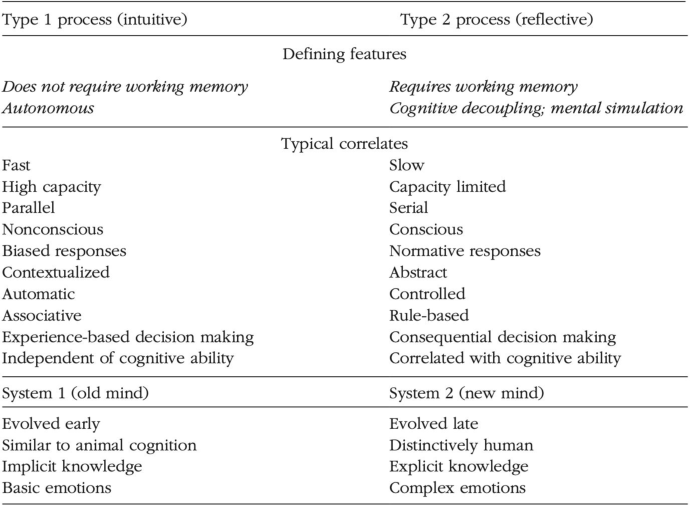
PSYCHOLOGICAL FOUNDATIONS Kahneman (Kahneman, 2011) presented the dual-process theory on behaviour, distinguishing between a fast and automatic System 1 and a slow, reflective System 2. System 1, being fast and, importantly, effortless, guides the vast majority of actions, whereas System 2 guides conscious deci- sions and behaviour. In order to influence behaviour either System can be targeted.
Following Kahneman, the dual-process theory has been refined and multi- ple theories have been suggested. Evans and Stanovich (Evans and Stanovich, 2013) have built upon critique and propose their dual-process theory of higher cognition, distinguishing between type 1 processes and type 2 pro- cesses, previously called system 1 and system 2 respectively. It is important to note that human decision making is far from being fully understood, but the dual-process model gives the important distinction between fast and automatic decision making which is prone to biassed responses and slower, consciously thought about decisions which can be controlled, and importantly, overrule the fast response.
In the case of “inclusive” systems engineering we aim to reduce the effort needed in order to target domain experts. Therefore it’s not sufficient to tar- get the type 2 processes exclusively. The conscious decisions in this context should focus on the end result instead of the engineering process, i.e. the deci- sion how two objects are related to each other should be conscious whereas the decision which syntax is used to represent this relationship should not. These processes are not exclusive to two different systems in the brain, as theorised before.
In order to differentiate influence methods utilising the different types of processing this work will refer to type 1 and type 2 processing, omitting the specific systems and their inner workings.
A Review of User Guidance Techniques to Enable “Inclusive” Systems Engineering 217
Figure 1: Cluster of attributes frequently associated with dual-process and dual-system theories of higher cognition (Evans and Stanovich, 2013).
BEHAVIOUR INFLUENCE METHODS Digital Nuding
Nuding [Thaler] proposes the possibility to influence behaviour by designing the environment, the so-called choice architecture, of a decision in order to make a certain outcome more likely. Most nudges make use of biases or basic emotions, targeting the type 1 processing.
Nudging has been adapted in the field of HCI (human-computer interac- tion) quickly, as a change in the choice architecture can be easily implemented and even be personalised if sufficient behavioural data is provided (Dalecke and Karlsen, 2020) (Karlsen and Anderson, 2019).
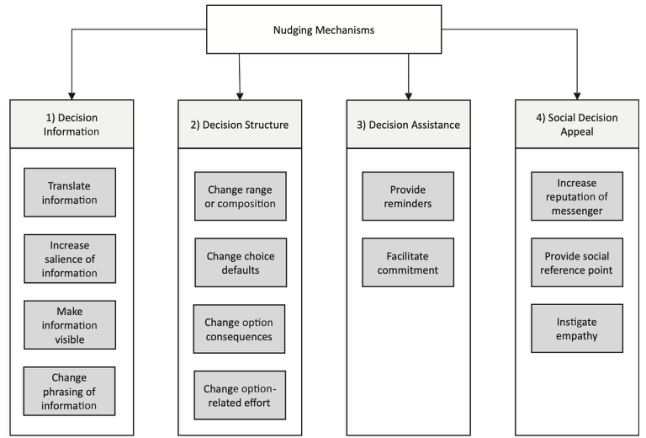
Caraban et al. (Caraban et al., 2019) identified 23 distinct mechanisms of nudging, whereas the more recent work of Jesse and Jannach (Jesse and Jannach, 2021) identified 87 mechanisms in 4 broader categories. Due to the limitations of this work not all of these mechanisms can be discussed in detail.
Fig. 2 shows their taxonomy. Each broad category describes an aspect of a decision, with subcategories showing strategies to change how the decision is processed. The identified 87 mechanisms are explicit examples of these broader strategies. The most common of these examples are aspects of infor- mation simplification, default choices and social comparison. Nudges mostly utilise decision biases, targeting the type 1 processing.
An important aspect of digital nudging is the focus on single decision points. The impact of one decision on future ones is usually not considered. A long term behaviour change is only pursued implicitly by nudging a recurring decision each time.
218 Dalecke
Figure 2: Taxonomy of nudging mechanisms (Jesse and Jannach, 2021).
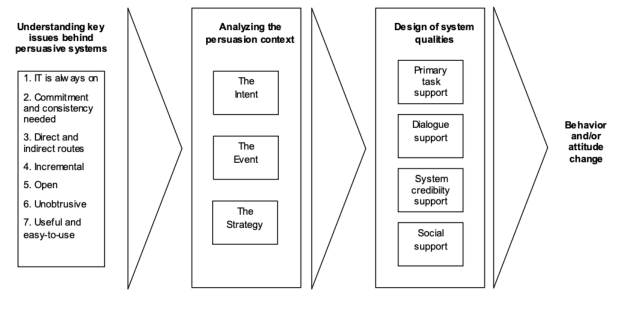
PERSUASIVE SYSTEM DESIGN Fogg (Fogg, 2002) was one of the first to consider using user interface design to guide user decision making. In his work on Persuasive Technology he presented a first framework with five principles. These five principles have been expanded since then towards 28 by Oinas-Kukkonen (Oinas-Kukkonen and Harjumaa, 2018) and have been also included by Murillo-Munoz et al. (Murillo-Munoz et al., 2018) in their proposed framework on persuasive mobile systems.
Figure 3: Phases in persuasive systems development (Oinas-Kukkonen and Harjumaa, 2018).
Figure 3 gives examples for the four categories of the last phase of the persuasive system design process, which are the specific principles used to
A Review of User Guidance Techniques to Enable “Inclusive” Systems Engineering 219
influence the behaviour. For example the primary task support focuses on simplification and personalisation, omitting unimportant information for the specific user. Importantly, social aspects are part of all other categories, emphasising the social role of the system, appeal to authority and social comparison respectively. The primary task support focuses highly on type 1 processing. The other categories focus on a mix of type 1 and type 2 pro- cessing by also making the user reflect upon the consequences and social implications of the decision for example.
Persuasive system design focuses both on the single decision point but includes many social aspects, targeting type 2 processing in order to change future behaviour into a certain direction. This intended behaviour change is likely the reason why persuasive system design has been applied in a number of healthcare applications and studies (Schneider et al., 2016).
Recommender Systems The observation that people tend to decide favourably towards recommen- dations by their social surroundings (Ricci et al., 2010) motivated research on recommender systems. These systems use different means (i.e. finding sim- ilarities in content, using ratings by other users and many more [Çano and Morris, 2017]) to gather possible choices to recommend a product or action to a user. By using a large quantity of data these systems suggest the per- ceived best options to the user, whereas the quality of these suggestions highly depend on the algorithms used to identify these options. However, the perti- nence of the suggestions is dependent on what the user considers to be helpful and important to them both currently and in the future.
Additionally, recommender systems need to consider psychological effects. Jesse and Jannach (Jesse and Jannach, 2021) have shown that only a compar- atively small number of nudging techniques have already been considered in recommender system research.
Generally, most recommender systems aim to prompt further direct choices made by the user, reducing the workload of the next decision and simplifying it. This targets type 1 processing in most cases unless a reflection on a decision is explicitly prompted to be used in future recommendations.
Gamification Matallaoi et al. (Matallaoi et al., 2017) defines gamification as the integra- tion of game mechanics and elements into non-game environments with the purpose to increase user engagement, enjoyment, as well as loyalty. Gami- fication tries to increase motivation, trying to change undesired behaviour into desired behaviour (AlMarshedi et al.) which is based on the assump- tion of motivation being a strong force of behaviour (Fogg, 2009). Mentally stimulating game aspects are used to stimulate the user, targeting the type 1 processing in order to reduce aversion to a task and thus prompting type 2 processing in future decisions in order to overrule the intuitive type 1 response and change future behaviour.
220 Dalecke
COMPARISON Comparing the discussed methods shows clear similarities between these methods.
This is expected, as all methods aim to utilise the same underlying psy- chological effects. The most prominent example is the use of framing and simplification when targeting type 1 processing and feedback and social reflection in case of type 2 processing. Surprisingly, Adams et al. (Adams et al., 2015) found that 94% of technologies aimed at behaviour change target type 2 processing.
Table 1. Comparison of behaviour influence methods.
Behaviour Influence Method Nudging Point of decision making
Only current decision
Mostly type 1 Processing
Only through repeated nudging Persuasive Systems
Current decision Possibly further decisions
Mixture of type 1 and type 2 processing
Point of decision making Reflection upon decision
Behaviour change through repeated use and social implications/ reflection Recommender Systems
After a decision Guiding towards future decisions
Mixture of type 1 and type 2 processing Focus on future decisions Focus on lasting behaviour change
Usually directly follow- ing decisions targeted No lasting behaviour change Gamification Change current decision feedback
Targeting type 2 processing to overrule type 1 processing
Table 1 gives an overview of the influencing methods, when they are used and which decisions are affected. Furthermore, it shows if type 1 or type 2 processing is targeted and if a lasting behaviour change is intended. As the specific examples of the methods can be quite different these are only broad classifications.
However, table 1 clearly shows the connection between nudging and per- suasive systems, both often targeting current decisions and often using type 1 processing to function. As shown before it’s also clear to see that both often use simplification and social norms, making both methods extremely similar. The main distinction is the focus on lasting behaviour change. Persuasive Sys- tems often aim towards lasting behaviour change, thus targeting the type 2 processing more.
Recommender systems and gamification are also quite similar, with the main difference of lasting behaviour change. Secondly, while both aim to change future decisions, gamification is more intended towards motivation of recurring decisions and repetition of the same task, whereas recommender systems focus on similar decisions to expand upon a decision.
It is important to note that recommender systems and gamification both are special by not only using nudges in order to function but can be consid- ered nudges themselves, as they often incorporate at least three of the four
A Review of User Guidance Techniques to Enable “Inclusive” Systems Engineering 221
categories from Figure 1, namely 1) Making information visible, 2) Change the option related effort and 4) Provide social reference points.
Overall, it is clear that all four methods work with the same behavioural principles in mind.
“INCLUSIVE” SYSTEMS ENGINEERING Domain experts usually have worked in their domain for a long period of time, being familiar with common methods and techniques in their domain. However, systems engineering is a comparatively new discipline with its own complex tools and techniques, making it hard for domain experts to also become experts in system engineering. Still, the knowledge of these domain experts is often the topic of many system engineering processes, giving rise to the need of domain experts who are also systems engineering experts. Guid- ing domain experts through the systems engineering process would therefore solve a major problem.
In order to guide domain experts through the systems engineering process requires the use of multiple of the aforementioned methods. Using nudges to focus on type 1 processing can simplify the process, especially regard- ing syntactical choices in order to keep mental capacity for the important semantic choices. These nudges can be further refined by using persuasive systems design to facilitate a behaviour change towards the engineering of more comprehensive systems, using reflection to highlight the benefits of comprehensive structures in the future.
The engineering process of more comprehensive systems can further be facilitated by using recommender systems to suggest areas for refinement, the reusing of already existing structures or even suggest complimentary new structures in varying amounts of detail.
Theoretically, gamification aspects can also be incorporated in order to motivate the user towards refinement of a system.
Keeping these methods in mind when designing new system engineering tools should result in tools which focus on making the syntactical part of system engineering as simple as possible and guiding the user along the way, suggesting common subsystems in order to draw upon the vast experience of domain experts without the need of dedicated system engineering experts needing to translate the knowledge of experts into systems, but enabling the experts to do this themselves, resulting in an “inclusive” systems engineering process.
Further simplification methods like natural language processing need to be considered as well, but are out of the scope of this paper.
ETHICAL DISCUSSION Influencing human behaviour subtlety should never be done lightly. In order to decide if it is ethical to influence human behaviour is highly dependent on the goal and the wilful participation of the target. The move towards an inclusive systems engineering process aims to make the systems engineering
222 Dalecke
process easier for domain experts, enabling them to satisfy their needs with- out relying as much on others. This can be considered as a positive effect for the targets. Furthermore it would be possible to build inclusive systems engineering tools which inform the user about the use of the influencing techniques or even give the option to remove the use of these.
Each inclusive systems engineering tool needs to be examined case by case, but the move towards a more inclusive systems engineering process itself can be considered ethical in the authors opinion.
CONCLUSION
In order to make the systems engineering process easier to use and thus more inclusive, the concept of “inclusive” systems engineering was proposed. The main idea is guiding a user through the systems engineering process by using nudges, persuasive systems design and recommender systems to reduce the complexity on the syntactic and semantic level.
This paper has discussed the concept of dual-process theory in order to categorise which types of processing are targeted by different behaviour influencing techniques. Furthermore, four common influencing techniques, namely nudging, persuasive systems design, recommender systems and gam- ification have been presented in order to give a broad comparison of these techniques.
This comparison has shown that the techniques importantly differ between the intent of lasting behaviour change and their focus on current or future behaviour.
Furthermore, it has briefly been discussed how these methods can be used in order to make the software engineering process more inclusive towards domain experts.
LIMITATIONS Studies regarding the effects of behaviour influencing techniques are rare and often not as well defined as one would hope. The concrete effects of the dif- ferent techniques are hard to quantify, especially when using them in unison where they can influence each other.
Furthermore, domain experts as the main audience to use systems engi- neering is a rare approach, making it impossible to use currently available, and mostly proprietary, systems engineering tools as a basis.
SysMD (Dalecke et al., 2022), which is currently being developed, aims to be the first open-source systems engineering tool focusing on being inclu- sive to use. However, being still in development means no studies and comparisons of this tool are available at the current moment.
REFERENCES
Adams, A. T., Costa, J., Jung, M. F. and Choudhury, T., 2015, September. Mindless computing: designing technologies to subtly influence behavior. In Proceedings of the 2015 ACM international joint conference on pervasive and ubiquitous computing (pp. 719–730).
A Review of User Guidance Techniques to Enable “Inclusive” Systems Engineering 223
AlMarshedi, A., Wanick, V., Wills, G. B. and Ranchhod, A., 2017. Gamification and behaviour. Gamification: Using game elements in serious contexts, pp. 19–29. Caraban, A., Karapanos, E., Gonçalves, D. and Campos, P., 2019, May. 23 ways
to nudge: A review of technology-mediated nudging in human-computer interac- tion. In Proceedings of the 2019 CHI conference on human factors in computing systems (pp. 1–15). Çano, E. and Morisio, M., 2017. Hybrid recommender systems: A systematic literature review. Intelligent data analysis, 21(6), pp. 1487–1524. Dalecke, S. and Karlsen, R., 2020, June. Designing dynamic and personalized nudges.
In Proceedings of the 10th International Conference on Web Intelligence, Mining and Semantics (pp. 139–148). Dalecke, Š., Rafique, K. A., Ratzke, A., Grimm, C. and Koch, J., 2022, May. SysMD: Towards “Inclusive” Systems Engineering. In 2022 IEEE 5th International Con- ference on Industrial Cyber-Physical Systems (ICPS) (pp. 1–6). IEEE. Evans, J. S. B. and Stanovich, K. E., 2013. Dual-process theories of higher cognition:
Advancing the debate. Perspectives on psychological science, 8(3), pp. 223–241. Fogg, B. J., 2002. Persuasive technology: using computers to change what we think and do. Ubiquity, 2002(December), p. 2. Fogg, B. J., 2009, April. A behavior model for persuasive design. In Proceedings of
the 4th international Conference on Persuasive Technology (pp. 1–7). Incose.org. (2017). Systems Engineering. [online] Available at: https://www.incose.org/systems-engineering. Jesse, M. and Jannach, D., 2021. Digital nudging with recommender systems: Survey and future directions. Computers in Human Behavior Reports, 3, p. 100052. Kahneman, D., 2011. Thinking, fast and slow. Macmillan. Karlsen, R. and Andersen, A., 2019. Recommendations with a nudge. Technologies,
7(2), p. 45. Matallaoui, A., Hanner, N. and Zarnekow, R., 2017. Introduction to gamification: Foundation and underlying theories. Gamification: Using Game Elements in Serious Contexts, pp. 3–18. Murillo-Munoz, M. F., Vazquez-Briseno, M., Cota, C. X. N. and Nieto-Hipólito, J. I.,
2018, February. A framework for design and development of persuasive mobile systems. In 2018 International Conference on Electronics, Communications and Computers (CONIELECOMP) (pp. 59–66) IEEE. Oinas-Kukkonen, H. and Harjumaa, M., 2018. Key Issues, Process Model and System Features 1. Routledge handbook of policy design. Ricci, F., Rokach, L. and Shapira, B., 2010. Introduction to recommender systems
handbook. In Recommender systems handbook (pp. 1–35). Boston, MA: Springer US. Schneider, H., Moser, K., Butz, A. and Alt, F., 2016, May. Understanding the mechanics of persuasive system design: a mixed-method theory-driven analysis of freeletics. In Proceedings of the 2016 CHI Conference on Human Factors in Computing Systems (pp. 309–320).
LISTED IN THE AHFE DIGITAL BOOKSTORE CATALOGUE
Explore the complete digital volume
Application of Emerging Technologies
Read this individual research paper free through the original publisher, or explore the full digital proceedings book.
ISBN 978-1-958651-91-9
Explore this ISBN in the AHFE Bookstore ↗Listed in the July 2026 bookstore catalogue; search by ISBN to confirm current availability · Digital book purchase optional