Kiyoshi Kurakawa, Megumi Aibara, Kazumi Sekiguchi, Takako Sinzi, Aiko Takazawa, Masakazu Furuichi (2023). Applicability of the Thank You Exchange System to Employee Evaluation and How to Apply it to External Organizations. In: Application of Emerging Technologies. AHFE Open Access, vol. 115, pp. 258–265. https://doi.org/10.54941/ahfe1004322
As a corporate CEO for many years, one of the authors has tried a variety of personnel management measures. Among them, our research group has particularly focused on bonus evaluation. Bonus assessment is based on “performance evaluation” and “emotional evaluation.” However, while the former enables objective judgment based on sales and working hours, the latter is based on interviews with supervisors, making it difficult to eliminate subjectivity. Therefore, we proposed a method that provides objectivity by swapping acknowledgments/gratitude among employees using a messages exchange system for employees. From November 2019 to November 2021, the system was operated in-house over four periods of six months each, and the applicability to bonus assessment was confirmed. In the next step, we are planning to expand this system not only to other companies but also to more broad external organizations. This paper describes the overview of this system, the evaluation results, and the future plans.
One of the authors has been a corporate CEO for many years and has tried many different human resource management measures (Kajiwara, 2004, Asahi, 2003). Among them, he has focused particularly on bonus evalua- tions. Among them, we have particularly focused on bonus evaluation. The assessment of performance-based compensations for employees is connected to “performance evaluation” and “emotional evaluation.” While the for- mer enables superiors’ objective judgment using individual achievements and organizational revenue improvement (e.g., sales and working hours), the lat- ter relies on subordinate-superior interviews, making it difficult to eliminate subjectivity. To maintain objectivity and secure privacy, our research team developed a new system: one is for employee communication, and the other is for a subordinate-superior interaction. This internal thank-you message
Applicability of the Thank You Exchange System to Employee Evaluation 259
exchange system (tBC) allows swapping acknowledgments/gratitude (i.e., “thank-you” messages) and gauging their weight among employees. From November 2019 to November 2021 the system was operated in-house over four periods of six months each, and the applicability to bonus assessment was determined. The first two periods were used as a preliminary experi- ment to identify operational problems, and the following two were used as the primary experiment for applying tBC to actual bonus assessments. As a result, our findings suggest that our proposed method is applicable for the emotional evaluation part of bonus assessment.
After this experimental operation, our company’s bonus assessments have been based on quantitative data using tBC, which means that we can use tBC for emotional evaluation within the same organization. In other words, this can be considered as a “value” in the form of a currency that compensates the employee by exchanging thank-you messages.
The common feedback received from employees who experienced this new bonus assessment system was the applicability of tBC. This indicates that records of the exchange of messages of appreciation with members of all communities to which the employee belongs can facilitate the creation of the “value” among community members in the context of their social activities in everyday life.
This paper describes the overview of tBC system and the developing extend version of tBC.
PROPOSED EMOTIONAL EVALUATION METHOD AND SYSTEM In this study, we focus on personnel evaluation in a company with a pyramid- like structure with a hierarchical chain of command, with the president and leaders of each department at the top. In such a company, there are various methods for grasping the status of employees and conducting personnel eval- uations, and as mentioned earlier, various methods have been applied in the company. This section describes the personnel evaluation and bonus assess- ment methods used in the company. The next section describes a method using the exchange of acknowledgment messages within the organization, including how it is considered applicable to the quantification of personnel evaluations.
In hierarchical organizations such as companies, it is common for mem- bers to meet and interview their superiors at the beginning of each fiscal year to set self-objectives. At the end of the fiscal year, those interviews with the supervisor are taken place to discuss the results of the self-evaluation. This procedure is regarded as collecting the thoughts of subordinates in con- sideration of their job responsibilities and positions, as their opportunities to self-report and communicate directly with their superiors. However, the outcomes of the meetings differ depending on the relationship between the interviewer and the interviewee, involving personal approaches and opin- ions, as well as styles of communication. As a result, issues of subjectivity and fairness arise.
To manage and mitigate these tensions, the 360-degree evaluation (Asahi, 2003) is expected to be introduced in recent years as the basis for personnel
evaluation based on ability-based and performance-based systems. This method uses evaluations from the number of anonymous employees, rather than one-on-one evaluations between supervisor and subordinate, which has certain effects on fair performance valuation compared to conventional meth- ods such as interviews. However, even if the evaluations are anonymous, depending on the scale of the organization, the respondents can be guessed, making it difficult for their true intentions to emerge.
Since all of the above-mentioned methods are commonly used at the time of self-reporting, interviews, multifaceted evaluation, and survey, it does not represent the entire period. In addition, managers needs to read and under- stand a large number of evaluation attributes, which may cause problems with fair evaluation. Furthermore, the extra workload on the evaluators was also ineffective in terms of efficiency.
In a company managed under such a personnel evaluation system, remu- neration is applied to “salary” and “bonus”. This study focuses on “bonus”, and here we describe the conventional method of bonus assessment. The bonus assessment method differs from company to company, but in the company that was the subject of this study, the total bonus amount was deter- mined according to the company’s performance, and the amount allocated to each employee was calculated and paid twice a year, in December and June, according to the following formula.
Bonus = BonusBasicBonusPerformance Ev.BonusEmotinal Ev. (1) The performance evaluation part is an evaluation of the results of the employee’s work, which is quantitatively determined by the income and expenditure of the project in charge in the department to which the employee belongs, the employee’s work hours, etc. The affective evaluation results from the employee’s attitude, motivation, and attitude and engagement. However, it was difficult to establish an evaluation method that would ensure both objectivity and feasibility to introducing to the company.
This study is concerned with a method for evaluating the sentiment of employees as well as for calculating the bonus amount for the emotional evaluation portion of the bonus assessment in the bonus allocation process that has been used in the company for some time (Equation 1). The emotional evaluation method proposed by the CEO author is based on the premise that employees use an internal message exchange system (tBC), and the system is operated during the bonus evaluation period under the following procedures and constraints: 1.
1) Employees use tBC as part of their daily work, and when they wish to express their gratitude or acknowledgement to other employees, they input “gratitude” and “weight of gratitude” into a thank-you card and send it. 2) Employees are allowed to send a thank-you card within a certain period of time.
The weight of gratitude that can be sent within a certain period of time is capped for each employee in advance, so that unlimited acknowledgments cannot be sent. Acknowledgement weights that are not sent within a certain period of time are lost.
Applicability of the Thank You Exchange System to Employee Evaluation 261
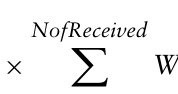
At the end of the period, the total “gratitude weight” received by each employee are calculated from the sending/receiving logs recorded in tBC, and the bonus amount for the emotional evaluation portion is calculated by multiplying the total amount by the unit price (Equation 2).
Equation reproduced from the original PDF.
By conducting bonus assessments based on this procedure, it is possi- ble to conduct bonus assessments based on objective data for the affective evaluation part, which has been difficult to eliminate subjectivity in the past.
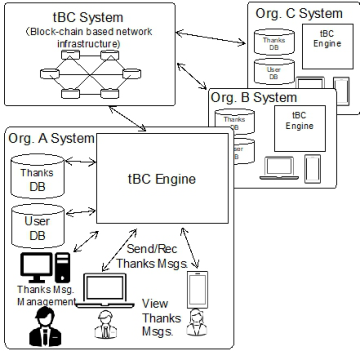
Next, an overview of the tBC system developed in-house is described. tBC is a system that allows employees to exchange “gratitude”, “gratitude weights”, “categories indicating the type of gratitude” and “free message” in the form of “Thanks Card” which are sent and received electronically and stored on a database for timely data visualization. The tBC system con- sists of a distributed database management part using blockchain and a tBC engine, and can be operated in cooperation with multiple organizations as shown in the figure. Within the scope of this study, we used the part of the “organization A” system in the figure.
Figure 1: Overview of tBC system.
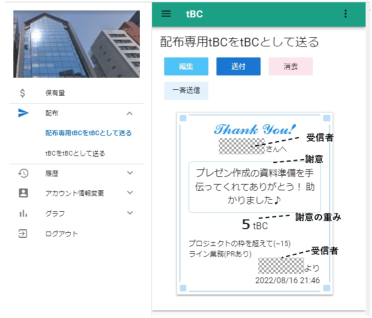
“Thanks Card” can be sent and received using familiar PCs and smart- phones (Figure 2), and can be sent and received not only within the workplace but also outside the office during remote work. The user DB stores the account information of employees who use tBC, and the acknowledgment DB stores the data of thank-you cards exchanged among employees, allow- ing the manager to analyse the gratitude DB to understand statistical data through visualization, as described below.
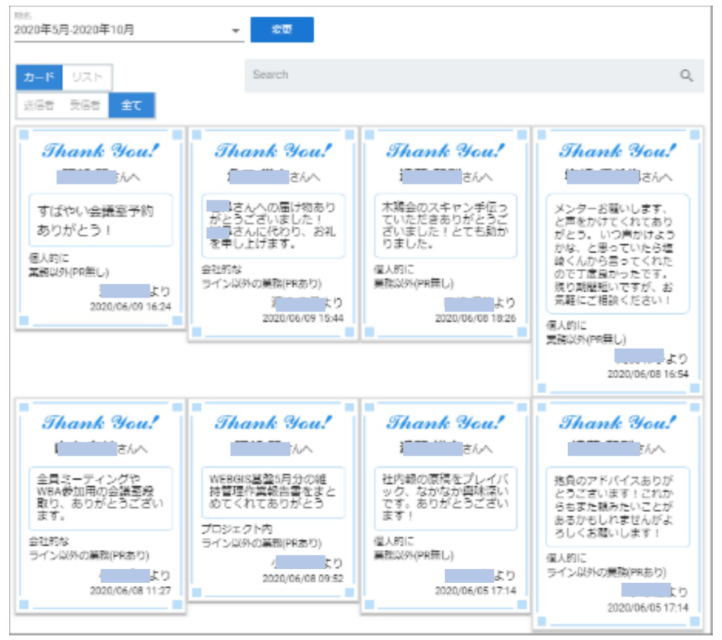
One of the company’s goals is to revitalize the company using tBC, so all employees can view the “Thanks Cards” of other employees (Figure 3) so
that they can always grasp the status of the exchange of acknowledgements throughout the entire organization within the same organization. The user side can arbitrarily configure the unit of the organization, which can be a division or a company within the same company.
Figure 2: Example of sender’s thanks card.Figure 3: Thanks card viewer of all staff members.
Applicability of the Thank You Exchange System to Employee Evaluation 263
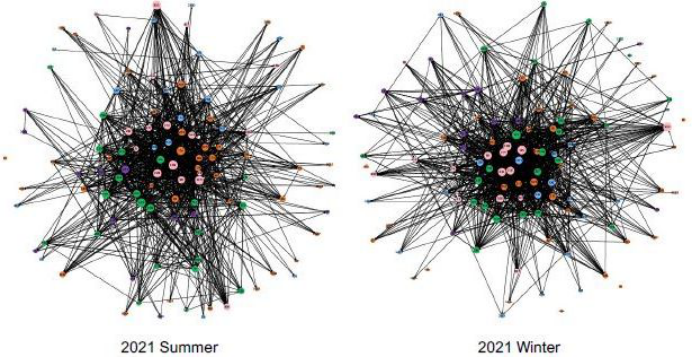
Since the exchange status among employees is stored in the system, the manager can visualize in various graphical formats which employees are sending and receiving messages. Figure 4 is an example of the visualization at the end of the term, showing which employees exchanged messages with which node indicated by the circle in the figure.
Figure 4: Overview of tBC system.
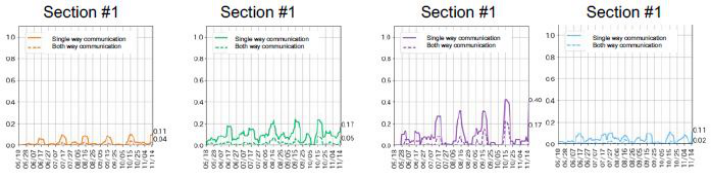
Figure 5 also shows how many employees in each department exchange acknowledgment messages with each other on a weekly basis, allowing man- agement to understand changes in the weekly status of each department from this graph.
Figure 5: Weekly average of the number of connected link.
Thank you Exchange system tBC is currently in its fourth year of opera- tion, and a major achievement is that the actual distribution of bonuses to employees is now based on objective and fair indicators (Kurakawa, 2023). In addition, it is felt that employees have become more proactive in send- ing and receiving thank-you messages to each other. However, since we don’t have a measurement system for proactiveness, the co-relationship between the number of messages and proactiveness has not analysed.
FUTURE USE AND EXPANTION TO EXTERNAL ORGANIZATION Regarding the use of this system within a single company, the affective evalua- tion part of the internal bonus allocation is currently in operation., Regarding the performance evaluation part, the project manager evaluates employee performance according to the sales of the department to which the employee belongs. This is also the case for this part of the evaluation process. We are currently examining whether tBC can also be utilized to increase objectivity in this area.
We are also considering the application of this method to the evaluation of people at the time of recruitment. For example, when a person changes jobs from another company to ours, the history of the exchange of acknowl- edgment messages within the previous company is very valuable. The same is also true when an employee of one company changes their jobs or transfers to other company. In order to utilize tBC on such occasion, it is necessary for both companies to conduct personnel evaluations based on tBC, and we are promoting its use by other companies with the aim of making it a de facto standard. We are currently discussing how to normalize the differ- ences between the two companies and how to share the results of this system between different organizations while concealing personal information.
Furthermore, by promoting the use of the system in local communities and for volunteer work, it may help to reinforce these activities or engagement. In particular, since these activities are free of charge, quantitative visualization of some of the results of these activities is expected to increase and sustain the motivation of those who engage in these activities.
Future implications and applications of tBC are as described in the ideas above, and will continue to evolve through internal use, application to other companies and communities, and so on. Furthermore, we anticipate that the usage of acknowledgment messages will differ from country to country and culture to culture, and experimentation in such environments will be a future topic of study.
CONCLUSION
In this paper, we have described the acknowledgment exchange system (tBC), which aims to company personnel management measures. Among the mea- surement systems, our research group has particularly focused on bonus evaluation, and we have shown the applicability of this system to “emotional evaluation.” As a result, objective and fair evaluations can now be introduced into the company’s personnel system and used in bonus allocation. In the future, we plan to expand the system so that it can be used not only within a company but also among multiple organizations and to study the possibility of using the system in organizations other than the company and using the system in different cultures.
ACKNOWLEDGMENT
The authors would like to express our acknowledgment to all those who cooperated in the execution of this study by using tBC within the company.
Applicability of the Thank You Exchange System to Employee Evaluation 265
REFERENCES
Asahi, Hidemasa and Ohsawa, Yukio (2003) Discovery of Evaluation Measure from Mixed Data 360-degree Feedback in Personnel Evaluation, Journal of the Japanese Society for Artificial Intelligence, Volume 20, No. 3, pp. 167–176. Kajiwara, Takehisa (2004). The Roles and Characteristics of Subjective Performance
Evaluation in Japanese Firms, Journal of Japan Association of Management Accounting. Vol. 13, No. 1 and 2, pp. 83–94. Kurakawa, K., Matsushima, T., Aibara, M., Furuichi, M. (2023). Application and Evaluation of an Inter-Employee Message Exchange System for Emotional Evalua- tion in Bonus Assessment, Transaction of Digital Practice, Information Processing Society of Japan, Volume 4, No. 2, pp. TDP, pp. 98–109.
LISTED IN THE AHFE DIGITAL BOOKSTORE CATALOGUE
Explore the complete digital volume
Application of Emerging Technologies
Read this individual research paper free through the original publisher, or explore the full digital proceedings book.
ISBN 978-1-958651-91-9
Explore this ISBN in the AHFE Bookstore ↗Listed in the July 2026 bookstore catalogue; search by ISBN to confirm current availability · Digital book purchase optional