Taisei Kondo, Mikihito Otani, Takako Sinzi, Megumi Aibara, Kiyoshi Kurakawa, Kazumi Sekiguchi, Atsushi Kobayashi, Aiko Takazawa, Masakazu Furuichi (2023). Life History Support System “LHS” - Recording Memories and Sharing Stories for Family Social Network. In: Emerging Technologies in Healthcare and Medicine. AHFE Open Access, vol. 116, pp. 231–238. https://doi.org/10.54941/ahfe1004376
The world is aging rapidly, and the population of over 65 years old in Japan is 29.1% (Sep. 15, 2022, Japan Statistic Bureau of Japan), which is the highest in Japanese history. Human memory and knowledge are rapidly being digitized on an incalculable scale. While its value as a booster for monetization is now known worldwide, such private and personal heritage, especially its whereabouts remains unknown. In particular, the memory and knowledge of elders are not recorded appropriately for the next generations, we claim that the current system has shown an enormous loss of value in society, especially for the family members. Therefore, the desire to interview and document the life experiences of different generations of family members is very important. However, interviewing and documenting are difficult to achieve for various reasons, in such cases as when family members live apart from each other. Therefore, our research group has started to develop Life History Support System called “LHS”. The new system aims to solve the problem and preserve elderlies' wisdom and knowledge cultivated in turbulent times, such as during WW II and the post-war years of recovery. The LHS is designed for the Family Social Network, allowing digital information to be accessed only by the same members. LHS is an application that runs on smartphones, tablets and PC which is connected to the Internet and works as a social network system (SNS), but the main difference between conventional SNS is (1) LHS can be accessed only by the family members or designated members, (2) it mainly works as a card type database to share topic cards among members. We have developed a prototype system using Apple’s Claris FileMaker database system which runs on-premises private server. Then, to test the prototype's applicability, we have performed a preliminary interview experiment in an actual user environment (family members living together or living apart, and the elderly person living alone). The result shows that we could identified the experience of “fun” by both, an interviewer and interviewee, during the process of recall of memories with the LHS setup. Rather, we confirm the needs in longitudinal study to capture the continuous use of the LHS. Since the LHS inherently gains its value by long-term regular use, interviewing, recording and viewing by many family members, it is necessary to add new functions based on some theories. We are planning to include gamification functions to LHS. This paper describes the LHS system overview and the current development status.
The world is aging rapidly. It can be said that the synthesis of memories is, in a sense, the story of life. If the memories and accumulated knowledge of the past are not kept, they will disappear. Along with the rapidly aging soci- ety, there is also growing interest in recording the life stories of the elderly (Showdon, 2001; Thornton, Collins, Birren and Svensson, 2011; Li, 2018; MemoryMan, 2020; StoryCorp, 2020). Studies showed that sharing personal life stories is an activity that benefits generations (Birren and Deutchman, 1991). It was also emphasized that telling life stories can lead to a better physical and mental health (Butler, 1963). Generally, young people under- stand that there are differences between living now and in the past, but there are many unknowns in the process of looking back on many aspects of culture and vicissitudes of history (Wood and Thompson, 1993). Numerous subjects can remain exotic until they are asked and shared. Many of the elder people memories are revived by trivial everyday interactions. Family memories can teach something that can’t be learned in books or classrooms (Csikszentmi- halyi, 2008). Thus, it is important to have an environment where people can talk about their experiences with peace of mind, without invasion of privacy and personal information worries.
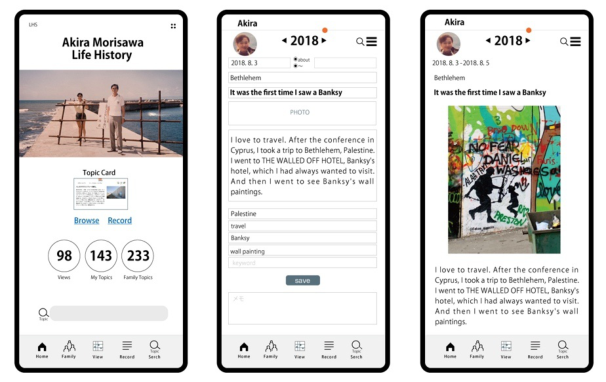
This work aims to contribute to the communication and transmission of knowledge and information in the aged society, “making present the voices of what is past” (Carruthers, 1990). We are developing a Life History Support System (LHS) that reconstructs family history by listening to the experiences of the elderly, sharing experiences and knowledge among family members, streamlining the interviewing process, and visualizing family history. Figure 1 shows the screen image of the currently developing second prototype of LHS.
Figure 1: Screen design of the second prototype of LHS (image).
The life stories are recorded through dialogue as part of family communi- cation, regardless of whether the family members live together or separate.
Life History Support System “LHS” Recording Memories and Sharing Stories 233
In our work we found that people are willing to talk about their experiences if they are not stressed and feel comfortable to communicate, typically if they are asked by someone close to them. So, an important feature of the system is the establishment of a communication network limited to family mem- bers, in order to avoid the various problems related to people’s privacy issues, ethical and moral matters. With LHS, we aim to encourage elder people to communicate, to get the feeling of achievement and sense of purpose.
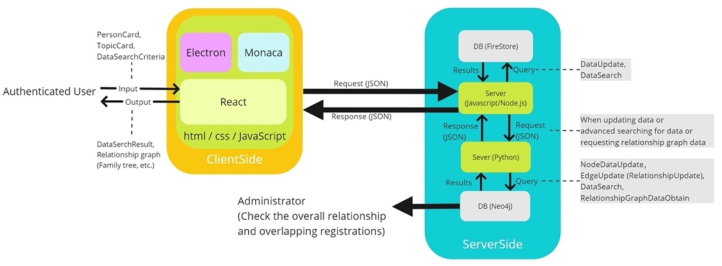
OVERVIEW OF LHS SYSTEM The First Prototype LHS system (Sinzi et al., 2022) runs on a PC(Win/Mac)/ SmartPhone/Tablet as a client terminal, and is connected to the dedicated database server. We used FileMaker for database and application develop- ment. LHS allows users to record, edit, and update their life stories based on dialogue and daily communication. The system has functions for record- ings, saving and editing. There are two main units in the system: Input and Output. The input system includes the administration function system for the interview content and archives. The output consists of the recorded text and visualization. It has an organized form, re-constructed in chronological order, or summarized by keywords. Development of the basic design began in late 2019, and the preliminary experiments were conducted in 2021-2022. From 2023, we are developing the Second Prototype system which uses Google’s FireStore for cloud database, and React as client side software framework. The reason of changing the software structure is mainly to obtain the security and the scalability. Figure 2 shows the software system structure of the second prototype, and Figure 3 describes the database structure. We are going to use this second prototype to verify the basic structure of database, then evaluate the security and scalability.
Figure 2: Software system structure of the second prototype of LHS.
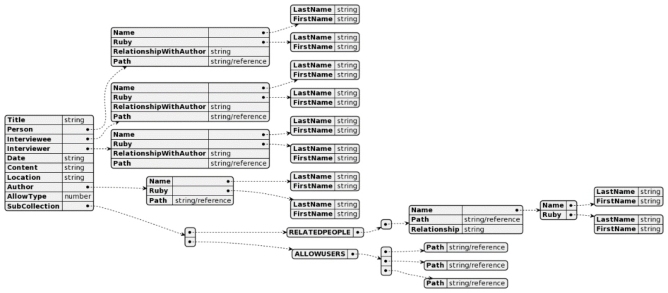
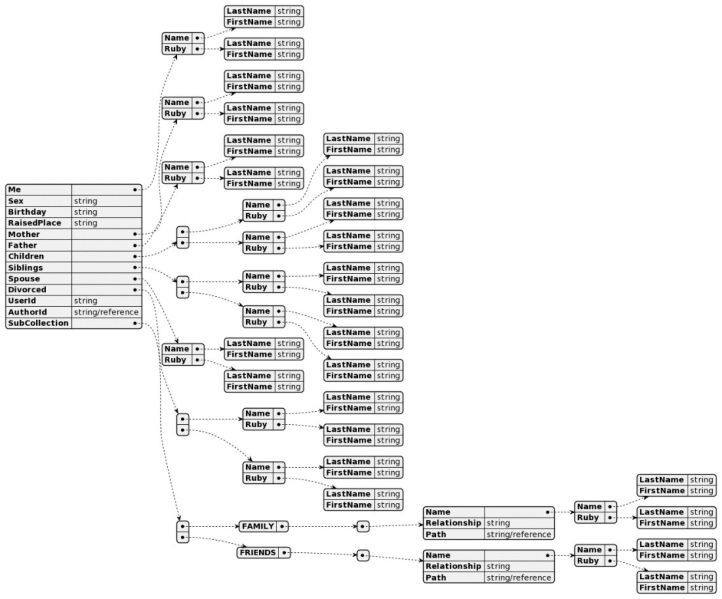
In the LHS database, collection of “Topic Cards” (Figure 3) and “Person” (Figure 4) are contained. In a standard situation of using LHS, there are an interviewer (IR) and an interviewee (IE). IR asks questions, and IE replies. The narration is typed by IR and recorded by the system. The recorded unit of memory is called a Topic Card (TC), and this process forms a collection of
“Topic Cards”. There is no limit for the number of topic cards. In our pro- totype experiments one session took about two hours. “Person” database contains a collection of a person’s data which describes the genealogical relationship of family members. In the figure, Ruby means “furigana”, or pronunciation of Japanese characters.
Figure 3: “Topic card” database structure of the second prototype of LHS.Figure 4: “Person” database structure of the second prototype of LHS.
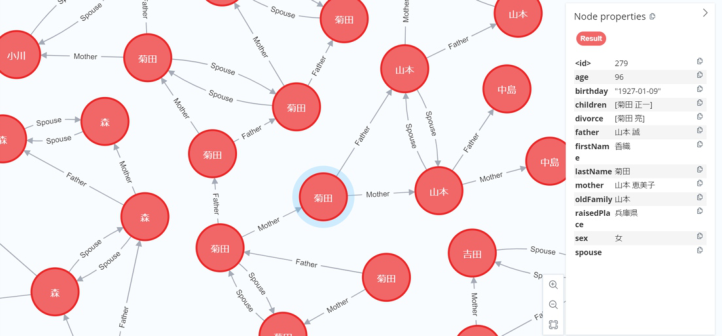
Figure 5 shows the administrator’s console of LHS. In the development phase, since the Topic Cards and Person database are linked intricately to
Life History Support System “LHS” Recording Memories and Sharing Stories 235
each other, the graph based visualization is convenient to understand the overall relationship.
Not only this approach is used for debugging the system, but we are considering to use it also for user’s interface.
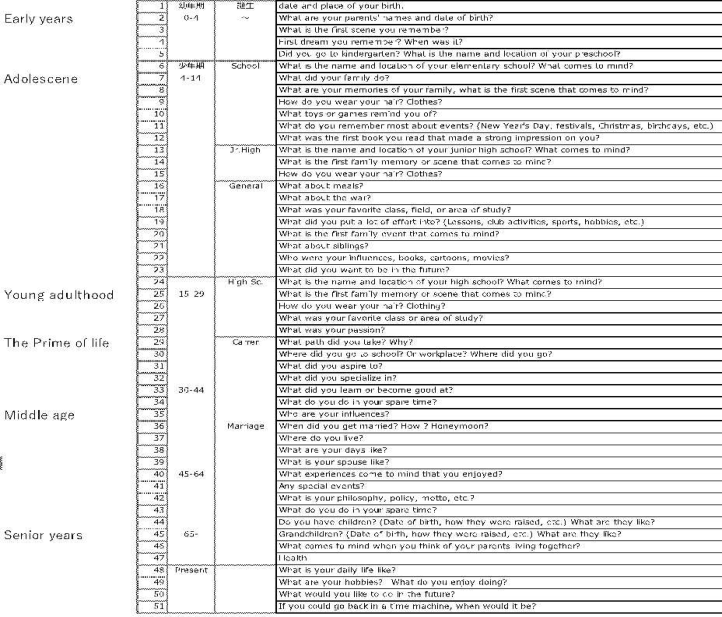
Figure 5: Administrator’s console of the second prototype of LHS.Figure 6: Standard topic table.
LHS places more emphasis on free recall than on accuracy of memory. The purpose was to start with the matters that can be easily answered. The emphasis was to follow a natural chain of recall. Then, we gradually follow the personal life history, tailored to individual characteristics of a person. To facilitate and generate natural recall of memories, we designed a Standard Topic Table (STT), shown in Figure 6. STT lists life stages, the corresponding ages in years, and question items. STT is aligned with the life stages. Life stage category refers to the general life stages adopted by the Ministry of Health, Labour and Welfare, Japan.
PRELIMINARY EVALUATION USING THE PROTOTYPE LHS aims to be easily used by family members, but interviews by interviewers other than family members also can be expected. At the R&D stage of the prototype development, it is the latter, because the interviews with the family members are conducted by us. When the LHS is operated by a family, each family member takes turns to be an interviewer, and each interviewer writes an episode by filling in the tabs on the topic card. Revisions and additions can be made without time limit. An important feature of this process is that once the interviews have been completed into written documents, they can be viewed by both parties.
Interview experiments with the system running on the on-premises server were conducted with the cooperation of three people in 2021 (Sinzi et al., 2022) and three people in 2022 (Sinzi, 2022). After explaining the example of the topic card screen, the session of about 2 hours for one person. Basically, we attempted to evaluate two points: the promotion of spontaneous recall using the TC and STT system as a source of information, and the impressions obtained from the collaborators through the interview.
These experiments reveal various insights. In the process of the interviews, a bird’s-eye view of one’s entire life became possible, and new information (new recalls) was often encountered. As a result, the number of episodes increased, and the volume of topic cards also increased. During the recalls, new information was added. By other words, recall itself has become a creative process. It helped to clarify gaps in information about current fam- ily members, previous family members, and relatives. When the life stages were organized in chronological order, what was missing became clearer. In addition, the method of filling in the gaps based on time periods is not as complicated as writing biographies, and can be done with ease. In the case of family members who are no longer with the family, the specific background of the family gradually became clearer as we attempted to collect their records via the Internet, and we came closer to understanding their thoughts and attitudes.
We asked each of the subjects about their feelings after spending two hours sessions. Here is variety of replies: “remembering became real”, “I had some- thing to think about and noticed again”, “I was able to talk relaxed”, “I had a sense of fulfilment, fun”, “I felt the passage of time quickly”, “was able to talk as I wanted”, “the more I see my own family history, the more I am in a state of flow, the more my curiosity is aroused, and the more I enjoy filling
Life History Support System “LHS” Recording Memories and Sharing Stories 237
in the blanks”. Here “fun” is defined as “one’s preference, wish or choice, source of enjoyment”.
In developing the concept of the LHS, we emphasized the possibility of family collaborative creative activities, in which children and grandchildren take turns using the LHS to interact with older family members and accu- mulate records. In order to make the activity more interesting, gratifying and enjoyable, we are working on introduction of elements of gamification. The possible themes are: a hunt for information and new knowledge, a combina- tion of old common sense fashion and modern day inventiveness, a journey through life of ancestors. The experience and knowledge can be transmit- ted to future generations through the “function of collection” of the LHS episodes and the “function of connection” of posting them on the family network.
Since memory as a dynamic system is subject to continuous changes across the lifespan (Shroots, van Dijkum and Assink, 2004), we think some new functions reflecting theoretical lifespan models must be envisioned for the future LHS system.
CONCLUSION
This paper reports on developing a system that mediates sharing experiences among families. We present the overview and the current stage of the Second Prototype of LHS. With the First Prototype, our concept was demonstrated, and the effectiveness was verified through experiments. The future task is to improve the current Second Prototype model, and examine how to introduce elements of gamification and serious games, security, scalability, an automatic infographics generation function, and the mechanism by which this system is continuously used. The collective effect of this system, when used by many families, could contribute to the task of healthy aging, building a better and more stable world.
ACKNOWLEDGMENT
The authors would like to acknowledge all the users and collaborators of the first prototype experiments, especially Prof. Kumiko Maruyama.
REFERENCES
Ando, M. et al. (2007). Life review interviews on the spiritual well-being of terminally ill cancer patients, Support Care Cancer, Vol. 15, No. 2 , pp. 225–231. Birren. J. E. and D. E. Deutchman, D. E. (1991). Guiding Autobiography Groups
for Older Adults: Exploring the Fabric of Life. Baltimore, The Johns Hopkins University Press. Butler, R. N. (1963). The Life Review: An Interpretation of Reminiscence in the Aged, Psychiatry, Vol. 26, No. 1, pp. 65–76. Carruthers, M. J. (1990). The Book of Memory, A study of Memory in Medieval
Culture, Cambridge University Press. Csikszentmihalyi, M. (2008). Flow: The Psychology of Optimal Experience (Harper Perennial Modern Classics).
Levy, B. et al. (2002). Longevity Increased by Positive Self-Perceptions of Aging, Journal of Personality and Social Psychology, Vol. 83, No. 2, pp. 261–270. Li, C. et al. (2018). Slots-story: facilitate inter-generational life story sharing and
preservation of the elderly, proceedings of the 10th Nordic Conference on Human- Computer Interaction (NordiCHI’ 18). Association for Computing Machinery, pp. 691– 695. MemoryMan. (June 18, 2020). Sydney, Australia, Website: https://www.memoryma n.com.au/life-stories.htm. Schroots, J. J. F., van Dijkum, C., Assink, M. H. J. (2004). Autobiographical Memory
from a Life Span Perspective. The International Journal of Aging and Human Development, Vol. 58, No. 1 pp. 69–85. Snowdon, D. (2001). Aging with grace: What the Nun Study Teaches Us About Leading Longer, Healthier, and More Meaningful Lives, New York: Bantam books. Sinzi, T., Aibara, M., Furuichi, M., Maruyama, K. (2022). Life History Support Sys-
tem: Sharing Experiences and Knowledge among Family Members, Information Processing Society of Japan, Transaction Digital Practice, Vol. 3, No. 4, pp. 39–50. Sinzi, T. (2022). Study on Development of Life History Support System, Doctor Thesis, Nihon University. StoryCorps. (June 18, 2020). Website: https://storycorps.org/. Thornton, J. E., Collins, J. B., Birren, J. E., Svensson, C. (2011). Guided Autobiogra-
phy’s Developmental Exchange: What’s In It For Me? The International Journal of Aging and Human Development 73(3), Vol. 73, No. 3, pp. 227–251. Wood, G., Thompson, P. (1993). The Nineties, BBC books.
LISTED IN THE AHFE DIGITAL BOOKSTORE CATALOGUE
Explore the complete digital volume
Emerging Technologies in Healthcare and Medicine
Read this individual research paper free through the original publisher, or explore the full digital proceedings book.
ISBN 978-1-958651-92-6
Explore this ISBN in the AHFE Bookstore ↗Listed in the July 2026 bookstore catalogue; search by ISBN to confirm current availability · Digital book purchase optional