Olga Shvetsova (2023). The impact of AI on business ecosystem development: pro and contra. In: Emerging Technologies and Future of Work. AHFE Open Access, vol. 117, pp. 253–259. https://doi.org/10.54941/ahfe1004425
Nowadays the rapid advancements in artificial intelligence (AI) have significantly transformed various industries, including the business ecosystem (Agrawal, A., Gans, J., & Goldfarb, A., 2022). This study aims to examine the multifaceted impact of AI on business ecosystem development, considering both the positive and negative aspects mostly focused on developed countries.The positive effects of AI implementation on the business ecosystem are manifold. AI-powered technologies enhance productivity and efficiency, automate repetitive tasks, and optimize resource allocation(Floridi, L., 2019). Furthermore, AI algorithms enable businesses to gain valuable insights from large volumes of data, leading to improved decision-making processes and the identification of new market trends (Martin, R., & McCrae, D., 2020). However, along with the promising prospects, there are notable concerns surrounding the implementation of AI in the business ecosystem. Ethical issues, such as privacy infringement and data security, arise due to the vast amounts of sensitive information processed by AI systems. (Davenport, T. H., & Ronanki, R. (2018). Furthermore, the concentration of power in AI technologies within a few dominant players can lead to challenges related to market competition and access to AI-driven solutions.This study combines a comprehensive review of existing literature with case studies and expert interviews to provide a balanced assessment of the impact of AI on business ecosystem development. By analyzing real-world examples and industry cases, this research aims to shed light on the practical implications of AI implementation and identify strategies to mitigate potential risks and challenges.The findings of this study will contribute to the ongoing discussions surrounding the integration of AI technologies in the business ecosystem. The results will be of interest to policymakers, business leaders, and researchers, providing valuable insights into harnessing the potential benefits of AI while addressing the associated concerns.
In order to make AI effective for business, enterprise should consider new business model, or business model innovation to be efficient. Business mod- els in general varies depending on company times, still there is common one concept for 4v: value creation, value capture, value proposition and value net- work. For example, University of Cambridge published “Targeting the full value of digital disruption” (by Akerkar, R., 2019) integrate the 4V model with newly emerged technologies. It’s still a question to estimate the full value potential empowered with disruptive technology and AI, nevertheless, cost-savings and productivity-gains in the US have been estimated around $1.8 trillion on average per year over the next 10 years. Moreover, companies with focus on digital investments (in both a) operational efficiency initiatives and b) growth through business model’s innovation) have generated close to
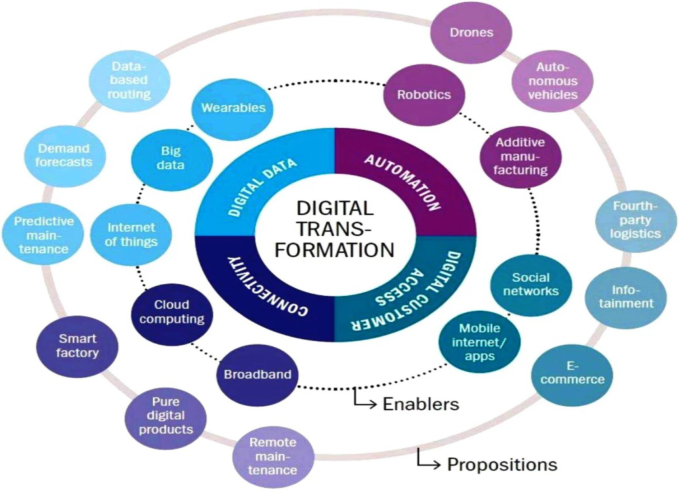
$3 trillion of value in the past decade (for example, Apple, Amazon, Facebook etc.) (Ciuriak, D., 2019). In other words, familiar to business technologies like IoT or blockchain combined with AI in particular will have a potential to enable strong network effects within business model innovation now and in the nearest future (Figure 1).
However, to apply AI-process to a business chain, a diagnose of company’s inner dimensions required. In 2022 Deloitte Digital published 10 types of innovations in business structure, which is divided into configuration, offer- ing and experience. Configuration includes profit model, network, structure itself and the process (Fountaine, T., McCarthy, B., & Saleh, T., 2019). Offer- ing includes product performance and product system. Experience includes service, channel, brand and customer engagement. Each component is called “a block of breakthrough”, therefore, each block separately can be empow- ered with disruptive technology caused by rapid development of “OpenAI”, several blocks at once or the whole structure of blocks to create a new paradigm of business model innovation (Armour, J., & Sako, M., 2020).
According to the latest article in New York Times (New York Times, April 16, 2023), Samsung going to replace Google search by default to such AI competitor Bing designed and created by Microsoft company. Although Google had never experience problem of leadership before, “OpenAI” became “the most serious threat to Google’s search business in 25 years, and in response, Google is racing to build an all-new search engine pow- ered by the technology”. In other words, a golden rush for AI technology begun (Hedberg, S. R., 1996).
Figure 1: Domains of digital systems integration (adapted from digital data transfor- mation (Samsung White Paper, 2020)).
The Impact of AI on Business Ecosystem Development: Pro and Contra 255
AI APPLICATION FOR BUSINESS MODELLING A business model is a way for a company to sustain itself by producing a product or service and earning profit (Arnold, T., & Scheutz, M. (2018). This means that the company must provide goods or services that customers find valuable and are willing to pay for, and the company must be able to gener- ate revenue from those goods or services that exceeds the costs of producing them. Business model describes the various decision-making components inside the company, such as the target market, the value proposition, the dis- tribution channels, the revenue streams, cost structure, key resources and key activities, partnerships etc. (Dimitras, A. I., Zanakis, S. H., & Zopounidis, C., 1996). Therefore, not only products or services are important. If a company experiences a rapid decline in profits or wants to gain a competitive advan- tage in the market it stands, the innovation of business process beyond the market standard is crucial. Changes to any of the components of the business model is named business model innovation, which involves creating a new way of doing business that can potentially elevate the company to a leading position.
Innovative Business Model Since sudden occur of ChatGPT, AI-modelling to support business ecosystem- based strategy for achievement of competitive advantage as well as make it more sustainable no longer a question of time. Many studies considered firms to be the only strategic subject, and lately recognized a consumer to be an active and major participant of a business system “interconnected by a loose foundation of various members such as customers, suppliers, part- ners and other stakeholders based on following studies” (Brock, J. K. U., & Von Wangenheim, F., 2019).
The latest case-studies have been already focused on responding disrup- tive innovations on example of retail shops in South Korea to innovate its business model through integration both online and offline ecosystems and suggest to improve it by adopting a new business model since main- taining an old one in the face of new innovation era can limit how busi- ness is conducted (Chang, T. M., Hsu, M. F., & Lin, S. J., 2018). Also, IT-enabled transformations within the K-pop industry goes from liner con- tent creation to a network through implemented digital platforms in a new digital business ecosystem. Not only commercial industry, but South Korean Government prepared for the Fourth Industrial Revolution, applying “a new business model innovation, that generates profit in a different way from the existing model, and therefore, changes the rules of the market” (Burgess, A., 2017).
In other words, it’s been recognized that advances of AI and infor- mation technology (IT) for different types of industries should be recon- sidered as a part of a new business ecosystem and the part of a business process through which one they become an active participant (Table 1).
256 Shvetsova
Table 1. Sample human systems integration test parameters (Folds et al., 2008).
Table available in the original PDF paper.
Description Core characteristics If AI is applicable Business model type Manufacturing & private labeling The prevalence of goods as a main type of traded item. Focus on production ownership.
Analytical, functional and interactive types of AI can be implemented for manufacturing and supply process tracking with further analysis of a product quality.
Businesses that create goods away from the selling location send the designs or models to a hired manufacturer who makes the item according to the customer’s requests. The manufacturer can then ship the product to the purchaser, or the company that ultimately sells the item.
Focus on social interaction and communication and based on subscription fee that generates revenue.
Analytical, interactive and textual AI assist the process of subscription payments, customers’ engagement and pricing policy. Integration of paid apps for subscription-based ecommerce.
Subscription Subscription-based businesses depend on a system where customers receive a package of items on a scheduled basis. These companies benefit from consistent revenue streams and can encourage customers to buy more subscriptions or refer others to subscribe. The product being traded is intangible, and it requires both parts to participate, resulting in ownership of the content.
Marketing analysis orientation. Creation new packages of information and data sets. Focus on customer behavior analysis.
High level of usage of an analytical type of AI to analyze market trends and customers attitude to a product or service helps to make analysis efficient.
Infomediary The emphasis is on providing a service/immaterial that enables businesses to conduct marketing analysis themselves. The company may also have ownership of the supplementary product. Even services focused on customer behavior analysis are considered production ownership because it produces a new package of information for business partners.
Visual, textual, analytical tools are useful and can be implemented in this business model, assisting in a process of advertising selling and creation
Offering of advertising services and products. The importance of intermediation role. The dissemination and necessity of agreements between a company that provides service and a client.
Advertising E-commerce in advertising industry to use media tools for products promotion. When the company acts as a mediator for placing advertisements on websites, resembling a broadcaster instead of selling a physical item, it falls under the service category while taking on an intermediation role.
AI tools in a field of activities for analysis of purchasing process and managing production section.
Purchasing products in advance. The merchant takes responsibility of goods. The opportunity to create substituted products.
Merchandising A company provides customers types of goods or services while the merchant assumes responsibilities for the products. This entails purchasing products ahead of time for future selling to customers. If a merchant introduces additional products, such as tools or devices, that facilitate the usage of other traded items, the ownership is categorized under the production section.
Source: made by author
The Impact of AI on Business Ecosystem Development: Pro and Contra 257
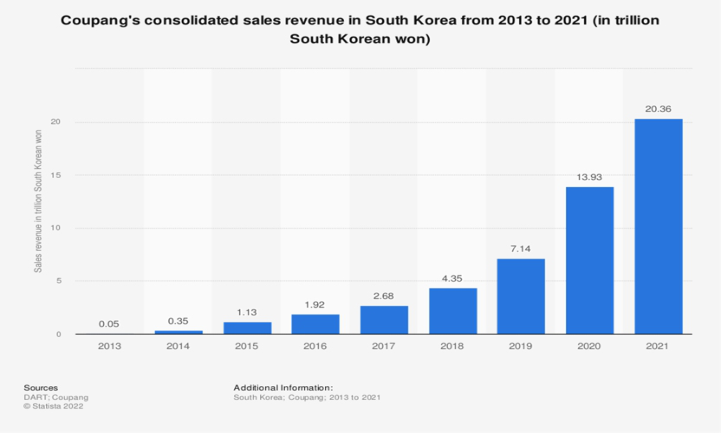
Case Study of Coupang Company Since the internet reinvented the whole retail industry, it seems that shopping industry could be considered as one of the leading in the new era of tech- nology race (Kosinski, M., Stillwell, D., & Graepel, T., 2013). Specifically, in e-commerce platforms become a representation of software application that enables businesses to create and manage an online store, where customers can browse, select, and purchase products or services (Gentsch, P., 2018). There- fore, this paper will go through a Coupang case - a South Korean giant e-commerce company to demonstrate a new business model innovation empowered by disruptive technology to provide a breakthrough among other competitors. Established in 2010, Coupang evolved their ecosystem and data- base network several times to become an evolved platform for Coupang’s multiple use and future scaling business-scenarios by 2019 (Figure 2).
Only for last two years Coupang patented innovations growth exceed over 80% and now Coupang owns a disruptive end-to-end AI network to run the entire process. With references to our business innovation model, we con- sider Coupang business core to divide into inner process specifically logistics part as main configuration, reliable e-commerce platform as offering and fast delivery service as experience provided.
End-to-end AI-management system in charge of 1) task coordination for workers and drivers 2) future prediction of force demands during the rush hours and holidays to prevent delivery last-long delays and 3) automatic gen- eration of unique path for each customer order from the moment it was paid down to the spot in the delivery car it should be loaded. If (1) and (2) mostly serve the needs of internal processes, (3) provides up-to-date information to customers in real-time that customers have access to the most current
258 Shvetsova
information, so that accurately and efficiently processed data flow enables both small businesses, who use the e-commerce platform stay fully prepared, and customers to make decisions on purchases and choose a suitable delivery day.
Not only AI boost the new innovation business model (Loebbecke, C., & Picot, A., 2015). As was considered, Coupang main configuration is about inner process and logistics as well fast delivery - about the core value expe- rience. Therefore, automated technologies required. Coupang implemented three types of automated technology: automated guided vehicles (AGVs) to bring around 100 units of goods per 1 trip right to picker’s workstation, sort- ing robots to sort goods by delivery area in few seconds with address scanning tool and driverless forklifts help to store and retrieve pallets in warehouse. This simple technology scheme increased Coupang’s capacity and reduce total workload around 65% (Wall Street Journal, October, 2023).
CONCLUSION
E-commerce has become a significant part of South Korea’s economy, with a well-established online marketplace and a high level of internet penetration. The country’s e-commerce sector has grown rapidly in recent years, driven by number of different factors such as the increasing usage of internet and mobile shopping. Korean online shopping offers a wide range of products from various brands and retailers; therefore, the local e-commerce market is highly competitive among big players like Naver Shopping, 11st Street, LotteON, Auction and G-market etc. vying for a share of the market and driving innovation in the sector.
However, Coupang, established in 2010 as start-up, completely outstand the e-commerce competitors to become the most popular online shopping platform in South Korea with around 6.62 million unique visitors in 2022 and overtake the long-time leading online marketplace G-market, which is owned by eBay. One of the key factors contributing to Coupang’s popu- larity is fast and reliable next-day Rocket delivery service, helping to stay a highly competitive in e-commerce industry. In addition, Coupang has invested heavily in automation technology and data analytics, which help to optimize its business core in logistics and supply chain operations (NASDAQ, Report 2023).
ACKNOWLEDGMENT
There is NO acknowledgement.
REFERENCES
Akerkar, R. (2019). Artificial intelligence for business. Springer. Armour, J., & Sako, M. (2020). AI-enabled business models in legal services: from traditional law firms to next-generation law companies? Journal of Professions and Organization, 7(1), pp. 27–46. Arnold, T., & Scheutz, M. (2018). The “big red button” is too late: an alter-
native model for the ethical evaluation of AI systems. Ethics and Information Technology, 20(1), pp. 59–69.
The Impact of AI on Business Ecosystem Development: Pro and Contra 259
Brock, J. K. U., & Von Wangenheim, F. (2019). Demystifying AI: What digital transformation leaders can teach you about realistic artificial intelligence. California Management Review, 61(4), pp. 110–134. Burgess, A. (2017). The Executive Guide to Artificial Intelligence: How to identify
and implement applications for AI in your organization. Springer. Chang, T. M., Hsu, M. F., & Lin, S. J. (2018). Integrated news mining technique and AI-based mechanism for corporate performance forecasting. Information Sciences, 424, pp. 273–286. Ciuriak, D. (2019). Economics of AI/ML and big data in the data-driven econ-
omy: Implications for Canada’s Innovation Strategy. In ML and Big Data in the Data-Driven Economy: Implications for Canada’s Innovation Strategy (March 25, 2019). Dimitras, A. I., Zanakis, S. H., & Zopounidis, C. (1996). A survey of business failures with an emphasis on prediction methods and industrial applications. European Journal of Operational Research, 90(3), pp. 487–513. Fountaine, T., McCarthy, B., & Saleh, T. (2019). Building the AI-powered organiza-
tion. Harvard Business Review, 97(4), pp. 62–73. Gentsch, P. (2018). AI in marketing, sales and service: How marketers without a data science degree can use AI, big data and bots. Springer. Hedberg, S. R. (1996). AI tools for business-process modeling. IEEE Expert, 11(4),
pp. 13–15. Kosinski, M., Stillwell, D., & Graepel, T. (2013). Private traits and attributes are predictable from digital records of human behavior. Proceedings of the national academy of sciences, 110(15), pp. 5802–5805. Loebbecke, C., & Picot, A. (2015). Reflections on societal and business model trans-
formation arising from digitization and big data analytics: A research agenda. The Journal of Strategic Information Systems, 24(3), pp. 149–157. NASDAQ Report 2023, https://www.nasdaq.com/market-activity/stocks/cpng /analyst-research, (last accessed on 12.10.2023). Taubman, Philip. (April 16, 2023) Top Engineers Shun Military; Concern Grow. The New York Times Website: https://www.nytimes.com/2008/06/25/us/25engineer. html. Wall Street Journal, https://www.wsj.com/market-data/quotes/CPNG/research-ratin
gs (last accessed on 12.10.2023) Wirtz, B. W. (2011). Business model management. Design–Instrumente– Erfolgsfaktoren von Geschäftsmodellen, 2(1), pp. 7–17.
LISTED IN THE AHFE DIGITAL BOOKSTORE CATALOGUE
Explore the complete digital volume
Emerging Technologies and Future of Work
Read this individual research paper free through the original publisher, or explore the full digital proceedings book.
ISBN 978-1-958651-93-3
Explore this ISBN in the AHFE Bookstore ↗Listed in the July 2026 bookstore catalogue; search by ISBN to confirm current availability · Digital book purchase optional