Janne Heilala, Kalea Texeira (2024). Mitigating Orbital Debris via Responsible System Design. In: Accessibility, Assistive Technology and Digital Environments. AHFE Open Access, vol. 121, pp. 208–215. https://doi.org/10.54941/ahfe1004629
The escalating space debris problem threatens satellite operations and space sustainability. This study proposes an intelligent debris removal spacecraft integrating reconfigurable surfaces, optimization algorithms, and ethical design principles. The architecture adapts to diverse debris shapes, ensuring precision targeting and capture efficacy. The development integrates sustainability criteria for responsible manufacturing and end-of-life deorbiting. Quantitative trajectory analysis and case studies of successful projects inform refined workflows. With machine learning enabling responsive debris characterization and risk probabilities alongside stakeholder participation driving conscientious design choices, the system pioneers a contingency-based approach to space preservation. The research underscores technical ingenuity balanced with environmental foresight as instrumental for the principled advancement of aerospace engineering for shared posterity.
The escalating threat posed by space debris mandates selecting a new stan- dard for regulatory adherence in spacecraft manufacturing, setting high requirements for a frontiersperson in a circular economy in space. The num- ber of debris orbiting Earth has increased rapidly, with over 128 million pieces estimated as of early 2022 (Larsen, 2020). This debris moves at velocities up to 17,500 mph, making even centimeter-sized pieces capable of critically damaging operating spacecraft (Grush, 2018). Consequently, the probability of collisions that generate further debris continues to rise, exacerbating this pressing issue. Efficient debris removal measures are crit- ical to ensure the sustainability and safety of space operations (Schilling, 2017). As the collision risk increases with space assets that occur daily, esti- mated within satellite self-monitoring systems, indicating the end of the life cycle (Stelzl et al., 2021), these dead Zombies are generating more fragments and exacerbating risk trajectories. While debris shields provide protection, developing efficient mitigation technologies remains imperative for safe space travel (Pieters & Noomen, 2022). Traditional removal methods have proven inadequate for comprehensively tackling accumulating debris. For instance,
Mitigating Orbital Debris via Responsible System Design 209
studies have highlighted the prohibitive costs, slow capture rates, and poten- tial fragment-generation risks with sole reliance on robotic arms for debris elimination (Mark & Kamath, 2019; Phipps & Baker, 2013). Likewise, the efficacy of ground-based lasers faces limitations from current technological constraints on power capacities for different debris types (Campbell, 2021). Statistical trajectory models underscore traditional approaches’ inability to match debris growth projections (Heilala, 2024b).
Undertaking operational satellite environmental conditioning necessitates agile part organization characteristics for small- to medium-sized firms advancing innovative and efficient debris removal technologies. Miniaturized satellites under 500 kg are increasingly vital, with over 13,000 anticipated to launch in the next decade (Schilling, 2017). Smaller enterprises developing cube satellites and novel solutions can contribute substantially toward debris remediation but face more significant challenges in organizational agility in sustainable cube development. Effectively optimizing team dynamics and leveraging innovative technologies like AME (additive manufacturing of elec- tronics) will be critical enablers driving efficient design. Emerging intelligent systems and reconfigurable surfaces provide more adaptive solutions by enhancing detection and maneuverability. Swarms of tiny satellites equipped with machine-learning algorithms and robotic manipulators demonstrate scalability and coordination for capturing debris objects based on real-time positional data (Lai et al., 2020; Bombardelli et al., 2013).
Meanwhile, reconfigurable intelligent surfaces of low-cost reflective units promise tunable wireless power transmission for tracking and deorbiting debris without physical contact (Qiu et al., 2021). These modern technologies indicate the potential for higher collection rates and precision targeting. At the same time, further testing is warranted and scientifically achieved, with intelligent reconfigurable systems emerging as a pivotal advancement, guided by systems resilience principles prioritizing adaptability to unpredictable orbital conditions. Applying biological design approaches can further opti- mize the spacecraft’s physical architecture for debris capture tasks (Sareh et al., 2015). Nevertheless, holistic solutions call for developing collaborative policy frameworks and advanced simulations to support ongoing innovations in space sustainability initiatives globally.
This study proposes a novel spacecraft to address this challenge by inte- grating reconfigurable intelligent surfaces, intelligence, and system design principles. The research questions are crafted to provide a holistic under- standing of the critical factors influencing the success of CubeSat devel- opment projects, focusing on the innovative use of AME. By addressing these inquiries, the research offers insights into optimizing team composi- tion, project management strategies, and integrating ethical considerations in CubeSat development, contributing to advancing space technology and exploration.
Remote sensing and technical exploration pioneers approaches for inte- grating Part-21 and Part-107 compliance considerations into the develop- mental phase, setting a new precedence for regulatory adherence in applying cutting-edge solutions. Establishing SC compliance early on can profoundly impact best practices in the industry. Drawing upon the foundational design
210 Heilala and Texeira
theories, this research outlines a systematic approach for optimizing space- craft architecture to enhance debris removal efficiency. By leveraging intelli- gent algorithms and solutions modeled on natural organisms, the spacecraft aims to improve adaptability, precision, and operational efficacy in the upfilling orbital environment; consideration of the ethical dilemma is topical.
This research emphasizes ethical considerations and dilemmas faced in CubeSat projects, such as balancing mission objectives and long-term sustain- ability. For instance, decisions around deorbiting strategies at the end-of-life cycle to mitigate debris accumulation pose complex trade-offs. To navigate these challenges, the study advocates stakeholder participation, transpar- ent assessment of risks and benefits, and implementation of best practices for responsible space utilization. Specifically, the proposed spacecraft design aims to pioneer sustainable deorbiting through its reconfigurable compo- nents and debris capture capabilities. The development process also integrates sustainability criteria in material selection, power systems, and part test- ing. Guiding CubeSat development with these ethical underpinnings fosters accountable and conscientious solutions essential for the evolving domain of small spacecraft applications. This project exemplifies integrating ethics and sustainability early on and driving innovation through cross-disciplinary collaboration on the pressing issue of space debris.
RESEARCH QUESTIONS Since the enterpreneural researcher professional professional development within CubeSat project teams can not influence the success and efficiency of their projects, it is a question to find the organizational driver by exploring the significance. The specialization on training in AME within organizational project dynamical outcomes. Research questions are set to examine the rela- tionship between specialized expertise, efficiency improvements from rapid manufacturing advancements, and overall CubeSat development success:
1. How do specific project management and communication strategies over- come the unique challenges presented by AME in CubeSat development?
This different problem focuses on identifying the most effective methodologies and tools to navigate the complex integration of AME in CubeSats. It considers critical planning, risk mitigation, and collab- orative digital platforms (Epicor, 2023) that can address AME-associated challenges in these projects locally. 2. How does integrating ethical considerations into performance evaluation frameworks affect innovation and sustainability in CubeSat projects?
This question investigates how adherence to ethical standards and sustainability criteria in assessing CubeSat designs drives continuous refinement. Ethical technology is a theory, the same launch rate to main- tain production and divide sustainability at the expense of operation rate does not only require reflective performance fit. Question explores prac- tically integrating environmental responsibility across all project lifecycle phases, from prototype to deorbiting.
Mitigating Orbital Debris via Responsible System Design 211
3. How does interdisciplinary collaboration influence CubeSat projects’ innovation and problem-solving capabilities integrating new technologies like AME?
Whether regulatory standards impact the design and deployment of CubeSats, particularly regarding new manufacturing techniques and materials, is of significant focus. In what ways can CubeSat projects incor- porate sustainability practices throughout their lifecycle, from design to deorbiting, to minimize space debris and environmental impact? Does well-optimized CubeSats design aim to incorporate project timelines and budgets for the inclusion?
THE METHODOLOGY FOR INVESTIGATING THE CUBESAT DEVELOPMENT This study utilizes a concurrent mixed methods approach, integrating qualita- tive case study analysis and quantitative statistical modeling to enable robust investigation of CubeSat development with AME.
The qualitative component applies an exploratory multi-case study methodology (Heilala 2024a) to examine successful CubeSat projects using AME, selected based on maximum variation sampling of project types and AME applications. Data triangulation is achieved by gathering project doc- umentation, design specifications, timelines, budgets, and ethical approvals, combined with key participant interviews for insightful context. Cross-case analysis identifies recurring themes related to team dynamics, management strategies, sustainability practices, and performance evaluation mechanisms using NVivo or similar research protocol for coding.
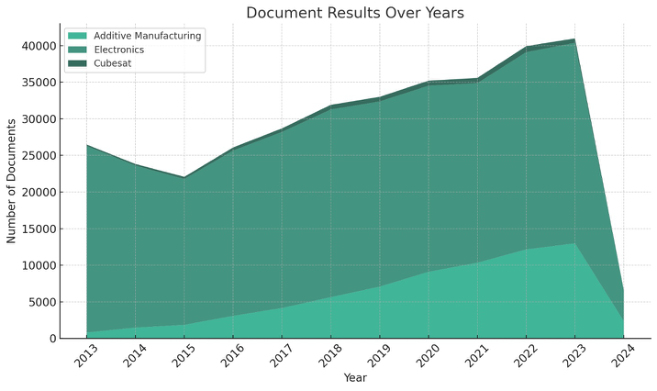
Concurrently, the study’s quantitative aspect statistically analyze litera- ture on CubeSat and AME development indexed in aerospace engineer- ing databases (e.g. Scopus/IEEE), searching terms like “Additive Manufac- turing”, “Electronics”, and “CubeSat”. The systematic review integrates PRISMA guidelines to chart literature selection, review, and compiled meta- data on publications, geographic trends, authorship, methodologies, and technological issues in AME-associated projects in figure 1.
The plot above shows the document results over the years for the sourced from the Scopus database. Advanced modeling of the expertise assesses the influence of factors like team, prototyping, and budgetary on project success metrics through multivariate regression to form standardization requirements.
Triangulating outcomes from influence of factor components provides a comprehensive perspective on AME’s role in furthering novel CubeSat appli- cations. The methodology integrates ethical considerations. Study considered the human source administer the gains of the aerospace sector globally. Study ensures protocol review with privacy consent to the database, with a plan for follow up studies. Expected contributions encompass synthesized insights on key enablers like specialized skillsets and streamlined collaborative platforms to optimize resource utilization in future CubeSat initiatives, guiding refined project lifecycles. Suggested AME design innovations could enhance orbital sustainability.
212 Heilala and Texeira
Figure 1: Python plot of a technological balance between CubeSat testing research (Scopus 26.2.2024).
DISCUSSION
Integrating intelligent systems and advanced manufacturing techniques like Additive Manufacturing of Electronics (AME) into CubeSat development could profoundly impact space engineering. Machine learning algorithms enhance debris identification, trajectory prediction, and precise capture in removal spacecraft designs (Lai et al., 2020). Meanwhile, AME facilitates streamlined CubeSat fabrication by reducing parts, material waste, and production timelines through 3D printing of electronics (Nano Dimension, 2024). Realizing intelligent systems and AME’s potential necessitates comprehen- sive evaluative frameworks assessing CubeSat project performance. Proposed metrics quantify debris capture efficacy, power optimization, ethical compli- ance, and sustainability practices of each design iteration. Surveys, simula- tions, and case study analyses will identify recurring challenges in applying AME to rapid prototype testing or streamlining supply chains. Findings can inform refined protocols and best practices for integrating AME in future CubeSat initiatives.
Updating space engineering curricula is critical for cultivating talent equipped to navigate industry changes. As mega-constellations like SpaceX’s Starlink drastically expand, engineers require skills in payload data analy- sis, space traffic management, and onboard software troubleshooting (Pretz, 2024). Enhanced programs focusing on AME, avionics, and responsible design can fulfill these demands. Partnerships with technology leaders may enable hands-on AME labs or workshops, cementing classroom learning.
Realistically though, uncertainties around long-term space sustainabil- ity call for deliberative planning. As LEO congestion increases cumu- latively each year, stricter deorbiting regulations would emerge. Care- ful assessment of mega-constellation proposals utilizing a precautionary
Mitigating Orbital Debris via Responsible System Design 213
principle could enforce responsible growth. Fostering cultural awareness and ethical practices also minimizes adverse impacts on the space envi- ronment. Ultimately, balancing technical ingenuity with conscientious restraint is instrumental for the principled advancement of space engineering fields.
CONCLUSION
The integration of intelligent systems, advanced manufacturing techniques like AME, and design principles sets a new precedent for responsible and effective space exploration. This fusion promises increased efficiency, adapt- ability, and precision in critical initiatives like debris removal while ensuring stringent regulatory compliance.
Realizing such potential necessitates interdisciplinary teams embracing continuous testing, especially on emerging technologies like AME and cube satellite development. Robust project management methodologies, enhanced by data-driven decisions and strong communication platforms, can optimize resource utilization. Regular benchmarking against perfor- mance indicators tied to ethical frameworks fosters improvement cycles. Ultimately, the synergistic strengthening of technical capabilities and consci- entious restraint will define the sustainable advancement of space programs globally.
FUTURE RESEARCH Capitalizing further on the gains of AME and cube satellites for space sustain- ability will rely on coordinated efforts across academia, industry, and policy realms. Fostering interdisciplinary collaboration can integrate insights from material sciences, computer engineering, and environmental law to enhance design and compliance. Dynamic industry partnerships, academic curric- ula, and online networks must also enable ongoing training as technologies rapidly evolve.
Additionally, increased adoption of data-driven decision making, through big data analytics and artificial intelligence, provides immense opportuni- ties for optimizing manufacturing workflows and on-orbit mission control processes. However, balancing optimized performance with ethical and cul- tural considerations remains paramount, calling for increased international cooperation on developing adaptive governance frameworks attuned to the complex space landscape. While expanded access to space promises immense possibility, preserving its viability as a shared resource for posterity is con- tingent on foresight and responsibility from all stakeholders involved in advancing space technologies. This concluding research marks initial inroads into a contigent, sustainable approach for space engineering fields in the era of a growing orbital economy.
214 Heilala and Texeira
ACKNOWLEDGMENT
The evaluations and views presented in this work are solely new scientific and independent models derived from professional experiences and knowl- edge within the industry. The Earth’s atmosphere is unluckily filled with all kinds of satellite debris. The co-author’s review and comments on the pub- lication show its quality merit. However, the views of the co-author do not represent the official views, policies, or positions of Strategic Communica- tions, Inc., the Federal Aviation Administration, the University of Turku, or affiliated businesses. The primary author’s contribution to the aviation indus- try is applied to saturate the high-demand industry development request from SpaceX (internal communication). Neither correspondence endorses the use of content to support any commercial operation. There are no conflicts of interest to disclose.
REFERENCES
Bombardelli, C., Peláez, J., & Lorenzini, E. (2013). Ion beam shepherd for asteroid deflection. Journal of Guidance, Control, and Dynamics, 37(4), 1270–1272. Campbell, J. W. (2021). Using ground-based lasers for active debris removal.
Aerospace, 8(9), 295. Epicor. (2023). How trusted ERP partners elevate business performance in manufacturing. Industry Insights 2023 Manufacturing Report. Retrieved January 25, 2024 from https://www.epicor.com/en-us/ Grush, Loren. (2018). Satellite uses giant net to practice capturing space junk. Article
19.9.2018. Heilala, J. (2024a). Bio-AI Metaverse Integration: Fusion of Surgical and Aerospace Engineering. In: Tareq Ahram, Waldemar Karwowski, Dario Russo and Giuseppe Di Bucchianico (eds) Intelligent Human Systems Integration (IHSI 2024): Integrat- ing People and Intelligent Systems. AHFE (2024) International Conference. AHFE Open Access, vol. 119. AHFE International, USA. https://doi.org/10.54941/ahfe 1004525 Heilala, J. (2024b). International Conference on Innovation in Artificial Intelligence
(ICIAI). (2024). Multiphysics modeling and simulation with artificial intelligence / Multiphysics modeling and simulation for technology transfer using artificial intelligence. Proceedings of the 8th International Conference on Innovation in Artificial Intelligence (ICIAI 2024), Tokyo, Japan, March 16–18. Lai, J., Wang, L., Wang, J., Wang, D., & Zuo, Z. (2020). Recognition and prediction of small space debris via machine learning. Aerospace Science and Technology, 107, 106189. Larsen, Paul. (2021). Climate Change Management in the Space Age. Mark, C. P., & Kamath, S. (2019). Review of Active Space Debris Removal Methods.
Space Policy, 47, 194–206. https://doi.org/10.1016/j.spacepol.2018.12.005 Nano Dimension Additive Division. (2024, January 15). CubeSats: Nano Dimension additive division. [Brochure]. Retrieved from https://www.nano-di.com. Phipps, C. R., & Baker, K. L. (2013). Removing orbital debris with lasers. Advances
in Space Research, 51(9), 1283–1300. Pieters, Liam & Noomen, Ron. (2022). Simulating arbitrary interactions between small-scale space debris and a space-based pulsed laser system. Advances in Space Research. 10.1016/j.asr.2022.04.049.
Mitigating Orbital Debris via Responsible System Design 215
Pretz, K. (2024, January 7). The LEO Satellite Industry Needs More Engineers.
IEEE.org. https://spectrum.ieee.org/leo-satellite-needs-more-engineers Accessed 7.1.2024. Qiu, J., Zhang, T., Li, Y., Huang, Y., & Guan, G. (2021). A review of impact and protection for spacecraft structures. Chinese Journal of Aeronautics, 34(8), 43–62. Sareh, S., Noh, Y., Li, M., Ranzani, T., Liu, H., & Althoefer, K. (2015). Macrobend
optical sensing for pose measurement in soft robot arms. Smart Materials and Structures, 24(12), 125024. Schilling, K. (2017). EP3580125B1. Small satellite suitable for fyling in a formation and formation thereof. Stelzl, D., Pfeiffer, E. K., Hemme, H. G. et al. ADEO: the European commercial
passive de-orbit subsystem family enabling space debris mitigation. CEAS Space J 13, 591–598 (2021). https://doi.org/10.1007/s12567-021-00355-7
LISTED IN THE AHFE DIGITAL BOOKSTORE CATALOGUE
Explore the complete digital volume
Accessibility, Assistive Technology and Digital Environments
Read this individual research paper free through the original publisher, or explore the full digital proceedings book.
ISBN 978-1-958651-97-1
Explore this ISBN in the AHFE Bookstore ↗Listed in the July 2026 bookstore catalogue; search by ISBN to confirm current availability · Digital book purchase optional