Hongcai Chen, Vongphantuset Jirawat, Yan Wang (2024). Strategic Integration of AIGC in Asian Elderly Fashion: Human-Centric Design Enhancement and Algorithmic Bias Neutralization. In: Artificial Intelligence and Social Computing. AHFE Open Access, vol. 122, pp. 208–216. https://doi.org/10.54941/ahfe1004658
The advent of Artificial Intelligence Generated Content (AIGC) has catalyzed transformative shifts in the domain of fashion design, providing novel opportunities for customization and innovation. This research delineates the strategic integration of AIGC within Asian elderly fashion design, critically examining its role in augmenting human-centric design principles while addressing the prevalent algorithmic biases. The objective is to empirically assess the efficacy of AIGC in creating designs that resonate with the functional and aesthetic preferences of the elderly Asian demographic. Employing a mixed-methods approach, the study first delineates the current limitations and potential enhancements AIGC offers to the fashion design process. Through iterative design experiments, AIGC applications are evaluated for their capacity to accommodate the nuanced needs of the target population. Concurrently, a fuzzy evaluation method systematically quantifies the feedback from design practitioners, revealing the salient factors and their relative influence on the AIGC-driven design process. Findings from the study highlight the dichotomy between AIGC's potential for personalized design and the inherent risks of reinforcing biases. The analysis provides a granular understanding of the interplay between AIGC capabilities and user-centered design requirements, emphasizing the necessity for a calibrated approach that prioritizes ethical considerations. The study culminates in a set of actionable guidelines that advocate for the integration of comprehensive educational modules on AIGC technologies in design curricula, aiming to bridge the interdisciplinary gap and enhance designer preparedness. The conclusion underscores the imperative for ongoing scrutiny of AIGC outputs, advocating for the development of robust frameworks that ensure equitable and inclusive design practices. Through this research, a path is charted toward the responsible utilization of AIGC, fostering a fashion industry that is adaptive, empathetic, and attuned to the diverse spectrum of aging consumers in Asia.
Strategic Integration of AIGC in Asian Elderly Fashion 209
INTRODUCTION
The fusion of Artificial Intelligence Generated Content (AIGC) with tra- ditional fashion design principles heralds a paradigm shift, particularly in elderly fashion design in Asia. This paper explores the integration of AIGC to cater to the unique needs of this demographic, focusing on customization, cul- tural sensitivity, and bias mitigation. It introduces innovative design method- ologies, leveraging technology to enhance user experience while addressing the challenges posed by AI in creative industries. Through rigorous design experiments and comprehensive feedback analysis, this study aims to con- tribute significantly to the field by balancing technological advancements with human-centric design approaches.
LITERATURE AND RELATED DESIGN RESEARCH REVIEW An analysis of recent advancements and critical discussions in three intercon- nected domains forms the foundation of our exploration into the integration of AIGC in fashion design, particularly for the elderly demographic in Asia. The review meticulously examines the following areas:
AIGC in Fashion: the transformative role of AIGC in the fashion indus- try, scrutinizing how this innovative technology reshapes design processes, enhances personalization, and aligns with the dynamic market trends. In the realm of the fashion industry, the integration of AIGC has been a subject of extensive research, reflecting a paradigm shift in design and con- sumer engagement strategies. A prominent study by Mohammadi and Kalhor (2021), titled “Smart Fashion: A Review of AI Applications in the Fashion & Apparel Industry,” serves as a cornerstone in this field. It methodically cate- gorizes over 580 articles into 22 fashion-related tasks, offering a structured pathway for future research and shedding light on the diverse applications of AI in fashion, from design inception to market trend analysis. Furthermore, the study “Perception of Innovative Usage of AI in Optimizing Customer Pur- chasing Experience within the Sustainable Fashion Industry” by Bolesnikov et al. (2022) delves into the perceptual dynamics between stakeholders and consumers towards AI in sustainable fashion, emphasizing AI’s pivotal role in shaping purchasing behaviors and guiding the fashion industry towards more sustainable practices. Another significant contribution is made by DuBreuil and Lu (2020) in their empirical assessment, “Traditional vs. big-data fash- ion trend forecasting: an examination using WGSN and EDITED.” This research critically evaluates the convergence and divergence between human- centric and AI-powered trend forecasting, illustrating the potential synergies between big data tools and human expertise for enhanced product develop- ment and market adaptability. Collectively, these studies not only underscore the escalating influence of AI in reshaping the fashion industry but also highlight the multifaceted avenues for harnessing AI’s potential in fostering innovation, consumer-centricity, and sustainability in fashion practices.
Human-Centric Design & Elderly Needs: Central to this section is the examination of human-centric design principles as they pertain to the elderly population. It addresses the necessity of understanding and integrating the specific needs, preferences, and cultural nuances of the elderly in Asia into
the design process. The integration of human-centric design in elderly care is crucial, as evidenced by recent studies focusing on the elderly population in Asia. Yao and Li (2022) illustrate the potential of design thinking in devel- oping textile products tailored for elderly needs, emphasizing empathy and user-centric approaches. Zhang et al., (2019) and He and Tang (2021) pro- vide insights into the disparities in long-term care between urban and rural areas, advocating for policy changes to address these gaps. Motahar and Ahmed’s (2022) study highlights the role of technology in supporting men- tal well-being among elderly women in Southeast Asia during the COVID-19 pandemic, underlining the importance of culturally sensitive tech solutions. Chen et al., (2021) explore racial disparities in healthcare expenditures in Singapore, suggesting the need for targeted interventions to address health- care inequalities among the elderly. Lastly, Chen et al., (2022) project the future of disability and functional status among the elderly in Korea and Sin- gapore, stressing the influence of educational gradients on health outcomes. Collectively, these studies underscore the multifaceted nature of elderly care, emphasizing the need for comprehensive, culturally attuned, and human- centric solutions in addressing the diverse needs of the elderly population in Asia.
Algorithmic Bias & Ethical Considerations: confronts the critical discus- sions surrounding algorithmic bias and ethical considerations in the use of AIGC. unpacks the potential biases inherent in AI systems, the ethical dilemmas they pose, and the strategies proposed to mitigate these issues. underscores the importance of maintaining a balance between technological innovation and ethical standards, ensuring that AIGC is deployed respon- sibly and inclusively in the realm of fashion design. The ethical landscape of AIGC is increasingly scrutinized, particularly in regard to algorithmic bias and ethical considerations. Hoffmann et al., (2018) initiate this dis- course by addressing fairness, accountability, and transparency in algorithms, underscoring the urgency to mitigate discrimination and bias in data-driven systems. Yapo and Weiss (2018) extend this narrative by analyzing biases in AI through management frameworks, highlighting the evolution of ethi- cal dilemmas and the importance of inclusivity and stakeholder awareness in the design of AI algorithms. Yam and Skorburg (2021) delve into the ethi- cal risks of hiring algorithms, advocating for international human rights law as a standard for algorithmic accountability. Ntoutsi et al., (2020) offer a broad multidisciplinary overview of bias in AI systems, focusing on techni- cal challenges and solutions well-grounded in legal frameworks. Fabi and Hagendorff (2022) argue for the intentional inclusion of cognitive and ethi- cal machine biases to enhance AI systems, suggesting a re-evaluation of the ethical significance of machine biases. Lastly, Brown, Davidovi´c, and Hasan (2021) present an algorithm auditing framework that emphasizes the impor- tance of considering multiple stakeholders and the broader social context. Together, these studies highlight the complexity of algorithmic bias and the imperative for a multifaceted approach in addressing ethical considerations in AI and AIGC, ensuring responsible deployment and fostering trust and fairness in technology.
Strategic Integration of AIGC in Asian Elderly Fashion 211
Through a thorough examination of these domains, the review aims to construct a holistic understanding of the current state and future prospects of AIGC in fashion, particularly focusing on its application in catering to the elderly demographic in Asia. the consolidated research challenges within the fashion industry, particularly in relation to AIGC, can be summarized into three key areas: Balancing Technological Innovation with Human-Centric Design: Address- ing the challenge of integrating AIGC in a way that respects and enhances human-centric design principles, focusing on personalized, culturally sensi- tive, and inclusive solutions that cater to the unique needs and preferences of diverse consumer groups.
Ethical Implications and Bias Mitigation in AI Systems: Confronting ethi- cal concerns related to algorithmic bias, ensuring fairness, transparency, and accountability in AI-driven processes, and developing strategies to mitigate unintended biases and uphold ethical standards in the design and deployment of AIGC solutions.
Interdisciplinary Competence and Adaptive Learning: Cultivating a work- force proficient in both design and technology, fostering cross-disciplinary competencies, and promoting continuous learning to adapt to the rapidly evolving landscape of AI in the fashion industry, ensuring that the integration of AIGC is both innovative and socially responsible.
CASE STUDY: APPLICATION OF AIGC AND IMAGING TECHNOLOGY IN ASIAN ELDERLY FASHION DESIGN Research Methodology and Subject Selection
In this exploratory study, the research team utilized design experimentation to probe the application of AIGC and imaging technology in fashion design for the Asian elderly demographic. This demographic was specifically chosen due to: Sociocultural Dynamics and Design Needs. The Asian elderly represent a significant, yet often underserved, segment of the population with dis- tinct cultural, aesthetic, and functional design requirements. Addressing these needs presents an opportunity to enhance the representativeness and inclusivity in the fashion industry.
Innovation in AIGC Application. AIGC stands at the forefront of techno- logical innovation in fashion design. Investigating its application within this specific demographic and cultural context offers insights into the adaptability and potential of AIGC to drive forward-thinking design solutions.
Addressing Design Challenges through Applied Research. This research aims to leverage AIGC technology to address personalized design needs and tackle prevalent issues such as algorithmic bias. The goal is to augment inclusivity and cultural sensitivity in design, aligning with the principles of human-centric design and ethical considerations.
Definition of Research Questions The study delves into the practical application of AIGC in fashion design for the Asian elderly, with a focus on evaluating its effectiveness in real-world
scenarios. The research questions are framed to unravel the potential of AIGC in this unique context: Enhancement of Design through AIGC: How can AIGC technology refine and elevate the facets of fashion design that are particularly pertinent to the Asian elderly, considering their unique cultural and aesthetic sensibilities?
Empowerment through AIGC: In what ways does AIGC technology empower the design process, specifically for Asian elderly fashion, and how does it contribute to a deeper understanding and fulfillment of their specific design needs?
Optimization of the Design Process: How does AIGC technology stream- line and optimize the design process for Asian elderly fashion, and what are the implications for efficiency, personalization, and ethical design practices?
Design Experiment 1: Initial Application of AIGC Technology in Asian Elderly Fashion Design Experiment Flow Preset Based on Design Thinking Theory The integration of AIGC technology within the context of design thinking theory offers a structured approach to addressing the unique fashion needs of the Asian elderly demographic. The application process unfolds in the following stages:
Empathize Stage-AIGC-Assisted Data Analysis and Understanding Needs. Leveraging AIGC for meticulous data analysis and pattern recognition, this stage involves an in-depth understanding of the Asian elderly’s specific needs, preferences, lifestyles, and cultural nuances. The focus is on gathering insights about their physical attributes, cultural heritage, aesthetic inclinations, and practical design requirements.
Ideate Stage-Creative Generation and Diverse Design Solutions. At this juncture, AIGC facilitates the generation of novel and diverse design con- cepts rooted in user data and prevailing market trends. This technological support allows designers to navigate various creative pathways, fostering a rich array of potential design solutions and amplifying the diversity and innovation within designs.
Prototype Stage-Rapid Prototyping and Real-Time Feedback: Utilizing AIGC for swift prototype creation empowers designers to garner user feed- back promptly. The use of AI-generated 3D models and virtual renderings offers a lifelike depiction of design concepts. Feedback-driven refinements enable designers to swiftly iterate and hone designs, aligning them more closely with the needs and preferences of the elderly demographic.
Test Stage-Design Evaluation and Optimization Adjustments. In this phase, AIGC aids in rapid design iteration and optimization. Designers can uti- lize simulation and visualization tools to gauge the practicality of design solutions. Gathering input from the target audience is crucial for assessing the viability and reception of the designs. This feedback informs the final adjustments, ensuring the design products resonate with the actual needs and aspirations of elderly users.
Strategic Integration of AIGC in Asian Elderly Fashion 213
Specific Experimental Steps Following the outlined process, the research team embarked on an exploratory design experiment to gauge the potential of AIGC in meeting the nuanced fashion requirements of Asian elderly women. The experi- ment, blending advanced AI with traditional design techniques, sought to assess AIGC’s proficiency in enriching design innovation, personalization, and cultural relevance.
Market Research and Sample Selection (Empathize Stage). The team’s selection of some popular denim tops from local markets underscored their empathetic grasp of current fashion trends and aesthetic preferences within the target demographic, as shown in Figure 1. This step demonstrated acute market awareness and insightful anticipation of the potential needs of Asian elderly women.
Figure 1: Some on-trend denim tops picked up at the local market.
Image Capture and AI Processing (Define & Ideate Stage). The process of photographing the chosen denim garment and employing AI language mod- els to identify and derive design-style prompts epitomized the convergence of user needs and market insights into concrete design criteria through AI analysis.
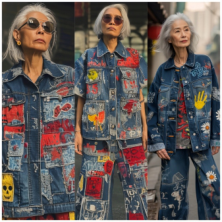
Design Generation and Simulation (Prototype Stage). Utilizing AIGC to create visual representations of Asian elderly women stylishly donning denim attire allowed for early-stage visual concept realization and laid the groundwork for subsequent design iterations, as shown in Figure 2.
Figure 2: AIGC creating visual representations of Asian elderly women stylishly donning denim attire.
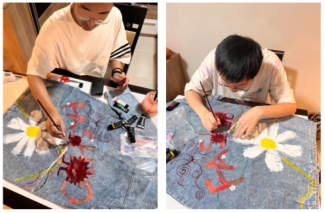
Design Iteration and Optimization (Test Stage). The selection and adap- tation of patterns from the AI-generated prototypes, coupled with the recreation of elements from the original garment, epitomized the iterative refinement process aimed at meeting the target users’ needs, as shown in Figure 3.
Figure 3: Preference of AIGC’s design solution for secondary design and remodeling of denim tops.
Experiment Summary and Problem Analysis Simplified Process vs. Actual Garment Manufacturing Process. The experi- mental stages of “Prototype” and “Test” in the design thinking framework might not capture the intricate details inherent in actual garment production, such as material choice, cutting techniques, and garment structure. While this streamlined approach facilitates rapid concept validation, it may not fully reflect the complexity and craftsmanship involved in real-world clothing design.
Lack of Representation of Real User Needs. The potential shortfall in thor- oughly understanding and analyzing the real needs of the Asian elderly during the experiment could lead to designs that are fashionable but not necessarily practical. Adequate research into the target group’s lifestyle, cultural back- ground, physical needs, and psychological preferences is paramount to ensure the designs’ relevance and attractiveness.
CONCLUSION
Summary of Findings This research offers a comprehensive exploration into the intersection of advanced technology and human-centric design. The study utilized AIGC and imaging technology to address the unique fashion needs of the Asian elderly population, a demographic that has not traditionally been the focus of mainstream fashion design. Through a meticulous process that involved empathizing with the target audience, ideating creative solutions, rapidly pro- totyping, and testing, the study provided valuable insights into how AIGC can be harnessed to create designs that are not only aesthetically pleasing but also culturally sensitive and personally relevant.
Strategic Integration of AIGC in Asian Elderly Fashion 215
Reflection on the Research Approach The research emphasized the importance of integrating human-centric design principles with technological innovation. The use of AIGC and FAHP allowed for a nuanced understanding of the elderly’s preferences and needs, ensuring that the designs were tailored to their specific requirements. How- ever, the study also highlighted the challenges associated with this approach, including the need for a deeper understanding of the complex nature of garment production and the real-world application of the designs.
Future Research Outlook Looking ahead, several avenues for future research have been identified:
Deepening Understanding of Target Demographic. Future studies could focus on a more in-depth analysis of the lifestyle, cultural background, phys- ical needs, and psychological preferences of the Asian elderly to ensure that the designs are not only fashionable but also practical and aligned with their real-life requirements.
Bridging the Gap Between Rapid Prototyping and Actual Production. While rapid prototyping is beneficial for quick iteration and concept vali- dation, further research could explore how to better integrate this process with the actual garment manufacturing process, ensuring that the designs are feasible and align with the complexities and craftsmanship of clothing production.
Addressing Algorithmic Bias and Ethical Considerations. Continuing to explore and address the ethical implications and potential biases in AI sys- tems is crucial. Future research should focus on developing more robust frameworks for ethical AI design, ensuring that AIGC technologies are used responsibly and inclusively.
Interdisciplinary Collaboration for Holistic Solutions. Encouraging col- laboration between designers, technologists, ethicists, and cultural experts can lead to more holistic and well-rounded design solutions. Future research should foster interdisciplinary dialogue and collaboration to ensure that the solutions developed are not only technologically advanced but also culturally sensitive, ethically sound, and deeply human-centric.
In conclusion, while the initial application of AIGC in Asian elderly fashion design has shown promise, there is still much to be explored and refined. The future of fashion design lies in the successful integration of technology with human-centric principles, ensuring that the solutions developed are as inclusive, ethical, and responsive to the users’ needs as they are innovative.
ACKNOWLEDGMENT
The authors wish to acknowledge the Fujian Provincial Science and Technol- ogy Plan Project for Foreign Cooperation (No. 2023I0040) “China-South Africa” Textile and Garment Digital Twin Collaborative Smart Manufactur- ing System Construction and Evaluationm, Minjiang University’s research project(MYK20026), Fujian Provincial Education Science “14th Five-Year Plan” in 2021 (FJJKBK21-140), 2021 Natural Science Foundation of Fujian Province Project 2021J011033. National Belt and Road Foreign Expert
Innovation Talent Exchange Project, General, Research on Design Work- shop Promoting Ethnic Flexible Integration under Rural Revitalization, No: DL2023020001L.
REFERENCES
Bolesnikov, M., Stijaˇci´c, M., Keswani, A., & Brkljaˇc, N. (2022). Perception of Innovative Usage of AI in Optimizing Customer Purchasing Experience within the Sustainable Fashion Industry. Sustainability. Brown, S., Davidovi´c, J., & Hasan, A. (2021). The algorithm audit: Scoring the
algorithms that score us. Big Data & Society, 8. Chen, C., Guo, X., Wee, H., & Tan, K. (2021). Racial disparities in hospitalization expenditures of older adults in Singapore. Innovation in Aging. Chen, C., Lim, J., Chia, N., Kim, D., Park, H., Wang, L., Tysinger, B., Zhao, M.,
Cook, A., Chong, M., Yuan, J., Ma, S., Tan, K., Ng, T., Koh, W., Yoong, J., Bhat- tacharya, J., & Eggleston, K. (2022). Educational Gradients in Disability among Asia’s Future Elderly: Projections for the Republic of Korea and Singapore. Asian Development Review. Chu, C., Leslie, K., Khan, S., Nyrup, R., & Grenier, A. (2022). Ageism in Artificial Intelligence: A Review. Innovation in Aging. DuBreuil, M., & Lu, S. (2020). Traditional vs. big-data fashion trend forecasting: an
examination using WGSN and EDITED. International Journal of Fashion Design, Technology and Education, 13, 68–77. Fabi, S., & Hagendorff, T. (2022). Why we need biased AI - How including cognitive and ethical machine biases can enhance AI systems. ArXiv, abs/2203.09911. He, A., & Tang, V. (2021). Integration of health services for the elderly in Asia: A
scoping review of Hong Kong, Singapore, Malaysia, Indonesia. Health policy. Mohammadi, S., & Kalhor, A. (2021). Smart Fashion: A Review of AI Applications in the Fashion & Apparel Industry. ArXiv, abs/2111.00905. Motahar, T., & Ahmed, N. (2022). Exploring Technology Usage of Southeast
Asian Elderly Women for Better Mental Health during COVID-19 Pandemic. CHI Conference on Human Factors in Computing Systems Extended Abstracts. Ntoutsi, E., Fafalios, P., Gadiraju, U., Iosifidis, V., Nejdl, W., Vidal, M. E.,... & Staab, S. (2020). Bias in data-driven artificial intelligence systems—An intro- ductory survey. Wiley Interdisciplinary Reviews: Data Mining and Knowledge Discovery, 10(3), e1356. Pena, A., Serna, I., Morales, A., Fierrez, J., Ortega, A., Herrarte, A., Alcantara, M., &
Ortega-Garcia, J. (2023). Human-Centric Multimodal Machine Learning: Recent Advances and Testbed on AI-based Recruitment. ArXiv, abs/2302.10908. Stypi´nska, J., & Franke, A. (2023). AI revolution in healthcare and medicine and the (re-) emergence of inequalities and disadvantages for ageing population. Frontiers in Sociology, 7, 1038854. Yam, J., & Skorburg, J. (2021). From human resources to human rights: Impact
assessments for hiring algorithms. Ethics and Information Technology, 23, 611–623. Yao, M., & Li, L. (2022). Design Thinking Applied to Home Textiles Innovation: A Case Study in an Elderly Centre in Hong Kong. Designs. Yapo, A., & Weiss, J. (2018). Ethical Implications of Bias in Machine Learning, 1–8. Zhang, L., Zeng, Y., Wang, L., & Fang, Y. (2019). Urban–Rural Differences in Long-
Term Care Service Status and Needs Among Home-Based Elderly People in China. International Journal of Environmental Research and Public Health, 17.
LISTED IN THE AHFE DIGITAL BOOKSTORE CATALOGUE
Explore the complete digital volume
Artificial Intelligence and Social Computing
Read this individual research paper free through the original publisher, or explore the full digital proceedings book.
ISBN 978-1-958651-98-8
Explore this ISBN in the AHFE Bookstore ↗Listed in the July 2026 bookstore catalogue; search by ISBN to confirm current availability · Digital book purchase optional