Yan Wang, Yixin Guo (2023). User Participation in Museum Digital Communication. In: Human Factors in Communication of Design. AHFE Open Access, vol. 90, pp. 52–60. https://doi.org/10.54941/ahfe1003695
The development of the Internet has brought about the transformation of communication modes and user behavior. Under the influence of participatory culture, the Internet has given the public more opportunities to participate and user participation has gradually become the key to the digital communication of museums. Based on the historical process of Internet development, this paper analyzes the communication modes of digital communication in museums in the era of Web 1.0, Web 2.0, and Web 3.0. This paper finds effective ways to expand user participation through the study of user participation in different periods and puts forward opinions and references for digital communication in museums.
Museums are important places to help people to learn knowledge and improve their cultural literacy. They are also important places to protect and pass on human civilization. With the development of the times, there are more and more demands from society and the public for the museum’s visit experience, interactive entertainment, learning, and education. In order to keep pace with the times, museums are gradually changing their concept of development, shifting their focus to “people-centered” and making full use of digital technology to meet the needs of their audiences through digital communication.
The development of the Internet has given the public more opportunities to participate, and there are more ways for museums and the public to interact and communicate with each other. The public can participate in the digital communication of museums anytime and anywhere. The traditional one-way linear communication mode has gradually evolved into a two-way interactive and multi-party communication mode with the development of the Internet. Museums can provide comprehensive and personalized services to the public through resource integration and cross-border cooperation. Thus audiences can communicate and share with museums on different platforms and parti- cipate deeply in the various contents (Hu and Li, 2019). Based on this, only by exploring the effective path of museum digital communication can museums make better use of digital technology to expand user participation. With the
User Participation in Museum Digital Communication 53
gradual participation of the public, the museum has narrowed its distance from the public and better realized cultural communication.
DIGITAL COMMUNICATION IN THE ERA OF WEB 1.0 One-Way Communication Mode in the Era of Web 1.0
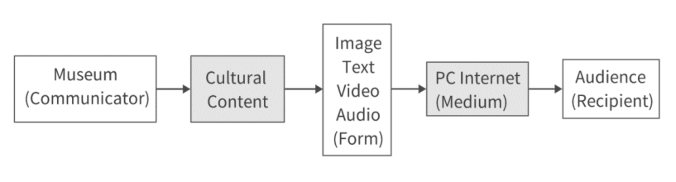
In the era of Web 1.0, users use their personal computers to access portals, browse and search for information through the web browsers. At this time, the center of the museum’s work was “collection-centered,”and the museum’s official website processed information about the collection. Museums provi- ded this information to the public in the form of graphics, audio, and video. While the public received the content through browsing and downloading, realized the one-way communication of content (see Figure 1).
Figure 1: One-way propagation mode.
User Participation in a One-Way Communication Mode User participation in the era of Web 1.0 is mainly done offline. The public can participate by visiting and interacting with commentators. The effect of educational communication is limited, which is limited by time and space. Therefore, museums began to gradually establish a collection information management system and an online display system through digital constru- ction. This enables the public to browse and read the relevant materials and information of the museum anytime and anywhere. In 1997, the Nanjing Museum launched the first online museum as the beginning (Li et al. 2020), which started a new mode of digital communication (Miao, 2019). In 2001, the official website of the Palace Museum was launched, and a large number of collections were presented in digital form and disseminated through the Internet for the first time. The website provides a large amount of informa- tion on cultural relics and images of cultural relics for museum enthusiasts and researchers (Wang, 2021). Users can browse, collect and save to ach- ieve learning participation, receive relevant knowledge, and realize digital communication.
At this time, the focus of the museum’s work is “collection-centered” and the content is mainly PGC (professional institution-produced content), which is provided by the museum. The user’s participation is only to receive the platform content, understand the relevant information through digital communication, and realize the one-way communication of cultural content.
54 Wang and Guo
DIGITAL COMMUNICATION IN THE ERA OF WEB 2.0 Two-Way Interaction Mode in the Era of Web 2.0
Different from the era of Web 1.0, the appearance of Web 2.0 technology broke through the limitation of traditional communication modes. The public began to gain the right to control media technology and information, and participatory culture came into being. Users’ participatory nature was sti- mulated and they started to actively participate in the web. At this time, the public is not only content recipients but also creators, which strengthens network communication. Museums have gradually shifted their focus from “collection-centered” to “people-centered”. Digital communication has also changed from the original top-down communication system dominated by museums to the communication system in which users and museums partici- pate together (see Figure 2). Museums began to use social media, short video platforms, and other platforms to provide the public with a variety of content and services. In this way, it is more convenient for the public to obtain infor- mation and two-way communication is more immediate. It also improves social communication effects and forms a positive participation atmosphere.
Figure 2: Two-way interaction mode.
User Participation in a Two-Way Interaction Mode During the era of Web 2.0, the audience’s subjective awareness began to awaken under the influence of participatory culture. During this period, the public not only participated in the media content produced by the museum, but also began to pay attention to the originality and self-expression of the content. Public gradually changed from passively receiving information in the era of Web 1.0 to actively publishing information and creating content. They began to enjoy the right to publish, modify, and interact with information. The public can participate in the Web through different platforms to achieve two-way interaction and communication with museums. It can also publish original content through various platforms to realize self-expression.
The emergence of massive new communication platforms has facilitated digital communication and user participation in museums and also changed the communication mode. In 2011, the Guangdong Provincial Museum lau- nched the first domestic tour service on WeChat (Zheng, 2021). With the advantage of the WeChat public platform, users can keep abreast of the latest information about the museum anytime and anywhere, communicate with the museum in two-way through messages and comments, and enjoy convenient digital services. Since 2011, hundreds of museums have begun to settle in Weibo, and made announcements, collection science, event tweets,
User Participation in Museum Digital Communication 55
and fan interactions through the Weibo platform. Their interactive, participa- tory, and instant features attract more audiences and museums to participate. Official blogs stimulate audiences’ curiosity and attract the public to par- ticipate in discussions by creating trending topics, like “#Big Year in the Forbidden City”. The interactive communication through social platforms shortens the distance between museums and audiences and encourages public participation in communication (Kuang, 2020).
The rise of short video platforms has expanded the communication plat- form. Public can not only participate in the discussion, but also share the content anytime and anywhere with its low threshold, instant and conveni- ent features. Under the influence of participatory culture, in addition to the official release of cultural content by museums such as the China National Museum and the Palace Museum, there are also a number of creators of high- quality museum content in Tik Tok, such as @ Ma Weidou, @ Yi Gongzi, @ Mercury visiting museums, etc. By releasing explanations and popular science content, they attracted a lot of attention. They provided rich and interesting cultural content for the public and inspired more people to participate in the dissemination of museums as creators.
The Web 2.0 period has been influenced by participatory culture, and the spread of technology and easy participation has allowed more audiences to join in the digital communication of museums. The two-way interactive com- munication mode also stimulates users’ participation. The active users can spread and share their personal views through social media, short videos, and other platforms to actively interact with museums. Besides, it also allows museums to instantly adjust content through the feedback to guarantee communication effectiveness and improves communication efficiency.
DIGITAL COMMUNICATION IN THE ERA OF WEB 3.0 Multi-Party Participation Mode in the Era of Web 3.0
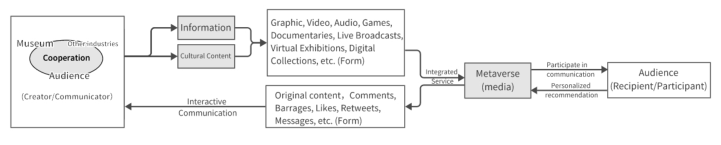
During the Web 3.0 period, the rapid development of technologies such as vir- tual reality and artificial intelligence has further promoted the development of digital communication. The new communication technology and carrier derived from the meta-universe have triggered the transformation of museum communication mode, and gradually moved towards intelligence and per- sonalization. Museums pay more attention to user experience and provide integrated services to meet users’ personalized needs through the integration of network resources. The Web 3.0 period not only facilitates communica- tion between museums and their audiences, but also promotes the integration of resources. There is extensive cooperation between museums and other industries. Through the participation of multiple parties, the communication forms are enriched and the metaverse is used as a medium to provide a good participation experience for the public (see Figure 3).
User Participation in Multi-Party Participation Mode In the Web 3.0 period, the integration of resources and the cooperation of multiple parties have brought comprehensive services to meet users’
56 Wang and Guo
Figure 3: Multi-party participation mode.
individual needs. So the new communication mode has brought new forms of communication and participation at this time.
The Google Art Project makes full use of new technologies and brings museum collections to the web through virtual reality, which has evolved to attract more than 700 museums to participate in the project until the Web 3.0 period. With the help of this project, users can view the world’s best museum collections online without leaving home. It has achieved the integration of digital resources through cooperation with museums, which has changed the way that the public participate in a certain extent. Today, the platform is online with tens of thousands of collections from more than 12,000 artists, and new museums and artworks are still coming online every week, continuously promoting the digital dissemination of museums (Isaac, 2019). Besides, the official blog of the National Museum of China initiated the “National Museum invites you to watch the exhibition in the cloud” during the special period under the epidemic, which also achieved a long period of online accompaniment, and trigger a wide range of public participation. The topic reading quickly exceeded 100 million on Weibo and realized an unexpected communication effect.
In the period of Web 3.0, museums pay more attention to the public, which makes them not only participants but also executors. And museums encou- rage the public to participate in various museum contents deeply. Google Arts & Culture has launched a curatorial program that allows users to create per- sonalized virtual exhibitions by selecting and saving artworks. What’s more, they can share their virtual exhibitions with others using social media such as Facebook and Instagram. On the official website of MIMA Art Gallery in the UK, users can also search and browse information about the MIMA col- lection based on the type of work and vote on the artists’ works. And MIMA will change the exhibits based on the voting results to give users more power (Liu and Jia, 2021).
In the Web 3.0 period, museums are paying more attention to the user experience, using new technologies and forms to bring smarter and more convenient experiences to users through mutual cooperation and resou- rce integration. They reshape the “dependency” relationship between users and platforms. They not only offer a variety of programs to encourage audience participation but also give more power to users. Users are incre- asingly engaged by communicating with museums and personalizing their curation.
User Participation in Museum Digital Communication 57
THE EFFECTIVE PATHS TO EXPAND USER PARTICIPATION Content: Connecting With the Public
In museums, both dated collections and intellectual content that are distant from the public’s daily life create a detachment between the museum and the public. This detachment hinders visits and affects the willingness to partici- pate in cultural communication (Chang, 2021). With the advent of the Web 2.0 period, the positioning of museums began to change. The official Weibo of the Palace Museum has changed its solemn image to use the lively and approachable language style to close the distance with the audience and ach- ieve effective cultural communication. The official Weibo service has carefully planned Life-oriented topics, like “How do you heat the palace in winter?” These topics not only satisfy the curiosity of the audience, but also attract a large number of fans to gather here to participate in interactive discussions. The communication effect is remarkable.
In 2018, Tik Tok launched the “Cultural Relics Players Conference” on International Museum Day. The treasures of many museums appeared on the Tik Tok platform in the form of sketches, combining the popular back- ground music of Tik Tok and the “Thousands of people, thousands of faces” and other characteristics of Tik Tok elements. Through this conference, colle- ctions achieve a spatial and temporal span, and modern audience to establish a connection, captured a large number of young viewers. The creative videos effectively achieved widespread participation and the cumulative play count of such exceeded 118 million, with 6.5 million likes.
After getting rid of the characteristics of seriousness and preaching, museums fully take care of the reception characteristics and cognitive laws of modern audiences. They constantly change their serious and rigid image and content and keep up with the trend of the times to expand user participation.
Forms: Making Full Use of New Technologies With the development of technology, the form of digital communication has also changed. In the Web 1.0 period, the forms are mainly graphics, audio, and videos; In the Web.2.0 period, massive graphic information, television works, and short video have appeared; In the Web 3.0 period, panoramic video, digital collections also began to intervene in the digital communication of museums, and constantly on the form of communication innovation.
Now, users can “cloud tour” museums anytime with VR panoramic tech- nology. In 2020, Tencent and the Dunhuang Research Institute launched the “Cloud Tour Dunhuang” applet, which uses virtual 3D technology to help viewers appreciate the charm of the Dunhuang murals and learn about their history and stories. The newest means of interaction has triggered the partici- pation of many viewers. With the support of AR, VR, and other technologies, major museums have launched digital collections to facilitate users to appre- ciate cultural relics on mobile devices and understand their background and history. The National Museum of China and Henan Museum’s “Treasures of the Museum” have been launched on Topnod one after another. And users can not only enjoy them by themselves, but also transfer them to their peers,
58 Wang and Guo
which facilitates communication among museum enthusiasts and provides a new path for the digital communication of museum relics.
As the public’s demand for user experience continues to rise, new tech- nologies such as AR, VR, and artificial intelligence have brought about innovations in communication formats. The application of new technolo- gies has brought different experiences to the public and stimulated their willingness to participate.
Willingness: Using Gamification to Increase Willingness to Participate In recent years, museums have introduced many forms of gamified partici- pation in order to meet the public’s entertainment needs and increase the willingness of visitors to participate. In 2005, the Palace Museum in Taipei launched a 3D online card game; In 2008, the Tate Britain offered various art-related online games on its children’s website (Wu, 2022). The gamified learning programs launched by these museums are in line with the needs of the public in the digital age and effectively stimulate users’ willingness to participate and learn. Since 2014, the Palace Museum in Beijing has also lau- nched its first app which attempts to “bring”cultural relics to mobile devices. The novel communication form of the game has stimulated users’ interest in participating and accumulated 200,000 downloads within two weeks of its launch. After that, the mobile applications of the Palace Museum continue to improve the product matrix, and the “Emperor’s Day”, “Forbidden City Adventure” and a series of games from viewing to education have been lau- nched one after another. Through dynamic interaction, role-playing and other forms of the display to achieve digital communication.
With the application of NFT technology in the museum industry, Dunhu- ang Research Institute and Tencent have jointly developed a public welfare cultural fun project, Dunhuang Digital Provider. It allows users to com- plete game tasks through interactive quizzes to unlock knowledge about the Dunhuang Mogao Caves and obtain public welfare digital collections. The rare attributes of game rewards can attract users. The digital collections can be shared and spread in social networks, allowing culture to flow among the public. This gamified participation method not only effectively increases the public’s willingness to participate, but also promotes communication and interaction among users and effectively expands the scope of participation.
Experience: Achieving Presence Immersion With the emergence of panoramic video, panoramic images, full live broa- dcasts, and other forms, the audience gradually turns from simple viewing to experience and participation. These forms make it easier for users to partici- pate in the process of communication, improve users’ experience and enhance their willingness to participate by achieving presence immersion.
Live streaming also attracts a large number of viewers to participate colle- ctively by virtue of its low threshold and convenience, and the instantaneous communication creates a sense of immersion and presence as the audience visits the exhibition in the same space. The pop-ups and comments used for
User Participation in Museum Digital Communication 59
live video streaming provide a channel for immediate discussion and partici- pation, bringing a good presence experience and achieving effective collective participation. In 2020, the Forbidden City conducted live streaming activities on International Museum Day and Chinese Cultural Heritage Day, achieving group participation with a total of over 460 million views. Through this par- ticipation in live streaming and museum interaction, achieving large-scale of cloud visits and expanding the communication impact of the museum.
Virtual reality technology has realized the overlap of space and time, through VR, H5, and other technical means to achieve the “cloud visit”. The public can watch at 360
to observe and research. Even the use of VR technology can be directly immersed in it, to achieve immersive “immersion”, which can not be achieved by traditional museums (Zhang, 2022). They can fully improve the user experience to attract more audience immersion and participation.
CONCLUSION
Digitization is an inevitable trend in the development of China’s museums. Although the digital construction of museums is developing more rapidly and the forms of communication are more diverse, the competitiveness is limited in the competition of the entire Internet. Therefore, it is necessary to change the concept of development, grasp the trend of the times and make full use of the existing technology. Museums should pay attention to user experience, and expand the public’s participation to realize cultural com- munication by constantly innovating communication methods and enriching communication forms.
While there is a growing interest in digital communication in museums today, the offline in-person experience is still something that cannot be repla- ced by the online experience and requires a complementary blend of online and offline. Museums need to consider the user’s experience before, during and after the visit. Before the visit, users can use the museum’s various digital resources to attract users and help them understand the museum. During the visit, they can enrich the visitors’ experience through digital communication. After completing the visit, museums need to use quality digital resources to extend the user experience and retain users. In the future, museums need to constantly update digital resources and strengthen online and offline cooperation to achieve user participation and cultural communication.
REFERENCES
Chang, Danjing (2021). Audience participation in museum learning: concepts, characteristics and responses. Southeast Culture, 2021(05), 169–175. Hu, F., Li, X. T. (2019) Research on the model and problems of user-generated
content in museums. China Museum, 2019(01):113–119. Isaac, J. (2019). Pics or it didn’t happen: The artwork formerly known as heritage in Google Street Art. Convergence, 25(3), 374–392. Kuang, Yeqing. (2020) The development of museums in the new media era The deve-
lopment of museums in the new media era: the example of the “Palace Museum”. Beauty and the times, 2020(02), 30–31.
60 Wang and Guo
Li Yichao, Peng Changchang, Qi Guanze. (2020) Research on regional museums in the context of new media. Cultural Identification and Appreciation, 2020(22): 108–110. Liu, Zhe, Jia, Qing. (2021) Public participation in museum education activities.
Science Education and Museums, 7(03): 233–237. Miao Jialin. (2019) The change of viewing in the digital context of museums. Nanjing University. Wang Xudong. (2021) The past, present and future of the digital Forbidden City.
Science Education and Museums, 7(06), 524–531. Wu, Dy. (2022) Analysis of the characteristics and design ideas of digital gamification learning in museums. Natural Science Museum Research, 7(02), 5–12+91. Zhang Jianguo. (2022) A study on the guaranteed strategy of the digital museum
for heritage conservation and global communication. Intelligence Science, 40(02), 59–64. Zheng Fan. (2021) Museum development and thinking under social media. Heritage Identification and Appreciation, 2021(14), 139–141.
LISTED IN THE AHFE DIGITAL BOOKSTORE CATALOGUE
Explore the complete digital volume
Human Factors in Communication of Design
Read this individual research paper free through the original publisher, or explore the full digital proceedings book.
ISBN 978-1-958651-66-7
Explore this ISBN in the AHFE Bookstore ↗Listed in the July 2026 bookstore catalogue; search by ISBN to confirm current availability · Digital book purchase optional