Renato Bispo, Samuel Gessner, Joana Blanc (2022). Oughtred's Circles of Proportion 2.0: A Proof of Concept for Hands-on Science Engagement. In: Human Dynamics and Design for the Development of Contemporary Societies. AHFE Open Access, vol. 25, pp. 346–354. https://doi.org/10.54941/ahfe1001407
This paper presents the development of a functional model of the logarithmic slide rule designed by the mathematician William Oughtred in the 17th century, known as Oughtred’s Circles of Proportion, to be used in educational contexts related to the history of science and the teaching of mathematics. The project consisted in interpreting the original instrument to develop a rigorous three-dimensional model of the slide rule, including its logarithmic scales and friction-tight joint, as well as adapting this artifact for 3D printing to the production of manipulable interactive objects at reduced costs. The paper presents the successive stages of development and collaboration, from the definition of goals and the target audience to the design of functional parts, the iterative testing in different educational contexts from schools to science events and plans to a revised version. The project exemplifies a promising way to engage with material heritage of science. The project constitutes a proof of concept for a generalized approach for the development of inclusive objects in science exhibitions, as a strategy to allow an easier and deeper understanding of the underlying scientific concepts and bringing the public closer to science.
The opportunity of making a hands-on model of the Oughtred’s Circles of Proportion arose with the presentation of an original artifact of this rare instrument in the exhibition “The intimacy of numbers: emerging technolo- gies between London and Lisbon”, organized in partnership by the National Museum of Natural History and Science in Lisbon (MUHNAC) and the Bri- tish Embassy in Lisbon, which was open to the public from 16th September to 17th December 2021.
The instrument, called Circles of Proportion, is an early form of the logarithmic slide rule that allows speeding up computation: multiplication, division, elevating to powers, extracting roots, all this and more can be done simply by moving the parts of the instrument and using the scales. The functional model designed for the hands-on component of this exhibition was
Oughtred’s Circles of Proportion 2.0: A Proof of Concept 347
the opportunity for a deeper study on new ways of presenting historical sci- entific instruments, in a search for alternatives that stimulate curiosity and engage wider audiences.
In a push-back against the banalization of digital tools and gamification in museums (Sanchez, E. and Pierroux, P. 2015), recent years have seen a rising interest in returning the focus on material culture and authentic colle- ctions (Lourenço, M.C.& Gessner, S. 2014). Also, museums with historical scientific instruments have never stopped developing activities during which participants can use simplified models.1 For instance, the experience of paper models is sufficient for conveying a sense of the functional principles of the instruments. Nevertheless, they are often imprecise, and the user experience is not close enough to both the pleasure and difficulties of using instruments in their historical form.2 On the other hand, 3D replicas are increasingly com- mon in museums, however, most of the examples that can be found are based on 3D scanning that do not keep the original object functionality, thus not allowing 3D printing of functional models.3 To address this challenge, a multidisciplinary team consisting of product and communication designers, a science historian, conservators, and museum educational staff was brought together. The aim was to develop a functio- nal interactive model of Oughtred’s instrument affording a user experience that should engage the audience beyond teaching mathematical principles and provide an interactive ‘hands-on’ experimental moment that allows exploring the properties of the historical shape, feel and use of Oughtred’s slide-rule. The printed model shares with the original its operating logic, but differs in its objectives and construction process, seeking to become as accessible as pos- sible and deal with new issues arising from new audiences and new contexts of use.
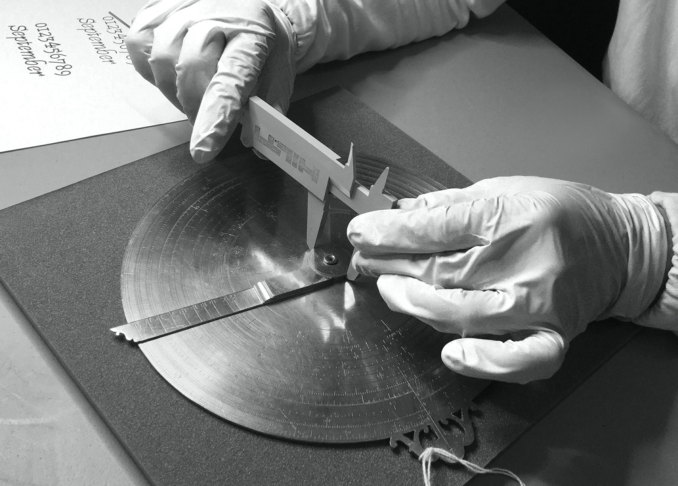
OUGHTRED’S CIRCLES OF PROPORTION A rare early 17th-century instrument, Circles of Proportion, a logarithmic computing device invented by William Oughtred (1574–1660), takes center stage in this paper. One of the seven known examples of this instrument is preserved at the University Museum in Lisbon (MUHNAC). It consists of a thin polished brass disc engraved with multiple circular scales (Figure 1). It’s size, 205mm in diameter, with rotating parts on both faces, conveniently fits into a large pocket. Our focus are the logarithmic scales on one face, although the central part of that face is taken up by a nocturnal instrument (for time keeping at night), and the reverse side is engraved with a horizontal stereographic projection allowing computation of daytimes, at a latitude of 54,5° North, the place for which the instrument has been made for.
1To name three of the most eminent museums: History of Science Museum, Oxford; Museo Galileo, Florence; Mathematisch-Physikalischer Salon, Dresden. 2Faithful replicas of historical instruments are used in rare cases, like at the Mathematisch-Physikalischer Salon, with the restriction, however, that only the demonstrator is manipulating the object. 3Many museums such as the Smithsonian Institution, the British Museum or the Museu de Évora in Portugal, to name just a few, have 3D replicas of their historical artifacts available online for viewing or printing. A large collection of these replicas can be found on the SketchFab platform.
Figure 1: Instrument preserved at the University Museum in Lisbon (MUHNAC). Mea- surement of the friction-tight joint which connects the compass legs to the plate with the logarithmic scales.
The style of the instrument allows attributing it to the London instrument maker Elias Allen (ca. 1588–1653) and the date of production is before 1638. As one of the earliest forms of logarithmic slide-rules the instrument was sen- sational in its time. Logarithms had only been introduced recently in the form of voluminous tables. The benefit and legitimacy of their use were still being discussed by mathematicians throughout Europe. Oughtred’s instrument had the benefit of visualizing the properties of logarithms in a convincing way, and its contribution in popularizing the new concept should not be underestima- ted, although the more successful form of slide-rules were the later common linear slide-rules used by engineers until the 1980s.
A 3D PRINTED INTERACTIVE MODEL Seeking to recreate the experience of using the original object, the design process of the interactive model started with the detailed observation of the original instrument, trying to adapt it to a new version that could be repro- duced in an accessible way to be used in museum activity with groups from schools or museum visitors, in 60 minutes sessions.
Due to resolution limitations arising from 3D printing4, it was found that it would not be possible to print scales as detailed as those existing in the original without increasing its size considerably. To create a user experience as similar as possible to the original, it was considered more relevant to keep 43D printing by fused filament fabrication was chosen for being widely available and low cost, namely by using open-source equipment such as the Prusa MK3S printer on which this project was printed.
Oughtred’s Circles of Proportion 2.0: A Proof of Concept 349
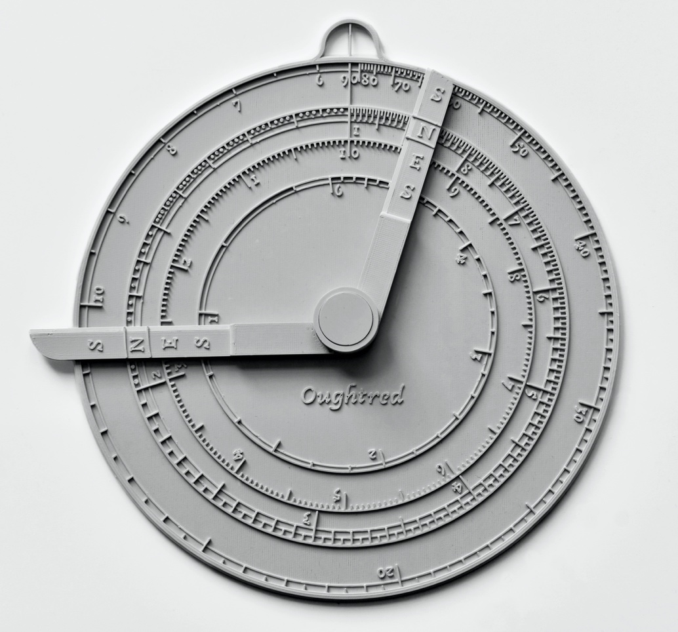
Figure 2: First version of the 3D-printed model of Oughtred’s Circles of Proportion with the chosen scales: The N scale, which represents a logarithmic scale from 1 to 9, and has an infinite nature adding a 0 in each complete turn; the E scale, a regular scale numbered from 1 to 10; and two S, sine scales, the inner one from 1 to 6, and the outer one from 6 to 90.
the dimensions of the object, as these refer to a way of using it that would be significantly altered in a large-scale model. Thus, four scales were selectively chosen, considered most relevant by the museum’s educational service, which allow both a first approach to the logarithmic operation of the slide rule, starting with simple calculations such as multiplication and division, and the realization of more complex calculations such as square roots, as the user gets more at ease with the logic of operation.
The option to produce the interactive model by 3D print led (Figure 2) to several adaptations of the original design, due to differences between this technology and the original construction method. Production by deposition of material, also commonly known as additive manufacturing, differs from the original, which, being an engraving process, consists of removing material by cutting the scales on a plate of solid brass. If in the original construction the only viable option would be to produce the scales in bas-relief, in a new 3D printed model this option no longer makes sense, with the high relief being considerably more rigorous and easier to print without errors.
This change causes an obvious alteration in the visual perception of the scales, as in the original object the contrast is guaranteed by the patina trap- ped in the bas-reliefs, which makes them darker, while in the printed model, the scales become visible by casting shadows that result from their volume- try. This solution has both advantages and disadvantages as regards legibility, namely because it is particularly sensitive to the light conditions of the envi- ronment in which the model is handled, which makes it difficult to read in low light, but increases the appetite for tactile support in reading, making it possible to count the numeric traces with the finger or fingernail.
Beyond the accuracy of the angle markings that make up the various scales, the proper functioning of this slide rule depends largely on the articulation between the two legs and their two levels of friction. The angle between the legs should be easily adjusted by the user, who will then rotate them on the plate without losing the angle to perform the calculations. If the angle between the legs changes during rotation, this will give the wrong result. To solve this problem, it was necessary to develop a joint with a level of friction between the legs that would prevent them from moving accidentally. Seve- ral hypotheses of articulation that would work consistently were developed, despite the possibility of error up to 0.1 mm existing in 3D printing and the wear of the plastic by use. Among the various possibilities, a hypothesis was selected that allows the user, or museum staff, to increase friction by pressing the center of the joint when the legs start to show signs of wear. To reduce the friction of the two legs with the base, for a free rotation without the risk of losing the angle, only one of them is seated on the base, with the other slightly suspended so as not to be noticed by the user.
The analysis of the legs also led to an insight of the affordances that they bring about, namely at the moment when the user marks the angle that will be used to calculate. This gesture can be performed in different ways, but one of the most effective is to hold one leg against the base while rotating the other to the desired angle. In the original object this way of operating was identified, having built one leg slightly longer than the other, one aligned with the edge of the disk and another that goes beyond it, creating a tip of the leg where it can be picked up. In the printed model this feature was accentuated by making the difference in size between the two legs more evident, which not only makes the gesture of marking the angle more intuitive but also facilitates the differentiation between them in whatever position they are, essential for a more fluid use by a new user.
In the same sense, the throne adorning the original object has been rede- signed to make more evident its essential function of orientation on the slide rule, to mark the zero point where all scales begin and which function as a reference to start any operation.
The existing numbers on the plate and the letters that identify the respective scales, were also adapted for 3D printing, designed in a similar way to those existing in the original. The inscription “Oughtred” was introduced on the dial, with the objective of allowing the user to familiarize herself with the name of the inventor of the object, which will allow her, if she wishes so, to find more information about this object and its origin. Finally, a color was
Oughtred’s Circles of Proportion 2.0: A Proof of Concept 351
chosen for printing that would present a good visual contrast and would not be significantly altered by the manipulation of visitors.
USER TESTING Repeated “real-life” tests of different types with a variety of users constituted important steps in the development process of the 3D-model. The first type of test was conducted through short interactions during museum events with a mixed public of random visitors (FICA, Oeiras, Oct. 12-17, 2021; Feira da matemática, Oct. 30, 2021; Rota dos Números, Nov. 4, 2021). The second type of test was the use of the model with school groups of different levels in Lisbon (7th grade primary school Eugénio dos Santos, Nov. 25, 2021; 12th grade, secondary school D. Filipa de Lencastre, Dec. 16, 2021). In half of the cases, the visitors had the opportunity to see the original instrument on display at the museum, in the other cases, only a small photo was shown of one face of the brass instrument.
The objective of the tests was not only to measure the power of attraction and stickiness of the object for the audience5 but also more specifically three levels of usability: (i) testing whether the user can easily distinguish the diffe- rent parts (throne, long leg and short leg) and the different scales (N scale, E scale, S scale) on the instrument; (ii) testing whether the users manage to read off the values from the scales, understand the shapes used in the graduation; (iii) testing whether the users can easily move the legs of the compass: either to set them to given values, or to move them jointly from one position to the next.
During most of the tests the person conducting the activity tried to memo- rize the reactions and the questions raised during the activity. In addition, at the end of the activity a quick survey was conducted orally, and the pupils were invited to leave their written comments on post-it clips. From the tests it was clear that the model was fairly mature. A good indicator for this maturity was the fact that the users performed the required task with the instrument without even giving much attention to the way it was made, or the fact that it constitutes a simplified derivation of the instrument seen at the museum.
Nevertheless, some observations became clear: (i) in rare cases, the opening between the legs changed when they were moved jointly. This means that under certain conditions the friction between the two legs is not sufficiently strong; (ii) several users suggested using different colors to distinguish the scale N from the scale E, as they easily tended to confound the two scales; (iii) in some cases, it was difficult to read the fractional part from the scale. Also the fact that, with a monochrome model, the scale contrast depends on light conditions, caused some difficulties in localizing the legs’ positions; (iv) in certain constellations, the leg hided the numbering of the scale, and this makes it hard reading off the value of the current position; (v) when angles of over 110° need to be represented on the scale, the compass legs cannot be
5Attraction power and stickiness are frequently used general parameters in museum and exhibition studies.
opened in the usual way. The users needed to find out that the leg-opening was limited – then figure out the workaround (using the coterminal angle).
NOTES FOR A SECOND VERSION At the time of writing a second version of the model is being developed based on the conclusions of the first test cycle. This second version will be tested like the first one, which does not prevent, however, some conclusions from being drawn right now.
Some of the reported legibility difficulties stem from the original object and its complex nature, such as the coexistence of several scales, which creates the confusion between them, the shorter leg which hides the numbers in some calculations, or the angle limitation between the two legs which forces to use the coterminal angle in some calculations. The problems observed allows us to cogitate how to overcome the functional and legibility issues without having to oversimplify the model and lose its idiosyncratic character.
The most recurrent error consists of users who wish to read a value on the N scale and mistakenly read it on the E scale. It is this confusion that led several participants to suggest the need to accentuate the N scale with a different color. It should be noted, however, that this difficulty does not seem to involve the two S scales, which points to the importance that the empty space between the scales has in this issue.
The problem of confusion between scales is magnified by the fact that most of the exercises performed in the tests, were aimed at people who are having their first contact with the model, which for this reason focus essen- tially on calculations on the N scale, paradoxically the one that has less free space below its numbering. It could be argued that this issue would justify the change in the order of the scales with respect to the original instrument, by placing the N scale inside and thus giving it more free space below the numbers, but this would also lead to a smaller diameter to distribute the markings. The original instrument maker’s decision to place the N scale on an outer diameter relative to the E scale was not random and is part of the intelligence present in the object. The N scale needs more space than the E scale, because it requires subdivisions with smaller angles. It is also for this reason that one of the S scales is near the periphery while the other is near its center. Scales that require smaller angular divisions were placed on the largest possible diameter.
The attempt to reproduce a functional model of an historical artifact, such as the Circles of Proportion, leads to reflecting on the compromises and deci- sions that the original builders had to make to be able to build it, encouraging those who are doing it today to dialogue with the decisions made hundreds of years ago. Some of these decisions have a technological dimension that no longer makes sense, but others have ergonomic, logical, or functional rea- sons that are the essence of what makes us want to understand this type of object.
The original object does not take advantage of difference or proximity between scales as a way of improving legibility and building a visual rela- tionship between them, choosing the maximum use of the available space.
Oughtred’s Circles of Proportion 2.0: A Proof of Concept 353
It can be assumed that, at the time, the readability difficulties were con- sidered as less relevant than the ability to contain as much information as possible.
In the context of the new model, the amount of information becomes less central than the need to make the readability more accessible, as the objectives of the model have changed, and today it serves to allow the understanding through experience of the principles underlying the Circles of Proportion.
The use of the empty space obtained from the presence of only four scales, associated with a greater freedom in the design of the scales allows a better differentiation between the scales, making it easier to notice what is different among them and making the model more efficient from the point of view of the dissemination of the mathematical principles underlying them.
In the specific case of the N scale, the way forward appears to be designing it wider and with more visual emphasis, which will not only lead to a better differentiation from the E scale, presumably solving the difficulties related with reading errors, but will also make it possible to understand more clearly its cyclical and infinite nature in which each turn increases by one 0 on the marked scale.
At this moment it is not yet possible to say that we are facing a definitive version, but whatever the new discoveries and developments may be, the goal of developing a model that allows reliable, low-cost printing and without the need for finishing with other technologies, remains valid, as this feature is essential for a wider dissemination, through 3D printing in places such as museums, schools or libraries, which tend to lack specialized technical sup- port. This productive criterion, for the time being, makes two-color printing unfeasible, which would require finishing processes using other technologies such as painting, the use of more sophisticated, expensive, and complex 3D printing equipment, or an interrupted printing process for the replacement of filament of a different color, which would make the process more technically demanding, time consuming and prone to failures.
Reliability issues, such as the development of the central joint with two levels of friction, which allows a fluid use without the angle being lost, have proved essential to the success of an object with a complex interaction, such as the Circles of Proportion. How 3D printing technology can respond to this need requires further study on how solutions can be achieved that overcome the difficulties related to the error tolerances that currently exist in fused filament printing, to the aging of the model due to plastic wear over time, and to a more democratized and heavy usage scenario, where scientific historical artifacts will be handled not only by specialists but also by the general public more prone to unexpected and incorrect uses.
CONCLUSION
The experience with the 3D printed model of Oughtred’s Circles of Proportion presented in this paper highlights a number of important aspects: (i) To develop a rigorous three-dimensional functional model of an original instrument, producing not a generic instrument, but one based on the parti- cular object preserved in the local collection ensures a good balance between
the feel of authenticity and easy interaction, essential for the motivation of the visitor; (ii) Three-dimensional printing by plastic filament is well ada- pted to the production of manipulable interactive objects at reduced costs; (iii) Reduction and simplification is needed, while complexity should not be wiped out totally because it is part of the experience offered by the histori- cal instrument and therefore an important component of the user experience. This arbitration needs to be found in dialogue between designer, museum edu- cation team and historian of science; (iv) Preliminary testing and developing successive versions are a natural part of the process.
Building on the acquired experience and established transdisciplinary col- laboration we plan to expand our approach to further historical instruments. With the steps outlined above, we arrived at an operational proof of concept for a generalized approach for the development of inclusive objects in science exhibitions, as a strategy to allow an easier and deeper understanding of the underlying scientific concepts and history of science.
ACKNOWLEDGMENT
This project was funded by the Foundation for Science and Technology FCT, in particular by a ‘Verão com Ciência’ two-month grant, and the Bri- tish Embassy in Lisbon. It benefitted from the partnership of the National Museum of Natural History and Science MUHNAC and the Liceu Luís de Camões highschool, with the collaboration of Carmo Elvas and Anabela Teixeira. We also acknowledge the contribution of the adaptation of the historical typeface by Aprígio Morgado.
REFERENCES
Lourenço, M.C.& Gessner, S. (2014). Documenting Collections: Cornerstones for More History of Science in Museums,” Science and Education, 23(4), 727–745. Sanchez, E. and Pierroux, P. (2015). Gamifying the Museum: A Case for Teaching for
Games Based Learning. Proceedings of the 9th European Conference on Games Based Learning (ECGBL 2015), Steinkjer, Norway, October 8–9, 471–479.
LISTED IN THE AHFE DIGITAL BOOKSTORE CATALOGUE
Explore the complete digital volume
Human Dynamics and Design for the Development of Contemporary Societies
Read this individual research paper free through the original publisher, or explore the full digital proceedings book.
ISBN 978-1-958651-01-8
Explore this ISBN in the AHFE Bookstore ↗Listed in the July 2026 bookstore catalogue; search by ISBN to confirm current availability · Digital book purchase optional