Etsuko Sugai, Yasunobu Ito (2024). Initial Education for CRCs with Different Background Knowledge: Case study of a company supporting clinical trials in Fukuoka, Japan. In: The Human Side of Service Engineering. AHFE Open Access, vol. 143, pp. 264–270. https://doi.org/10.54941/ahfe1005106
The purpose of this paper is to examine the curriculum requirements for the development of clinical research coordinators (CRCs). In particular, the purpose of this paper is to examine and clarify what kind of effect their prior knowledge and skills had in acquiring the basic knowledge and skills of CRCs when they landed this profession. Clinical trials on human subjects are trials to test the efficacy and safety of drug candidates (hereafter referred to as investigational drugs). CRCs come from a variety of backgrounds, including licensed nurses, licensed laboratory technicians, and non-medically qualified personnel. Companies must provide initial and ongoing education to CRCs to ensure they become an asset in the company. However, there is no uniform training curriculum in the industry to date, as each company is providing its own training to CRCs. In this study, we conducted in-depth interviews with six CRCs at Company F in Fukuoka, Japan, including three new CRCs (one CRC a certified laboratory technician, one CRC a certified nurse and one CRC without a medical license). In addition, CRCs’ work practices were conducted by participant observation to examine what kind of initial education is needed for CRCs with different backgrounds, in line with the qualitative data.
Drugs must be both effective and safe. Therefore, the final step in the develop- ment of a new drug is to conduct efficacy and safety studies in humans. These trials are called “clinical trials.” Clinical trials are conducted by three par- ties: the pharmaceutical company, the medical institution, and the subjects. Because of the rigorous and complex procedures involved in conducting a clinical trial, it is essential to have an organization that supports the pharma- ceutical company and the medical institution. Generally, CRC is outsourced because medical institutions are usually preoccupied with medical treatment and at the same time have to perform complex clinical trials. The role of CRC is not only to support clinical trials, but also to oversee the proper conduct of clinical trials in accordance with Good Clinical Practice (GCP). The CRC profession emerged since the establishment of Good Clinical Practice (Ebbe
Initial Education for CRCs With Different Background Knowledge 265
and Kurt, 2003) in 1997, which tightened the conduct of clinical trials, and has enabled medical institutions to conduct clinical trials with efficiency and provide appropriate informed consent. Although CRCs are indispensable for conducting clinical trials with thorough knowledge of GCP (Jessica et al., 2020), there is no national qualification system in Japan. Furthermore, the history of the CRC as a profession is about 20 years old, much younger than nurses and other medical professions, hence the education system and career ladder has not yet been standardized throughout the industry.
Another characteristic of outsourced CRCs is that they are not allowed to perform medical procedures. According to data from Japan SMO Association (JASMO, 2023), in 2022, 28.3% of CRCs were not medically qualified.
In clinical trials, the collection of data on adverse events (all adverse health events) in subjects is a major part of safety assessment. CRCs are first to obtain information than anyone else as they need to conduct interviews with subjects and check test results. CRCs are not allowed to practice medicine or make medical judgments, but they are required to make judgments on matters that require medical urgency. Since certain medications cannot be used in combination, if a subject starts a new treatment, the CRC needs to make sure it is not a prohibited treatment, and no adverse events have occurred. Thus, CRCs must have basic knowledge of diseases, drugs, and laboratory values, as well as the skills to negotiate and coordinate with all departments within the institution to ensure that the trial is conducted according to protocol and in compliance with GCP. Most of the CRCs have experienced other professions such as a nurse or a pharmacist before landing their career in this profession. Some even have no professional medical qualifications. In the initial stage of their career, CRCs’ basic job-related knowledge and skills vary depending on their backgrounds. Therefore, optimal training would be tailor-made to suit each individual albeit the issue of high cost. While there is much debate regarding the training of CRCs, there has been no qualitative studies which focus on the background knowledge of individual CRCs. This study aims to examine the background knowledge of CRCs. Being aware of the issue, we conducted an ethnographic study of CRCs at Company F and examined specific qualitative data to clarify what kind of abilities CRCs acquire and what kind of training programs are effective.
The questions pursued in this study should have implications on various types of in-house training for working professionals, in terms of which train- ing considers the individual’s background knowledge in the early stages of his or her professional career.
METHODS
Ethnographic research (Ito, 2016) mainly based on participant observation and interviews, was conducted on six CRCs working with Company F. The study period was from April 2022 to January 2024. The work experience of the observers is shown in Table 1.
266 Sugai and Ito
Table 1. Attributes of the CRCs.
Table available in the original PDF paper.
CRC History of CRC Background (Previous Occupation) L 13 years Medical Qualification: laboratory technician Previous occupation: laboratory technician 2 years PK 9 years Medical Qualifications: laboratory technician Previous occupation: embryologist 3 years E 2 years Medical Qualifications: no medical qualifications Previous occupation: a design job Clinical trials administration: 1 year CRC assistant: 2 years PD 4 years Medical Qualification: laboratory technician Previous occupation: laboratory technician 1 year 9 months O 2 years Medical Qualification: laboratory technician Previous occupation: laboratory technician: 3 years, embryologist: 2 years J 1.5 years Medical Qualification: nurse Previous occupation: 1 year as a nurse
One of the authors (ES) worked as a nurse for 10 years before switching her career to CRC and is now the executive manager of Company F. She assumes the additional post as CRC and works with the CRCs in the study daily, so she was able to observe them in action.
In addition, casual reporting from each of the CRCs provided information on their work activities. Emails and checklists shared by the CRCs and med- ical institutions for dealing with subjects provided insights into how CRCs approached each stakeholder. At the kick-off meeting for medical institutions conducting clinical trials for the first time, senior CRC and new CRC had a meeting with the medical institution staff. This allowed us to grasp the extent to which the new CRCs had acquired knowledge about the clinical trial in detail.
RESULTS AND DISCUSSIONS
Table 2 below shows an example of the work and role of a CRC during a visit to a hospital. It describes a day of a CRC.
Table 2. An example of a CRC’s activity in a day (visited two hospitals in one day).
Table available in the original PDF paper.
Item Contents Check the process for handling subjects Confirm type of assessment and order Confirm specimen kit contents, pick-up booking, etc.
Interviews: to check on medical adherence, to check for adverse events, to check concomitant medications, etc.
Assistance with medical examination: reporting the con- tents of the interview and confirming the safety assess- ment => confirm whether the clinical trial can continue, confirm the efficacy assessment of the regulations
Allocate investigational medicinal products by electro- magnetic system and request for prescriptions from physicians
(Continued)
Initial Education for CRCs With Different Background Knowledge 267
Table 2. Continued.
Table available in the original PDF paper.
Item Contents
Laboratory assistance: check the number, volume and collection time of specimens
Investigational medicines: check that the correct inves- tigational medicines have been given to the subject and explain how to use the investigational medicines
Explanation on the date of the next visit
Confirm accounting (will be different from normal med- ical fees)
Data entry into electronic reports
Prepare for the next subject visit
Subsequent process- ing
Prepare specimen kits and book for collection
(a few days later) Receipt of test results
⇒Request a safety assessment to a doctor
same as above same as above Visit S-clinic
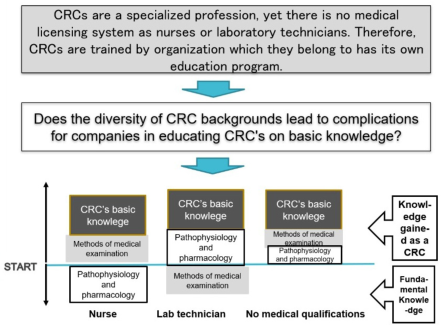
CRC is a highly specialized profession (Speicher et al., 2012) and requires a solid initial education, but the type and presence of medical qualifications complicate the education. For example, qualified nurses have basic knowl- edge of pathology and pharmacology prior to the start of basic CRC educa- tion but must learn new test processing methods and basic CRC knowledge. Those without medical qualifications need to acquire basic CRC knowledge in addition to pathology, pharmacology, and test processing methods. At company F, all newcomers undergo CRC introduction training including 35 items on basic knowledge (including pathology, pharmacology and test pro- cessing methods). However, it was anticipated that the understanding of an individual would differ depending on his or her background (Fig. 1).
Figure 1: Image of basic education for those with different backgrounds.
Below are the results of research conducted with three new CRCs (one CRC a certified nurse, one CRC a certified clinical laboratory technician, and one CRC without a medical certification).
268 Sugai and Ito
Observations and Interviews With Ms. J, Who Has Experience as a Nurse During our observations in the medical institution, Ms. J always observed the nurses very closely. She also timed her requests to the busy nurses to examine the subjects. She said, “Right now, Nurse H is explaining the test to another patient, and it will take a while, so I will ask the subject to wait in the waiting room for about five minutes.” “Now that there are so many patients in the clinic, I will talk to Nurse H and change the order for testing the subject.” In the scattered circumstances, she suggested optimizing the entire outpatient flow so that the response to subjects could be completed efficiently.
She stated the following in an interview: “Although I’m not as good as a pharmacist, I do know what drugs the subjects are using (and I know what effect they have).” “On the other hand, back in college (University of Nurs- ing), I only studied laboratory tests briefly, so I don’t know how to process blood specimens. Even when I was a nurse, when I took blood samples, I immediately sent it to the clinical laboratory... So, after I became a CRC, I learned how to process and practiced it” (Interview with J, November 27, 2023).
Observation and Interview With Mr. O, A Licensed Laboratory Technician Ms. O is a licensed laboratory technician, so she is familiar with specimen processing. She stated the following in the interview: “I am a laboratory tech- nician, so I am familiar with laboratory data. Even if there is an abnormal blood test result, laboratory technicians have the advantage to tell imme- diately whether it is an adverse event or within the range of physiological fluctuations. On the other hand, as a laboratory technician, I only dealt with numerical values and had no opportunity to communicate with patients, so in the beginning, I had difficulty extracting important information, such as signs of adverse events, from conversations with subjects. However, as I gained experienced at work, I gradually became proficient in eliciting important information” (Interview with Ms. O, January 12, 2024).
Observations and Interviews With E, Who Is Not Medically Qualified Ms. E originally worked in a design-related field. Although she was not medically qualified, she had some knowledge of CRC work, having worked in a clinical trial office for one year and as a CRC assistant for two years before becoming a CRC, and she understood what kind of medical knowl- edge was needed for a CRC and how to interact with senior CRC staff to gain knowledge.
Even though, Ms. was not medically qualified, she always kept a test text- book (she described it as the Bible) with her and went through each test procedure one by one. For example, when she asked a nurse to perform an EKG on a subject, she would refer to the textbook and explain the proce- dure to the nurse, in case the nurse made a mistake. “I somehow manage to explain the procedure to the nurses by referring to the textbook”she said. But
Initial Education for CRCs With Different Background Knowledge 269
I cannot diagnose if the EKG waveform is normal or abnormal” (Interview with Ms. E, November 29, 2023).
CONCLUSION
In this paper, the authors focused on how to supplement the CRC’s initial education. Both Mr. O, a qualified nurse, and Ms. J, a qualified laboratory technician, were aware of the strengths and weaknesses of their backgrounds and made efforts to compensate for their own areas of weakness.
Ms. E, who has no medical qualifications, did not talk to the author about her weakness as much in response to the author’s interview. In fact, from her narrative, “I somehow manage to explain by referring to the textbook,” it was discernible that she felt anxious about her work. Incidentally, Company F has a mentor-mentee system (Kram, 1983) and practices “visualization” of what they can do and what they cannot do. As Ms. E was a CRC assistant, she did not take part in this system. This may be part of the reason why her concerns have not been addressed and resolved.
Because of their different background knowledge, the CRCs have their own strengths and weaknesses. One way to improve initial education would be to make the backgrounds of CRCs “visible” to each other so that they can complement each other, such as the mentor-mentee program that F Corp. is attempting. We will discuss this point in more detail in another paper.
Furthermore, we believe that the initial training discussed in this paper will have implications not only for the CRC sector, but for other industries as well.
Limitations of This Study and Implications for Future Research It is difficult to say that one of the authors who employed CRCs in this study had not had any effect on the interviews with the CRC subjects. In the inter- views, it was found that they felt reluctant in explaining their weaknesses. This is a limitation of the research data in this study. In the future, we plan to conduct further observation and interviews with CRCs from other companies for comparison.
ACKNOWLEDGMENT
This work was supported in part by JSPS KAKENHI Grant Numbers JP 22H00770.
REFERENCES
Ebbe E. and P. Kurt (2003). ICH-GCP Guideline: quality assurance of clinical trials.
Status and perspectives. Ugeskrift for Laeger, 165(16): 1659–62. Ito, Y. (2016). “‘Ethnography’ in Japanese Corporate Activities: A Meta- anthropological Observation on the Relationship Between Anthropology and the Outside”, in: Enterprise as an Instrument of Civilization: An Anthropological Approach to Business Administration, H. Nakamaki, K. Hioki, I. Mitsui, Y. Takeuchi (Eds.). Springer, pp. 55–72.
270 Sugai and Ito
Japan Association of Site Management Organizations, (2023). JASMO Data 2022, JASMO website https://www.jasmo.org/assets/pdf/about/data2023.pdf (in Japanese). Jessica T., L. Alison, B. Kari, J. Michelle and M. James (2020). How do clinical
research coordinators learn Good Clinical Practice? A mixed-methods study of factors that predict uptake of knowledge. Kram, K. E. (1983). Phases of the mentor relationship. Academy of Management Journal, 26: 608–625. Speicher, L. A, G. Fromell, S. Avery, D. Brassil, L. Carlson, E. Stevens and M. Toms
(2012). “The Critical Need for Academic Health Centers to Assess the Training, Support, and Career Development Requirements of Clinical Research Coordi- nators: Recommendations from the Clinical and Translational Science Award Research Coordinator Taskforce,” Clinical Translational Science 5(6): 470–475. https://doi.org/10.1111/j.1752-8062.2012.00423.x
LISTED IN THE AHFE DIGITAL BOOKSTORE CATALOGUE
Explore the complete digital volume
The Human Side of Service Engineering
Read this individual research paper free through the original publisher, or explore the full digital proceedings book.
ISBN 978-1-964867-19-9
Explore this ISBN in the AHFE Bookstore ↗Listed in the July 2026 bookstore catalogue; search by ISBN to confirm current availability · Digital book purchase optional