Maya Kondo, Yasunobu Ito (2024). “Unintended Consequences” of ICT System Introduction in Organizations and Operations: A Case Study on Efficiency Improvement of Transportation Operations in Four Daycare Facilities. In: The Human Side of Service Engineering. AHFE Open Access, vol. 143, pp. 288–295. https://doi.org/10.54941/ahfe1005109
Publisher statistics will load when you open Metrics.
AHFE OPEN ACCESS OPEN ACCESS CONFERENCE PROCEEDINGS PAPER
“Unintended Consequences” of ICT System Introduction in Organizations and Operations: A Case Study on Efficiency Improvement of Transportation Operations in Four Daycare Facilities
The purpose of this paper is to clarify and categorize the factors of “unintended consequences” when introducing ICT transportation systems in elderly care facilities. The shortage of elderly care personnel in Japan has become a serious problem. One of the expected countermeasures is the use of ICT systems. Until now, the introduction of ICT systems in the field of elderly care has been discussed with the main objective to “verify its effectiveness” in terms of how information sharing has changed as a consequence. In spite of this, it is possible for the system to be utilized in a manner differently from which was initially intended by the management, or not being introduced in the first place after all. There are not many studies done thus far that have clarified the factors that lead to “unintended consequences” in the introduction of ICT systems in the field of elderly care. In this paper, we investigate the “unintended consequences” in the introduction of an ICT pick up and drop off system at a company, hereinafter referred to as Company X, that operates four elderly care facilities. The results of the research identified discrepancies between what management initially envisioned to be the issues in transportation operations and what the front-line workers felt were burdensome in operations. The facilities which introduced the system were “as intended” by the management; the study also revealed the reality in which the system was utilized in ways that differed from the management’s intentions.
Japan is facing a serious shortage of elderly care workers, and it is estimated that an additional 100,000 workers will be needed by 2025 and 470,000 by 2040 (Ministry of Health, Labour, and Welfare, 2021).
“Unintended Consequences” of ICT System Introduction in Organizations and Operations 289
There are various types of elderly care insurance services available to those who require nursing care, but this paper focuses on daycare services. The daycare service is one of the service categories stipulated in Japan’s Long- Term Care Insurance Law, whereby persons requiring long-term care (mainly elderly persons) commute from their homes to receive care such as meals and bathing, as well as functional training to maintain and improve their physical and cognitive functions. In most cases, the facility provides trans- portation between their homes and the elderly care facility. A survey showed that the transportation service accounts for 30% of the workload in elderly care, however it is considered one of the most burdensome tasks (Ministry of Economy, Trade, and Industry, 2016). Therefore, in recent years, an ICT transportation system is expected to reduce the burden of transportation work.
The purpose of this paper is to clarify and typify the factors in “unintended consequences”during the introduction of an ICT pick up and drop off system at elderly care provider Company X.
Company X have been considering the introduction of an ICT transporta- tion system for some time, and Mr. Z, a system manager at the company’s headquarters, explained the purpose of the introduction and the functions of the system to the heads of four facilities. After a trial period, the heads of each facility made decisions on system suitability, nevertheless two of the four facilities did not introduce the system.
Company X’s management and Mr. Z, the person in charge of the sys- tem (hereinafter referred to as “management headquarters”), assumed that all four facilities would introduce the system, so the fact that two facilities did not introduce the system (two facility directors did not make the decision to introduce the system) was an unexpected result (unintended result). Fur- thermore, in the two facilities where ICT was introduced, even then it was confirmed that the effects intended by the management headquarters were not achieved in part.
Target Facilities of This Study The study targets four daycare facilities operated by elderly care provider X. The four facilities are located within an 8-kilometer radius of each other in an area with a population density of more than 7,000 persons/km2 which is a relatively large residential area in Japan.
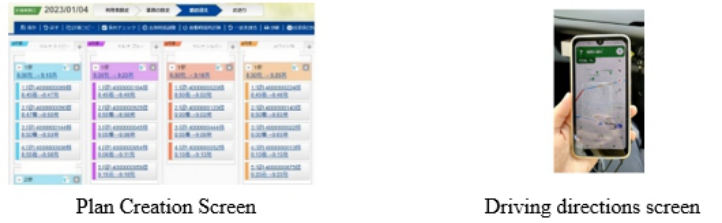
Target ICT Transportation Systems The two main functions of the ICT pick up and drop off systems under study are as follows: The first is a function for “pick up and drop off schedule”, which allocates users to the transport vehicles on the same day and generates efficient navigation routes. The second is a “route guidance” function where the contents of pick up and drop off schedule are automat- ically linked to the driver’s smartphone map application, and directions are displayed.
290 Kondo and Ito
Figure 1: Systems under investigation in this study.
METHODS
Ethnographic research (Ito, 2016) used semi-structured interviews and par- ticipant observation as the data collection method.
A total of seven interviewees were interviewed: four heads from each facil- ity, a transportation staff member one of each from Facilities B and D, and a systems staff member at Company X’s headquarters, Mr. Z.
Participant observation was conducted for driving and transportation planning.
The Perspective of “Unintended Consequences” Unintended consequences are an issue that has been discussed repeatedly in sociology (Merton 1936; Berton, 1982). In discussing the findings in this paper, we refer to Matsushima’s (2015) “Radical Reflexivity Regarding Unin- tended Consequences” (Matsushima, 2015: 113). He notes the difficulty for an outside observer to observe “unintended consequences” as follows:
As an outside observer, the researcher can only base his/her analysis on the observable “(new) intentional acts” that resulted from the reflective semantic identification of unintended consequences by the parties
themselves (Matsushima, 2015: 111).
The key point to focus on in this study is the following: For Company X, facil- ity director’s decision on implementing the system was an “unintended con- sequence”for Company X management. According to Matsushima (2015), if we were to express this situation from the perspective of an outside observer, it would mean that the constructed theory has failed. In other words, manage- ment’s intention was based on the theory “implementing the system would lead to time savings in operations,” but this theory “failed” because of unin- tended consequences. (Incidentally, he calls the restructuring of the failed theory as “radical reflexivity over unintended consequences” (Matsushima, 2015: 113)). If the authors, as outside observers, were to analyze Company X in this way, we must first clarify management’s intentions and their “theory”.
By observing what is happening on-site, we clarified why it turned out to be unintended consequences; in other words, which part of management’s theory led to “failed theory” (Matsushima, 2015: 113) and attempted to reconstruct the theory.
“Unintended Consequences” of ICT System Introduction in Organizations and Operations 291
RESULTS AND DISCUSSIONS Intentions of the Management Headquarters
An interview with Mr. Z, the system supervisor, revealed the intention of the management headquarters. The transportation operations of an elderly care facility can be divided roughly into two aspects: “creating a transportation plan” and “driving.” One of the issues that the management headquarters were facing for some time was the preparation of the transportation plan. Headquarters believed that this task took up to one hour to complete and that the “high degree of difficulty” limited the number of available staff who can handle the task at each facility. The reason for this is the various conditions that must be considered when preparing the plan, such as “attendance of users on the day” and “the type of vehicle and the number of seats.”
On the other aspect of transportation operations, “driving,” the training of new employees was identified as a challenge. Until newcomers can stand on their own, senior staff members accompany them and instruct them on route directions and how to deal with elderly people. However, in the field of elderly care, where manpower is limited, it leaves a burden on other staff when two staff are undergoing on-the-job training.
The management headquarters expected the following three benefits from using this system: (1) to enable anyone to create a transportation plan, (2) reduce the time required to create a plan, and (3) reduce the burden of training new staff members.
Characteristics of the Facilities That Have Implemented the System At the end of the day, all the facilities that introduced the system reduced time in creating transportation schedule by more than 10 minutes. However, it was confirmed that for Facility A, some of the functions had limited usage, and some situations required “handwritten” or “rote calculation”, which used more time and effort than Facility B (10–15 minutes more than Facility B). In addition, the number of staff members in charge of planning remained almost the same as before the introduction of the system, in contradiction to the “intention” of the management headquarters.
The backdrop to be noted is that for Facility B, the timing of the sys- tem introduction coincided with the launch of the facility, which led to the introduction of the system without any resistance from the staff.
Regarding the training of new staff, both facility directors appreciated the navigation function and felt it reduced the burden of teaching and training the new staff members. On the other hand, various considerations were required of a newcomer such as communicating with elderly people while driving, which could be a challenge that could not be covered by the introduction of the system.
Characteristics of Facilities That Did Not Decide to Introduce the System Facility D, which decided not to introduce the system, differs from the other three facilities in that it did not have a smartphone at the time when a decision was made by the previous facility director.
292 Kondo and Ito
The navigation function of the system requires a map application which runs on smartphones, and the director in Facility D did not see the benefit of introducing the system at the time.
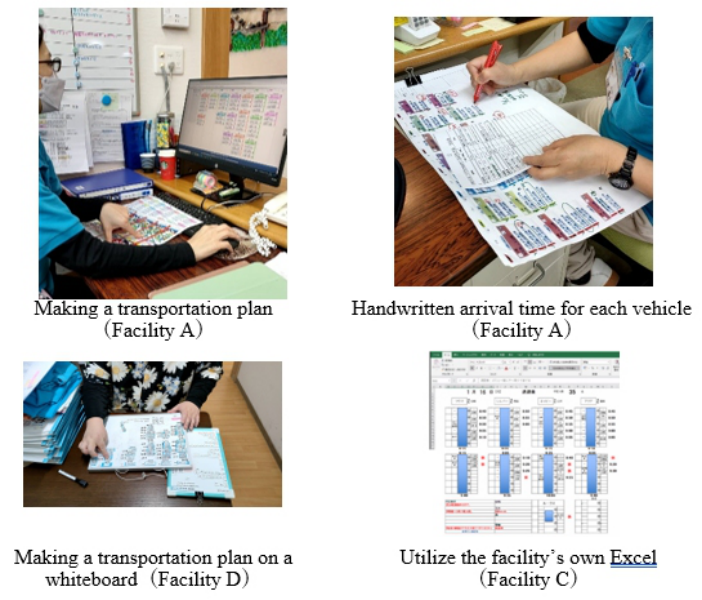
Facility C uses a proprietary Excel function to create pick up and drop off schedules. Using this table, even a newcomer who is not familiar with transportation operations can create it. Currently, the facility director and a full-time employee are mainly in charge of creating the transportation plan, and the time required is 2 to 3 minutes.
However, it can be inferred that Facility C originally had a relatively small transportation workload compared to the other three facilities because of the small-sized facility (number of users and number of vehicles) and the lack of training opportunities for new employees due to the low staff turnover.
Figure 2: Photographs of preparing the transportation plans and the sheet screen.
An overview of the facilities surveyed and their situation at the time of implementation is shown in Table 1X. In the case of Company X, employees work five days a week, eight hours a day, while part-time workers work one to four days a week, three to six hours a day. Therefore, it is not uncommon that part-time workers do not meet face-to-face with other staff during their working hours.
“Unintended Consequences” of ICT System Introduction in Organizations and Operations 293
Table 1. Overview of the surveyed facilities and their situation at the time of introduction.
Table available in the original PDF paper.
Number of cars
Number of drivers per day
The situation when the system was installed
Number of users per day
Whether the system is implemented or not
How to create a transportation plan (A and B before system implementation)
Facility A
Already implemented
45∼50 staff
8 cars
0 full-time employees 8∼9 part-time staff Whiteboards and magnets
Faced with the challenge of streamlining transportation work. Facility B
1 full-time employee 7 part-time staff Whiteboards and magnets
Smartphones were not installed.
Typology of Unintended Consequences Based on the above discussion, we applied the unintended consequences and reconstructed theory presented by Matsushima (2015) to Company X as a case. Furthermore, having clarified the question “why the theory needed to be restructured,” we typified the unintended consequences into the following four categories (Table 2).
Table 2. Factors that caused the “intention” and “unintended consequences” of the management headquarters.
Table available in the original PDF paper.
Management Division’s “Intent”
Theory With Reconstruction
An Intention- Based Theory
Why Rebuild? Unintended Consequences Factors human factors
Reduced planning time.
Using the system saves time
Not as effective as expected depending on how the system is used.
Field staff’s use of the system was different from management’s expectations problem factors
Reduce the burden of training new employees.
Employees can stand alone if they know the way.
There were driving challenges outside of what the system could cover.
There are other reasons employees can’t stand on their own besides not knowing how to get there.
environmental factors
Anyone with access to a PC can do it.
Make it possible for anyone to create a transportation plan.
Planning is not more challenging than driving. Fewer planners are not a problem in itself.
Staffing structure unique to day- care facilities, with one or two full-time employees at each facility
Not necessarily a benefit, depending on the size of the facility, etc.
All facilities will have systems in place.
technological factors
Utilization of the system will benefit the transportation operations of all facilities.
Like Facility C, it is small and has little staff turnover. Not necessarily a benefit, depending on the facility’s technical environment and existing work methods.
Like Facility D, no smart phone installed in the first place / Like Facility C, utilizing its own Excel
294 Kondo and Ito
CONCLUSION
The unintended consequences in Company X were brought about by the fol- lowing four factors: first, “human factors,” in which the way the frontline staff used the system was different from management’s intention; second, “issue factors,” where the system could not cover all on-site issues with sys- tem improvement (i.e., issues that management had assumed) alone; similarly, in the case of newcomers being able to stand on their own. The third factor is the “environmental factor,” which refers to the basic premise conditions of the facility, such as the size of the facility and the number of full-time employ- ees, etc. The fourth is the “technology factor,” which is the prerequisite for the technical aspects, such as the availability of smartphones and the use of proprietary Excel tables. These factors influenced the implementation of the system, and led to “unintended consequences” at Company X.
Limitations of This Study and Implications for Future Research It goes without saying that this report is limited to the case of elderly care provider X and may not be applicable to all cases. The results of the survey may differ if conditions such as location, facility size, and staff employment vary.
In the case of Company X, the “unintended consequences” are viewed as negative content by management (failure of introducing the system), but if we take a further look at Facility C, where the facility utilized its own tools, it could be said that there is potential to view “non implementation” as not necessarily a “failure”but on the contrary, the decision not to implement was more beneficial for the facility.
For the ultimate, ideal pick up and drop off operations, we presented a partial analysis of cases where management and the operators on-site are in some kind of contradiction. In the future we would like to take a further approach in studying these cases.
ACKNOWLEDGMENT
This work was supported in part by JSPS KAKENHI Grant Numbers JP 20K20405/22H00770.
REFERENCES
Boudon, R, 1982, The Unintended Consequences of Social Action, London: Macmillan. Ito, Y., 2016, ‘Ethnography’ in Japanese Corporate Activities: A Meta- anthropological Observation on the Relationship Between Anthropology and the Outside. In H Nakamaki, K Hioki, I Mitsui, Y Takeuchi eds., Enterprise as an Instrument of Civilization: An Anthropological Approach to Business Administration. Springer, pp. 55–72. Japanese Ministry of Health, Labor and Welfare. (2021). dai 8 ki kaiohokenjigy-
oukeikaku ni motoduku kaigoshokuin no hituyousuu ni tuite (Number of Nursing Care Workers Needed Based on the Eighth Long-Term Care Insurance Business Plan) (In Japanese). https://www.mhlw.go.jp/content/12004000/000804129.pdf Japanese Ministry of Economy, Trade and Industry, 2016, shourai no kaigo jyuyou ni sokusita kaigo service teikyou ni kansuru kenkyukai houkokusho (Report of the Study Group on the Provision of Long-Term Care Services in Accordance with Future Demand for Long-Term Care). (In Japanese) https://kosenchin.jp/kosenchinDefault/2_2016_04_04/20160413.pdf.
“Unintended Consequences” of ICT System Introduction in Organizations and Operations 295
Merton, R. K, 1936, “The Unanticipated Consequences of Purposive Social Action”, American Sociological Review, 1: 894–904. Matsushima, N. 2015, The Informatics Embedded in Workplace Practice: Organiza-
tional Approach for IT-use Practice. Yuhikaku. (In Japanese).
LISTED IN THE AHFE DIGITAL BOOKSTORE CATALOGUE
Explore the complete digital volume
The Human Side of Service Engineering
Read this individual research paper free through the original publisher, or explore the full digital proceedings book.
ISBN 978-1-964867-19-9
Explore this ISBN in the AHFE Bookstore ↗Listed in the July 2026 bookstore catalogue; search by ISBN to confirm current availability · Digital book purchase optional