Siri Hegna Berge, Joost de Winter, Yan Feng, Marjan Hagenzieker (2024). Phantom braking in automated vehicles: A theoretical outline and cycling simulator demonstration. In: Advances in Human Factors of Transportation. AHFE Open Access, vol. 148, pp. 224–233. https://doi.org/10.54941/ahfe1005212
The emerging use of automated driving systems introduces novel situations that may affect the safety of vulnerable road users such as cyclists. In this paper, we explain and conceptualise the phenomenon of phantom braking – sudden and unexpected deceleration – in automated vehicles. We apply signal detection theory to interpret phantom braking as a by-product of automated decision-making, with the vehicle favouring the avoidance of accidents at the cost of potentially causing rear-end accidents. To illustrate phantom braking and its effects on cyclists, we used a newly developed cycling simulator. An exploratory measurement conducted with a single cyclist participant revealed a possible complacency effect of the cyclist, with the cyclist’s decision-making mirroring the automated vehicle’s decision-making. The findings provide a testament to using cycling simulators for further exploration of the effects of phantom braking on cyclists.
Automated vehicles (AVs) have the potential to transform the dynamics of urban traffic. The impact of these changes on the safety of vulnerable road users is a topic of great concern (Matin and Dia, 2023). The absence of a human driver will likely affect how vulnerable road users interact and communicate with vehicles. Moreover, the increasing use of automated driv- ing systems introduces novel situations and unpredictable vehicle behaviour. Among these behaviours is the phenomenon of phantom braking (Berge et al., 2024). Phantom braking in AVs refers to the sudden, unexpected decelera- tion typically caused by the vehicle’s sensors or algorithms misinterpreting the traffic situation (Linja et al., 2022; Moscoso et al., 2021; National Highway Traffic Safety Administration, 2022).
frequency of phantom braking and its impact on cyclists is vital. The present paper aims to explain and demonstrate the concept of phantom braking and measure a cyclist’s response to such events.
Signal detection theory (Abdi, 2007; Green and Swets, 1966) provides a framework that can be used to understand the process behind phantom brak- ing in AVs. This theory describes how AV sensors distinguish meaningful data (“signals”), such as the presence of a pedestrian at a zebra crossing, from irrelevant sensor input (“noise”). The decision threshold of the sensor sys- tem determines whether the AV will respond to a given sensory input. Setting a lower threshold may increase the detection of actual hazards but also the chance of false positives, leading to phantom braking. For instance, an AV with an appropriate decision threshold would decelerate and stop to let a pedestrian cross at a zebra crossing but not stop when unneeded. In contrast, an AV with a lower threshold may also brake and stop due to irrelevant sensor input, such as a leaf or plastic bag blowing across the road.
AVs are typically programmed with a sensitive threshold to minimise the risk of overlooking real threats. Such overly sensitive thresholds are seen in studies on automated shuttle busses: De Ceunynck et al. (2022) reported that cyclists’ overtaking manoeuvres often led to phantom braking, and in Boersma et al. (2018), high grass on the side of the road had to be cut to stop triggering the shuttle’s emergency braking. Unexpected automated driving system behaviour, such as phantom braking, is also reported among drivers of privately owned vehicles (Nordhoff et al., 2023) and robo-taxis (Pitts, 2023). According to Petrovi´c et al. (2020), AVs are often rear-ended compared to manual-driven vehicles, yet they exhibit a very low incidence of pedestrian collisions. In that sense, phantom braking can be seen as a by-product of an imperfect sensor system and may persist until technological improvements in sensors and algorithms are realised.
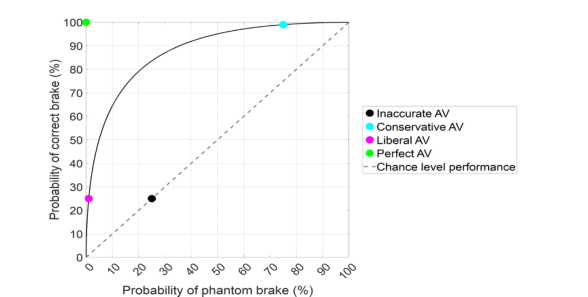
Figure 1: Hypothetical ROC curve for four types of AV sensors: perfect AV (fail-to-brake [FBR]: 0%, phantom brake rate [PBR]: 0%), inaccurate AV (d’ = 0.00; FBR: 75%; PBR: 25%), and accurate AV (d’ = 1.65) with two different criterion levels, resulting in con- servative (FBR: 1%, PBR: 75%) vs. liberal AV behaviour (FBR: 75%, PBR: 1%). Note that in this figure, we assume normally distributed signal + noise and noise distributions with equal standard deviations. d’, an index of sensor discriminability, is calculated as Z(correct brake rate) - Z(phantom brake rate), where Z is the inverse of the normal cumulative distribution function.
Figure 1 shows a hypothetical receiver operating characteristic (ROC) curve explaining the performance of AV braking systems. The x-axis signifies the probability of phantom braking events, and the y-axis depicts the proba- bility of correct braking events. The curve depicts the trade-off faced by AV systems: the sensitivity to real hazards that require a braking action versus the tendency for phantom braking, i.e., unwarranted braking events in the absence of actual hazards.
The curve of Figure 1 is plotted with data points representing four AV sys- tems, each illustrating different sensitivity thresholds. The ‘Inaccurate AV’ represents a vehicle with poor sensor capabilities, performing at chance level, characterised by frequent phantom braking and low rates of correct braking. Conversely, the ‘Conservative AV’ indicates a vehicle system with better capa- bilities but a low decision threshold, leading to a high correct and phantom braking rate. It is plausible that AV manufacturers opt for this conservative approach. The ‘Liberal AV’, with a high decision threshold, brakes less often, reducing phantom braking but increasing the risk of missing genuine haz- ards. Lastly, the ‘Perfect AV’ is a hypothetical system with ideal sensors that perfectly discriminate true from false braking cues, ensuring 100% correct braking without phantom instances.
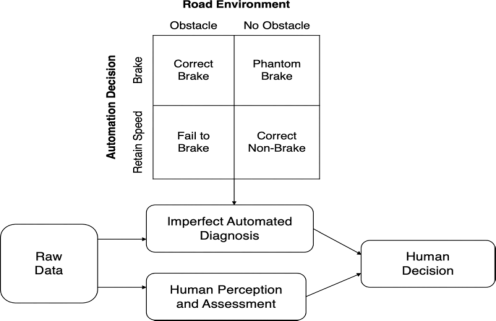
In traffic, one must understand the AV’s responses to the environment and how a human road user – the cyclist – interprets and reacts to both the AV and their surroundings. Figure 2 illustrates this concept, building on signal detection theory and the model of parallel human and automation alerting system adapted from Wickens et al. (2023).
Figure 2: Conceptual model of phantom braking (adapted from Wickens et al., 2023, p. 30). Depending on the level of trust in the AV, the human decision-maker may assign more weight to the visual cues from the AV (i.e., mirroring the imperfect automated diagnosis) or to the surrounding environment (i.e., human perception and assessment based on raw data).
In Figure 2, environmental visual information, termed ‘Raw Data’, is fed into two parallel decision-making processes: the AV’s ‘Imperfect Automated Diagnosis’ and the cyclist’s ‘Human Perception and Assessment’. The AV and the cyclist can decide whether to respond based on their respective decision
Phantom Braking in Automated Vehicles 227
thresholds. Suppose the AV frequently triggers phantom braking or fails to detect real obstacles (fail to brake, e.g., retains speed when a pedestrian indi- cates intent to cross the road). This can diminish the cyclist’s trust in the reliability of the AV. Consequently, the cyclist may become more inclined to ignore the brake lights and instead rely on their own assessments of the situ- ation, potentially leading to overtaking the vehicle or braking independently of the AV’s actions. Thus, the cyclist’s response is shaped by AV behaviour, which depends on its sensor capabilities and criterion level, and the cyclist’s own decision thresholds.
Having conceptualised and introduced the theoretical rationale behind phantom braking, the present study seeks to illustrate further the effects of phantom braking on cyclist behaviour in a simulated environment. Bicycle simulators have been increasingly employed in research on cyclist behaviour and have the advantage of enabling researchers to conduct measurements in controllable and safe conditions (Sporrel et al., 2023). Using a single- participant approach in a virtual reality (VR) bicycle simulator, this proof- of-concept study aims to set the stage for broader empirical research on AV-cyclist interaction. Our work also highlights the need to prioritise cyclist experiences and cyclist and pedestrian safety in the deployment of AV technologies.
METHOD
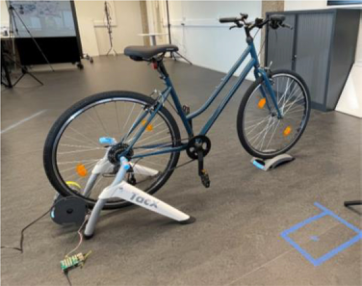
Cycling Simulator In this study, we illustrate a cyclist’s responses to phantom braking using a newly developed VR cycling simulator at the Faculty of Civil Engineering and Geosciences at Delft University of Technology. The study was approved by the university’s Human Research Ethics Committee (ID #3327). The bicy- cle simulator consists of a bicycle mounted on a Tacx Flow Smart wheel-on trainer and a VR headset (HTC VIVE Pro Eye). It offers resistance through an electromagnetic resistance unit on the rear wheel. The simulator features no bicycle tilt or pitch and only allows forward motion without steering, see Figure 3.
Figure 3: The virtual reality cycling simulator.
Experiment Design The AV’s braking behaviour was categorised into four types: correct brake, phantom brake, fail to brake, and correct non-brake. Table 1 describes the respective behavioural variables.
Table 1. The programmed AV braking behaviour.
Table available in the original PDF paper.
Variable Definition Correct brake The AV correctly stops for a pedestrian at a zebra crossing Phantom brake The AV stops without a pedestrian present at a zebra crossing Fail to brake The AV fails to stop when a pedestrian is present at a zebra crossing Correct non-brake The AV correctly continues driving through a zebra crossing without a pedestrian present
We designed four experimental conditions, each consisting of 16 pedes- trian crossings, with the likelihood of each event type based on the proba- bilities shown in Figure 1. At 8 of the 16 pedestrian crossings, there was a pedestrian standing still at approximately 1.5 m from the side of the road; at the other 8 pedestrian crossings, there was no pedestrian present. A sin- gle cyclist, identified as author S.B., rode the simulator in each of the four conditions:
Inaccurate AV: This AV failed to brake for a pedestrian in 6 out of 8 cases and incorrectly stopped without a pedestrian present (phantom brake) in 2 out of 8 cases.
Conservative AV: This AV displayed high caution, with correct braking in front of a pedestrian at the crossing (8 out of 8 cases) and a high degree of phantom braking: 6 out of 8 cases with no pedestrian present.
Liberal AV: The liberal AV behaved in the opposite way of the conservative AV. It retained its speed (correct non-brake) in 8 out of the 8 cases with no pedestrian present at the crossing but had only 2 cases of correct braking (i.e., braking with a pedestrian present). The liberal AV had no phantom braking.
Perfect AV: This AV exhibited perfect detection capability, stopping 8 of the 8 times a pedestrian was present at the crossing (correct brake). The perfect AV also retained speed at 8 out of 8 cases with no pedestrian present at the crossing (correct non-brake).
The order of the 16 events was randomised for each trial. The AV main- tained a predetermined distance from the cyclist, meaning that the cyclist could not alter this distance by cycling slower or faster. The fixed distance was released upon nearing a pedestrian zebra crossing and re-established before the next pedestrian zebra crossing. The speed of the AV showed fluctuations with respect to the cyclist’s speed, as a result of which the centre- to-centre distance between the AV and the cyclist varied between 14 and 21 metres. The concept of the lead vehicle maintaining an automatic set distance from the trailing road user was based on earlier research that used a similar experimental design among car drivers (De Winter et al., 2023).
Phantom Braking in Automated Vehicles 229
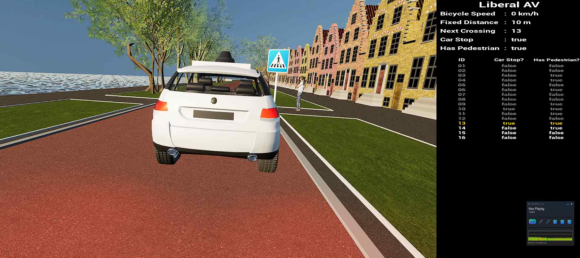
Figure 4 provides a screenshot of the experimenter’s terminal. It shows the participant’s view of the VR headset and the experimental progress. In this frame, the AV has just come to a full stop while a pedestrian is present. This event represents a correct brake since the AV stopped for a pedestrian.
Figure 4: Screenshot of the terminal of the experimenter.
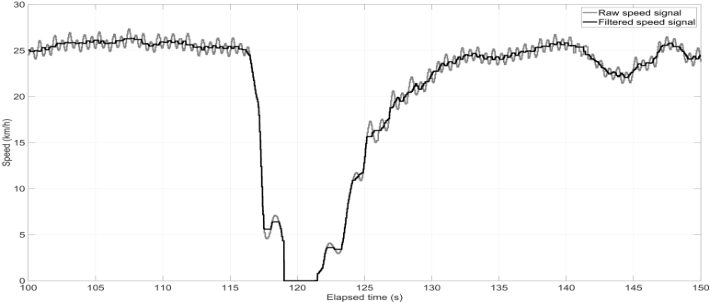
Data Collection and Analysis The data from the four conditions was collected in an Unreal Game Engine 4 research module (Feng et al., 2022). The speed of the virtual bicycle was slightly affected by the pedalling frequency of the cyclist. This variation in speed indicates the high accuracy of the speed measurement but is not directly relevant to our purposes. Therefore, we filtered the speed signal of the bicycle and that of the AV. We did this with a forward-reverse moving median filter, applied over a time interval of 90 samples, corresponding to 1 second. Subse- quent analysis involved calculating the cyclist’s brake reaction times (BRTs). These were calculated by subtracting the moment the AV initiated decelera- tion from the moment the cyclist began decelerating. The speed filtering result is illustrated in Figure 5.
Figure 5: Filtering of the bicycle speed signal.Figure 6: Speed of the cyclist and the AV in the four conditions. Note that BRT is the cyclist’s brake reaction time.
RESULTS
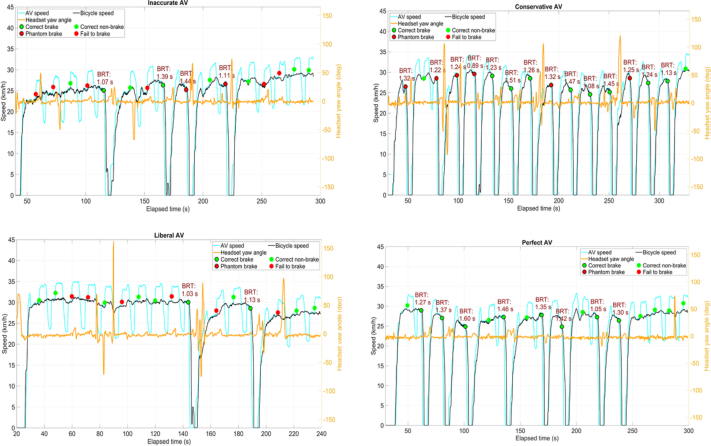
The speeds of the cyclist participant and AV are illustrated in Figure 6. In all cases where the AV decelerated – whether due to the correct identification of pedestrians (correct brake) or unnecessary phantom braking – the cyclist also braked to a stop. The corresponding brake reaction times (BRTs) varied between 1.0 and 1.6 seconds. This demonstrates that the cyclist responded quite consistently to the AV’s implicit and explicit deceleration signals, such as the looming cues of the approaching AV during braking and the brake light signals.
Interestingly, the cyclist did not brake, as shown by the near-constant cycling speeds, when the AV failed to brake for the pedestrian. In other words, if a pedestrian was present at the crosswalk and the AV continued, the cyclist also maintained their speed. The data from Figure 6 also shows that both the cyclist and the AV, which was programmed to maintain a constant distance from the bicycle, generally travelled at a high speed, nearly 30 km/h. This speed was partly due to the adjustable resistance motor but could also reflect the experience of riding an electric bike, where such speeds are more easily achievable.
Finally, from the recorded head movements, it was observed that the cyclist primarily looked straight ahead, in the direction of the AV, with occasional intermittent glances to the left or right sides. Especially at a standstill or low speed, the cyclist tended to look at the pedestrian, as indicated by the positive yaw-angle value.
DISCUSSION
In this study, we introduced and demonstrated the concept of phantom brak- ing in AVs in a VR bicycle simulator. While the results are not generally
Phantom Braking in Automated Vehicles 231
applicable due to the single-participant design, they lay the groundwork for additional empirical research on phantom braking and its implications for cyclists.
Our research highlights the issue of phantom braking and interprets it through signal detection theory. We argue that phantom braking results from imperfect sensor systems and the inherent trade-off between avoiding acci- dents and unnecessary braking (phantom braking). Previous research shows that AV manufacturers likely prefer a conservative approach for safety and liability purposes (Berge et al., 2024; Boersma et al., 2018; De Ceunynck et al., 2022; Nordhoff et al., 2023). This erring on the side of caution inadvertently increases the frequency of phantom braking.
Furthermore, by applying the model of Wickens et al. (2023) (see Figure 2), we clarified that a following cyclist’s responses depend on the braking behaviour of the leading AV, as well as cues in the environment, such as a pedestrian at a crosswalk. However, in our demonstration, we observed that the cyclist mimicked the AV behaviour, effectively disregarding the rights of the pedestrian. This reliance on automation behaviour, termed complacency (e.g., Bahner et al., 2008) or automation bias (e.g., Parasuraman and Manzey, 2010), forms an interesting phenomenon to be explored in future research. Our data revealed the risk that cyclists may depend too much on the lead AV reactions without considering ‘raw data’ in the environment, such as the pedestrian. This leader-and-follower phenomenon could also have real-life implications for cyclist safety, as complacency might cause cyclists to pay less attention to the road and environment, potentially increasing their chances of rear-end accidents due to abrupt braking, or the cyclist swerving, losing balance, and falling due to unanticipated braking events of the vehicle.
The cyclist disregarding their legal obligation to yield to the pedestrian could be attributed to the participant’s idiosyncratic interpretation of the task. Another explanation is that cyclists may be inclined to overlook or ignore traffic regulations due to their agility and relatively small size com- pared to cars, as suggested by Berge et al. (2022). Furthermore, in our virtual environment, the pedestrian remained stationary at the crossing, regardless of the cyclist stopping, which might have influenced the cyclist’s decision to continue pedalling. Gathering more data would provide more clarity on these behaviours.
Finally, this study offers a new perspective on using VR bicycle simulators. Previous studies (e.g., Lee et al., 2017) faced challenges in simulating realistic cycling experiences, especially in steering and balancing, due to the complex dynamics of a bicycle and the role of peripheral vision in inducing a sense of motion, which can lead to imbalance and simulator sickness. By deploying a fixed bicycle simulator on a straight road and focusing on stop-and-go deci- sions, we found a pragmatic method to test the decision-making of cyclists in a controlled environment. To address the rising issues of simulator sickness or safety, a large TV screen may be considered instead of a VR headset, which would sacrifice the ability to track head movements natively.
CONCLUSION
This study using a novel VR bicycle simulator is an initial step in understand- ing phantom braking in AVs and its impact on cyclists. Our single-participant findings indicate the need for AV systems that balance safety with real-world
functionality. The data also provides validation for using bicycle simulators to further explore the effects of phantom braking by an AV. Future studies should include a larger sample to study phantom braking and its effects on cyclists regarding behavioural changes such as complacency and the risk of rear-end accidents.
ACKNOWLEDGEMENT AND SUPPLEMENTARY DATA This project has received funding from the European Union’s Horizon 2020 research and innovation programme under the Marie Skłodowska-Curie grant agreement 860410, the Institute of Transport Economics: Norwegian Centre for Transport Research, and The Research Council of Norway.
Supplementary data is available at https://data.4tu.nl/datasets/3e441314- 6fa1-4a42-8c8f-57d9e3b88785/1.
REFERENCES
Abdi, H. (2007) ‘Signal detection theory (SDT)’ in McGaw, B., Peterson, P. L. and Baker, E., eds., Encyclopedia of education (3rd edition), New York: Elsevier, 886–889. Bahner, J. E., Hüper, A.-D. and Manzey, D. (2008) ‘Misuse of automated deci-
sion aids: Complacency, automation bias and the impact of training experience’, International Journal of Human-Computer Studies, 66(9), 688–699. Berge, S. H., De Winter, J., Cleij, D. and Hagenzieker, M. (2024) ‘Triangulating the future: Developing scenarios of cyclist-automated vehicle interactions from literature, expert perspectives, and survey data’, Transportation Research Interdisciplinary Perspectives, 23. Berge, S. H., Hagenzieker, M., Farah, H. and De Winter, J. (2022) ‘Do cyclists need
HMIs in future automated traffic? An interview study’, Transportation Research Part F: Traffic Psychology and Behaviour, 84, 33–52. Boersma, R., Van Arem, B. and Rieck, F. (2018) ‘Application of Driverless Electric automated shuttles for public transport in villages: The case of Appelscha’, World Electric Vehicle Journal, 9(1). De Ceunynck, T., Pelssers, B., Bjørnskau, T., Aasvik, O., Fyhri, A., Laureshyn, A.,
Johnsson, C., Hagenzieker, M. and Martensen, H. (2022) ‘Interact or counter- act? Behavioural observation of interactions between vulnerable road users and autonomous shuttles in Oslo, Norway’, Traffic Safety Research, 2, 000008. De Winter, J. C. F., Saffarian, M. and Senders, J. W. (2023) ‘The effect of an occlusioninduced delay on braking behavior in critical situations: A driving simulator study’, Human Factors, 65(7), 1336–1344. Feng, Y., Duives, D. C. and Hoogendoorn, S. P. (2022) ‘Development and evaluation
of a VR research tool to study wayfinding behaviour in a multi-story building’, Safety Science, 147. Green, D. M. and Swets, J. A. (1966) Signal detection theory and psychophysics, New York: Wiley. Lee, O., Dialynas, G., De Winter, J., Happee, R. and Schwab, A. L. (2017) Description
of a model based bicycle simulator, translated by Davis, California, USA. Linja, A., Mamun, T. I. and Mueller, S. T. (2022) ‘When Self-Driving Fails: Evaluating Social Media Posts Regarding Problems and Misconceptions about Tesla’s FSD Mode’, Multimodal Technologies and Interaction, 6(10).
Phantom Braking in Automated Vehicles 233
Matin, A. and Dia, H. (2023) ‘Impacts of Connected and Automated Vehicles on Road Safety and Efficiency: A Systematic Literature Review’, IEEE Transactions on Intelligent Transportation Systems, 24(3), 2705–2736. Moscoso, C., Foss, T. and Jenssen, G. D. (2021) Phantom braking in Advanced Driver
Assistance Systems: Driver experience and Car manufacturer warnings in Owner manuals, Trondheim, Norway: SINTEF Community. National Highway Traffic Safety Administration (2022) Unexpected brake activation, U. S. Department of Transportation. Nordhoff, S., Lee, J. D., Calvert, S., Berge, S. H., Hagenzieker, M. and Happee, R.
(2023) ‘(Mis-) use of standard Autopilot and FSD Beta: Results from interviews with user of Tesla’s Full-Self Driving (FSD) Beta’, Frontiers in Psychology, 1. Parasuraman, R. and Manzey, D. H. (2010) ‘Complacency and bias in human use of automation: an attentional integration’, Human Factors, 52(3), 381–410. Petrovi´c, Ð., Mijailovi´c, R. and Peši´c, D. (2020) ‘Traffic Accidents with Autonomous
Vehicles: Type of Collisions, Manoeuvres and Errors of Conventional Vehicles’ Drivers’, Transportation Research Procedia, 45, 161–168. Pitts, C. W. (2023) ‘Waymo explains why its self-driving stopped driving on Phoenix street’, 12 News Sporrel, B., Stuiver, A. and De Waard, D. (2023) On the use of bicycle simulators,
translated by De Waard, D., Hagemann, L., Omnasch, A., Toffetti, D., Coelho, A., Botzer, M., De Angelis, M., Brookhuis, K. and Fairclough, S. Wickens, C. D., McCarley, J. S. and Gutzwiller, R. S. (2023) ‘Attention control’ in Wickens, C. D., McCarley, J. S. and Gutzwiller, R. S., eds., Applied Attention Theory, Boca Raton, FL: CRC Press.
LISTED IN THE AHFE DIGITAL BOOKSTORE CATALOGUE
Explore the complete digital volume
Advances in Human Factors of Transportation
Read this individual research paper free through the original publisher, or explore the full digital proceedings book.
ISBN 978-1-964867-24-3
Explore this ISBN in the AHFE Bookstore ↗Listed in the July 2026 bookstore catalogue; search by ISBN to confirm current availability · Digital book purchase optional