Naohisa Hashimoto, Wu Yanbin, Masaki Masuda (2024). Analysis of Bus Driver Actions for Development of Automated Bus Passenger Safety System - Bowtie Analysis-. In: Advances in Human Factors of Transportation. AHFE Open Access, vol. 148, pp. 491–496. https://doi.org/10.54941/ahfe1005240
Digital Architecture Research Canter, National Institute of Advanced Industrial Science and Technology (AIST), 1-1-1 Umezono, Tsukuba-shi, Ibaraki-ken, 305-8568, Japan ↗
One of the key advantages of Level 4 automated buses is the potential for unmanned operation. To achieve this, two essential tasks must be addressed: controlling the bus and ensuring passenger safety. This study focuses specifically on passenger safety and the development of a safety system for automated buses. Initially, we investigated the tasks typically performed by bus drivers by observing their actions from when a passenger boards to when they disembark. For each task, we utilized bowtie analysis, examining them from five perspectives: hazard source (cause), prevention of occurrence, hazard source (consequences), impact mitigation, and harm. Tasks are categorized into three situations: door opening and closing, driving, and when starting. In each situation, every task is analysed using bowtie analysis. This approach results in a visual representation of tasks with identified threats, consequences, mitigations, and preventive measures. We will show a comprehensive explanation of all results and discussions derived from the analysis, utilizing real recorded driver’s data to enhance clarity. The primary challenge in developing the system to manage these tasks instead of relying on a bus driver lies in determining how the system will interact with passengers and the extent to which it can ensure passenger safety through the passenger safety system.
Japan became one of the world’s most rapidly aging societies (United Nations, 2019; United Nations, 2019), also Asian countries have same tendency. Traf- fic accidents, which caused by elderly drivers, are becoming social issues, and the number of elderly drivers who return their driver’s license is increasing (Japan Plans New Driver’s License System for Elderly as Accidents Surge, 2019). In urban area, efficient public transportation is available, but in rural area it is difficult to travel anywhere without driving car. Useful mobility service should be provided for elderly people in rural area.
is about controlling the bus, the other is about providing passenger safety in the bus.
This study focuses on passenger safety and development of the passenger safety system in bus. Firstly, we investigated the bus driver’s tasks by observ- ing the driver’s actions until a passenger gets on and off the bus. In addition, we asked the driver about what he looked at, how he confirmed, and what he did in each task. We employed bowtie analysis for each task. In the bowtie analysis, all tasks were analysed from five perspectives: hazard source(cause), prevention of occurrence, hazard source (consequences), impact mitigation, and harm, all tasks were analysed.
EXTRACTED TASKS OF BUS DRIVER FOR PASSENGER SAFETY AND ANALYSED RESULT OF EVERY TASK This study focuses on the task of passenger safety. We have been discussing bus driver’s tasks for passenger safety with bus operators about the passenger safety. First, all tasks were picked out from several operators, and the tasks were divided into two groups in every situation (ordinary and emergency). To realize the unmanned automated bus, all tasks in both situations must be handled by from bus operator to the in-vehicle or remote monitoring system. Normally, unnamed operation needs remote monitoring system. Also, there is a possibility that some tasks will be removed by changing services and operations.
We conducted a verification using bowtie to validate that the considered system requirements mitigate hazards. In the bowtie diagram, we identified the causes that manifest as events (hazard sources), barriers to prevent their occurrence, as well as the consequences (hazards) and barriers to mitigate them. The identification process was carried out based on combinations of when hazards occur (e.g., during door opening/closing, starting, or while driving) and what types of hazards (or undesired events) may occur (such as safety concerns, availability issues, on-board troubles, vehicle accidents, fires, or incidents). In all tasks, there are three situations (door opening and closing, while traveling and on starting).
One primary challenge encountered in developing the system to assume these tasks of the bus driver is determining the optimal interaction with pas- sengers and assessing the system’s capacity to ensure passenger safety. This encompasses defining the extent to which the passenger safety system can guarantee safety while effectively engaging with passengers.
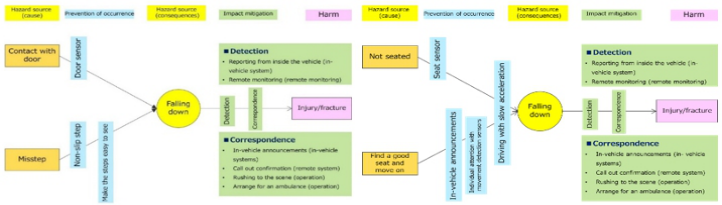
Task on the Door Closing and Opening Task In Fig. 1, there is a potential risk of passengers falling. Specifically, we identi- fied the risk of passengers contacting the doors or stepping off the platform. To prevent such occurrences, essential measures include adopting non-slip steps to prevent slipping accidents and implementing measures to enhance the visibility of the steps. As a system requirement, we propose the installa- tion of sensors that prevent the doors from opening or closing if a person approaches them, thus preventing contact. As a mitigation strategy for cases where falls occur, we envision systems such as one where other passengers can report a fallen individual or a remote monitoring system to detect falls. Additionally, considering assistance to the fallen individual until assistance
Analysis of Bus Driver Actions for Development of Automated Bus Passenger Safety System493
arrives, the possibility of utilizing the onboard system’s announcement fea- ture to communicate with them remotely was proposed. During door opening and closing, issues concerning availability arise when individuals linger near the doors or when the doors malfunction, preventing them from closing and thus impeding vehicle operation.
Task on Starting In Fig. 1 right, there is a potential risk of passengers falling. Specifically, we recognize the possibility of falling due to not being seated properly when the bus starts moving, or while attempting to find a suitable seat by moving around. As a system requirement for preventing such occurrences, the imple- mentation of seat occupancy sensors and movement detection sensors were proposed. These sensors would trigger onboard announcements if they detect situations where passengers are not seated or are moving around, thereby dis- couraging unsafe behavior. As an additional measure, we consider conducting periodic awareness campaigns to educate passengers about the importance of remaining seated while the vehicle is in motion. In terms of mitigation strate- gies for when falls occur, systems for passengers to report fallen individuals or remote monitoring systems to detect falls could be implemented. Addition- ally, utilizing the onboard system’s announcement feature to communicate with fallen passengers until assistance arrives is also under consideration.
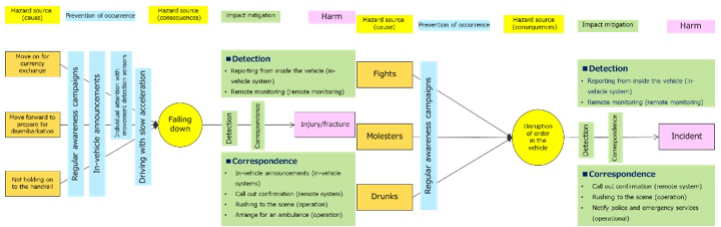
Task While Traveling In Fig. 3 left, there is a potential risk of passengers falling. Specifically, we acknowledge the risk of falls when passengers move around, prepare to disembark by moving forward, or fail to hold onto handrails, thus being influenced by the vehicle’s acceleration and deceleration. To prevent such occurrences, essential measures involve driving with gentle acceleration to anticipate and accommodate these unsafe behaviors. As a system require- ment, it is conceivable to implement detection systems that individually alert passengers when they engage in movement. As an auxiliary measure, conducting periodic awareness campaigns to educate passengers about safe behavior should be considered while the vehicle is in motion. In terms of mitigation strategies for when falls occur, systems for passengers to report fallen individuals or remote monitoring systems to detect falls could be implemented.
In Fig. 3 right (internal issue1 in the bus while traveling), there’s a poten- tial risk of disruptions to onboard order due to internal issues. Specifically, we recognize the possibility of altercations, incidents of harassment, or intoxicated individuals boarding the vehicle. Implementing essential mea- sures to prevent such occurrences proves challenging. As auxiliary measures, we’ve considered initiatives like posting informative posters and conducting periodic awareness campaigns. In the event of onboard disorder, mitiga- tion strategies could involve implementing systems for passengers to report incidents or remote monitoring systems to detect onboard troubles. Addition- ally, utilizing the onboard system’s announcement feature to communicate with passengers until assistance arrives is under consideration as an interim response.
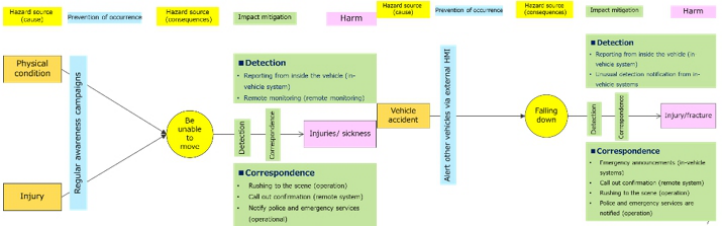
In Fig. 4 left (internal issue 2 in the bus while traveling), there’s a risk of passengers becoming incapacitated due to illness or injury. Implementing essential measures to prevent such incidents proves challenging. As auxiliary measures, we’ve considered initiatives like posting informative posters and conducting periodic awareness campaigns. As mitigation strategies, systems for passengers to report incidents or remote monitoring systems to detect individuals in need of assistance or medical attention could be implemented. Additionally, utilizing the onboard system’s announcement feature to com- municate with passengers until assistance arrives is under consideration as an interim response.
In Fig. 4 right (vehicle accident while traveling) there’s a risk of passengers falling due to vehicle accident. Implementing essential measures to prevent such incidents proves challenging. As auxiliary measures, utilizing exterior Human-Machine Interface (HMI) systems was proposed to alert surround- ing vehicles and enhance overall awareness. As mitigation strategies for when falls occur, systems for passengers to report incidents or remote monitor- ing systems to detect fallen passengers could be implemented. Additionally, utilizing the onboard system’s announcement feature to communicate with fallen passengers until assistance arrives is under consideration as an interim response.
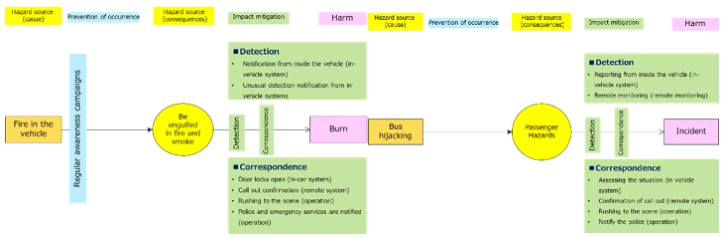
In Fig. 5 left (on fire in bus), there’s a risk of passengers sustaining burns due to an onboard fire. Implementing essential measures to prevent such inci- dents proves challenging. As auxiliary measures, we’ve considered initiatives like posting fire prevention posters and conducting periodic awareness cam- paigns. In the event of a fire, mitigation strategies could involve implementing systems for passengers to report incidents or systems capable of detecting abnormalities in the onboard environment. Additionally, considering the use of the onboard system’s announcement feature to communicate with passen- gers remotely, or exploring functionalities such as unlocking doors, is under consideration as an interim response.
In Fig. 5 right (incident), there is a risk of incidents such as bus hijackings while traveling. Establishing preventive measures for such occurrences is chal- lenging. As mitigation strategies to protect passengers from danger, systems allowing passengers to report incidents or remote monitoring systems are conceivable. Additionally, considering the utilization of the onboard system’s announcement feature is under review.
Figure 1: Results of bowtie analysis (left: on the door closing and opening, right: on starting).
Analysis of Bus Driver Actions for Development of Automated Bus Passenger Safety System495
Figure 2: Results of bowtie analysis (left: while traveling, right: while traveling and in-vehicle problems 2).Figure 3: Results of bowtie analysis (left: while traveling and in-vehicle problems 2, right: while traveling and vehicle accident).Figure 4: Results of bowtie analysis (left: while traveling and in case of fire, right: while traveling and incident).
CONCLUSION
To provide the Level 4 automation, the tasks of bus driver for passengers are extracted. Tasks were categorized into three situations: door opening and closing, driving, and when starting. In each situation, every task was anal- ysed using bowtie method. This approach results in a visual representation of tasks with identified threats, consequences, mitigations, and preventive mea- sures. We showed a comprehensive explanation of all results and discussions derived from the analysis. The primary challenge in developing the system to manage these tasks instead of relying on a bus driver lies in determining how
the system will interact with passengers and the extent to which it can ensure passenger safety through the passenger safety system.
ACKNOWLEDGMENT
This research has been funded by the Ministry of Economy Trade and Industry in Japan.
REFERENCES
AA Dakare, Y Wu, N Hashimoto, T Kumagai, T Miura, “Fall Detection Inside An Autonomous Driving Bus:-Examination of Image Processing Algorithms”, 2023 IEEE International Conference on Consumer Electronics (ICCE), 1–4. D. Li, L. Cui, “Study on Flight Risk Assessment Method Based on Bow-Tie and
Bayesian Networks,” 2020 International Conference on Urban Engineering and Management Science (ICUEMS), 2020, pp. 736–739. Federal Transit Administration, Safety Performance Targets Guide, Public Transportation Agency Safety Plan Regulation (49 CFR Part 673), Version 2 (June 2021). General guidance and supervision implementation manual (in Japanese), https://www.mlit.go.jp/jidosha/anzen/03safety/resourse/data/bus_honpen.pdf, accessed on 15th April 2024. H. Shi, Y. Y. Lu, “Analyzing bowtie structures by a vertical mode expansion
method,” 2017 IEEE International Conference on Computational Electromagnet- ics (ICCEM), 2017, pp. 282–283. Japan plans new driver’s license system for elderly as accidents surge, https://www.japantimes.co.jp/news/2019/06/11/national/japan-plans-new- drivers-license-system-elderly-accidents-surge/, accessed on 15th April 2024. Ministry of Land, Infrastructure and Transport “Process Safety (in Japanese)”, https://www.mlit.go.jp/maritime/content/001412558.pdf, accessed on 15th April 2024. United Nations (2019), World Population Ageing. United Nations (2019). World Population Prospects. United Nations (2019, World Population Ageing. Van Nunen Karolien, Swuste Paul, Reniers Genserik et al., “Improving Pallet Mover
Safety in the Manufacturing Industry: A Bow-Tie Analysis of Accident Scenarios”, Materials, vol. 11, no. 10, 2018. Vehicle Standard (Australian Design Rule 68/00 – Occupant Protection in Buses)
2006. Website of Road to L4, https://www.road-to-the-l4.go.jp/ accessed on 15th April
2024. Y Wu, N Konishi, K Kihara, M Kimura, Y Takeda, N Hashimoto, “Passenger’s Preference on Internal Interface Design in Automated Buses: A Survey”, Proceedings of the 15th International Conference on Automotive User Interface, 2023.
LISTED IN THE AHFE DIGITAL BOOKSTORE CATALOGUE
Explore the complete digital volume
Advances in Human Factors of Transportation
Read this individual research paper free through the original publisher, or explore the full digital proceedings book.
ISBN 978-1-964867-24-3
Explore this ISBN in the AHFE Bookstore ↗Listed in the July 2026 bookstore catalogue; search by ISBN to confirm current availability · Digital book purchase optional