Jeffrey Mahachi (2024). Challenges in the Implementation of Modern Methods of Construction, Including Construction 3D Printing, in South Africa: A Comprehensive Examination of Products Performance. In: Sustainable Construction in the Era of the Fourth Industrial Revolution. AHFE Open Access, vol. 149, pp. 33–42. https://doi.org/10.54941/ahfe1005272
Publisher statistics will load when you open Metrics.
AHFE OPEN ACCESS OPEN ACCESS CONFERENCE PROCEEDINGS PAPER
Challenges in the Implementation of Modern Methods of Construction, Including Construction 3D Printing, in South Africa: A Comprehensive Examination of Products Performance
South Africa's national building regulations currently accommodate conventional building products compliant with specified standards in South African National Standards. Additionally, provisions are made for Innovative Building Technologies (IBT), including Modern Methods of Construction and Construction 3D Printing, which must adhere to Agrèment South Africa's performance requirements. These IBTs undergo rigorous certification processes encompassing structural strength, stability, fire resistance, and thermal performance assessments. While various IBTs have received certification and found application in housing, schools, and clinics, a gap persists in translating research and knowledge into widespread implementation. This paper focuses on establishing a knowledge base for IBT building walling products, particularly those related to Modern Methods of Construction and Construction 3D Printing, certified by Agrèment SA. The research methodology involves data collation and analysis from Agrèment SA, categorizing products based on building occupancy and performance through a stratification process. Validation of certificate data was conducted through interactions with system owners. The study also reviews challenges hindering the implementation of some certified products, emphasizing the specific context of Modern Methods of Construction and Construction 3D Printing. The paper concludes with a recommendation for a conceptual framework integrating research, knowledge dissemination, innovation, government involvement, and market diffusion to address these challenges and facilitate effective implementation.
Globally, concerns persist regarding the limited adoption of innovation within the construction industry, particularly in the realm of housing. Despite the South African regulatory environment’s non-prescriptive stance on build- ing construction materials and products, Modern Methods of Construc- tion (MMC) uptake has been notably sluggish compared to international counterparts. This study defines MMCs as construction methods utiliz- ing non-conventional building products certified by Agrèment South Africa,
where no South African National Standards exist for evaluating their perfor- mance. These methods encompass prefabricated products and 3D Construc- tion Printing, holding significant economic implications for South Africa, including alleviating housing backlogs, providing superior housing and construction products, and potentially reducing life cycle costs.
Internationally, innovations have brought about significant changes in home construction, impacting various aspects such as materials, building processes, performance, affordability, and occupant satisfaction (Fairclough, 2002; Burger, 2014). In the context of South Africa, the housing industry is distinctly segmented into two markets - the bondable housing market and the government-subsidized housing market.
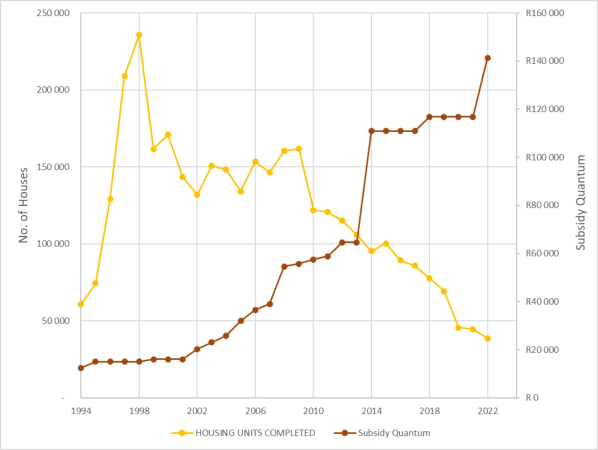
The bondable housing market, primarily influenced by the private sec- tor, has shown a slow yet consistent growth trajectory, even in the face of economic downturns. Conversely, government-subsidized housing deliveries are on the decline, despite an increase in the subsidy Rand-Value (US Dollar value), as illustrated in Figure 1. This decline emphasizes the pressing need for intervention in this sector.
Figure 1: Delivery of houses (aggregated from: www.dhs.org.za).
As of 2022, South Africa’s government-subsidized housing delivery stands at just under 50,000 units, underscoring the potential for a more substantial impact with existing technical capabilities. This highlights the urgent need for significant interventions from both the government and private developers in the built environment, prompting a call for a paradigm shift to explore how innovation can reshape housing and social infrastructure delivery. Despite the potential advantages, the slow adoption of Modern Methods of Construc- tion (MMCs) in South Africa is attributed to limited knowledge, perceived
Challenges in the Implementation of Modern Methods of Construction 35
high costs, and challenges related to social acceptability. Agrèment South Africa’s pivotal role in testing and certifying innovative construction products is acknowledged, but an urgent need is emphasized for a well-documented and stratified knowledge base encompassing certified performance, limita- tions, costs, and more. This repository is seen as crucial for facilitating a more informed and effective integration of MMCs in the South African construc- tion landscape, addressing barriers and maximizing the benefits of innovative construction methods.
AIM OF THE STUDY This study aims to conduct a thorough literature review on walling-building technologies in South Africa and understand the factors limiting their widespread adoption. The research focuses on key questions, including the assessment and approval of these technologies by Agrèment SA, the varia- tions in their performance, systematic stratification based on performance characteristics, constraints affecting adoption, and the government’s role in influencing technology uptake. The study emphasizes that it is specifically centred on walling building technologies, particularly those evaluated and endorsed by Agrèment SA. The data used is sourced from Agrèment SA certifi- cates, complemented by insights from technology innovators when available. This targeted investigation intends to provide nuanced insights into the South African landscape of walling building technologies, shedding light on both certified performance and practical constraints influencing their adoption.
RESEARCH METHODOLOGY AND DESIGN The research methodology employed in this study is a robust and systematic four-stage approach designed to achieve scientific rigour and reliability. The first stage involves a critical review of building performance standards and the Agrèment SA certification process for walling building systems, provid- ing a comprehensive understanding of evaluation criteria. The second stage is exploratory, compiling a dataset through Agrèment SA’s website and dis- cussions with officials, systematically analyzing certificates to stratify walling systems based on performance attributes.
The third stage emphasizes validation through direct engagement with technology innovators and owners, ensuring the integrity of information from certificates and gaining insights into their experiences with innova- tive technologies. The final stage synthesizes the data collected, creating a conceptual framework that forms the basis for scholarly analysis. This comprehensive and systematic approach ensures the acquisition of reliable, validated data, contributing substantially to the understanding of walling building technologies in South Africa and enhancing the existing body of knowledge in the field.
LITERATURE REVIEW
Adopting Modern Methods of Construction (MMC) has been a global phenomenon, with various countries facing unique challenges and opportu- nities in integrating innovative construction practices. This literature review
36 Mahachi
explores the challenges encountered in MMC implementation across diverse contexts, encompassing developed and developing nations.
In the UK, the construction industry has been at the forefront of MMC adoption. The key challenges identified include resistance to change within the traditional construction sector, high initial investment costs, and a frag- mented regulatory framework (Pan et al., 2018; Lützkendorf & Balouktsi, 2017). Despite these challenges, the UK has made significant strides in pro- moting MMC, supported by government initiatives and a growing awareness of the benefits, such as reduced construction time and enhanced sustainabil- ity.
European countries collectively exhibit varied approaches to MMC adop- tion. While some nations, like Germany and Sweden, have embraced off-site construction methods, others face challenges related to standardization and interoperability (Ling et al., 2020). European initiatives, such as Hori- zon 2020, aim to address these challenges by fostering collaboration and innovation in the construction sector.
In the USA, MMC faces obstacles related to a predominantly on-site con- struction culture, limited standardization, and complex regulatory processes (Ogunlana et al., 2018). However, recent advancements in 3D Construction Printing have gained attention, with initiatives like ICON’s construction of affordable homes showcasing the potential for transformative change in the industry (Buswell et al., 2018).
Japan, known for its advanced technological landscape, has encountered challenges in MMC adoption linked to an ageing workforce and a tra- ditional craftsmanship-focused construction culture (Kaneko et al., 2018). Government-led initiatives to promote research and development in MMC aim to overcome these challenges and position Japan as a global leader in innovative construction practices (Wong et al., 2019).
In Australia, the construction industry grapples with issues such as skills shortages and a lack of standardized processes for MMC (Love et al., 2019). Nevertheless, the government’s commitment to sustainability and efficiency has fueled initiatives promoting MMC adoption, emphasising modular construction (Ma et al., 2018).
China’s rapid urbanization has prompted the exploration of MMC to address housing demands. Challenges include quality control concerns, a fragmented industry structure, and the need for increased research and devel- opment (Li et al., 2020). The Chinese government’s support for MMC, particularly in the context of 3D Construction Printing, underscores its commitment to transformative construction practices (Yuan et al., 2018).
On the other hand, developing nations face unique challenges in MMC adoption, often influenced by resource constraints and varying techno- logical readiness levels. In Malaysia, for instance, factors such as limited awareness and a traditional construction mindset hinder widespread MMC implementation (Haron et al., 2020).
The advent of 3D Construction Printing introduces a paradigm shift in construction methodologies. Challenges, however, include material con- straints, regulatory uncertainties, and the need for standardized processes (Gibb & Shanks, 2019). Innovations such as using robotics and advanced
Challenges in the Implementation of Modern Methods of Construction 37
materials are poised to overcome these challenges, presenting a transfor- mative potential in achieving sustainable and cost-effective construction solutions (Khoshnevis et al., 2016).
The concept of building performance has evolved significantly in recent decades, with notable contributions from scholars such as Foliente (2000), Fairclough (2002), and Hartkopf et al. (2008). In the existing literature, performance-based standards emphasise defining what a building product is expected to achieve rather than dictating the specific methodologies involved. This approach aligns with the definition of a performance-based building by CIB (2003).
The South African building regulatory framework mirrors this performance- oriented perspective. The National Building Regulations (NBR) and Building Standards Act (Act No. 103 of 1977, as amended) outline three avenues for meeting performance requirements, one of which involves performance assessment through Agrèment SA.
In summary, the challenges in implementing MMC and 3D Construction Printing are multifaceted, varying across countries due to distinct socio- economic, cultural, and regulatory contexts. A comprehensive understanding of these challenges is essential for developing effective strategies to promote the global adoption of innovative construction practices.
REVIEW OF BUILDING PERFORMANCE AND AGREMENT SA CERTIFICATION This section meticulously evaluates walling systems certified by Agrèment SA, focusing on active systems in the database using a strategic sampling methodology guided by Agrèment SA. The selected systems are analyzed and stratified based on structural performance into four primary groups, revealing commonalities in manufacturing and performance. The categories include Sandwich Insulated Panels (SIP), Light Concrete Building Systems, Polyvinyl Chloride (PVC) Building Systems, Container Building Systems, Building Blocks, and 3D Construction Printing.
Sandwich Insulated Panels (SIPs) comprise multiple layers, providing remarkable structural and energy performance suitable for off-site manufac- turing. Light Concrete Building Systems incorporating lightweight concrete or Autoclaved Aerated Concrete (AAC) offer advantages such as reduced weight, improved thermal properties, and cost savings. PVC Building Sys- tems, known for versatility and resilience, feature interlocking shells or modules reinforced by concrete. Container Building Systems offer modular steel construction with benefits like easy transportation, swift installation, flexibility, and alignment with sustainable practices. Building Blocks encom- pass various types, emphasizing on-site manufacturing using local labour and stringent quality control. Finally, 3D Construction Printing, a cutting-edge technology, holds promise for speed, cost efficiency, and sustainability, but its integration awaits Agrèment SA approval due to the need for comprehensive performance assessments.
The diverse range of walling systems underscores the potential for inno- vation in the construction industry, with each category presenting unique
38 Mahachi
attributes and applications. The inclusion of emerging technologies like 3D Construction Printing highlights the industry’s evolution, albeit with a cau- tious approach to ensure safety, durability, and compliance with regulations before widespread adoption. Top of Form
Table 1. Building walling system stratification groups.
Table available in the original PDF paper.
Building Groups Names of Building Systems Building Occupancies* a. Spaceframe 2000 Building System A3, D2, G1, H2, H3, H4
1. Sandwich Insulated Panels
b. Amsa Protea Building System H3, H4 c. FSM Building System A3, H2, H4 d. Kwikspace Modular Building System A3, D2, D3, G1 e. MIB Building System A3, B2, B3, D2, D3, E3, F2, G1, H3, H4 f. SARDA Building System A3, B2, B3, D2, D3, F2, G1, H2, H3, H4 2. Light Concrete Building Systems
a. UCO Solidwall Building System A3, B2, B3, E3, F2, G1, H3, H4, J2, J3 b. Robust Building System A3, B2, B3, D2, D3, E1, E3, F1, F2, F3, G1, H2, H3, H4 c. Tilt-up Pre-fabricated Building System H3, H4 d. Uvuyo Building System B2, B3, F2, H3, H4 3. PVC Building Systems
a. ITAS Modular Building System G1
a. Flex Building System A3, B2, B3, F1, F2, F3, G1, H3, H4, J2, J3 b. Luxwood Wall Panel Building System B2, B3, D2, D3, F1, F2, F3, G1, H3, H4 c. GHS Wall Technology Building System A3, A4, B2, B3, C2, D2, D3, D4, E3, F2, F3, G1, H2, H3, H4, H5, J2, J3, J4 4. Container Building Systems
a. Mega Building System A3, B3, F2, G1, H3, H4
b. Xtraspace Container Building System A3, B2, B3, D1, D2, D3, F2, G1, H1, H2, H3, H4 5. Building Blocks b. Stumbelblock Building System A3, B2, B3, D2, D3, F2, G1, H2, H3, H4 c. Benex Masonry Building System A3, A4, B3, D2, D3, F2, G1, H2, H3, H4 d. Compressed Earth Building System A3, A4, B2, B3, F2, G1, H2, H3, H4 e. Hydraform Building System A3, B2, B3, D2, D3, F2, G1, H2, H3, H4, J1, J2 f. Ikhaya Brick Building System H3, H4 g. Izoblock Building System A3, A4, B2,B3, D2, D3, E3, F1, F2, F3, G1, H1, H2, H3, H4 h. Klevabrick Building System A3, B2, B3, D2, D3, E3, F1, F2, F3, G1, H1 i. Automapolyblock Building System A3, B2, B3, D2, D3, F2, G1, H2, H3, H4
*As per National Building Regulations Nomenclature and described in more detail in the next section.
The systematic stratification of walling building systems, as meticulously delineated in Table 1 (based on the data extractable at that juncture), offers a panoramic view. It is imperative to acknowledge that while the list is exten- sive, further in-depth analysis may prove beneficial, a facet that subsequent sections will delve into, elucidating the building occupancies intrinsically associated with these systems.
Challenges in the Implementation of Modern Methods of Construction 39
ANALYSIS OF THE BUILDING SYSTEMS Occupancy Classification
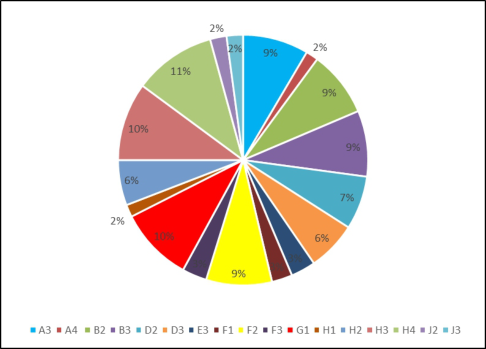
The National Building Regulations (NBR) categorize buildings based on their intended use, encompassing thirty classifications ranging from resi- dential and commercial to hospitals, schools, garages, and storage areas. Agrèment certification aligns with NBR’s occupancy classification, reflecting a product’s performance, as outlined in Table 1. The distribution of occu- pancy classifications was scrutinized, presenting the percentage distribution in Figure 2.
Figure 2: Distribution of occupancy classes (classes are as per NBR).
Insights from the data:
1. Limited Coverage for High-Risk Occupancies:
The certification of walling building systems is notably scarce in spe- cific high-risk classes, including Entertainment and public assembly (A1), Theatrical and indoor sport (A2), Outdoor sport (A5), High-risk commer- cial service (B1), Exhibition hall (C1), Hospital (E2), Health care (E4), and High-risk storage (J1). These occupancies demand stringent compliance due to their potential impact on societal health and safety. 2. Focus on Low-Risk Occupancies: A considerable number of certifications are concentrated in low-risk classes, such as Places of instruction (A3), Low-risk commercial services (B3), Moderate-risk industrial (D2), Low-risk industrial (D3), Small shop (F2), Offices (G1), Domestic residences (H3), and Dwelling house (H4). However, the emphasis on H3 (multiple units on a site) poses challenges, especially in low-income housing, where structural concerns, fire risks, poor workmanship, and budget limitations are prevalent. The choice of a walling system becomes crucial in addressing these challenges. 3. Challenges and Opportunities:
The challenges and opportunities in the adoption of innovative building systems become apparent on the ground. SIP products encounter hurdles
40 Mahachi
as their manufacturing demands substantial capital, impeding widespread adoption due to funding constraints. Additionally, the “knock-on” effect, altering traditional aesthetics, may result in social unacceptability. Block building systems, favored locally for their solid nature, face a slower con- struction speed compared to SIP building systems. In the face of disasters, there is a pressing need for the rapid implementation of social infras- tructure, where SIP and Container Building Systems stand out for their potential for swift deployment. These dynamics highlight the practical challenges faced in the uptake of various building systems and underscore the potential advantages in specific contexts, emphasizing the need for a nuanced approach in their application. 4. Specialized Occupancy Classes: Only one system from the sample caters to the unique requirements of E1 (Place of Detention), necessitating robust structural strength, stability, acoustics, and energy efficiency. Another system aligns with the H1 classi- fication for Hotels, leveraging steel containers and demanding additional scrutiny for structural integrity.
Energy and Thermal Performance The section on Energy and Thermal Performance provides an insightful overview of energy usage in buildings, covering aspects such as winter heating, summer cooling, and maintaining indoor air comfort. Agrèment employs building energy simulation programs to assess energy needs, using a Reference Standard Brick House (SBH) as a benchmark. Various build- ing systems are observed to match or surpass SBH performance, particularly when equipped with additional insulation, showcasing the efficiency of inno- vative walling systems in reducing energy consumption. Notably, systems within the SIP group, AAC-based products, and lightweight concrete prod- ucts exhibit commendable energy efficiency, offering cost-effective solutions in energy-scarce regions like South Africa.
The implications for sustainable construction are substantial, as these innovative walling systems have the potential to significantly contribute to minimizing energy demands in residential and commercial structures. In regions facing energy scarcity and high costs, the adoption of these sys- tems becomes a practical solution to enhance energy efficiency. The notable performers, such as SIPs, AAC, and lightweight concrete products, indicate promising avenues for promoting sustainable building practices in South Africa and beyond. Recognizing the growing importance of energy efficiency in the construction industry, the adoption of these innovative systems can lead to long-term environmental and economic benefits.
GENERAL DISCUSSIONS In this comprehensive discussion on construction innovation, the focus cen- tres on the potential of integrating innovative building systems to reshape the industry. The analysis and stratification of various innovative walling systems highlight their performance attributes, emphasizing the need for innovation adoption. The discourse addresses challenges and opportunities and proposes
Challenges in the Implementation of Modern Methods of Construction 41
an integrated framework to bridge current gaps, fostering acceptance of mod- ern construction practices. Evaluating the performance and environmental impact of these systems underscores their sustainability and positions them as alternatives to traditional construction methods.
Engaging with system innovators reveals challenges and opportunities within the construction innovation landscape, from certification processes to competitive dynamics. Government support’s critical role is scrutinized, noting limited assistance despite past resolutions favouring Innovative Build- ing Technologies (IBT). The discussion underscores the necessity for active government involvement and a nuanced understanding of construction inno- vation’s societal impact and proposes an integrated delivery framework emphasizing collaboration, informed decision-making, and Agrèment SA’s certification as the final step in ensuring thorough research underpins the journey from conceptualization to implementation.
CONCLUSION AND RECOMMENDATIONS The nexus between testing, assessment, and certification of building products emerges as a linchpin for fostering innovation in the construction sector. For- tified by a supportive regulatory framework for MMCs, South Africa notably relies on Agrèment SA for impartial and professional evaluation in align- ment with National Building Regulations. While the certificates issued by Agrèment SA offer a commendable foundation for industry stakeholders, a palpable gap persists, hampering the seamless transition from research and knowledge to effective product implementation.
To bridge this gap and unlock the full potential of construction innova- tion, it is imperative to embark on an earnest journey of comprehensive knowledge development. This entails meticulously exploring walling building products, going beyond their stratified performance to delve into their actual “as-built”attributes, local material availability, manufacturing processes, and societal acceptability. A holistic knowledge base encompassing these vital facets will serve as a catalyst for the widespread adoption of innovative construction products. This, in turn, is poised to catalyze economic devel- opment, aligning the construction sector with the broader goals of national progress. Consequently, a concerted effort towards developing and utiliz- ing such a knowledge base becomes a strategic imperative for South Africa’s construction landscape.
REFERENCES
Agrèment SA. 2010. The performance concept. www.agrement.co.za, Pretoria.
Agrèment South Africa. Agrèment South Africa Act (Act 11 of 2015), Government Gazette 41186, 20 October 2017, Pretoria, South Africa. Burger, S. 2014. Innovative building technologies can aid delivery of social infras-
tructure. Creamer Media. South Africa. Buswell, R. A., Soar, R. C., Gibb, A. G., & Thorpe, T. (2018). Digital concrete: opportunities and challenges. The European Physical Journal Special Topics, 227(22), 2641–2652.
42 Mahachi
CIB. 2003. Performance based building: first International State-of-the-Art Report.
Rotterdam, CIB Development Foundation: PeBBu Thematic Network. Fairclough, J. 2002. Rethinking construction innovation and research: A review of government R&D policies and practices. London: Department of Trade and Industry/Department of Transport, Local Government. Foliente, G. 2000. Developments in performance-based building codes and stan-
dards. Forest Products Journal, 50(7/8), pp. 12–21. Gibb, A., & Shanks, G. (2019). Toward a new theory of construction as production.
Automation in Construction, 98, 4–16. Haron, A. T., Ismail, N., Mohamad, N., Zainun, N. Y., & Ismail, M. (2020). Barriers to the implementation of industrialized building system (IBS) in Malaysia. Sustainability, 12(10), 4068. Hartkopf, V., Loftness, V., and Mill, P. 2008. The concept of total building per-
formance and building diagnostics. Building performance: Function, Preservation and Rehabilitation, ASTM STP 901, G. Davise, Ed., American Society for Testing and Materials, Philadelphia, 1986, pp. 5–22 Kaneko, Y., Tomita, K., Kondo, Y., & Inamura, H. (2018). Innovation management strategies for the Japanese construction industry. Procedia CIRP, 70, 524–529. Khoshnevis, B., Dutton, R., Kolb, J. F., Mankins, J. C., Todd, M., & Vakhshouri,
B. (2016). Automated construction by contour crafting—Related robotics and information technologies. Automation in Construction, 68, 21–33. Lützkendorf, T., & Balouktsi, M. (2017). Innovations in building retrofitting: The potential of building typologies. Energy Policy, 101, 381–394. Li, Z., Zhang, Y., Shen, G. Q., Yu, A. T., & Zhang, W. (2020). A review of the
application of prefabrication in China’s construction industry. Automation in Construction, 113, 103091. Ling, F. Y. Y., Tse, Y. K., Wang, Y., Shen, L., & Zhang, M. (2020). Critical success factors for offsite manufacturing construction in European countries. Journal of Cleaner Production, 271, 123027. Love, P. E., Edwards, D. J., & Goh, Y. M. (2019). Modelling the readiness of the
construction industry for off-site manufacturing. Construction Innovation, 19(4), 484–508. Ma, T., Lu, W., Skitmore, M., & Zhang, X. (2018). Challenges and potential solutions for prefabricated and modular construction: A case study of Australia. Journal of Cleaner Production, 180, 401–415. NBR. 1977. National Building Regulations and Building Standards Act. No. 103 of
1977, as amended. Government Gazette. Pretoria. South Africa. Ogunlana, S., & Papadonikolaki, E. (2018). A framework for the adoption of off-site manufacturing in the USA. Journal of Construction Engineering and Management, 144(1), 04017110. Pan, W., Zhang, Q., Liu, J., & Wu, P. (2018). Barriers to the adoption of off-site
construction in China: An empirical study. Journal of Cleaner Production, 195, 97–106. SANS 10400 (2012): The application of the National Building Regulations, SABS, Pretoria, Republic of South Africa. Wong, T. N., Wong, K. A., & Ho, S. P. (2019). Barriers to the adoption of Build-
ing Information Modeling in the Hong Kong construction industry. Journal of Professional Issues in Engineering Education and Practice, 145(3), 04019006. Yuan, Y., Wang, Y., Gu, Y., & Ding, Z. (2018). A review of the housing industrialization policies in China: The past, present, and future. Journal of Cleaner Production, 176, 787–801.
LISTED IN THE AHFE DIGITAL BOOKSTORE CATALOGUE
Explore the complete digital volume
Sustainable Construction in the Era of the Fourth Industrial Revolution
Read this individual research paper free through the original publisher, or explore the full digital proceedings book.
ISBN 978-1-964867-25-0
Explore this ISBN in the AHFE Bookstore ↗Listed in the July 2026 bookstore catalogue; search by ISBN to confirm current availability · Digital book purchase optional