Carlos Alejandro Martinez-ibanez, Martha Roselia Contreras-valenzuela (2024). Identification of Risk Factors in Work Environments with Ornamental Aquaculture Activities in Morelos. In: Social and Occupational Ergonomics. AHFE Open Access, vol. 152, pp. 51–58. https://doi.org/10.54941/ahfe1005320
Global aquaculture comprises extraction fishing and aquaculture; both sectors pose occupational safety and health (OSH) challenges, with physically demanding tasks leading to higher injury rates. In Morelos, Mexico, the highest concentration of production units (UP) and ornamental fish production has persisted for over a decade. However, no research has delved into the inherent occupational risks of this activity, and there is a lack of knowledge regarding potential impacts on worker safety and health in this industry. This proposes a questionnaire to identify ergonomic risks in ornamental aquaculture activities and environments. It integrates five sections: physical, chemical, biological, ergonomic and psychosocial risk factors, the resulted questionnaire 84 questions with 112 response options.
The FAO, a global data repository on fisheries and aquaculture since 2003, emphasizes that in 2020, these activities employed 58.5 million people glob- ally, with 35% in aquaculture and 65% in fisheries, including 21% women. Despite challenges such as informal employment and child labour, the FAO and the ILO express their concern for improving livelihoods through decent jobs in aquaculture (FAO, 2022). In Mexico, the Ministry of Labour and Social Welfare establishes guidelines through regulations to develop and promote preventive services for safety and health at work, along with the nec- essary actions for the creation of a Workplace Safety and Health Diagnosis (DSST) for every workplace, as the norm is mandatory (SADER, 2020). The need to enhance the safety and health of workers in aquaculture is emphasized due to the demanding nature of the jobs.
Bibliographic Review Aquaculture in Morelos, as an activity in primary production, is recognized as having large areas of opportunity, one of them is the safety and health of workers, since it is known that most jobs in primary production tend to be essentially demanding, often resulting in higher rates of injuries and illnesses
compared to other occupations (CDC, 2024). Considering the previous con- text and the importance of the activity at the national level, currently, no research has been carried out in order to know the inherent occupational risks of this activity (Fry et al., 2019), much less the repercussions that they could have on safety and security health of workers in this industry. Added to this, in Mexico, statistics show that 93% of the population that is dedicated to both fishing and aquaculture is small-scale, that is, inland water work- ers, estimating that there are around 295,033 thousand people who depend on of these two activities and emphasizing that 241 thousand people are in some degree of poverty or extreme poverty (SADER, 2020). For the above and considering the National Fisheries and Aquaculture Program, the sus- tainable Nation Project 2018–2024 of the current government of Mexico, as well as the development objectives, which frame scientific and technological research as an element within its objectives. fundamental to achieve the max- imum sustainable use of fishing and aquaculture resources, this research is carried out with the purpose of contributing to the understanding of occupa- tional risks, coming from physical, chemical, biological as well as ergonomic aspects of the activity.
MATERIALS AND METHODS
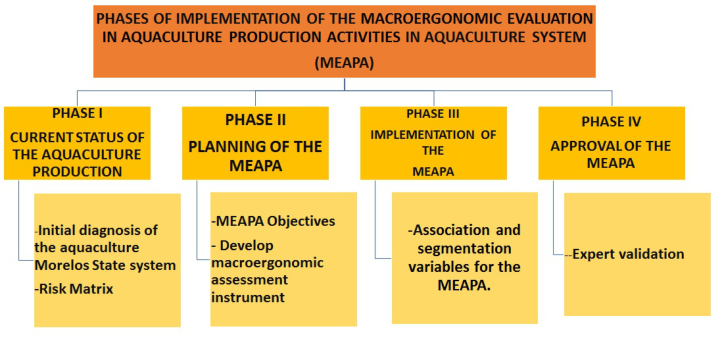
Soft Model to Identify Risk Factors in Ornamental Aquaculture Activities Environments For identifying the level of risk in aquaculture production units and their activities was necessary to specify in advance the risks present in the cul- tivation process. This information was required during the analysis stage to determine workers’ risks. This information was obtained using the “Observa- tion Instrument for Macroergonomic Evaluation in Aquaculture Production Activities” (MEAPA) as was defined Figure 1.
Figure 1: MEAPA soft model.
Identification of Risk Factors in Work Environments With Ornamental Aquaculture 53
This model was created for assessing the risk level in activities in aqua- culture production units, in the Morelos State, was supported by the information-gathering method used in occupational risk assessments, specifi- cally the PLIBEL evaluation methodology. PLIBEL is a standardised diagnos- tic method used in ergonomic interventions. It gathers information through a questionnaire that relates to different body parts to identify possible harmful effects on the activity under evaluation (Kemmlert, 1987). It is worth men- tioning that it is performed under the observation of the tasks to be analysed, collecting data from all stages of the production process.
For this research, the checklist was modified, innovating the creation of the evaluation instrument (MEAPA). It was designed whit the objective to build an assessment questionnaire, wish contains the number of variables neces- saries for workplace assessment as was defined in (Contreras-Valenzuela & Martínez-Ibanez, 2024), The content of the questionary was classified into five groups based on the presence or absence of stress factors. The numbers of question for each section are presented in Table 2.
Table 1. Five association and segmentation variables for the MEAPA.
The resultant questionnaire integrates the observation of the activity and is distributed into five sections: Physical, chemical, biological, ergonomic, and psychosocial. The questions for each segment are presented as following.
Physical Risk Assessment
1. The aisles where you work are dirt? 2. The aisles where you work are made of concrete? 3. Have you slipped in aisles or work areas? 4. Is there any type of handrails to hold onto to prevent falls? 5. Do you check for any issues in your work area before starting your tasks? 6. Do you have contact with physical agents that could harm you, such as wires, glass, noise, vibrations? 7. Do you take measures to reduce or control exposure to these agents? 8. Do you engage in activities directly exposed to solar radiation?
a. More than one hour b. Less than one hour c. The entire shift
54 Martínez-Ibanez and Contreras-Valenzuela
9. Do you know if your job is classified as light, moderate, or heavy according to NOM-015-STPS-2001?
a. Light b. Moderate c. Heavy
10. Do you consider that the workstations are adapted to you? 11. Do you have recovery times in the shade after solar exposure? 12. Do you identify hazardous or risky areas in your company? 13. Do you have personal protective equipment (PPE)?
a. Trouser guards b. Gloves c. safety glasses
14. Do you have safety training for the performance of your duties? 15. Are you aware of the risks associated with the tasks you perform? 16. Do you have a dining area separated from other work areas? 17. Do you consider that the ponds are designed in a way that allows you to perform your activities entirely with a safe reach without dangerous stretching? 18. Do you have toilets with water, paper, and soap? 19. Do you have bins to separate the garbage? 20. Do you use machinery and equipment in aquaculture? 21. Are you trained for the handling and/or operation of this machinery or tools? 22. Is the machinery and tools you use appropriate for the activity you perform? 23. Is the machinery and tools you use kept in good condition through regular maintenance? 24. Are there established and safe procedures for the handling and opera- tion of machinery or equipment? 25. Do you work inside a greenhouse? 26. Do you take measures to prevent and/or control extreme conditions of temperature, humidity, or other environmental factors? 27. Have you experienced heatstroke? 28. Do you know what to do if you experience adverse weather conditions? cold, heat, rain? 29. Do you work in confined spaces? 30. Do you have contact with electrical installations? 31. Have you experienced an electric shock? 32. Do you have information for the proper handling of electrical equip- ment (such as air pumps, water pumps, extensions, heaters) to prevent the risk of short circuits? 33. Do you use lockout/tagout procedures for electrical equipment? 34. Have you been in a situation of possible drowning in a bathtub or pond?
a. Because you don’t know how to swim b. Due to an accidental situation
Identification of Risk Factors in Work Environments With Ornamental Aquaculture 55
Chemicals and Substances or Mixtures Risk Assessment
35. Do you use chemical agents in your operations? 36. Have you been poisoned by any chemicals? 37. Do you know if the chemicals you use are specific to aquaculture activities? 38. Do you have safety sheets (SS) for all the chemical products you use? 39. Are you trained on the safe handling and associated risks of chemical products? 40. Do you know what proper storage of chemicals looks like? 41. Do you use personal protective equipment (PPE) when working with chemicals? 42. Have you experienced any spills with chemical? 43. Do you know what to do in case of a chemical spill or accidental exposure? 44. Do you perform standardized sanitization procedure?
Biological Risk Assessment
45. Do you wash your hands after handling living/dead organisms? 46. Have you been in the cultivation water in contact with dead organisms? 47. Have you performed tasks within the pond in direct contact with cultivation water and living organisms? 48. Have you contracted any ailment such as fungi? 49. Have you suffered illnesses as a result of your activities? 50. Do you apply health treatment to dead organisms? 51. Do you have a current vaccination record? 52. You undergo regular health checks? 53. Have you suffered from any of the following zoonotic diseases?
a. Mycobacterium sp. b. Streptococcus iniae c. Streptococcus agalactiae d. Francesilla noatunensis
54. Have you had stings or injuries from aquatic species? 55. Do you wash your hands before and after eating your food? 56. Do you use the bathroom for your physiological needs? 57. Do you have training on biological risks? 58. Do you know what to do in case of emergency due to exposure to a biological agent? 59. Have you suffered an emergency due to exposure to biological agents? 60. Do you slaughter fish? 61. Do you have the necessary utensils to carry out the controlled killing of organisms based on the animal welfare standard?
a. Upper trunk (neck, dorsal, upper back) b. Mano c. Upper limbs (arms, forearms, shoulder) d. Lower limbs (thighs, knees, legs) e. Feet f. Lower back (lumbar and sacrum)
63. Are you provided with information on ergonomics?
Strength
64. Do you hold, rotate, or push? of: a. Cast nets. b. Skimmer Net c. Fishing net d. Water hoses
Repetitive Movements
65. Do you carry out fish selection activities? 66. Do you handle loads less than 3k? 67. Do you carry out manipulation with your hands in the bagging activity in which it is necessary?
a. Wrist flexion b. Wrist extension c. Radial deviation (towards thumb) d. Ulnar deviation (towards the little finger) e. Finger strength
68. Are the activities carried out for more than three hours without inter- mediate breaks?
a. Bagged b. Selection for sale c. Unfold
69. Are you provided with ergonomic equipment, when necessary, espe- cially for repetitive tasks?
Manual Material Handling
70. Do you handle loads over 3k? 71. Do you handle loads over 3k more than three times a day? 72. Do you have protocols for the manual handling of loads? 73. Do you have protocols for manual handling of loads?
Pushing and Pulling
74. Do you push or drag loads?
a. With auxiliary equipment (wheelbarrow, cart, little devil) b. Without auxiliary equipment (Boxes, Bags, tubs, tare)
Identification of Risk Factors in Work Environments With Ornamental Aquaculture 57
Psychosocial Factors
75. Have you suffered stress from the activities you do? 76. Have you witnessed any traumatic events? 77. What kind?
a. Work accident b. Work death c. Amputation d. Hit or direct physical aggression from the boss e. Hit or direct physical assault of another worker
78. Do you consider that the workload is managed equitably among all workers? 79. How many hours you work for the company allows you to spend time with your family? 80. Do you have social security from your company? 81. Have you carried out emergency drills in the event of an environmental contingency? 82. Do you work overtime frequently? 83. Do you have periodic audits of your activities? 84. Is there an effective risk communication channel to inform superiors about potential dangers and safety measures?
As previously defined all the questions were considered as stress factors from macroergonomic point of view, as is required by MEAPA except Bio- logical risk due to the consequences of this kind of risk requires of personnel specialized in zoonotic illnesses developed in the aquaculture production units. In the case of psychosocial factors, they were considered as stress fac- tors, which define some characteristics of presence or absence of sustainable decent work. As first stage of this investigation, as future work the implemen- tation of the questionnaire developed is considered, and the data processing will be a possible cause of limitation if it is not considered an appropriate analysis method.
CONCLUSION
This research aims to contribute to the understanding of occupational risks arising from ornamental aquaculture. The proposed questionnaire integrates five sections to identify physical, chemical, biological, ergonomic and psy- chosocial risk factors, The resulted questionnaire includes 84 questions with 112 response options. It can be implemented in future works as tool to assess decent work established in the objectives of the 2030 agenda. The ques- tionnaire seeks to propose science-based sustainable interventions that can prevent or reduce the severity of injuries and illnesses in the workplaces.
ACKNOWLEDGMENT
The authors would like to express their gratitude to the National Council of Humanities, Sciences, and Technologies of Mexico (CONAHCYT), as well as to the Autonomous University of the State of Morelos (UAEM). The support provided by the Ergonomics Laboratory of the Faculty of Chemical Sciences and Engineering (FCQeI) has been instrumental in carrying out this research.
58 Martínez-Ibanez and Contreras-Valenzuela
REFERENCES
CDC. Centers for Disease Control and Prevention. Agricultural Safety. NIOSH. 2024 Available At: Available: https://www.cdc.gov/niosh/topics/aginjury/default.html. Contreras-Valenzuela, M. R., & Martínez-Ibanez, C. A. (2024). Hierarchical Clus-
tering Analysis of Musculoskeletal Stress Factors and Their Risk Level in 2 Cardboard Manufacturing: A Research from PLIBEL. Journal of Occupational Health, 2024;, uiae008, https://doi.org/10.1093/joccuh/uiae008. FAO. (2022). International Year of Artisanal Fishing and Aquaculture. 2022 Global Action Plan. FAO. Available At: https://www.fao.org/artisanal-fisheries-aquacult ure-2022/home/es/. Fry, J. P., Ceryes, C. A., Voorhees, J. M., Barnes, N. A., Love, D. C., and M. E. Barnes,
“Occupational Safety and Health in U. S. Aquaculture: A Review,” Journal of Agromedicine, vol. 24, no. 4. Taylor and Francis Ltd., pp. 405–423, Oct. 02, 2019. doi: 10.1080/1059924X.2019.1639574. Kemmlert, K. (1987). A. Method for identification of musculoskeletal stress factors which may have injurious effects. SADER. (2020). National Fisheries and Aquaculture Program 2020-2024-Mexico.
Available At: https://www.gob.mx/cms/uploads/attachment/file/616554/PROG RAMA_Nacional_de_Pesca_y_Acuacultura_2020-2024baja.pdf.
LISTED IN THE AHFE DIGITAL BOOKSTORE CATALOGUE
Explore the complete digital volume
Social and Occupational Ergonomics
Read this individual research paper free through the original publisher, or explore the full digital proceedings book.
ISBN 978-1-964867-28-1
Explore this ISBN in the AHFE Bookstore ↗Listed in the July 2026 bookstore catalogue; search by ISBN to confirm current availability · Digital book purchase optional