Vanessa Mai, Johanna Nickel, Anna Gähl, Rebecca Rutschmann, Anja Richert (2024). AI-based Chatbot Coaching for Interdisciplinary Project Teams: The Acceptance of AI-based in Comparison to Rule-based Chatbot Coaching. In: Human Interaction and Emerging Technologies (IHIET 2024). AHFE Open Access, vol. 157, pp. 249–259. https://doi.org/10.54941/ahfe1005484
Project-based work is integral in corporate and academic settings, where coaching plays a crucial role in enhancing team performance and project success. To streamline this process and improve scalability, we developed a coaching chatbot at TH Köln/University of Applied Sciences to assist interdisciplinary teams. Utilizing a systemic coaching approach, the chatbot prompts self-reflection through solution-focused questions. We collaboratively created it with student facilitators and lecturers and tested it during a University-wide Interdisciplinary Project Week in November 2023. The pilot study involved two versions of the chatbot: a rule-based system and a hybrid model incorporating generative AI capabilities. As part of the field test, we analysed its acceptance: How effective is the chatbot in supporting projects groups and facilitating reflection processes? Are there differences in acceptance between the two chatbots? Half of the project groups in the one-week course used the rule-based chatbot, while the other half of the project groups were provided with the AI-based chatbot. 134 students participated and used the chatbots at the end of each day of the project week. The results of this study indicate that our test subjects accepted both types of chatbots with moderate to good scores in acceptance. However, the AI-based chatbot fared significantly worse in terms of performance expectancy and effort expectancy. This is possibly due to the fact that hybrid coaching chatbots are neither widely developed nor researched. We conclude that regardless of the technical basis of such a chatbot, conversation design and prompting is an essential part of chatbot development and contributes significantly to acceptance. This study demonstrates the potential of chatbots in supporting group coaching, not only in educational settings but also in corporate environments where they can aid agile project teams. This research marks one of the initial explorations into the acceptance of group coaching through chatbots.
INTRODUCTION: CHALLENGES IN INTERDISCIPLINARY TEAMWORK Project-based interdisciplinary work has become a crucial component of the corporate landscape, necessitating robust support systems for teams. Effective teamwork hinges on the provision of continuous guidance and assistance. In this context, coaching emerges as an essential tool, aiding in the reflection on team dynamics and work processes within project settings. In many organizations, process facilitators or internal coaches are employed to help teams address and navigate work-related challenges effectively (Lippmann, 2013).
Navigating interdisciplinary team dynamics in a corporate environment presents its own set of challenges, particularly in digital workplaces. Teams must overcome initial obstacles, gel as a cohesive unit, manage tasks autonomously, and engage collectively in reflective practices. While some teams naturally excel with minimal intervention, others benefit from structured support, appreciating the guidance offered. However, some teams may be hesitant to engage in reflection with an outside facilitator present.
Also, a significant challenge is making reflective processes scalable across large numbers of employees. Digital tools and AI-based technologies, such as chatbots, are helpful in this regard, providing personalized, on-demand support that promotes self-coaching and prepares employees for human to human reflection sessions (Kanatouri, 2020; Mai and Rutschmann, 2023). Studies suggest that chatbots are often perceived as non-judgmental, which can facilitate more open and effective reflection among team members (e.g. Lee et al., 2020).
DEVELOPING A COACHING CHATBOT FOR INTERDISCIPLINARY TEAMWORK Use Case and Concept
At TH Köln/University of Applied Sciences, our students already train during a Bachelor’s degree course to work in interdisciplinary project teams and to meet the challenges described above. Within the “Hochschulweite Interdisziplinäre Projektwoche” (University-wide Interdisciplinary Project Week) students work in interdisciplinary teams for one week. They make joint decisions and develop an understanding of the methods and ways of thinking of other disciplines. The aim of the Interdisciplinary Project Week is to bring the importance and function of interdisciplinary work processes to the fore and to develop an awareness of them.
To accompany the students within this week, we have developed a coaching chatbot as a virtual process facilitator for interdisciplinary project teams. The aim of the coaching chatbot is to provide low-threshold coaching for student project groups in their team and work processes. Based on the systemic coaching approach, it asks solution- and resource- orientated questions that stimulate self-reflection (Berninger-Schäfer, 2018). The concept of a coaching chatbot for students is based on previous
AI-Based Chatbot Coaching for Interdisciplinary Project Teams 251
developments of a coaching chatbot on the topic of exam anxiety (Mai et al., 2021; 2023).
We developed the chatbot in a co-creation process with student process facilitators and lecturers and first used it as a prototype in November 2023 as part of the one-week University-wide Interdisciplinary Project Week at TH Köln. The chatbot concept is based on the tasks the student process facilitators fulfil during the project week: Throughout the week, a process facilitator accompanies each group and provides support. Their tasks include supporting the project’s start, conducting daily stand-ups and reflection sessions in the afternoon, and evaluating the lecturer’s feedback together with the project team. Our coaching chatbot serves as a virtual process companion for the afternoon reflection round. It was used during the project week at the end of each project day from Monday to Thursday. This project is unique in that it involves group reflection with a chatbot.
To ensure an authentic chatbot design and a strong user experience, we collaborated with former process facilitators. Their experience allowed us to integrate cooperative principles into the conversation design to make it authentic. Cooperative principles date back to Paul Grice and describe how contributions to a conversation should align with the conversation’s purpose (Grice, 1975). To enable the chatbot to conduct a productive dialog, it utilizes elements of the conversation from the training guide for the process facilitators of the Interdisciplinary Project Week.
The coaching interaction comprises of the following phases: Onboarding, review of the day, goal setting, solution finding, and farewell. Onboarding is an essential component of the chatbot concept and involves welcoming and getting to know the user (Kohne et al., 2020). The coaching phase focuses on reflection methods that follow a solution- and resource-oriented approach (Berninger-Schäfer, 2018). Here, the coaching chatbot uses interventions and methods that the student process facilitators also use, such as scaling questions to assess satisfaction with teamwork.
Design Approach: Rule-Based vs. AI-Based For our accompanying study, we developed two variants of the coaching chatbot: a rule-based chatbot and a hybrid chatbot that had an interface to generative AI (here: chatGPT) in addition to rule-based processes. We developed the rule-based chatbot using the no coding platform Landbot and the hybrid chatbot in cooperation with the start-up evoach.
Rule-based chatbots are programmed so that the responses generated follow a predefined structure. They therefore follow defined decision paths, which means that they always have the same process. Users primarily control them through selection options and buttons (Stucki et al., 2020). Rule- based chatbots have a less flexible flow of conversation, which often seems somewhat rigid. However, these guardrails also offer advantages: Rule-based bots are secure and predictable; by providing buttons and a clear path for coachees, the communication flow is smoother (Mai and Rutschmann, 2023). We have developed our rule-based chatbot in Landbot. Landbot is a chatbot platform that can be used to develop a chatbot without any
programming knowledge. It can be used to design and implement rule-based chatbots with which users can interact via click-based buttons (Landbot, 2023). For the hybrid chatbot, we concentrated on a rule-based approach for the onboarding part to ensure consistency and reliability, followed by an AI generated part for the actual self-reflection to ensure a natural conversation flow with the aim to appear less scripted. The chatbots were created on the evoach platform, which can be used to design either scripted, hybrid or fully AI integrated chatbots through the use of a state machine enabling a fully no-code experience to create these chatbots. In order to access the chatbots, participants had to sign-up with the evoach platform. For the onboarding part of the chatbot, we ensured to follow a proposed design framework to create AI coaches (Terblanche, 2020). We especially focused on providing clarity on the process, confidentiality and data policies as well as on providing transparency about the underlying technology used and the risk of generative AI delivering inaccurate or misleading information. This was important in order to manage expectations of the AI’s capabilities by being clear on its limitations. We also ensured that all communication generated by AI was labeled visually for transparency and full disclosure, as suggested by (Lee and Choi, 2017).
For the prompting of the AI generated self-reflection parts we designed different prompts for the reflections of each of the project days (day 1, day 2, day 3 and the final reflection on the last project day). The prompts consisted of two parts, the role and the task part, where the role stayed consistent for all prompts while the tasks differed according to the project phases:
1. Role (consistent for all prompts): ensuring the personality and role is defined the AI should incorporate for this conversation by providing a name, role (supporting students in reflecting on their group collaboration), personality (supportive, empathetic, showing concern for the team during the conversation and encouraging them to fully express their feelings). 2. Task (different for each prompt): outlining the clear task the AI should follow for the self-reflection of that day/phase, describing the questions to ask and defining a maximum amount of questions to ask.
RELATED WORK AND RESEARCH QUESTION In chatbot research, the study of acceptance is central to investigating the extent to which users accept chatbots. To date, there has been little research into the acceptance of chatbot coaching. However, studies on chatbot coaching indicate that users’ acceptance of chatbots as coaching tools is highly dependent on the productivity of the chatbot system and the users’ performance expectations (Brandtzaeg and Følstad, 2017; Mai et al., 2023; Terblanche and Cilliers, 2020). Crucial factors include performance expectancy, defined as “the extent to which an individual believes that the chatbot will help him or her to achieve performance improvements” (Venkatesh et al., 2003, p. 450) and effort expectancy, described as the
AI-Based Chatbot Coaching for Interdisciplinary Project Teams 253
degree of ease associated with using the system (Venkatesh et al., 2003). Davis et al. (1989) found that people are more likely to use an application if they perceive it to be easy to use. This involves not only ensuring the chatbot platform operates smoothly but also that the coaching conversations are rooted in validated coaching methods and dialogue processes to maximize user benefits (Terblanche, 2020). Developers of coaching chatbots need to craft a cohesive concept and bot persona, anchoring their design in clear expectation management. Terblanche and Kidd (2022) show for a goal- attainment coaching chatbot that the willingness to use it depends not only on how much the chatbot supports them in achieving their goals, but also on how much other people are willing to use a coaching chatbot and how easy and convenient it is to use.
Goal achievement is a focus area of coaching that leads to increased performance, progress and achievement of outcomes (Grant, 2012). The purpose of the chatbot in the present study was specifically to guide group reflection and facilitate the process. Since the construct of performance expectancy measures perceived performance growth (Terblanche, 2020), and since daily reflection with the chatbot is related to the achievement of the project goal, we hypothesize that performance expectancy has a significant impact on individual intention to use the chatbot for group reflection. Moreover, we hypothesize that effort expectancy influences the individual intention of the students to use a chatbot for group reflection.
As part of our field test, we therefore analyzed the acceptance of our coaching chatbot – measured with the items performance expectancy and effort expectancy – for interdisciplinary project work and formulated the following research questions:
How effective is the chatbot in supporting projects groups and facilitating reflection processes?
Are there differences in acceptance between the two chatbots (rule-based vs. AI-based)?
RESEARCH DESIGN The experimental design of this study consists of a combination of chatbot coaching with the developed and programmed coaching chatbots and a survey. A questionnaire was used to capture the student’s perceived acceptance of the chatbot coaching. Half of the project groups in the one- week course interacted with the rule-based chatbot, while the other half of the project groups were provided with the AI-based chatbot. The participants were asked to interact with the coaching chatbot at the end of every project day for the daily stand-up reflection session; however, they were free to decide whether they wanted to use the coaching chatbot. In addition, there was support from human process facilitators – independent of the use of the chatbot. The students were further asked to fill out the questionnaire at the end of the first and the last day of the project week (Monday and Thursday).
Frameworks such as the Technology Acceptance Model (TAM) or the Unified Theory of Acceptance and Use of Technology (UTAUT) are valuable
methods for assessing technology acceptance (Venkatesh et al., 2003). From the UTAUT, we selected the two constructs performance expectancy and effort expectancy, which were measured with a total of nine items. Demographic data such as gender, age, and field of study were collected at the end of the questionnaire.
The answers to all items on acceptance were given on a five-point Likert scale (1 = strongly disagree, 5 = strongly agree). Reliability according to Cronbach’s alpha is given for both constructs: For performance expectancy (PE).89 and for effort expectancy (EE).61. The data were analysed using descriptive and inductive statistical methods. For each construct (PE, EE), we conducted a t-test to measure significant differences in the experimental groups (rule-based vs. AI-based chatbot). The significance level for the evaluation of the data in this study is 5%.
RESULTS AND DISCUSSION
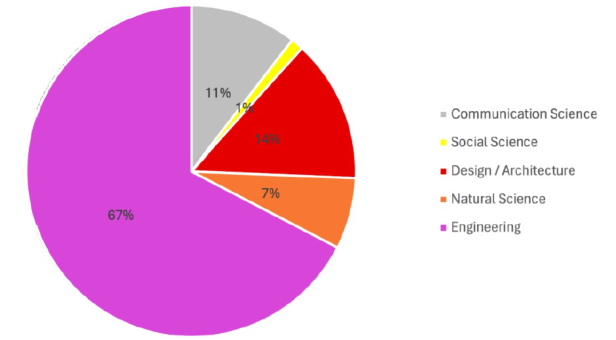
Sample Description A total of 134 students interacted with the chatbots. The individual project groups consisted of an average of 10 students from different disciplines. The following diagram (Figure 1) shows the disciplines represented in the project groups. They were formed in such a way that students from every discipline were represented in each group. The youngest study participant was 19 and the oldest 39 years old. The average age of the study participants was 21.5. 14.3 % of students were female, 43.7 % were male and 1.3 % were other/both/neither/interchangeable.
Figure 1: Disciplinary affiliation of the participants in the University-wide interdisciplinary project week. The project groups were formed in such a way that students from every discipline were represented in each group.
AI-Based Chatbot Coaching for Interdisciplinary Project Teams 255
Results: (AI-Based) Chatbot Coaching for Interdisciplinary Project Teams Is Accepted
Table 1 illustrates the results of of the questionnaire survey on acceptance, with the constructs performance expectancy (PE) and effort expectancy (EE), conducted at the end of the project’s first day. Both constructs indicate moderate to high levels of acceptance. In terms of acceptance, the rule- based chatbot outperforms the AI-based chatbot for both PE and EE, with mean scores of 3.26 and 3.81 respectively, compared to 3.10 and 3.60 for the AI-based chatbot. However, only the differences in EE are statistically significant, with the rule-based chatbot showing significantly higher scores than the AI-based chatbot.
Table 1. Statistical analysis of the questionnaire results at the end of the first project day (acceptance) (N = 134).
Table available in the original PDF paper.
First project day (Monday) Performance Expectancy (PE, 5 items) – Mean (Standard Deviation)
Table 2 illustrates the results of of the questionnaire survey on acceptance, with the constructs performance expectancy (PE) and effort expectancy (EE), conducted at the end of the project’s last day. Here as well, both constructs indicate moderate to high levels of acceptance. Overall, the results of the last project day confirm the results of the first day.
The acceptance values for the rule-based chatbot have slightly decreased, with mean values of 3.01 for PE and 3.74 for EE. However, for the AI- based chatbot, these values have significantly dropped, particularly for PE, indicating significant differences compared to the rule-based chatbot. In terms of acceptance, the rule-based chatbot outperforms the AI-based chatbot for both PE and EE statistically significant, with mean scores of 3.01 and 3.74 respectively, compared to 2.22 and 3.38 for the AI-based chatbot.
Notably, the PE values for the AI-based chatbot plummeted from 3.10 on the first day to 2.22 by the project’s end. Additionally, the data shows that the number of participants in the survey decreased from 134 to 86 from the beginning to the end of the project.
Table 2. Statistical analysis of the questionnaire results at the end of the last project day (acceptance) (N = 86).
Table available in the original PDF paper.
End of last project day (Thursday) Performance Expectancy (PE, 5 items) – Mean (Standard Deviation)
The results enable us to infer levels of acceptance and user needs. They reveal that chatbot coaching is well-received by interdisciplinary project teams and suggest guidelines for designing such chatbots.
Survey outcomes indicate both types of chatbots (rule-based and AI-based) are accepted with moderate to good scores in performance expectancy (PE) and effort expectancy (EE). This aligns with findings that the acceptance of chatbots, particularly for coaching, relies on a coherent concept and clear expectation management (Mai et al., 2022; 2023; Terblanche, 2020; Terblanche and Cilliers, 2020). For our chatbots, we assessed the needs of the target group beforehand, collaboratively developed the chatbot concept with participants (student process facilitators), and refined it through several feedback cycles.
We encountered unexpected aspects in our study. Firstly, contrary to our expectations, the AI-based chatbot did not receive higher acceptance than the rule-based one, despite its capability for more flexible, personalized responses via AI-generated answers. This may be due to its hybrid design, where AI- generated responses were only partially used, which did not significantly affect acceptance. Nonetheless, this underscores the adequacy of the chatbot concept and design for our purposes, effectively supporting students in reflecting on their project work. Our first research question, regarding the chatbot’s effectiveness in supporting project groups and facilitating reflection processes, can be affirmatively answered.
As for our second question about differences in acceptance between the two chatbots, the answer is also partially affirmative. Surprisingly, the AI-based chatbot fared significantly worse in terms of effort expectancy, which measures ease of interaction. At the end of the project week, the AI- based chatbot significantly underperformed also in terms of performance expectancy. Although both chatbots shared the same underlying concept and script, their differing user interfaces might explain this variance. The rule-based chatbot was more accessible, requiring no registration and being directly usable via a URL. In contrast, the AI-based chatbot required registration and login via a platform, complicating access. This may also explain the drop in the number of participants between the first and last day of the project – which fell in particular for the AI-based chatbot (78 vs. 35 participants in the survey, a drop-out rate of more than 50%). These findings echo research suggesting that a chatbot’s ease of use significantly impacts user willingness to engage (Terblanche and Kidd, 2022). Another reason could be that there has been little development and research into hybrid coaching chatbots yet – consisting of a rule-based foundation and interfaces to generative AI – as used in this study. This is therefore a very early prototype which might have affected its acceptance.
LIMITATIONS, FUTURE RESEARCH AND DESIGN IMPLICATIONS This study is subject to several limitations regarding its research design. Our study focused on performance expectancy (PE) and effort expectancy (EE), and as a result, we did not collect other acceptability items. Consequently, no comparisons can be made between this study and other studies that have
AI-Based Chatbot Coaching for Interdisciplinary Project Teams 257
used the full UTAUT construct. To enable comparisons, it would be necessary to use the entire UTAUT construct in the next study.
Another limitation is access to the study: the study participants used the chatbot in an online environment. One group member interacted with the chatbot, while the other group members observed the chat display via Zoom. In other words, the entire group collaborated with the chatbot, but only one person operated it. There may be differences in the acceptance of the chatbot depending on whether someone interacted with it themselves or “just” watched. This should be taken into account in future studies.
For subsequent studies, it is also essential to pay particular attention to the conversations histories with the chatbot. These could be utilised to draw further valuable conclusions about user acceptance. The study also shows limitations with regard to the chatbot design. The chatbot interaction was quite short, which may have had an impact on the acceptance values.
Moreover, the findings offer insights into the technical and conceptual design of coaching chatbots for interdisciplinary teamwork and guide future research directions. Next, we plan to assess a more developed prototype of the AI-based chatbot and explore its impact on acceptance. We will also evaluate other variables like effectiveness with regard to relationship design (e.g. working alliance, social presence). Further, analyzing the conversations histories of the chats will help identify challenges in dialogue and suggest improvements for conversational design. Insights into the content will shed light on the bot’s effectiveness in fostering reflection.
Future research should also investigate how groups utilize such a chatbot: whether it’s typically one person responding on behalf of the group, if its use promotes group dialogue, and how it compares to interaction with a human facilitator in terms of helpfulness and limitations.
CONCLUSION
The results of this study show that coaching chatbots for interdisciplinary teamwork are accepted. They also show that regardless of the technical basis of such a chatbot (rule-based vs. AI-based), conversation design and prompting is an essential part of chatbot development and contributes significantly to acceptance.
This is one of the first studies to show the acceptance of group coaching with a chatbot. This means we will keep refining and researching our chatbot. Beyond its application in student project settings, there are numerous other potential uses, such as aiding and assisting agile project teams in the industrial sector.
ACKNOWLEDGMENT
The teaching project of this study was supported by the Foundation for Innovation in Higher Education as part of the REDiEE project. The aim of REDiEE is to promote the development of hybrid approaches to teaching and learning at Cologne University of Applied Sciences (TH Köln) that combine “future skills” and specialist expertise in order to strengthen the profile of its alumni.
The authors would furthermore like to acknowledge for the support in conceptualizing our chatbots provided by our student assistants and process facilitators, Rebecca Broich and Melisa Cansiz. We also extend our thanks to our colleague Christian Deggelmann for his assistance in analyzing the data.
REFERENCES
Berninger-Schäfer, E. (2018). Online-Coaching. Springer Fachmedien. https://doi.or g/10.1007/978-3-658-10128-2 Brandtzaeg, P. B., & Følstad, A. (2017). Why People Use Chatbots. In I. Kompatsiaris,
J. Cave, A. Satsiou, G. Carle, A. Passani, E. Kontopoulos, S. Diplaris, & D. McMillan (Eds.), Lecture Notes in Computer Science. Internet Science (Vol. 10673, pp. 377–392). Springer International Publishing. https://doi.org/10. 1007/978-3-319-70284-1_30 Davis, F. D., Bagozzi, R. P., & Warshaw, P. R. (1989). User acceptance of computer technology: A comparison of two theoretical models. Management Science, 35(8), 982–1003. https://doi.org/10.1287/mnsc.35.8.982 Grant, A. M. (2012). An integrated model of goal-focused coaching: An evidence-
based framework for teaching and practice. International Coaching Psychology Review, 7(2), 146–165. https://www.academia.edu/18048251/An_integrated_mo del_%20of_goal_focused_coaching Grice, H. P. (1975). Logic and conversation. Academic Press, New York. Kanatouri, S. (2020). The Digital Coach. Routledge. https://doi.org/10.4324/ 9780429022753 Kohne, A., Kleinmanns, P., Rolf, C., & Beck, M. (2020). Conversation Design.
In A. Kohne, P. Kleinmanns, C. Rolf, & M. Beck (Eds.), Chatbots: Aufbau und Anwendungsmöglichkeiten von autonomen Sprachassistenten (pp. 83–97). Springer Vieweg. https://doi.org/10.1007/978-3-658-28849-5_5 Landbot. (2023). Landbot Knowledge Center. https://landbot.io/knowledge-center Lee, Y.-C., Yamashita, N., Huang, Y., & Fu, W. (2020). “I Hear You, I Feel You”: Encouraging Deep Self-disclosure through a Chatbot. In R. Bernhaupt, F. Mueller, D. Verweij, J. Andres, J. McGrenere, A. Cockburn, I. Avellino, A. Goguey, P. Bjørn, S. Zhao, B. P. Samson, & R. Kocielnik (Eds.), Proceedings of the 2020 CHI Conference on Human Factors in Computing Systems (pp. 1–12). ACM. https://doi.org/10.1145/3313831.3376175 Lee, S., & Choi, J. (2017). Enhancing user experience with conversational agent for
movie recommendation: Effects of self-disclosure and reciprocity. International Journal of Human Computer Studies, 103, 95–105. Lippmann, E. (2013). Coaching: Angewandte Psychologie für die Beratungspraxis.
Springer. https://doi.org/10.1007/978-3-642-35921-7 Mai, V., & Rutschmann, R. (2023). Chatbots im Coaching. Potenziale und Einsatzmöglichkeiten von digitalen Coaching-Begleitern und Assistenten. Organisationsberatung, Supervision, Coaching, 30(1), 45–57. https://doi.org/10. 1007/s11613-022-00801-3 Mai, V., Bauer, A., Deggelmann, C., & Richert, A. (2023). Acceptance and User Needs of Coaching Chatbots: An Empirical Analysis of a StudiCoachBot’s Conversation Histories. In P. Zaphiris, A. Ioannou, R. A. Sottilare, J. Schwarz, F. Fui-Hoon Nah, K. Siau, J. Wei, & G. Salvendy (Eds.), Lecture Notes in Computer Science: Vol. 14060, Hci International 2023 – Late Breaking Papers: 25th International Conference on Human-Computer Interaction, HCII 2023, Copenhagen, Denmark, July 23–28, 2023, Proceedings, Part VII (1st ed. 2023, pp. 176–190). https://doi.org/10.1007/978-3-031-48060-7_14
AI-Based Chatbot Coaching for Interdisciplinary Project Teams 259
Mai, V., Neef, C., Richert, A. (2022). “Clicking vs. Writing”: The Impact of a Chatbot’s Interaction Method on the Working Alliance in AI-based Coaching. Coaching: Theorie & Praxis (8). 1–17. https://doi.org/10.1365/s40896-021- 00063-3 Mai V., Wolff A., Richert A., Preusser I. (2021). Accompanying Reflection Processes
by an AI-based StudiCoachBot: A Study on Rapport Building in Human-Machine Coaching Using Self Disclosure. In HCI International 2021 – Late Breaking Papers: Cognition, Inclusion, Learning, and Culture. Lecture Notes in Computer Science. 439–457. https://doi.org/10.1007/978-3-030-90328-2_29 Stucki, T., D’Onofrio, S., & Portmann, E. (2020). Chatbots gestalten mit Praxisbeispielen der Schweizerischen Post: HMD Best Paper Award 2018. Springer eBooks Computer Science and Engineering. Springer Vieweg. https: //doi.org/10.1007/978-3-658-28586-9 Terblanche, N. (2020). A design framework to create Artificial Intelligence Coaches.
Advance online publication. https://doi.org/10.24384/B7GS-3H05 Terblanche, N., & Cillers, D. (2020). Factors that influence users’ adoption of being coached by an Artificial Intelligence Coach. Philosophy of Coaching: An International Journal, 5(1), 61–70. https://doi.org/10.22316/poc/05.1.06 Terblanche, N., & Kidd, M. (2022). Adoption Factors and Moderating Effects
of Age and Gender That Influence the Intention to Use a Non-Directive Reflective Coaching Chatbot. SAGE Open, 12(2). https://doi.org/10.1177/ 21582440221096136 Venkatesh, Morris, & Davis (2003). User Acceptance of Information Technology: Toward a Unified View. MIS Quarterly, 27(3), 425. https://doi.org/10.2307/ 30036540
LISTED IN THE AHFE DIGITAL BOOKSTORE CATALOGUE
Explore the complete digital volume
Human Interaction and Emerging Technologies (IHIET 2024)
Read this individual research paper free through the original publisher, or explore the full digital proceedings book.
ISBN 978-1-964867-33-5
Explore this ISBN in the AHFE Bookstore ↗Listed in the July 2026 bookstore catalogue; search by ISBN to confirm current availability · Digital book purchase optional