Marialaura Delvecchio, Francesco Tesauri, Roberto Montanari, Silvia Chiesa (2024). The Human-Centered Design approach for Operational Workflow Re-design: A Case Study in Safety for Agricultural Automotive Industry. In: Human Factors in Design, Engineering, and Computing. AHFE Open Access, vol. 159, pp. 628–637. https://doi.org/10.54941/ahfe1005629
Traditionally, Safe Design has been applied mainly to product and environmental aspects, including sectors such as control rooms, automotive engineering, and medical equipment. However, its principles have been less frequently considered in critical organizational workflows. This paper addresses this gap by proposing an innovative application of a user-centered methodology to redesign procedures within industrial settings, with a specific focus on enhancing safety protocols in the Safety & Compliance teams of the agricultural automotive sector.Safety procedures are vital throughout the product lifecycle in industrial design, serving as essential safeguards against potential hazards. However, their effectiveness can be hindered by complexity, lack of user-friendliness, and insufficient attention to human factors. This paper seeks to address these issues by integrating a Human-Centered Design (HCD) approach into the safety protocols redesign process, thereby improving usability, effectiveness, and overall user experience.Two key elements for the success of this project are the integration of the HCD approach, which prioritizes end-users' needs, preferences, and capabilities, and the adoption of a redesign perspective rather than traditional procedural design. In conclusion, this article highlights the importance of extending Safe Design principles to include critical organizational workflows, particularly safety protocols. By integrating the HCD approach and focusing on procedural redesign, organizations can enhance the usability and effectiveness of their safety procedures, reinforcing their commitment to safety throughout the product lifecycle while also improving workflow efficiency.
Inadequate design is a significant contributor to many workplace incidents, leading to accidents, downtime, and avoidable risks (Horberry, 2012). These incidents often stem from equipment design deficiencies, impacting maintainability or operability, and are thus theoretically preventable. Therefore, in industries where production involves significant risk factors (e.g., chemical companies, gas and oil, nuclear power plants, automotive etc.),
The Human-Centered Design Approach for Operational Workflow Redesign 629
the concept of Safe Design is of paramount importance. Safe Design is a proactive process aimed at eliminating Occupational Health and Safety (OHS) hazards or minimizing potential risks throughout the lifecycle of a product (Beaumont, 2021).
To address the risks associated with products or operations, the industry develops and implements standardized operational Risk Assessments. These Risk Assessments aim to ensure that product and operations are carried out with adequately managed risks maintained at an acceptable level (Beaumont, 2021). Risk assessment procedures are essential for comprehending and effectively addressing risks. Apart from traditional risk management approaches such as the HAZard and OPerability study (HAZOP), there are numerous specialized tools tailored to reinforce safety in design strategies (Horberry, 2012).
Nevertheless, established industrial risk management procedures may not always be foolproof. Various obstacles can hinder personnel from fully understanding the risks.
For example, the following deficiencies have been identified in the offshore oil and gas sector (such as production platforms):
Inadequate Risk Assessments that might miss critical risk factors (Veland and Aven, 2015).
Insufficient follow-up on the findings from Risk Assessments, leading to the identification of hazardous conditions but lacking proper management due to shortcomings in safety culture or underlying agendas (Veland & Aven, 2015).
It is argued that significant improvements can be made to current Risk Assessment practices in the industry (Veland & Aven, 2015), and this assumption could be generalized to many other work situations.
The current paper explores this matter by proposing the development of a methodology to overhaul risk management procedures, ensuring both product and operational safety. This proposed approach entails the application of Safe Design principles commonly utilized in product and equipment design. The emphasis is placed on the imperative to restructure or redesign entrenched processes within the existing corporate culture.
SAFE DESIGN AND HCD APPROACH The concept of Safe Design has evolved significantly over time, transitioning from a narrow focus on products and equipment to a broader emphasis on the design process itself. Safe Design entails a systematic approach that involves decision-makers and, ideally, end-users in the design process. It prioritizes hazard analysis and Risk Assessment methods to generate design options that not only eliminate hazards but also reduce risks for those involved in the manufacturing, operation, and maintenance of the product (Horberry, 2012).
The key message for generalist OHS professionals is that applying a participatory ergonomics approach to safe design processes can help create more user-centered equipment, systems, and processes for end-users
(Horberry, 2012). A Human-Centered Design (HCD) approach to safe design requires an understanding of the attitudes, abilities, limitations, motivations, and expectations of users relevant to all components of the work system across its entire lifecycle (Fadier and De la Garza, 2006).
To develop a methodology for redesigning Risk Assessment procedures, inspiration was drawn from Safety in Design Ergonomics (SiDE), a tool based on operability and maintainability analysis and the general safe design process (Horberry, 2012). The SiDE process typically involves seven stages, with the first four conducted in joint workshops between designers and end-users: Context and scope definition (Stage 0); Identification of critical tasks (Stage 1); Task decomposition (Stage 2); Risk identification (Stage 3); Development of human-centered solutions (Stage 4); Iterative evaluation of solutions (Stage 5); Management and documentation (Stage 6). The SiDE tool was developed with the philosophy that understanding real usage conditions is crucial for safe redesign, especially in industries like mining, where designers often cannot visit sites (Horberry et al., 2010).
Although SiDE is adaptable to other contexts, such as highway design (Horberry and Burgess-Limerick, 2015), its influence on the redesign of Risk Assessment procedures - distinct from physical product and equipment design - remains unexplored.
HUMAN CENTERED REDESIGN METHODOLOGY FOR RISK ASSESSMENT PROCEDURES The Accreditation Board for Engineering and Technology (ABET) defines engineering design in its curriculum guidelines as the process of creating a system, component, or process to meet specified requirements. This process involves making decisions, often iteratively, and uses basic sciences, mathematics, and engineering sciences to efficiently convert resources to achieve the set objectives (Haik et al., 2011).
Building on these considerations, two further fundamental elements are critical for successfully embedding a methodology to redesign user-centered Risk Assessment procedures: integrating the Human-Centered Design (HCD) approach and adopting a redesign perspective rather than a traditional procedural design.
The integration of the HCD approach prioritizes the needs, preferences, and capabilities of end-users throughout the design process, leveraging insights from user-centered methodologies.
The adoption of a redesign perspective can instead be considered a developmental design where the designer starts from an existing design, but the outcome may differ markedly from the initial one (Haik et al., 2011).
Peculiar of this project is that these principles can be applied not only to physical products but to Standard Operating Procedures (SOPs). SOPs are detailed, written instructions that describe a step-by-step process necessary to properly and safely perform an activity (National Academies of Sciences engineering medicine, 2016).
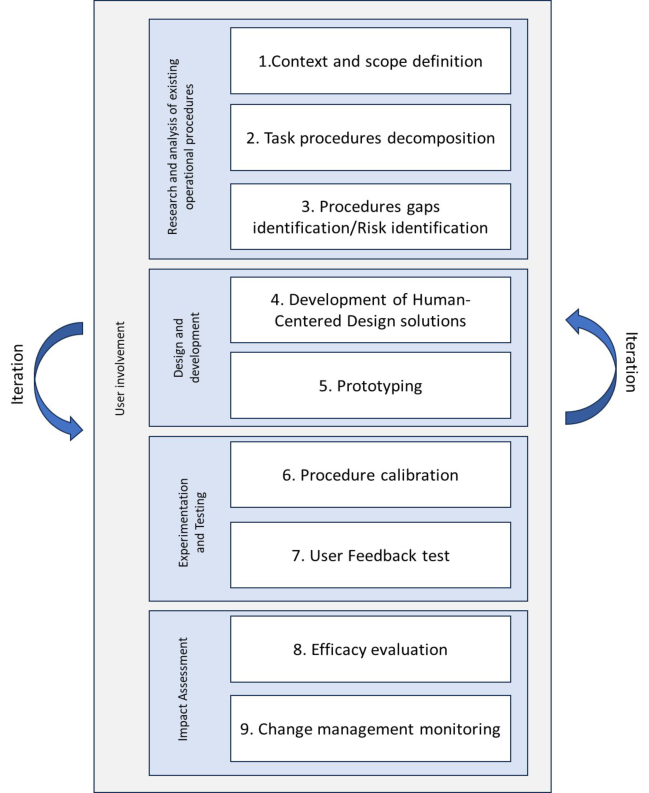
Following these considerations, the methodology for a user-centered redesign of Risk Assessment procedures is based on iterative processes and involves the use of appropriate User Centered Design tools.
The Human-Centered Design Approach for Operational Workflow Redesign 631
The key components of this iterative process are outlined in the table below (see Table 1).
Table 1. Risk assessment procedures redesign process pillars.
Table available in the original PDF paper.
Description and Objective Example of Tools and Activities Process Pillar Component Research and analysis of the existing operational procedure.
An analysis is conducted on the current procedures with the purpose of identifying critical points and potential safety risks.
Questionnaire; Interviews; Non-participant observation; Literature Research; Focus Group; Content Analysis; Task Analysis; Cognitive Walkthrough. Design and development
Literature Research; Requirements creation; Workshop and Co-Design sessions; Focus Group.
New operational procedures are developed with a particular emphasis on utilizing participatory design methodologies.
Experimentation and testing
Practical evaluation is conducted to assess the usability and effectiveness of the new operational procedures compared to the existing ones.
Usability test; Interviews; Questionnaire; Focus Group and Dry run; Cognitive Walkthrough; Technical tool calibration; Role plays. Impact assessment Evaluations are conducted to analyze the effects of new operational procedures.
All the above methodologies.
Survey; interview; longitudinal study; Trainings. User involvement Users are involved from the beginning of the design process, utilizing different methods across phases.
The process pillars represent the critical frame of each step in the process, which are identified as follows (see Figure 1):
1. Context and scope definition: This stage involves understanding the context in which the Risk Assessment procedures operate and defining the scope of the assessment. This includes identifying stakeholders, understanding the operational environment, and setting clear objectives for the redesign process. 2. Task procedures decomposition: Breaking down the existing Risk Assessment procedures into individual tasks to understand each step in detail. This analysis helps to identify the specific functions and sub- processes that constitute the overall procedure. 3. Risk Assessment procedures gaps identification/Risk identification: Identifying gaps, inefficiencies, or risks within the current procedures. This involves a thorough analysis to pinpoint where and why the existing Risk Assessment procedures fail to meet desired standards or pose potential risks. 4. Development of Human-Centered Design Solutions: Creating solutions that prioritize the needs, preferences, and capabilities of the end-users. This involves brainstorming, research, and conceptualization of design solutions based on user needs. 5. Prototyping: Developing a preliminary version of the new Risk Assessment procedures or solutions, allowing for an initial evaluation and testing of the design concepts. 6. Technical Testing: Conducting technical tests on the new procedure to evaluate its effectiveness in achieving the required objectives. This
involves testing the procedure from a technical standpoint to ensure it functions as intended and meets technical specifications. 7. User Feedback test: Conducting tests with actual users to evaluate the functionality and usability of the new procedures. Gathering feedback with the goal to make necessary adjustments and iterating the process to refine the solutions. 8. Efficacy evaluation: Evaluating the changes resulting from the introduction of the new Risk Assessment procedures over an extended period. This includes assessing user satisfaction and measuring how the quality of work and products has changed or improved as a result of the new procedures. 9. Change Management Monitoring: Monitoring the introduction of the procedure within the company’s structure to track the acceptance of change through training activities and ongoing assessment of implementation.
The Human-Centered Design Approach for Operational Workflow Redesign 633
USE CASE RESULTS: HUMAN CENTERED REDESIGN METHODOLOGY FOR RISK ASSESSMENT PROCEDURES IN AGRICULTURAL AUTOMOTIVE SECTOR The methodology outlined above was applied to a specific use case within an agricultural automotive products company. The project focused on improving the Risk Assessment procedure used by the Safety and Compliance team. A non-participatory observation methodology was employed during the research and analysis of the existing procedure, which was broken down into task procedures across three phases: Pre-Risk Assessment, During Risk Assessment, and Post-Risk Assessment. Several key deficiencies were identified and analyzed within each phase as follows (see Table 2).
Table 2. Research and analysis phase: Identification of procedure issues across phase.
Table available in the original PDF paper.
Pre-Risk Assessment During Risk Assessment Post Risk Assessment
1. There was limited background information, making it difficult for facilitators and participants to have a common understanding.
6. The final decision was centered on threshold scores instead of accurate risk evaluation. 7. There was a lack of recommendations for low scores; inadequate guidance was given when scores were below the acceptance criterion.
2. It was identified that during meetings, a group thinking bias was present, leading to the dominance of a leader’s viewpoint and hindering diverse opinions. 3. The procedure was based on a rating scale which proved to be too broad and confusing. 4. The discussions in meetings were score-driven; issues with scores below a certain Critical Risk Index (CRI) were often ignored. 5. Low frequency often led to the underestimation of severe issues.
Workshops were conducted during the design and development phase, resulting in the emergence of new redesign proposals aimed at addressing the identified deficiencies (see Table 3).
Table 3. Design and development phase: Redesign proposals across phases.
Table available in the original PDF paper.
Pre-Risk Assessment During Risk Assessment Post Risk Assessment
1. An introductory document was created to gather all the background information.
6. To avoid threshold score discussions, a methodology based on color codes and descriptions instead of score numbers was introduced. 7. All outcomes led to recommendations.
2. Instant online survey was introduced to overcome the group thinking bias. 3. The rating scale was simplified. 4. The revised score table was not disclosed during discussions to avoid score-driven discussions. 5. Frequency was removed, focusing on exposure, severity, and avoidance.
A new set of procedures was prototyped, considering the redesign proposals of the new process.
The new Risk Assessment procedure was calibrated and validated from both a technical and user feedback perspective. The main steps of the experimentation and testing phase were:
Rescaling Calibration: Replayed 22 past Risk Assessment procedures with the new method to ensure consistency.
Internal Dry Runs: Conducted 8 dry runs with fictitious cases to calibrate internally.
External Dry Runs: Conducted 8 dry runs with stakeholders to further calibrate.
Collected User Feedback: Gathered user feedback during focus groups and user tests to refine the tool and process.
During the final phase of impact assessment, several training sessions were held to ensure the correct introduction of the new procedures into the organizational culture.
A longitudinal assessment is being conducted to ensure that the tool tuning process continues until full integration is achieved. After five months from the initial tool release, a preliminary assessment of the actual impact of the procedure is conducted through a structured questionnaire to evaluate the changes resulting from the introduction of new Risk Assessment procedures. This 6-point Likert-based questionnaire is divided into two main sections with the purpose of comparing the old procedure to the new one. The questionnaire was distributed to two main groups, each holding a different role in the procedure’s accomplishment: 4 Coordinators and 5 Participants of the Risk Assessment.
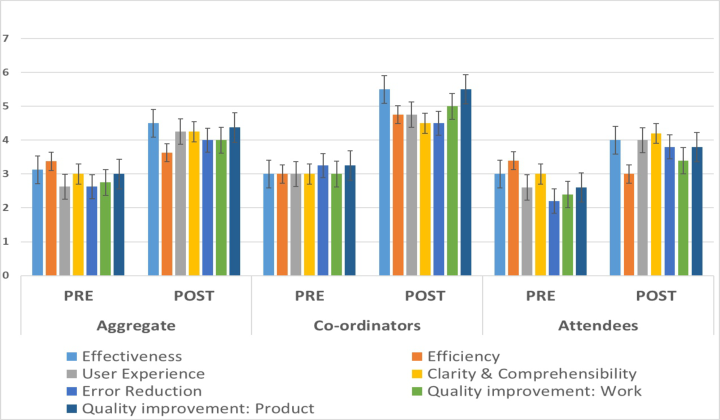
The first analysis focused on comparing the sample experience with old (207 performed) and new (27 performed) procedures across seven key variables: Effectiveness (1), Efficiency (2), User Experience (3), Clarity & Comprehensibility (4), Error Reduction (5), Quality Improvement in Work (6), and Quality Improvement in Product (7).
The t-test results for the aggregated data indicated significant improvements in several areas with the introduction of the new procedures, particularly in Effectiveness (t = −3.162, p <.05), User Experience (t = −3.775, p <.05), Clarity & Comprehensibility (t = −3.578, p <.05), Error Reduction (t = −4.274, p <.05), Quality Improvement in Work (t = −3.833, p <.05), and Quality Improvement in Product (t = −3.536, p <.05). Efficiency did not show a significant improvement (t = −0.830; p > .05) (see Figure 2).
The analysis comparing the group of Attendees and the group of Coordinators for both old and new procedures revealed key differences in their experiences. For the old procedure, the t-test results indicated no significant differences between the two groups across all seven key variables, suggesting similar levels of satisfaction (Effectiveness: t = 0.0, p > .05; Efficiency: t = 0.59, p > .05; User Experience: t = −0.88, p > .05; Clarity & Comprehensibility: t = 0.0, p > .05; Error Reduction: t = −1.76, p > .05; Quality Improvement in Work: t = −1.32, p > .05; Quality Improvement in Product: t = −1.05, p > .05). However, with the introduction of the new
The Human-Centered Design Approach for Operational Workflow Redesign 635
procedure, significant differences were observed in several areas, particularly in Effectiveness (t = −2.65, p <.05), Efficiency (t = −3.17, p <.05), Quality Improvement in Work (t = −3.53, p <.05), and Quality Improvement in Product (t = −2.40, p <.05), indicating that the group of Coordinators rated these aspects more favorably than the group of Attendees.
Figure 2: Mean ratings – pre - and post - redesign procedure enhancement.
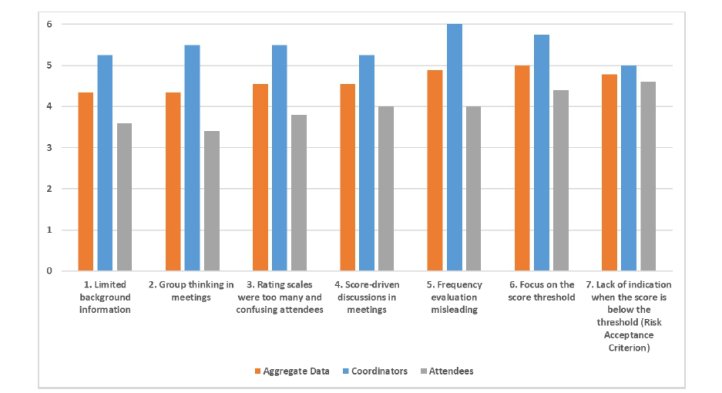
The second analysis focused on evaluating seven specific aspects of the new procedure on a scale from 1 to 6, where 1 represents “not resolved at all”and 6 indicates “completely resolved”. The aggregated results showed moderate to high mean scores across these variables, indicating general approval of the new procedures. Particularly noteworthy were the variables “Frequency evaluation misleading” and “Focus on the score threshold”, which received the highest ratings, suggesting these aspects were well-received.
Comparing the results between groups, Coordinators group consistently rated the new procedure more favourably and showed lower variability in their responses. For example, Coordinators group’s mean ratings for most variables were above 5, indicating strong consensus and satisfaction. In contrast, Participants Group had lower mean scores and higher variability, suggesting mixed perceptions and potentially less uniform adaptation to the new procedures (see Figure 3).
Figure 3: Mean ratings - focus on new procedure.
CONCLUSION
The preliminary assessment indicates that the new Risk Assessment procedures have resulted in significant improvements across several key areas, including effectiveness, user experience, clarity, error reduction, and overall quality. Variations between the Coordinators Group and Participant Group highlight differences in how various subgroups perceive and adapt to the procedures. The Coordinators Group demonstrated substantial and consistent improvements, whereas the Participant Group showed less pronounced changes and greater variability in responses. These findings underscore the need for further qualitative investigations and targeted adjustments to ensure uniform benefits across all user groups. Integrating qualitative insights with quantitative results will provide a comprehensive understanding of the impact and opportunities for enhancement in the new procedures, which is crucial for longitudinal studies.
The methodology, validated through a use case in the agricultural automotive sector, exemplifies a systematic approach to redesigning Risk Assessment procedures. By identifying and addressing procedural deficiencies through iterative testing and user feedback, the study ensures that the new procedures meet technical specifications and enhance user satisfaction and safety outcomes. This comprehensive approach highlights ongoing efforts to refine Risk Assessment practices, essential for fostering safer workplaces and operational environments.
REFERENCES
Beaumont, D., 2021. Global Concept: Health Core Body of Knowledge for the Generalist OHS Professional Copyright notice and licence terms.
The Human-Centered Design Approach for Operational Workflow Redesign 637
Fadier, E., De la Garza, C., 2006. Safety design: Towards a new philosophy. Saf. Sci., Safety and Design 44, 55–73. Haik, Y., Shahin, T. M., Sivaloganathan, S., 2011. Engineering design process.
Cengage Learning Stamford. Horberry, T., 2012. Better integration of human factors considerations within safety in design. Theor. Issues Ergon. Sci. 15, 293–304. Horberry, T., Burgess-Limerick, R., 2015. Applying a human-centred process to re-
design equipment and work environments. Safety 1, 7–15. Horberry, T., Burgess-Limerick, R., Steiner, L. J., 2010. Human Factors for the Design, Operation, and Maintenance of Mining Equipment. CRC Press, Boca Raton. Sciences, N. A. of, Earth, D. on, Studies, L., Sciences, B. on C., Expansion, C. on
C. M. T., Procedures, S. O., 2016. Chemical Laboratory Safety and Security: A Guide to Developing Standard Operating Procedures. Veland, H., Aven, T., 2015. Improving the risk assessments of critical operations to better reflect uncertainties and the unforeseen. Saf. Sci. 79, 206–212.
LISTED IN THE AHFE DIGITAL BOOKSTORE CATALOGUE
Explore the complete digital volume
Human Factors in Design, Engineering, and Computing
Read this individual research paper free through the original publisher, or explore the full digital proceedings book.
ISBN 978-1-964867-35-9
Explore this ISBN in the AHFE Bookstore ↗Listed in the July 2026 bookstore catalogue; search by ISBN to confirm current availability · Digital book purchase optional