Maryna Zharikova, Stefan Pickl (2025). Modeling the emergence of collaborationism. In: Intelligent Human Systems Integration (IHSI 2025): Integrating People and Intelligent Systems. AHFE Open Access, vol. 160, pp. 759–764. https://doi.org/10.54941/ahfe1005882
This paper explores the complex phenomenon of collaborationism, particularly in the context of Russian aggression against Ukraine. It examines the socio-political, economic, and ideological factors that contribute to an individual's propensity to collaborate with occupying forces. By leveraging extensive data collected in Ukraine, the study proposes a novel approach using neural networks to model the emergence of collaborationism. This approach aims to identify potential collaborators by analyzing indicators such as material well-being, ideological beliefs, and moral qualities. The research highlights the importance of understanding the interplay between pre-existing conditions and trigger events, offering predictive models that can be applied across Europe to enhance national and international security frameworks. The findings underscore the need for comprehensive strategies to address both the symptoms and root causes of collaborationism, thereby strengthening resilience against internal and external threats.
Collaborationism, defined as a political or social stance that supports cooperation with an occupying power or foreign government (Hoffmann, 1968; Armstrong, 1968; Pysmenskyi, 2020), has been observed throughout history in various countries. Today, the concept of collaborationism finds its most vivid expression in the context of Russian aggression against Ukraine (Pysmenskyi, 2020). The temporary occupation of parts of Ukraine by the Russian Federation has led to the emergence and spread of various forms and directions of cooperation among the inhabitants of these territories with the occupiers. This type of illegal behavior, recognized as collaborationism in both international and national legislation, occurs in all military conflicts involving the seizure of territories.
V.O. Hapelyuk identifies several circumstances that have contributed to the spread of collaborationist behavior in the temporarily occupied territories of Ukraine, including (Lychova, 2023):
External factors: Long-term planned preparation for occupation actions.
Internal factors: Peculiarities of Ukraine’s social and political development.
Historical and ideological factors: Relics of post-Soviet society and attachment to Soviet narratives.
With the onset of full-scale armed and informational aggression by the Russian Federation against Ukraine, many collaborators have been exposed. However, numerous covert collaborators continue to operate secretly in the interests of the aggressor country. These individuals often hold leadership positions, wield influence over subordinates, make critical decisions, and have access to classified information. They can deliberately distort ideas and propagate false information for propaganda purposes. Covert collaborators pose a threat not only to their local institutions but also to the entire country, undermining its security and sovereignty.
Currently, there is an urgent need to study the cause-and-effect relationships involved in the formation of collaborationism to identify potential collaborators. This will ensure the fair punishment of those guilty of aiding the enemy during and after the war, and will contribute to the country’s security (Dolhoruchenko, 2022). The issue of collaborationism is relevant not only in Ukraine but also in other European countries, causing significant damage to sovereignty, territorial integrity, defense capability, and the economic or informational security of these nations. Collaborationism is a crime against the peace, security, and well-being of humanity, falling under the jurisdiction of international law and the national legislation of countries that uphold human rights and democracy.
Ukraine has collected a substantial database of information about collaborators, including details about their biographies, career stages, and other relevant factors before they became collaborators. Analyzing this information will be instrumental in studying the conditions that lead to collaborationism. The paper aims to investigate the factors influencing a person’s propensity for collaborationism and to build patterns that reflect causal relationships within a collaborator database. These patterns, derived from data in Ukraine, can be applied to other European countries, aiding in the identification of potential collaborators and enhancing security both nationally and on a pan-European scale.
The goal of this paper is to develop an approach to modeling the emergence of collaborationism by analyzing the factors and dynamics that contribute to its development. By leveraging the extensive data collected in Ukraine, the paper seeks to build predictive models that can be applied across Europe to identify and mitigate collaborationist behavior, thereby strengthening national and international security frameworks.
STATE-OF-THE-ART Collaborationism as a scientific concept has been primarily explored by historians and political scientists (Kalishchuk, 2023; Hetmanchuk, 2022). However, since the onset of Russia’s large-scale aggression on February 24, 2022, the issue of responsibility for collaborationism has also attracted the interest of criminal lawyers (Kalishchuk, 2023; Lychova, 2023).
In the realm of information sciences, there is a notable gap in studies that thoroughly investigate the cause-and-effect relationships in the formation
Modeling the Emergence of Collaborationism 761
of collaborationism, which could aid in identifying potential collaborators. Existing models, such as those developed during World War II, continue to be used. For instance, the collaboration model proposed by Gächter and Vidal-Anarisio examines collaborationism based on the comparison of personal material benefits versus those offered by the aggressor country (Kalishchuk, 2023). However, it is evident that beyond material needs, the formation of collaborationism is also influenced by individuals’ moral values, ideological beliefs, and patriotic qualities.
Recent studies have begun to consider the impact of motivations and personality traits on an individual’s propensity for collaborationism (Shymko et al., 2023; Shymko et al., 2024; Shaikan et al., 2021). Despite these efforts, the nature of the emergence of collaborationism remains insufficiently studied. An analysis of contemporary research in the field of information sciences suggests that existing attempts are often superficial or focus only on certain general conditions influencing the emergence of collaborationism.
Currently, no research comprehensively examines all these conditions collectively. Despite the prolonged occupation of parts of Ukraine and the widespread occurrence of collaborationism, the scientific community has yet to thoroughly analyze the mechanisms underlying the emergence of collaborationism. Thus, a comprehensive study of the conditions influencing collaborationism represents a new scientific direction, offering significant potential for advancing our understanding of this complex phenomenon.
HYPOTHESIS The emergence of collaborationism is not a sudden phenomenon but the result of a complex interplay of conditions and trigger events throughout an individual’s life. To become a collaborator, a person requires certain pre-existing conditions and a specific trigger event.
A set of conditions form the foundational basis for a person’s propensity towards collaborationism. Conditions for each person have their indicators. Three primary types of conditions have been identified so far:
Material Well-being: Indicators can include salary level, access to basic necessities like food, clothing, housing, electricity, and transportation.
Ideological and Patriotic Qualities: These can be inferred from a person’s biography, such as holding influential positions in the former USSR, having relatives in the aggressor country, and engaging with specific content on social media.
Moral Qualities: These include behaviors such as career advancement through connections or bribery, and abuse of official positions.
It is hypothesized that intellectual abilities may also play a role, as there is a noted link between intellectual level and corruption (Asongu, 2015).
A trigger event typically involves material or financial incentives offered by occupiers, such as money, jobs, or housing. Each person has a unique “trigger event threshold,” which represents the minimum reward required for them to become a collaborator. This threshold, expressed in monetary terms, is influenced by the aforementioned conditions.
762 Zharikova and Pickl
If the reward of a trigger event exceeds a person’s threshold, they may become a collaborator. The same trigger event may affect individuals differently based on their thresholds.
The interplay between different conditions is crucial. For example, low income might increase susceptibility to corruption, thereby influencing collaborationism. The presence of multiple conditions simultaneously can significantly affect a person’s response to a trigger event.
Ukraine has amassed extensive data on collaborators, including biographical details and career trajectories. A national register of state traitors and regional databases exist (https://www.chesno.org/traitors/). This data will be used to identify indicators reflecting the conditions that foster collaborationism.
This research proposes developing a neural network to learn the dependencies between these indicators and a person’s propensity for collaborationism, as expressed by the trigger event threshold. The neural network will classify individuals into categories based on their threshold levels.
Based on the trained neural network, templates will be developed to model the relationship between conditions and collaborationism propensity. These templates will help simulate scenarios and identify potential collaborators not only in Ukraine but across Europe.
The hypothesis is that potential collaborators can be identified using templates derived from statistical analyses of Ukrainian collaborators, focusing on the impact of material well-being and personal qualities on collaborationism propensity.
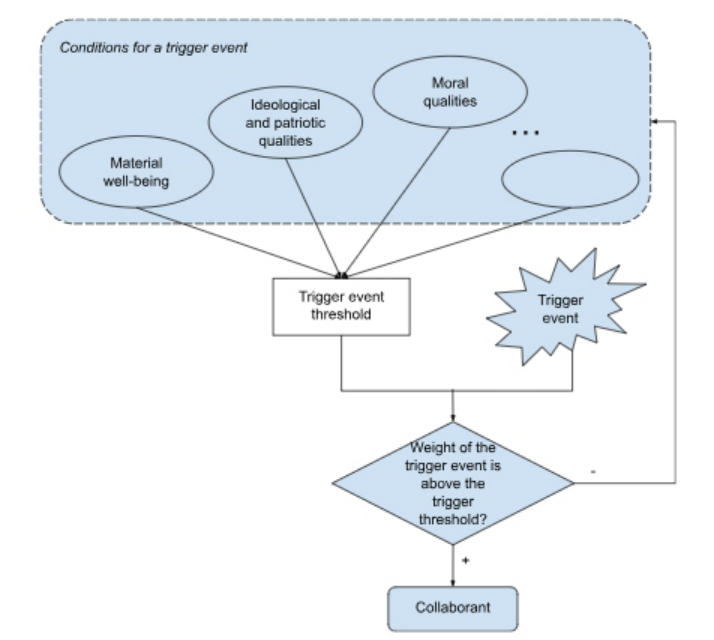
RESEARCH METHODOLOGY The methodology proposed in this paper is based on the collaborator formation scheme (Fig. 1).
Conditions are needed to form collaborators. At present, three groups of conditions have been identified such as material well-being, ideological and patriotic qualities, as well as moral qualities. Each group of conditions is characterised by certain indicators.
To switch to collaboration, a trigger event is needed from the occupier, which is often a monetary or material reward. The trigger event has a weight expressed in monetary units.
Each person has a trigger event threshold, also expressed in monetary units. The trigger event will work if its weight is higher than the trigger threshold.
The goal of the paper is to determine the dependency of trigger event threshold on conditions.
The system will collect a dataset of statistical information about collaborators containing indicators for the tendency to collaborationism.
A neural network will be developed to self-learn the dependencies between indicators and tendency of person to collaborationism (expressed by the trigger event threshold). The neural network will be trained on the collected data to classify people into classes with different trigger event thresholds.
Modeling the Emergence of Collaborationism 763
Figure 1: Scheme for forming a collaborator.
Based on the trained neural network the templates of the dependence of a person’s tendency to collaborationism on the set of conditions will be developed.
Scenarios of forming the collaborators will be built based on the templates. Using templates to play out collaborator formation scenarios will help identify potential collaborators.
CONCLUSION
The study of collaborationism, particularly in the context of the Russian aggression against Ukraine, reveals a complex interplay of socio-political, economic, and ideological factors that contribute to an individual’s propensity to collaborate with occupying forces. By analyzing historical data and contemporary examples, this paper underscores the importance of understanding the underlying conditions and trigger events that lead to collaborationism. The proposed approach of using neural networks to model these dynamics offers a promising avenue for identifying potential collaborators by examining indicators such as material well-being, ideological beliefs, and moral qualities.
The findings suggest that collaborationism is not merely a product of immediate incentives but is deeply rooted in pre-existing conditions that vary
764 Zharikova and Pickl
from individual to individual. The development of predictive models based on Ukrainian data provides a framework that can be adapted to other contexts, enhancing the ability of nations to safeguard their sovereignty and security. By identifying and mitigating collaborationist behavior, these models contribute to a broader understanding of collaborationism as a phenomenon, offering valuable insights for policymakers and researchers alike.
This research highlights the need for comprehensive strategies that address both the symptoms and root causes of collaborationism, ensuring that nations are better equipped to handle the challenges posed by internal and external threats. The continued study and application of these models will be crucial in fostering resilience against collaborationism and strengthening national and international security frameworks.
REFERENCES
Armstrong, J. A. (1968). Collaborationism in World War II: The Integral Nationalist Variant in Eastern Europe. The Journal of Modern History, 40(3), 396–410. http: //www.jstor.org/stable/1878147 Asongu, Simplice & Nwachukwu, Jacinta. (2015). The Incremental Effect of Education on Corruption: Evidence of Synergy from Lifelong Learning. Economics Bulletin. 35. 2288–2308. 10.2139/ssrn.2661448. Dolhoruchenko, K. O. (2022). Collaborationism as a Phenomenon of War and a
Scientific Concept within Historical and Legal Studies. Scientific Bulletin of the International Humanitarian University, 2022, No. 56, pp. 16–18. https://doi.org/ 10.32841/2307-1745.2022.56.4. Hetmanchuk, M. (2022). Modern Approaches to Highlighting the Nature, Causes, and Manifestations of Soviet Collaborationism During World War II (1939– 1945). Litopys Volyni, Issue 27, pp. 142–148. Hoffmann, S. (1968). Collaborationism in France during World War II. The Journal
of Modern History, 40(3), 375–395. http://www.jstor.org/stable/1878146 Kalishchuk, O. (2023). The Phenomenon of Collaborationism in the Legal System of Ukraine: Historical Retrospective and Modern Challenges. Litopys Volyni, Issue 28, pp. 108–113. https://doi.org/10.32782/2305-9389/2023.28.14 Lykhova, S., & Komanetska, V. (2023). Collaborationism in Modern Ukraine as a
Criminal-Legal Problem. Scientific Works of National Aviation University. Series: Law Journal “Air and Space Law”, 2(67), 210–215. https://doi.org/10.18372/ 2307-9061.67.17863 (in Ukrainian). Pysmenskyi, Yevhen (2020). Collaborationism in Modern Ukraine as a Criminal- Legal Problem. Law of Ukraine, ISSN: 1026-9932, Issue: 2020/12. doi: 10.33498/louu-2020-12-116; http://dx.doi.org/10.33498/louu-2020-12-116. Shaikan, A., & Shaikan, V. (2021) Legal Assessment and Speculation on the Topic
of Collaborationism in Ukraine. Digital Dimension, SHS Web Conf., 100 (2021) 03001. doi: https://doi.org/10.1051/shsconf/202110003001. Shymko, V. & Babadzhanova, A. (2023) Probation of collaborationists in Ukraine: exploratory research of personality trait contribution in social reintegration endeavor (January 4, 2023). Available at SSRN: https://ssrn.com/abstract= 4438185 or http://dx.doi.org/10.2139/ssrn.4438185. Shymko, V., & Babadzhanova, A. (2024). Exploring the Motivations and Personality
Traits of Pro-Russian Collaborationists in Ukraine. International Journal of Offeander Therapy and Comparative Criminology, 0(0). https://doi.org/10.1177/ 0306624X241240707 Ukrainian database of state traitors https://www.chesno.org/traitors/.
LISTED IN THE AHFE DIGITAL BOOKSTORE CATALOGUE
Explore the complete digital volume
Intelligent Human Systems Integration (IHSI 2025): Integrating People and Intelligent Systems
Read this individual research paper free through the original publisher, or explore the full digital proceedings book.
ISBN 978-1-964867-36-6
Explore this ISBN in the AHFE Bookstore ↗Listed in the July 2026 bookstore catalogue; search by ISBN to confirm current availability · Digital book purchase optional