Cayo Gamber (2025). Human Interactions with Holocaust Survivor AIs: Current and Future Applications of Visitors’ Interactions with Holocaust Survivor “Holograms”. In: Human Interaction and Emerging Technologies (IHIET-AI 2025): Artificial Intelligence and Future Applications. AHFE Open Access, vol. 161, pp. 162–172. https://doi.org/10.54941/ahfe1005907
Currently in use at over a dozen museums worldwide, pre-recorded interviews with individual Holocaust survivors incorporate specialized display technology and natural language processing to generate interactive conversations between survivors and visitors. These non-generative AI recordings, created by the USC Shoah Foundation Dimensions in Testimony (DiT) project, are prepared to answer well over 1000 possible questions visitors might ask of them. These current-day interactions with DiT recordings of Holocaust survivors are indebted to a cadre of historians who recognized it was vital to gather the testimony of those who were persecuted. As this paper will demonstrate, for the past eight decades historians, archivists, and technology specialists have worked persistently and creatively to collect, to preserve, and to provide access to the eyewitness testimonies of those who survived the Shoah.
INTRODUCTION: THE PURPOSEFUL ACT AND ART OF COLLECTING THE ORAL HISTORIES Today survivor testimony holds a central place in Holocaust research and education. That was not always the case. Historians did not initially embrace what Tony Kushner called “history from below,” history derived from evidence offered by ordinary people, by those who experienced the Shoah first-hand but who often were not formally educated or members of the social elite (Kushner, 2009). In addition, as Timothy Snyder, the Fortunoff Archive’s faculty advisor and the Richard C. Levin Professor of History in Yale’s Faculty of Arts and Sciences argues, while we now “take for granted that the survivor should have a voice…. For decades a common opinion was that all historians needed was the German official sources. This could only change because people worked together to give survivors a voice. There was nothing easy about that. It took vision and it took labor” (qtd. in Cummings, 2024). An essential component of the labor involved is locating a willing and magnanimous listener/interviewer. Oral history testimonies, Dori Laub
Human Interactions With Holocaust Survivor AIs: Current and Future Applications 163
observes, “are not monologues; they cannot take place in solitude. The witnesses are talking to somebody: to somebody they have been waiting for a long time” (Laub, 1992). Those who collect the oral histories do so because they believe survivors not only have a unique story, but also have a story that should be made part of the historical record. Individuals who give their oral histories often discover they sincerely longed for the opportunity: “[f]or many of us,” Primo Levi notes, “being interviewed was a unique and memorable occasion, an event we had been waiting for since the day of the liberation and that even gave our liberation a meaning” (Levi, 1995).
“Holocaust survivors who choose to testify reaffirm their individuality, which the Nazis wanted to take away from them, by striving to give a true account of their own individual history, an account that we now call testimony” (Muller, 2014). In offering their testimonies “the person of the witness” was made manifest (Hartman, 2006). “The ‘six million’ were now” as Hartman argues, “exemplified by the speech and demeanor of each survivor. One by one the survivors emerged, a saved and perhaps saving remnant” (Hartman, 2006). In telling their stories, survivors become vital carriers of memory as they “may be the last repository of an entire procession of the dead whose memory” each of them strives, and often struggles, to communicate (Wieviorka, 2006). In speaking both for themselves and for the six million who perished, as Geoffrey Hartman observes, the testimonies of Holocaust survivors “transmit vital autobiographical as well as intensely burdened narratives” (Hartman, 2006).
What made the transmission of such “burdened” stories possible was the purposeful exchange between the interviewer and the interviewee. “The very presence,” Hartman explains, “of interlocutors who no longer represent a world that was ignorant or indifferent during the genocide motivates a sense of civic responsibility as interviewer and interviewee form a testimonial alliance aimed at making Holocaust awareness and education a reality” (Hartman, 2006). The testimonial alliance, thus, is forged in the process of the mutual labor involved in eliciting the survivor’s story in all of its fullness and authenticity.
The Importance of Collecting, Preserving, and Creating Access to Oral Testimony
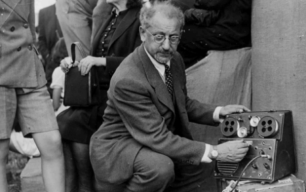
Figure 1: David Boder and his Model-50 Wire Recorder, 1946, Paul V. Galvin Library, Illinois Institute of Technology.
164 Gamber
In 1946, armed with a Model-50 Wire Recorder, 200 spools of carbon- steel wire, and an assortment of converters and transformers, David Boder, a Latvian-American professor of Psychology at the Illinois Institute of Technology, traveled to Europe to seek out displaced persons1 in order to provide individuals the opportunity to tell their own stories of their personal experience of the Shoah. I cite this example of Boder because the fate of his work is illustrative. Boder published, verbatim, eight of his recorded interviews in I Did Not Inteview the Dead (1949). After its publication, the book did not receive a great deal of attention nor were the remaining interviews Boder had conducted immediately sought after. In fact, the whereabouts of the original wire spools recorded in Europe are currently unknown. Fortunately, Boder had created copies of the wire spools. Those copies of the original spools first were deposited with the National Institute of Mental Health and then were held by the Library of Congress. In order to address current technology, the Library of Congress transferred the spools to tape; however, the set they maintained currently is incomplete as eleven spools are believed to be missing. In 1998, 109 of those taped interviews subsequently were archived at the United States Holocaust Memorial Museum (USHMM). In 2007, a set of the Boder recordings long presumed lost were found by chance. The recordings “sat unknown for decades in a basement of the [the Illinois Institute of Technology] archives” until their accidental rediscovery (Levitt, 2017).
This account reveals how complex it has been to make individual testimonies available, how precarious it is to archive these stories, and how difficult it may be to provide access to individual narratives. At this time, many of the early recorded interviews conducted by a range of interviewers in a wide variety of locations might be lost. In addition, the recorded interviews that are available very well may need to be re-recorded in order to meet changes in technology. Or, it may be the case, that the recorded histories may have been forgotten altogether. Thus, it is highly likely that a researcher will not learn about a wide number of stories that once were recorded and/or will find it difficult to locate and/or access individual recordings cited in research sources. In the case of Boder, however, the researcher will discover the truly rare good fortune that the collection currently also is available online: digitized, indexed, and delivered by Voices of the Holocaust at the Illinois Institute of Technology (http://voices.iit.edu/).
Boder’s collection of testimonies raises important questions about the fragility and future of survivor testimony. Those questions include asking: What work is being done, now, in order to respond to the many ways archival practices have evolved? How are the individual stories inventoried and indexed (e.g., how have metadata schemas and the multiplicity of digital formats been engaged)? In what ways are the repositories making the histories available currently and what plans do they have to continue to make
1In 1945, those who had survived were referred to by their refugee status, as displaced persons who were housed in Displaced Persons camps until they could be repatriated and/or immigrate to new countries and new homes. The term survivor came into use after the Eichmann Trial, a trial during which a multitude of survivors’ voices not only were brought into evidence but were highlighted during the proceedings.
Human Interactions With Holocaust Survivor AIs: Current and Future Applications 165
them available, and, in particular, more widely available? In essence, it is vital to ask: where are specific repositories of oral testimonies now and how are the obligations to both preserve them and to make them available being met?
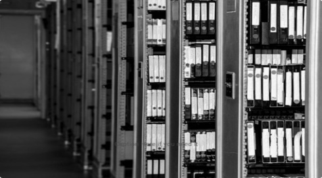
Figure 2: Videocassettes onsite at the fortunoff video archive for holocaust testimonies, fortunoff video archive.
In “The Witness in History,” Annette Wieviorka notes that “toward the end of the 1970s, the systematic collection of audiovisual testimonies began” in earnest (Wieviorka, 2006). The Fortunoff Video Archive for Holocaust Testimonies offers a meaningful example of the early evolution of recording survivors’ narratives and providing access to survivors’ stories. As the Archive explains on their website, [i]n 1979, a grassroots organization, the Holocaust Survivors Film Project, began videotaping Holocaust survivors and witnesses in New Haven, Connecticut.2 In 1981, the original collection of testimonies was donated to Yale University…. [T]he Fortunoff Archive has worked to record, collect, and preserve Holocaust witness testimonies, and to make its collection available to researchers, educators, and the general public.
Geoffrey Hartman notes,”[b]y 2002 the archive had taped more than four thousand witnesses and at least ten thousand hours of testimony. Witnesses were interviewed at Yale or at affiliates established throughout the United States and eventually in Israel and Europe” (Hartman, 2006). Early on, the researchers who collected the interviews understood the complexities of creating “an integrated archive” (Hartman, 2006). As a result of their efforts, a protocol of how to prepare the interviewers was developed, accompanied by plans not only to preserve the tapes physically but to provide access to them for scholars, educators, and the general public. A valuable, if painful, documentation, with important educative as well as memorial value, would not become an inert deposit deteriorating on the shelves (Hartman, 2006).
2This initial type of effort – characterized by being localized and driven by a small community of researchers – was the model for the majority of the first efforts to collect oral testimony from survivors. Given that these efforts were initiated and conserved by a small cadre of individuals, maintaining the survivors’ recordings has been highly changeable and/or unreliable. As a result, a number of collected testimonies now may be lost to us.
166 Gamber
Hartman’s caution that this collection of testimonies should not become “an inert deposit deteriorating on the shelves” is at the heart of this paper and of the DiT effort to make the stories of individual survivors available to visitors at select museums as well as on their website.
It also is worth noting what defined “state-of-the-art” technology 25 years ago: “Yale’s recently opened state-of-the-art repository preserves these vulnerable records. And from the beginning, a system of machine-readable cataloging was introduced, so that summaries of each testimony could be called up via the Internet from any computer. The researcher can learn what is in the archive, then travel to Yale, consult with the Fortunoff archivist, and view specific, time-coded tapes of interest” (Hartman, 2006). This example clarifies that – in addition to ensuring testimonies don’t languish, forgotten, in the basement of a school archive or sit inert on a shelf – the technology used to make the recordings available constantly needs to be updated. It is and was a point of concern, for example, that a great number of researchers would not be able to “travel to Yale” in order to view a specific tape of interest. From its inception, the Fortunoff Archive also confronted ongoing concerns regarding the preservation of the testimonies. For example, they had to ensure they were able “to preserve the original tape for reasons of authenticity” (Hartman, 2000). Moreover, the archivists discovered that “after 15 years or so the life of the [tape made available to researchers] begins to run out. So we have to transfer about 8,000 hours of material to a better quality tape and that is in itself a huge expense” (Hartman, 2000).
In 1994, the USC Shoah Foundation Institute for Visual History and Education, then named the Survivors of the Shoah Visual History Foundation, initiated their efforts to gather video testimonies from survivors and other witnesses of the Holocaust. It was the Shoah Foundation that devised the innovative method of digitizing the testimonies. To date, the Foundation has collected over 55,000 oral histories in their Visual History Archive, which includes testimonies from Holocaust survivors, witnesses, and rescuers from around the world.
Speaking to the Present and Future Generations “Clad in cobalt blue, hands folded in her lap, her well-coifed head tilting from side to side,” the DiT survivor projection of Fritzie Fritzshall tells her story to visitors to the Illinois Holocaust Museum and Education Center (IHMEC) (Kang, 2017). Fritzshall’s “survivor projection” has been “future-proofed,” in that her recording is ready to be adapted to holographic projection once that technology is available. In the meantime, from the stage at IHMEC a “convincing three-dimensional” representation of Fritzshall, a survivor of Auschwitz-Birkenau, answers a wide range of questions (Kang, 2017). When individuals first are confronted with the recording, Shoshana Buchholz- Miller, Vice President of Education and Exhibitions at IHMEC, notes “there’s usually an audible gasp” from the visitors. Buchholz-Miller adds
and then the first person asks a question, and the recording answers. And everyone seems to relax a little. And they’re asking the questions. What did you feel like? What happened to your family? And I think the
Human Interactions With Holocaust Survivor AIs: Current and Future Applications 167
use of the word “you” is so important because they really think they’re talking to this person. And the technology falls away, and it’s about the story. And that’s really what we want (qtd. in Shapiro, 2017).
In the initial set of interviews, the theatre in Los Angeles employed 360-degree video, over 100 cameras, and cost 2.5 million dollars. In subsequent years, they were able to reduce “the set-up required, so they [could] take a mobile rig on the road to record survivors close to where they live” (qtd. in Stahl, 2020). Whether interviewed in Los Angeles or close to where they live, in addition to a substantial financial investment, each interview requires a great deal of commitment on the part of the survivor. First off, there is a time commitment. For example, Aaron Elster recalls spending “a grueling week of interviews, [during] which he wore the same clothes every day and sat still in a chair for hours at a time under bright lights and cameras, answering difficult questions” (qtd. in Braunstein, 2018). In addition to a time commitment, there is a substantial emotional commitment. The survivors who participated in this project clarify that engaging in a prolonged interview is harrowing and re-traumatizing. Aaron Elster – who survived as a child in hiding with a Polish family – noted that while watching his recording, post-production, he wanted to cry (Billock, 2017). As he explains, the video recreated, for him, the reality of the event: I had a little sister, Sarah, who loved me so much. I created this terrible image of how she died, and that causes me such pain. Do you have any idea how long it takes to die in a gas chamber? It takes 15 to 20 minutes before your life is choked out. Think about it. A 6-year-old little girl, people climbing on top of her in order to reach out for any fresh air that still exists in the room. They lose control of all their bodily functions and they die in agony. This is what you carry with you. It’s not a story. It’s reality (qtd. in Billock, 2017).
Sam Harris – who survived because he was hidden by his sister, a slave laborer, in the concentration camp outside of Deblin, Poland – also found the interview experience lengthy and painful. He recalls, [t]hey gave us a rest each hour. I had a T-shirt. I had to change my T-shirt. It was always wet. You see, to answer a question, I always put myself in the position to where the answer was, like watching somebody being hanged. And I’m really there watching it. And I see it. And I describe it. This goes on for five, six hours a day (qtd. in Shapiro, 2017).
Harris endured the distress of the interview process because, as he notes, “what saves you is you do it for a purpose. You do it so that fifty years from now, a hundred years from now, people can look you in the face, ask a question. And by gosh, I give the answer” (qtd. in Shapiro, 2017). Renée Firestone, a survivor of the Auschwitz-Birkenau and Liebau concentration camps, echoes Harris’ claim for engaging in this recording process: “It was very difficult, but the outcome is rewarding,” she said. “I think it’s amazing that this will be able to be seen a hundred years from now. That’s why I’m
168 Gamber
doing it” (“Renée Firestone Records,” 2015). Simiarly, Aaron Elster observes that through this technology, survivors’ testimonies “will exist longer than we will” (qtd. in Billock, 2017). Additionally, Fritzie Fritzshall argues, we do it for a reason. We don’t do it for ourselves—because we can go out and play golf or sit in the sun or whatever. We’re doing it because we have become the voice for those that did not survive…. Every time I stand up and speak to a group of students or anyone, it opens a wound…. I do it because I feel I have an obligation to do it. Maybe this is why I survived (qtd. in Kang, 2017).
Elster, Harris, Firestone, and Fritzshall, all honor what Eli Wiesel calls their duty “to bear witness for the dead and for the living,” a duty that is grounded in Wiesel’s belief that survivors have “no right to deprive future generations of a past that belongs to our collective memory”(Wiesel, 1985). All four meet their obligation, in the words of Fritzshall, to become the voice for those who did not survive and meet their obligation to the present and future generations by participating in a project that confirms their memories will continue to be made part of our collective memory of the Holocaust.
These testimonial efforts also evidence that survivors are motivated by a sense of “urgency,” prompted by the “fear that their dying out will mean an attrition of the memory of the Holocaust. Every witness, at some level of consciousness, becomes the last—the only remaining – witness” (Hartman, 2006). As carriers of the memory of the Holocaust, the survivors who have committed their testimonies to this DiT project understand that these recordings represent a new and meaningful platform for engaging the public, a new and meaningful way to reach future visitors who will engage with their conversational AIs.
CONCLUSION: A PERSONALIZED NARRATIVE OF THE HOLOCAUST When interviewers gathered survivors’ oral testimonies, their efforts were grounded, in part, by following a chronological approach meant to promote historical clarity and accuracy. In the words of Greenspan and Bollosky, for decades, the types of questions interviewers asked and the order of the questions asked were meant to exhibit “a tangible expression of protection, containment and care – one that invited fuller recounting rather than constricting it” (Greenspan and Bollosky, 2006). For the DiT interviewers, when asking the survivors 1000 questions, chronology mattered as well. However, the questions asked by DiT interviewers also reveal they tried to imagine the wide variety of questions various visitors – who are of widely disparate ages and who possess widely disparate knowledge of the Holocaust – might ask.
Visitors’ experience of the survivor AIs may not be grounded in witnessing an unfolding, carefully managed, interview and personal history. In fact, the memorable component of engaging with conversational survivor AIs is the meandering, elastic nature of interacting with the survivor AI. The pedagogical promise of this technology is realized through a spoken exchange – through the creativity and persistence of the visitor’s questioning,
Human Interactions With Holocaust Survivor AIs: Current and Future Applications 169
on the one hand, and of the survivor AI’s responses, on the other. This process calls for visitors to consider what questions they want answers to and, thus, changes the dynamic of learning the “history” of the Holocaust from survivors. For Stephen Smith, USC Shoah Foundation Executive Director, the pedagogical promise of these narratives is realized, in large part, because DiT ensured that this activity is personalized. As he observes, ‘[i]t’s about you. It’s about what you want to know…. And that is where the deepest learning takes place” (Smith n. d.).
Three years ago, when I initiated research related to Renée Firestone’s AI, housed at the Holocaust Museum Los Angeles (HMLA), I spent over fifteen hours studying how she responded to over one hundred questions I personally asked of her. In reviewing my questions, I discovered they were not asked in a particular narrative order. I most decidedly didn’t observe the type of chronology trained interviewers would use. My initial questions addressed my immediate desire to know more about questions related to her experience of the epicenter of the Shoah in the various labor, concentration, and extermination camps and her knowledge about the fate of her immediate family members. In addition, the majority of my questions were conceived of in clusters; my desire to get one question answered prompted multiple interrelated questions. For example, in order to learn the fate of Renée’s family members, I needed to ask multiple questions about each of them. Her mother, Julia, I learned, was sent to the gas chamber after selection at Birkenau. Her father, Mauritius, survived the concentration camp, but was in such a weakened state, he died soon after liberation. Her brother, Frank, survived, a fact she discovered, by chance, when she encountered him post-liberation in Prague. In addition, she recounted that after many years of making inquiries about her sister’s ultimate fate, Renée finally learned that her sister, Klara, was murdered after she was forced to undergo medical experiments.
I also have dedicated research time to watching other individuals interacting with Renée’s AI at HMLA. I spent time – one on one – carefully observing twenty separate individuals engaging in a Q and A with her AI. Renée Firestone’s AI is located in a small gallery that comfortably seats four to six people. As a result of my study of these twenty subjects, I discovered that not only is a conventional, chronological narrative sequence potentially disrupted, my subjects of study revealed that many of the courteous conventions that probably would have been observed if they had been face-to-face with Renée herself were more easily ignored. When interacting with the AI, the subjects felt a greater license to ask a full range of more sensitive questions. For example, individuals in my study asked questions such as how much she weighed when she was liberated or whether or not she knew if there had been instances of rape during the Shoah.
Furthermore, I observed that visitors’ own expectations of the Q-and-A process itself were interrogated. The individuals I studied quickly discovered they needed to learn how to ask questions that would be recognized by the language processing system. Compound questions, for instance, often did not produce a response. For example, Renée’s AI was unable to respond to the question: “When you didn’t have Klara with you, did you have someone else
170 Gamber
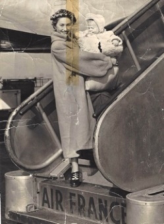
to support you in the camps?” Other times, a simple question would produce a circuitous response. For example, the question, Where did you grow up?, is cued to a long response that contains the answer, however, that answer is deeply embedded. Renée replies that she had a happy childhood and goes on at length about her family life and neighborhood, and, finally, towards the end of the story about her childhood, she offers the name of the town where she grew up in Czechoslovakia. Other questions produced unexpected results. For example, in answer to the question, What was it like moving to America?, Renée told a riveting story of traveling to the U.S. with her daughter, Klara (named after her sister who perished). As she explained, when Renée was putting their immigration papers in order she needed to be able to demonstrate her baby didn’t have tuberculosis. On the day of their doctor visit, Klara had a cough so while in the doctor’s office, Renée asked another woman if she could take her baby in for the check-up. She and the other woman’s baby received certificates of clear health. When Renée and baby Klara arrived in the U.S., a flight attendant told her to remain seated after all the other passengers had disembarked. Renée was terrified that someone had learned that Klara hadn’t really been seen by the doctor, especially when she saw blinking lights outside. It turned out that the lights were the flashbulbs of journalists who were waiting to capture her arrival – an image of a survivor and her daughter, staged at the end of their flight – for the papers.
Figure 3: Renee and Klara Firestone arrive in America at LaGuardia Airport in New York City, in 1948, Credit: Klara Firestone.
Visitors’ access to the survivor AIs constantly is evolving. For example, come 2026, as a result of a major renovation to HMLA, visitors will be able to interact with Renée’s AI in a theater built for the express purpose of allowing large groups – such as eighth graders on a school trip – to interact with the DiT survivor recording, an interaction that has been impossible in the modest gallery space that has been in use since 2021. At other museum sites where the AIs are presented in larger arenas to groups of individuals who all may have questions for the survivor’s recording, museums call for docents to facilitate the interaction. The docents both field the questions individuals in the group may have and help to refashion the questions asked to secure the most apt response from the AI. This type of intermediary is referenced in the following
Human Interactions With Holocaust Survivor AIs: Current and Future Applications 171
blog from Kasandra Fager and Emily Shaver who had the opportunity to interact with Renée’s AI at IHMEC during a university-sponsored field trip:
The show’s director explained that we could ask Renée questions and she would answer if possible. The small crowd of people began to ask her questions, such as what her childhood was like or how it felt seeing her brother after the Holocaust. The director would rephrase the question to trigger the hologram’s keyword phrase responses, and the hologram would answer the question (Fager and Shaver, 2023).
This type of intercession changes the immediacy – the perfectly queued answer, the surprising story, or the lack of a response – that comes with interacting one-on-one with the survivor recording. That said, as noted by Shoshana Buchholz-Miller, once the AI begins answering visitors’ questions, “the technology falls away,” as does the docent, I would add, and then “it’s about the story” itself (qtd. in Shapiro, 2017).
DiT also has made a limited number of survivor AIs available to visitors online. Thus, there are opportunities for individuals worldwide, who are interested, to engage with these “eyewitnesses to history” and to learn from those who actually were there. This democratization of access is a testament to the vital ways that technology is ensuring that survivors’ stories live on.
In conclusion, this nongenerative AI technology meaningfully addresses the fragility of the eyewitnesses to the Shoah, the precariousness of preserving their personal stories, and the tenuousness of making their testimonies available. It is worth noting that since they participated in making these DiT recordings, a majority of the survivors have since passed away. However, as they had desired, their stories live on. We may be awaiting the day new technology will ensure these recordings are made into holograms; however, as a result of the current technology – a technology which creates intimacy, immediacy, and authenticity through conversational interactions with these survivor AIs – these survivors’ testimonies are neither lost in basements or languishing on shelves, their personal histories poignantly inform the public about each survivor’s lived experience of the Holocaust.
REFERENCES
Billock, Jennifer. (December 1, 2017). “An Exhibit in Illinois Allows Visitors to Talk with Holograms of 13 Survivors.” Smithsonian Magazine Website: http://www.smithsonianmag.com/travel/chat-holographic-holocaust-survivor-18 0967085/. Braunstein, Ellen. (January 22, 2018). “At this Holocaust Museum You Can Speak with Holograms of Survivors” The Times of Israel Website: https://www.timesofisrael.com/at-this-holocaust-museum-you-can-speak-with- holograms-of-survivors/. Browning, Christopher R. (2003). Collected Memories: Holocaust History and
Postwar Testimony. U of Wisconsin P.
172 Gamber
Cummings, Mike. (July 24, 2024). “Beinecke Exhibition ‘Lifts Up’ the Voices of Holocaust Survivors.” YaleNews Website: https://news.yale.edu/2024/07/24/beinecke-exhibition-lifts-voices-holocaust-sur vivors#: : text=The%20exhibition’s%20opening%20section%2C%20consisting, a%20chief%20organizer%20of%20the. Des Pres, Terrence. (1980). The Survivor: An Anatomy of Life in the Death Camps.
Oxford UP. Fager, Kasandra and Emily Shaver. (May 5, 2023). “We Are Not Throwing Away our Shot!” Bowling Green State University Department of History. Website: https: //blogs.bgsu.edu/history/2023/05/we-are-not-throwing-away-our-shot/. Greenspan, Henry and Sidney Bollosky. (2006). “When Is an Interview and
Interview? Notes from Listening to Holocaust Survivors.” Poetics Today, Vol. 27, No. 2. Hartman, Geoffrey. (2000). “An Intellectual Feast.” GW Magazine. Hartman, Geoffrey. (2006). “The Humanities of Testimony: An Introduction.”
Poetics Today, Vol. 27, No. 2. Kang, Esther. (October 24, 2017). “Thanks to the Illinois Holocaust Museum, Visitors Can Talk to Survivors for Decades to Come.” Chicago Magazine Website: https://www.chicagomag.com/chicago-magazine/november-2017/illino is-holocaust-museum-and-education-center-survivor-stories/. Kushner, Tony. (2009). Anglo-Jewry since 1066: Place, Locality and Memory.
Manchester U P. Laub, Dori. (1992). “Bearing Witness or the Vicissitudes of Listening”, in: Testimony: Crises of Witnessing in Literature, Psychoanalysis, and History. Felman, Shoshana and Dori Laub (Eds.). pp. 57–74. Levi, Primo. (1995). “Contre l’oubli”, in: Le devoir de mémoire: Entretien avec Anna
Bravo et Federico Cereja. Gayraud, Joel (Trans.), pp. 73–81. Levitt, Aimee. (February 9, 2017). “The First Voices to Emerge from the Holocaust: David Boder’s Nightmarish Journey, Rediscovered.” Forward Website: https://forward.com/news/362762/the-first-voices-to-emerge-from-the- holocaust-a-rediscovered-1946-recording/. Muller, Beate. (2014). “Translating Trauma: David Boder’s 1946 Interviews with Holocaust Survivors.” Translation and Literature Vol. 23, No. 2. “Renée Firestone Records Interview for New Dimensions in Testimony.” (December 7, 2015). USC Shoah Foundation, Dimensions in Testimony. Website: sfi.usc.edu/news/2015/12/10485-renee-firestone-records-interview-new- dimensions-testimony. Rosen, Alan. (2010). The Wonder of their Voices: The 1946 Interviews of David
Boder, Oxford UP. Shapiro, Ari. (December 19, 2017) “Illinois Holocaust Museum Preserves Survivors’ Stories – As Holograms.” NPR Website: www.npr.org/transcripts/572068474. Smith, Stephen. (n. d.) “What Is Dimensions in Testimony: A Short Video
Introduction to the Technology.” Website: sfi.usc.edu/dit. Stahl, Lesley. (August 30, 2020). “Artificial Intelligence is Preserving Our Ability to Converse with Holocaust Survivors even after They Die.” 60 Minutes. Website: http://www.cbsnews.com/news/holocaust-stories-artificial-intelligence- 60-minutes-2020-08-30/. Wiesel, Elie. (1985) Night. Wiesel, Marion (Trans.). Hill and Wang. Wieviorka, Annette. (2006) “The Witness in History.” Poetics Today, Vol. 27, No. 2.
LISTED IN THE AHFE DIGITAL BOOKSTORE CATALOGUE
Explore the complete digital volume
Human Interaction and Emerging Technologies (IHIET-AI 2025): Artificial Intelligence and Future Applications
Read this individual research paper free through the original publisher, or explore the full digital proceedings book.
ISBN 978-1-964867-37-3
Explore this ISBN in the AHFE Bookstore ↗Listed in the July 2026 bookstore catalogue; search by ISBN to confirm current availability · Digital book purchase optional