Lawrence Al-fandi, Kawther Jamal, Fatma Jamal, Ruqaya Safar, Ghadeer Al-neama, Fatma Al-sarraf (2025). Hospital Kitchen Ergonomics: Analysis of Manual Operations in a Hospital Kitchen Using Jack Software. In: Human Interaction and Emerging Technologies (IHIET-AI 2025): Artificial Intelligence and Future Applications. AHFE Open Access, vol. 161, pp. 530–539. https://doi.org/10.54941/ahfe1005945
Kitchens are considered risky workplaces. Musculoskeletal disorders (MSDs) are one of the leading causes of occupational illnesses that occur due to performing specific forceful kitchen tasks. The study aims to improve kitchen ergonomics by analyzing and redesigning manual operations in a local hospital kitchen in Kuwait using JACK software. A questionnaire was distributed to identify the workers' complaints. Tasks causing pain in the affected areas were investigated. After developing the digital human model, different performance metrics from JACK software tool analysis, such as Rapid Upper Limb Assessment (RULA), Ovako Working Posture Analysis (OWAS), and Lower Back Analysis (LBA) were used to analyze the tasks studied.The findings revealed high initial ergonomic risks, with tasks such as vegetable washing consistently scoring 6–7 on the RULA scale, indicating urgent intervention needs. Post-intervention, risk levels were significantly reduced, with RULA scores dropping to 3–4, particularly for the vegetable washing task, which benefitted from tailored ergonomic modifications like food-washing racks and leg supports. Lower back forces were also notably reduced, especially for lighter workers, highlighting the differential impact of task redesign on anthropometric variations. OWAS scores remained stable, reflecting moderate postural risks throughout. This study underscores the effectiveness of tailored ergonomic interventions in reducing MSD risks and improving workplace safety. The proposed methodology, integrating advanced digital modeling and performance metrics, offers a systematic approach for addressing ergonomic challenges in hospital kitchens and other industrial settings.
Kitchens are among the three industries with the highest worker health risks (Australian Workplace Barometer, 2012). Many types of injuries could be caused in kitchens. Injuries that may be caused include serious burns, wounds, and injuries that cause musculoskeletal disorder (MSD). According to Ullrich, (2011), MSDs are injuries and disorders that affect the body’s function by affecting areas such as muscles, tendons, ligaments, nerves, and mainly body parts such as back, shoulders, upper arms, etc. There are many ways to
Hospital Kitchen Ergonomics: Analysis of Manual Operations 531
prevent the causes of work-related MSDs. One way is by following a well- ergonomically designed workplace guide. Ergonomics is a field of industrial engineering that focuses on designing a safe and comfortable work zone for the workers (Jaffar et al., 2011). In the case of this paper, as the kitchen work environment is top-rated to cause MSDs, ergonomics in kitchens is needed.
Kitchen tasks, specifically large serving kitchens such as hospital kitchens, generally require force exertion, awkward posture, repetitive motion, and prolonged standing while working, resulting in a high risk of developing muscle fatigue (Subramaniam et al., 2018). Tasks that require such movements may include cooking, mixing, washing, and carrying large quantities. Since these tasks serve large quantities, they can lead to hazards. To be able to solve these risks, they should be first well analyzed. Specialists today use human digital modeling as an analysis tool. Jack software can be used for such analysis; it has international metric analysis such as rapid upper limb assessment (RULA), Ovako working analysis system (OWAS), and Lower Back Analysis tool. Jack is programmed to provide extremely sensitive and detailed analysis of the risk of each part of the body when performing a task. This paper analyzes and solves tasks performed in a hospital’s kitchen using Jack software. This software aims to prevent the cause of MSD in tasks performed by hospital kitchen workers, such as heavy lifting, dishwashing, and vegetable washing.
This paper focuses on reducing work-related MSDs for kitchen workers. The majority of the workers suffered from upper limb disorders and lower back injuries. The following tasks, adding water, vegetable washing, and dishwashing, were studied as they were the most complained about.
METHODOLOGY
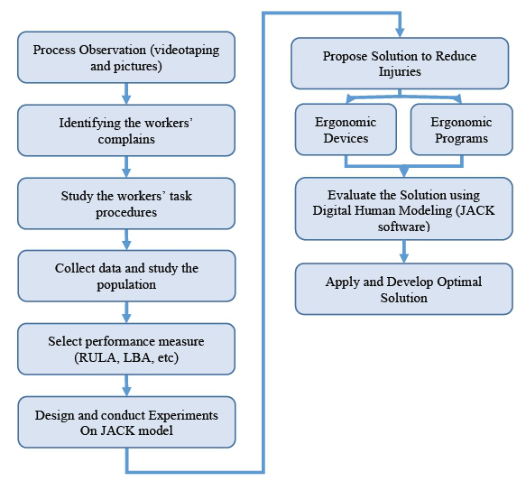
The current study was conducted in a local hospital kitchen in Kuwait, examining three different tasks. The tasks were selected based on a questionnaire distributed to the workers, illustrating the most affected body parts. The methodology for this study is shown in Figure 1.
Identifying the Worker’s Complains The Nordic Musculoskeletal disorders (MSDs) questionnaire has been distributed to 100 out of 120 workers. The goal is to collect information about the workers’ duties and tasks and identify problems that cause musculoskeletal disorders (MSDs). The results of the questionnaire show that the most affected body areas are the upper limb and lower back. According to the results of the questionnaire, 54% of the workers declared they suffered from upper limb pain. Moreover, 24% had hip problems, 12% had lower back pain, and 10% suffered from leg fatigue.
Figure 1: The methodology.
Study the Workers’ Tasks Procedures The following tasks were selected for modeling based on the majority of complaints:
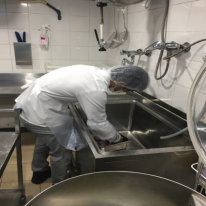
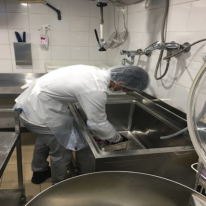
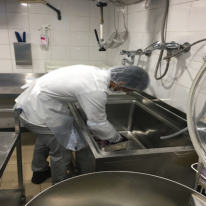
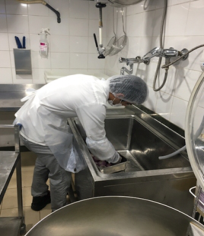
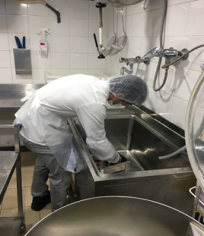
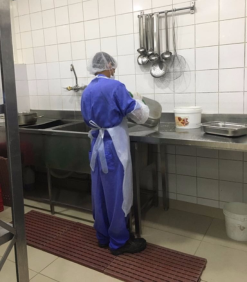
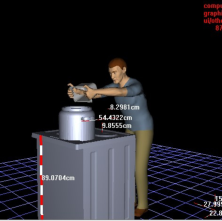
1. Vegetable Washing Operation: In this task, the worker washes the vegetables by extensively bending, as shown in Figure 2.1; this posture is considered awkward. 2. Washing Dishes: In this task, the worker grabs the dishes from a high shelf, brings them to the sink, and then starts washing them. This posture includes heavy lifting and extreme reaching Figure 2.2. 3. Pouring Water: The worker fills a big pot with boiling water in this task. This task includes heavy lifting Figure 2.3.
Figure 2. 1. Vegetable operation.Figure 2. 2. Washing dishes task.Figure 2. 3. Pouring hot water task.
Hospital Kitchen Ergonomics: Analysis of Manual Operations 533
Select Performance Measure Performance measures were selected to assess the tasks: Lower Back Analysis tool, Ovako Working Posture Analysis (OWAS), and Rapid Upper Limb Assessment (RULA). A description of each tool is as follows:
Lower Back Analysis Tool: This tool helps evaluate the spinal forces acting on a virtual human’s lower back under any posture and loading condition.
Ovako Working Posture Analysis: A simple method for quickly checking the comfort of working postures and determining the urgency of taking corrective measures.
Rapid Upper Limb Assessment (RULA): Helps you evaluate workers’ exposure to the risk of upper limb disorders.
GENERATION OF DIGITAL HUMAN MODELS Real Scenario
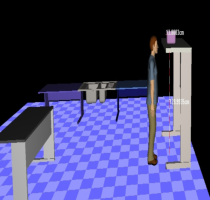
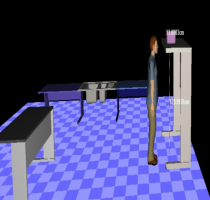
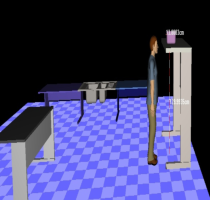
Digital human models were generated using JACK software. All tasks have been converted to CAD model simulation and are evaluated through chosen tools (RULA, OWAS, LBA). Figures 3.1, 3.2, and 3.3 represent the digital human model for tasks: vegetable washing, dishwashing, and pouring hot water task.
Figure 3. 1. Dish washing.Figure 3. 2. Washing vegetables.Figure 3. 3. adding water into container.
Experiments The research aims to generalize the study and improve its applicability to a diverse workforce by incorporating experiments that include various anthropometric measures. The experiment examines musculoskeletal disorders’ risk factors and prevalence to improve workplace tasks and procedures. The factors considered are the Height (Stature) and weight. Gender was not considered a factor since all the workers were males. The levels are 5th, 50th, and 95th percentiles of male Indian models, representing the smallest, medium, and largest dimensional Indian people for each height and weight.
RESULTS
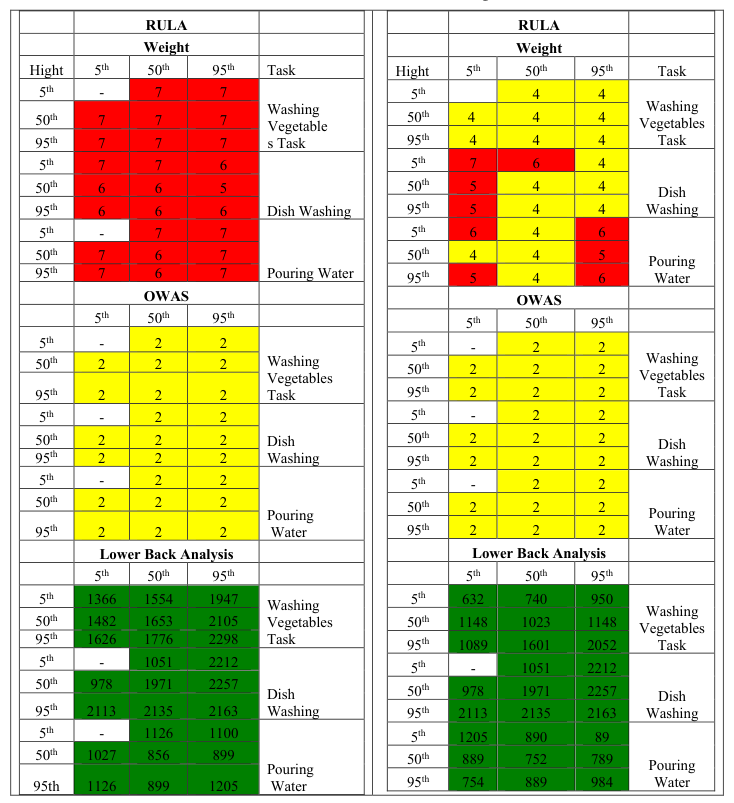
The results are analyzed using three tools (RULA, OWAS, and lower back). Each tool has a specific score, and each range is specified in a different color.
For the Rapid Upper Limb Assessment (RULA), scores range from 1 to 7. A score of 1-2, marked in green, indicates negligible risk with no action required. In contrast, a score of 6-7, marked in red, signifies very high risk, necessitating immediate corrective action. Lower back analysis gives a green color for scores lower than 6300N and a red color for scores higher than that range. Finally, OWAS shows a score of 1 (green) when posture does not affect WMSDs, 2 (yellow) when posture has a slight effect, 3 (orange) when posture has a harmful effect, and 4 (red) when posture has a significant effect on WMSDs and action needed.
Vegetable Washing Task
Figure 4. 1 shows a worker performing a real vegetable washing task. The figure shows that the worker is bending very low to perform the task. Ergonomically, this posture is not comfortable to perform in these conditions. Having such working postures can expose the worker to a risk of MSD. Figures 4.2 & 4.3 below show the task converted into a CAD model through JACK software before and after applying the proposed solutions of raising the sink, adding food-washing racks on the sink to decrease worker bending, and providing leg support, which will decrease the ergonomic risks.
Figure available in the original PDF paper.
Figure 4. 1. Real task. Figure 4.2. vegetables operation task in JACK software before changes.Figure 4. 3. vegetables operation task in JACK software after changes.
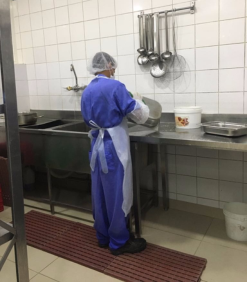
Washing Dishes Task Hand-washing dishes requires much effort and can lead to great fatigue. As shown in Figure 5.1, the dishwashing was analyzed to identify the causes of the fatigue.
The suggested solution is to put the worker seated and give leg support. In RULA, we changed the option to (seated, with legs and feet well supported).
Hospital Kitchen Ergonomics: Analysis of Manual Operations 535
Figure 5. 1. Real dishwashing task in the kitchen.Figure 5. 2. Dishwashing task in the JACK.
Add Water Task Adding water is a task performed by the cooks. It is performed by filling the big pot with boiled water to start cooking, as shown in Figure 6.1. This task can have many risks for the worker, like burns or spills, or maybe can cause slipping. However, the task requires lifting a heavy container (9 kg) and pouring it into another.
Figure 6. 1: Pouring the water’s task in the JACK.
The following changes were suggested to improve the pouring task: a stress relief mat to support the workers’ legs, loads to be reduced to smaller amounts, increased resting breaks to prevent fatigue, and low-weight containers to reduce the weight carried. The main recommendation proposed for this task is lowering the load filled in the container from 9 kg to 3 kg three times. This suggestion is proposed and tested with positive results.
KPI’s Before and After Improvement
Table 1 shows the KPI results from the status quo scenario (before) and after applying the recommended solutions. The height levels are 5th, 50th, and 95th percentiles in the column, while weights are in the row.
Table 1. KPI’s before (on the left side) and after (on the right side).
Discussion
The ergonomic intervention study focused on analyzing and mitigating musculoskeletal disorder (MSD) risks in a hospital kitchen through digital human modeling using JACK software. The analysis employed three primary assessment tools: Rapid Upper Limb Assessment (RULA), Ovako Working Posture Analysis (OWAS), and Lower Back Analysis.
The RULA analysis revealed critical insights into upper limb disorder risks across anthropometric configurations. Initially, most tasks exhibited high-risk scores between 6-7, indicating an urgent need for ergonomic interventions. Following the proposed modifications, a significant reduction in risk levels was observed. The vegetable washing task, previously consistently scoring 7 (very high risk), was uniformly reduced to a score of 4, suggesting a moderate risk that still requires further consideration.
Hospital Kitchen Ergonomics: Analysis of Manual Operations 537
The dish washing and water pouring tasks showed more nuanced improvements. The variability in post-intervention RULA scores (ranging from 4-6) suggests that ergonomic solutions may have differential effectiveness depending on worker anthropometrics. This finding underscores the importance of tailored ergonomic interventions for individual physical characteristics.
OWAS scores remained consistently at 2 across all tasks and worker configurations, indicating a slight effect on work-related musculoskeletal disorders. While this suggests that the interventions did not dramatically alter postural risks, it also implies that the initial working conditions were not at the most critical risk levels.
The lower back analysis demonstrated the most pronounced improvements. The vegetable washing task showed substantial reductions in lower back forces, particularly for workers in the lower weight percentiles. The most significant improvements were observed in the 5th weight percentile, suggesting that lighter workers were disproportionately affected by the original task design.
The dish washing task exhibited relatively stable lower back forces, indicating that the initial ergonomic risks were less severe. However, the water pouring task revealed notable reductions in lower back forces, particularly for workers with lower body weights.
CONCLUSION
This study addresses musculoskeletal disorders (MSDs) in hospital kitchen environments by employing digital human modeling through JACK software to analyze and redesign manual operations. The research highlighted the significant health risks faced by kitchen workers, with a comprehensive questionnaire revealing that over half of the workers experienced upper limb pain and substantial percentages suffered from various musculoskeletal issues. The study demonstrated remarkable improvements in workplace ergonomics by utilizing advanced performance metrics including Rapid Upper Limb Assessment (RULA), Ovako Working Posture Analysis (OWAS), and Lower Back Analysis.
The interventions developed through digital human modeling significantly reduced ergonomic risks across different tasks. RULA scores dramatically decreased from high-risk levels of 7 and 6 to more manageable scores of 3 and 4, indicating a substantial reduction in potential upper limb disorders. OWAS evaluation scores similarly improved, while the Lower Back Analysis consistently maintained safety levels.
Tailored ergonomic solutions were implemented for specific tasks, including introducing food-washing racks and leg support for vegetable washing, providing additional support during dishwashing, and modifying water-pouring procedures to reduce physical strain. These interventions addressed immediate safety concerns and provided a systematic methodology for workplace risk assessment that can be applied across various industrial settings.
REFERENCES
Australian Workplace Barometer (2012). University of South Australia. Retrieved on December 15, 2017 from https://www.safeworkaustralia.gov.au/sites/swa/about/P ublications/Documents/748/The- Australian-Workplace-Barometer-report.pdf. Blanchonette, P. (2010). Jack Human Modelling Tool: A Review. Collins, R. M., Van Rensburg, D. J., & Patricios, J. S. (2011). Common work-related
musculoskeletal strains and injuries: CPD article. South African Family Practice, 53(3), 240–246. Demirel, H. O., & Duffy, V. G. (2007, July). Applications of digital human modeling in industry. In International Conference on Digital Human Modeling (pp. 824–832). Dr. Lumbago – Lower back pain helpful information; sciatica and neck pain too -
Dr. Lumbago. (2017). Drlumbago.com. Retrieved 27 November 2017, from https: //drlumbago.com/. Duffy, V. G. (Ed.). (2008). Handbook of digital human modeling: Research for applied ergonomics and human factors engineering. CRC press. Ease Carpal Tunnel Pain In 10 Minutes or Less with These 4 Points. (2017). The
Hearty Soul. Retrieved 27 November 2017, from https://theheartysoul.com/acup ressure-for-carpal-tunnel/. Ehs.iastate.edu. (2018). Awkward Postures | Environmental Health and Safety.
[online] Available at: https://www.ehs.iastate.edu/occupational/ergonomics/awkw ard-postures [Accessed 25 Apr. 2018]. Gigstad, Justin. “Ergonomic analysis of production cooks at XYZ high school.” The Graduate School University of Wisconsin-Stout Menomonie, Wisconsin (2002). Gupta, A., Bhat, M., Mohammed, T., Bansal, N., & Gupta, G. (2014). Ergonomics
in Dentistry. International Journal of Clinical Pediatric Dentistry, 7(1), 30–34. Haruyama, Y. (2017). Burn and cut injuries related to job stress among kitchen workers in japan. Jstage.jst.go.jp. Retrieved 27 November 2017, from https: //www.jstage.jst.go.jp/article/indhealth/52/2/52_2013-0143/_pdf/-char/ja. Injuries, Illnesses, and Fatalities. (n.d.). Retrieved December 26, 2017, from https:
//www.bls.gov/home.htm. Jaffar, N., Abdul-Tharim, A. H., Mohd-Kamar, I. F., & Lop, N. S. (2011). A literature review of ergonomics risk factors in construction industry. Procedia Engineering, 20, 89–97. Jatinder Kishtwaria, Puja Mathur & Aruna Rana (2017). Ergonomic Evaluation
of Kitchen Work with Reference to Space Designing. Journal of Human Ecology Vol. 21, Iss. 1, 2007. Jones, N. (2011). Kitchen hazards. Rospa Occupational Safety & Health Journal, 41(4), 11–14. Jayaram, U., Jayaram, S., Shaikh, I., Kim, Y., & Palmer, C. (2006). Introducing
quantitative analysis methods into virtual environments for real-time and continuous ergonomic evaluations. Computers in industry, 57(3), 283–296. Kiran S., Harshal Tukaram P., Tanmayee P. (2015). Role of Ergonomics in Kitchen Related Back Problems. Spinalogy Clinic, Next to Hotel Sarja, ITI Road, Aundh, Pune 411007, India. Kroes, P. (2002). Design methodology and the nature of technical artefacts. Design
studies, 23(3), 287–302. Massaccesi, M., Pagnotta, A., Soccetti, A., Masali, M., Masiero, C., & Greco, F. (2003). Investigation of work-related disorders in truck drivers using RULA method. Applied ergonomics, 34(4), 303–307.
Hospital Kitchen Ergonomics: Analysis of Manual Operations 539
Meksawi, S., Tangtrakulwanich, B., & Chongsuvivatwong, V. (2012). Musculoskeletal problems and ergonomic risk assessment in rubber tappers: A community-based study in southern Thailand. International Journal of Industrial Ergonomics, 42(1), 129–135. Medial epicondylitis (Golfer’s elbow). (2017). Shoulderandelbowspecialist.co.uk.
Retrieved 27 November 2017, from https://www.shoulderandelbowspecialist.co. uk/elbow-conditions/medial-epicondylitis-golfers-elbow.aspx. Niu, J. W., Zheng, X. H., Zhang, L., Xu, S. Y., Li, X., Guo, S. S., & Ding, S. T.
(2011, September). Investigation of ergonomics in Chinese university cafeterias’ working situation at peak hours using jack. In Industrial Engineering and Engineering Management (IE&EM), 2011 IEEE 18th International Conference on (pp. 595–599). IEEE. Ono, Y., & Shibata, E. (1993). Actual conditions of cooking work. Rodo no Kagaku (Science of Labour), 48, 196–200. Shankar, S., Shanmugam, M., & Srinivasan, J. (2015). Workplace factors and
prevalence of low back pain among male commercial kitchen workers. Journal of back and musculoskeletal rehabilitation, 28(3), 481–488. Subramaniam, S., Murugesan, S., & Jayaraman, S. (2018). Assessment of shoulder and low back muscle activity of male kitchen workers using surface electromyography. International Journal of Occupational Medicine and Environmental Health, 31(1), 81–90. Shiue, H. S., Lu, C. W., Chen, C. J., Shih, T. S., Wu, S. C., Yang, C. Y.,... & Wu, T. N. (2008). Musculoskeletal disorder among 52, 261 Chinese restaurant cooks cohort: Result from the National Health Insurance Data. Journal of occupational health, 50(2), 163–168. Spaghetti Diagram. (2018). whatissixsigma. Retrieved 20 February 2018, from https:
//www.whatissixsigma.net/spaghetti-diagram/. Safety and Health Topics | Ergonomics - Solutions to Control Hazards | Occupational Safety and Health Administration. (2018). Osha.gov. Retrieved 25 April 2018, from https://www.osha.gov/SLTC/ergonomics/controlhazards.html#guidelines. Standing Task Chair helps you sit and stand at the same time. (2018). Newatlas.com.
Retrieved 25 April 2018, from https://newatlas.com/standing-task- chair/27841/#gallery. The IUP Journal of Mechanical Engineering (2010). Risk Assessment and Ergonomic Analysis for the Design of Kitchen Workstation Used in Indian Middle-Class Hotels. Vol. III, No. 4. Veisi, H., Choobineh, A. R., & Ghaem, H. (2016). Musculoskeletal Problems in
Iranian Hand-Woven Shoe-Sole Making Operation and Developing Guidelines for Workstation Design. The international journal of occupational and environmental medicine, 7(2 April), 725–87. Xu, Y. W., & Cheng, A. S. (2014). An onsite ergonomics assessment for risk of workrelated musculoskeletal disorders among cooks in a Chinese restaurant. Work, 48(4), 539–545.
LISTED IN THE AHFE DIGITAL BOOKSTORE CATALOGUE
Explore the complete digital volume
Human Interaction and Emerging Technologies (IHIET-AI 2025): Artificial Intelligence and Future Applications
Read this individual research paper free through the original publisher, or explore the full digital proceedings book.
ISBN 978-1-964867-37-3
Explore this ISBN in the AHFE Bookstore ↗Listed in the July 2026 bookstore catalogue; search by ISBN to confirm current availability · Digital book purchase optional