While Japan's universal health insurance system reduces the burden of medical expenses, it may lack direct incentives to improve patient adherence to medication. To solve the problem, penalties and financial incentives have been considered as possible measures. However, these methods are not suited to the cultural background of Japan and may have limited effectiveness. In this study, we empirically verified a new intervention model suited to the Japanese context. Drawing an analogy between reporting on the progress of a graduation thesis and medication adherence, we focused on “social needs” within Maslow’s Hierarchy of Needs as a motivational mechanism. We utilized notifications and information sharing through Slack to engage students. Furthermore, we propose that a “motivation engineering” perspective is essential for problem solving, in which individual motivations are analyzed scientifically and the most appropriate intervention measures are designed. The experimental results suggest that understanding personal values and fostering habit formation are important factors in influencing medication behavior. Additionally, the findings highlight the importance of designing individual intervention measures and motivation strategies that account for cultural characteristics.
Medication adherence is defined as “the extent to which a person’s behavior—taking medication, following a diet, and/or executing lifestyle changes—corresponds with agreed recommendations from a healthcare provider” (World Health Organization, 2003). Various strategies have been proposed to improve medication adherence, including the use of pillboxes (Karagiannis et al., 2022), wearable devices (Ikeda et al., 2022), and telephone-based interventions (Cross et al., 2019). The importance of adherence is particularly emphasized in chronic diseases such as hypertension and diabetes (Balkrishnan, 2005). In this context, psychological and economic approaches, such as motivational interviewing (Linden et al., 2010) and financial incentives (Claassen et al., 2007), have also been explored. However, in Japan, where universal health insurance provides access to medical services at a relatively low cost, implementing financial incentives
Motivational Engineering for Medication Adherence 147
remains challenging. Moreover, the issue of unused medicines and their impact on healthcare costs has drawn attention, highlighting the need to encourage voluntary behavioral changes in medication adherence. One approach to addressing these Japan-specific challenges is to leverage the concept of “Shikake” (Matsumura, 2013), defined as a mechanism that uses an “embodied trigger” to induce “specific behavior” and ultimately solve a “social or personal issue.” Attempts have been made to apply this concept to promote healthier habits (Hirai et al., 2022). Although “Shikake”is expected to be effective in inducing specific behaviors, it does not necessarily foster an understanding of the treatment’s effectiveness or value an aspect particularly crucial in the context of medication adherence. From this perspective, our research group is conducting studies on both quantitative and qualitative design methods to better understand fundamental issues and gain deeper insights into problem solving (Koike et al., 2024). In this study, we consider the daily task of reporting the progress of undergraduate thesis projects as analogous to medication adherence, based on similarities such as being a periodic action, not involving financial incentives, and being performed voluntarily. Moreover, both medication adherence in chronic diseases and the progress reporting of undergraduate thesis projects despite the effects not being immediately visible can be understood as fulfilling “social needs” within Maslow’s Hierarchy of Needs. Maslow’s Hierarchy of Needs has also been referenced by pharmacists (Poirier et al., 2019). Using this analogy, we conducted both quantitative and qualitative analyses to identify individual interventions aimed at improving adherence motivation.
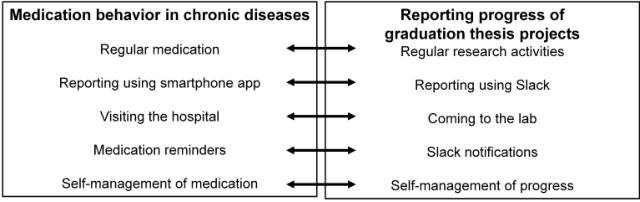
CASE STUDY USING AN ANALOGY MODEL WITH UNDERGRADUATE THESIS PROJECTS As discussed above, improving motivation for medication adherence requires not only interventions from healthcare professionals but also behavioral changes in which patients voluntarily and proactively modify their actions, taking their medication appropriately according to the prescribed dosage and regimen. This study analyzed medication behaviors by using the daily task of reporting undergraduate thesis progress as an analogy for medication adherence. Analogies have been studied in the field of human-computer interaction (HCI) to support idea discovery and decision-making based on structural similarities (Gilon et al., 2018; He et al., 2024). The analogy model used in this study is illustrated in Figure 1.
Figure 1: An analogy model used in this study.
As a daily task, six undergraduate students who had started their graduation theses in the Department of Mechanical Systems Engineering at Kogakuin University were instructed to record their “tasks completed today,” “goals for tomorrow,” and “current page count” on Slack, a team communication tool, over 16 weekdays from December 1 to December 22, 2023. In addition, a notification prompting input was sent at 7:00 PM to Slack-enabled smartphones and PCs. After the task period, semi- structured interviews regarding the tasks were conducted. The interviews were recorded and subsequently transcribed using Whisper, developed by OpenAI. As the interviews followed a semi-structured format, participants were encouraged to freely express their thoughts and feelings. The main topics included “reasons for failure,” “the priority of a task,” and “strategies used.” Additionally, two indices were defined: the proactiveness score representing the “proportion of participation days,” and the continuity score represents the “proportion of the maximum number of consecutive participation days.” It should be noted that this study is still at an exploratory stage, and the validity and reliability of these indices remain issues to be addressed in future research.
proactiveness score = number of days participated overall schedule (16 days) continuity score = maximum consecutive days of participation
overall schedule (16 days)
RESULTS
Table 1 shows the scores of the participants. Tables 2–7 show excerpts from the interview responses reflecting participants’ approaches to and perceptions of the graduation thesis progress tasks. All textual data were collected in Japanese, and when translated into English, the content was verified to ensure consistency with the original interview responses.
Table 1: Participants scores.
Table available in the original PDF paper.
Score Participants A B C D E F Proactiveness 0.31 0.56 0.19 0.13 0.06 0.00 Continuity 0.25 0.31 0.13 0.06 0.06 0.00
Table 2: Interview with participant A.
Table available in the original PDF paper.
Interview Topic Interview Answers Situation I wrote it when I was at school just before I went home, or when I was at home and had finished all the work for the day.
Continued
Motivational Engineering for Medication Adherence 149
Table 2: Continued Interview Topic Interview Answers
Table available in the original PDF paper.
Situation The notifications would come at 7 pm in particular, and I would usually finish my work by 10 pm, or later in the day, so I wasn’t really conscious of the notifications and just did what I wanted to do whenever I wanted to. Consciousness of others I just looked at the page numbers a little bit. Sense of agency I felt like I was doing it 100% by myself. Because there was no enforcement. Lifestyle I had a training session at work until around 9 pm, so I started working on my graduation thesis early.
Table 3: Interview with participant B.
Table available in the original PDF paper.
Interview Topic Interview Answers Trigger The most common reason was that I saw someone else’s post on Slack and thought I should try it, and then I did it for myself, because I wanted to be satisfied with it or leave evidence that I was doing it. Reasons for failure First, I didn’t notice the notification and forgot to report the task. Second, I thought I would report it later, and the date passed. Priority I thought it was quite important. The reason for this is that there is a limit to how much you can do by yourself. By sharing your progress with your colleagues, I think I can increase my motivation. Strategy I thought it was important, but I didn’t think it was essential, and I just thought it would be okay if I forgot about it. Sense of agency In terms of percentage, I felt that 80% of my actions were self-initiated, while 20% were driven by a sense of obligation.
Table 4: Interview with participant C.
Table available in the original PDF paper.
Interview Topic Interview Answers Situation I think that most of the time, I would go to the lab, do tasks, or work, or research, and then I’d finish up and do things before going home. Reasons for failure There were a few times when I got a notification and thought I should write, but I ended up leaving after 7pm, so I put it off. Consciousness of others I’ve never looked back at other people’s past records, but seeing others making progress has made me think I need to work harder. Strategy If I raise the priority level of something that was previously low for me to something like writing a thesis or researching a thesis, I think I will naturally start doing it.
Table 5: Interview with participant D.
Table available in the original PDF paper.
Interview Topic Interview Answers Situation I decided to do it on Monday. I didn’t know how to do it at first. Trigger At first, I thought we would all send it at 7 pm, and I was skeptical about the time itself. Influence of the task Anyone just looks at the number of pages, like how far everyone else is, right? Not the content of what’s written, but when I was at 10 pages, everyone else was saying 25 or something, and I hadn’t put in any at the time, and I was at 10 or something, so when I saw that, I was like, “Oh no, I need to add more text.” Lifestyle In my case, I work part-time in the morning, so I finish at 9:30 and get home around 10:00. So around 10:00 I’m free, so I can either eat breakfast or go to school.
Table 6: Interview with participant E.
Table available in the original PDF paper.
Interview Topic Interview Answers Reasons for failure I guess the reason for the progress is that I’ve started to only do the series of operations that I have to enter myself when I feel like it, and there’s no visible reward even if I do it, or there’s no goal, so it’s fine if I do it, but there are also times when I feel like it’s just not worth it. Priority I think it’s pretty much at the bottom, and I think it’s just a bonus. Influence of the task As expected, since I get asked about it every day, even on days when I think I don’t need to do it today, I’ll just push through one page because I have this so I can report. Now that I think about it, it’s become a kind of motivation to continue doing small things every day. Consciousness of others Even if I’m watching a movie or playing a game, I might check Slack to see if someone has posted, and if I see someone who’s 5 pages ahead of yesterday, I might feel a bit anxious.
Table 7: Interview with participant F.
Table available in the original PDF paper.
Interview Topic Interview Answers Reasons for failure It’s a hassle and I wonder if they’ll check it if I send it. I haven’t made any progress so I don’t want to send it. Strategy I wonder if there’s some way to send them regularly, I’ll look into that first. Influence of the task If it had been the same number of pages as the previous day, I might have felt a little awkward. I might have been a little hesitant to move to another page.
Continued
Motivational Engineering for Medication Adherence 151
Table 7: Continued Interview Topic Interview Answers
Table available in the original PDF paper.
Consciousness of others I first thought that there were people who were typing and people who weren’t. So, I thought that the people who were typing had a lot of pages. Because the number of pages was so large, I had to do it too.
DISCUSSION
We analyzed the relationship between task performance scores and participants’ interview responses.
First, focusing on participants A and B, who had relatively high scores: Participant A stated, “The notifications would come at 7 pm in particular, and I would usually finish my work by 10 pm, or later in the day, so I wasn’t really conscious of the notifications and just did what I wanted to do whenever I wanted to.” This suggests that Participant A executed tasks proactively at their own pace without relying on notifications. Meanwhile, Participant B stated, “I thought it was quite important. The reason for this is that there is a limit to how much you can do by yourself. By sharing your progress with your colleagues, I think I can increase my motivation.” This indicates that Participant B found value in task execution and was aware of the motivational benefits of sharing progress with others.
On the other hand, focusing on participants C and D, who had moderate scores: Participant C stated, “There were a few times when I got a notification and thought I should write, but I ended up leaving after 7 pm, so I put it off.” This response revealed a misalignment between the timing of receiving notifications and the actual execution of the task. This discrepancy is similar to the mismatch observed between medication reminder notifications and actual medication behavior in the context of adherence. Additionally, Participants C and D were aware of the progress of others and felt a sense of urgency. Participant C said, “I’ve never looked back at other people’s past records, but seeing others making progress has made me think I need to work harder,” indicating that they recognized the need for improvement. Participant D said, “Anyone just looks at the number of pages, like how far everyone else is, right? Not the content of what’s written, but when I was at 10 pages, everyone else was saying 25 or something, and I hadn’t put in any at the time, and I was at 10 or something, so when I saw that, I was like, ‘Oh no, I need to add more text.” suggesting that although they were conscious of others’ progress, this awareness did not necessarily lead to task execution.
Finally, among participants E and F, who had relatively low scores, participant E stated, “There’s no visible reward even if I do it, or there’s no goal, so it’s fine if I do it, but there are also times when I feel like it’s just not worth it.” Similarly, participant F stated, “If it had been the same number of pages as the previous day, I might have felt a little awkward. I might have been a little hesitant to move to another page.” These responses indicated that low task execution scores were related to a sense of difficulty in task execution
and a lack of extrinsic motivation. Furthermore, although participants were aware of the progress of others, they struggled to find intrinsic value in their own task execution, which may have contributed to their decreased performance.
Important insights applicable to medication adherence support were obtained through a case study using a progress reporting task for graduation theses. This case study revealed a gap between “recognizing the value of an action” and “implementing it correctly.” For example, Participant C demonstrated a case in which, despite recognizing the value of the action, they were unable to act due to a time discrepancy. This suggests that, in medication adherence support, it is crucial to provide context-aware reminders (Arakawa et al., 2024) and other forms of assistance tailored to individual lifestyles and situations.
Generally, medication guidance aims to help patients gain a better understanding of their treatment and voluntarily improve their medication adherence. However, previous studies have pointed out that simply increasing knowledge and beliefs does not necessarily enhance the effectiveness of interventions (Albarracín et al., 2024). Therefore, incorporating mechanisms that raise awareness of one’s surroundings, such as those implemented in task experiments, may be effective in supporting medication adherence. Additionally, building trust and focusing on emotional factors have also been identified as important aspects of promoting behavioral change (Strömmer et al., 2020).
This case study also identified participants who struggled to fully understand the value of their action. This suggests that, in medication adherence support, an effective approach may be to first encourage habit formation while gradually guiding individuals toward understanding the value of medication adherence. In behavioral science, if-then planning has been shown to have a certain effect (Gollwitzer et al., 2006), and the use of context cues has also been reported to be effective (Neal et al., 2012). These insights could be leveraged to establish stable medication adherence.
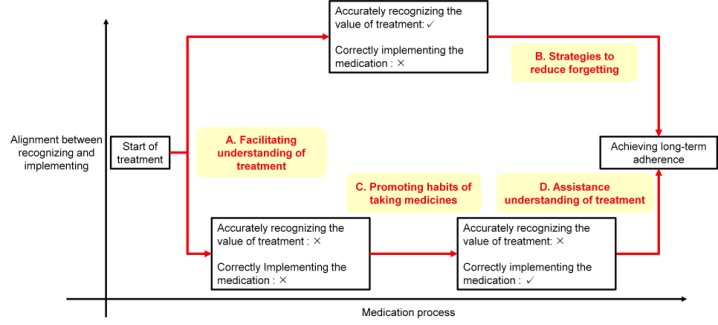
Furthermore, even for actions that have already become habitual, appropriate medication guidance may help individuals reassess their goals, thereby promoting self-control and strengthening their adherence to a long-term habits (Wood et al., 2007). Thus, in medication therapy, two distinct routes can be proposed: understanding value and promoting habit formation. This highlights the necessity of motivational engineering for medication adherence that addresses both aspects. The framework outlining this concept is illustrated in Figure 2.
Our research group is also conducting research on chatbots to support medication adherence, incorporating insights from behavioral economics. This chatbot is designed based on Self-Determination Theory to support (C), which promotes habit formation. However, it does not yet sufficiently address support elements, such as (A), (B), and (D), which include medication guidance from healthcare professionals and measures to prevent missed doses. By utilizing the proposed framework in this way, it becomes possible to discuss in greater detail which specific target groups the developed medical device aims to serve to improve medication adherence. It is essential to
Motivational Engineering for Medication Adherence 153
analyze existing adherence devices and medication support systems based on this framework. By clarifying whether each support method contributes more to “value understanding” or “habit formation,” we can develop more effective designs for medication adherence support.
Figure 2: A proposed motivational framework for medication adherence (“3” indicates that the goal has been fully achieved, and “×” indicates that the goal has not been fully achieved).
CONCLUSION
In this study, we propose a medication adherence framework based on a case study using an analogy model with undergraduate thesis projects. By analyzing task execution tendencies, we gained insights into personalized interventions for medication adherence. However, this study had several limitations. First, only six undergraduate students from the Department of Mechanical Systems Engineering at Kogakuin University participated, resulting in a homogeneous sample in terms of age and academic background. Furthermore, because the analysis was based on an analogous model, excessive generalization was difficult. Additionally, the intervention period was limited to 16 weekdays, whereas medication adherence is typically a long-term issue, spanning months or even years. Although this study may capture initial behavioral changes, it is likely insufficient to provide insights into long-term habit formation and maintenance. Finally, the proposed framework is conceptual and has not yet been validated in a clinical setting. Further investigations are required for practical implementation in real-world healthcare environments.
ACKNOWLEDGMENT
This study was supported by the 2024 Kogakuin-Tokyo Medical University Collaborative Research Program.
REFERENCES
Albarracín, Dolores, Bita Fayaz-Farkhad, and Javier A. Granados Samayoa.
“Determinants of behaviour and their efficacy as targets of behavioural change interventions.” Nature Reviews Psychology 3.6 (2024): 377–392. Arakawa, Riku, Hiromu Yakura, and Mayank Goel. “PrISM-Observer: Intervention agent to help users perform everyday procedures sensed using a smartwatch.” Proceedings of the 37th Annual ACM Symposium on User Interface Software and Technology. 2024. Balkrishnan, Rajesh. “The importance of medication adherence in improving
chronic-disease related outcomes: What we know and what we need to further know.” Medical care 43.6 (2005): 517–520. Claassen, Dirk, et al. “Money for medication: financial incentives to improve medication adherence in assertive outreach.”Psychiatric Bulletin 31.1 (2007): 4–7. Cross, Andrew, et al. “99DOTS: A low-cost approach to monitoring and improving
medication adherence.” Proceedings of the Tenth International Conference on Information and Communication Technologies and Development. 2019. Gollwitzer, Peter M., and Paschal Sheeran. “Implementation intentions and goal achievement: A meta-analysis of effects and processes.” Advances in experimental social psychology 38 (2006): 69–119. Gilon, Karni, et al. “Analogy mining for specific design needs.” Proceedings of the
2018 CHI conference on human factors in computing systems. 2018. He, Gaole, et al. “Opening the Analogical Portal to Explainability: Can Analogies Help Laypeople in AI-assisted Decision Making?” Journal of Artificial Intelligence Research 81 (2024): 117–162. Hirai, Kei et al. “Effects of health promotion interventions using communication
strategies and nudges to encourage health behavior change.” Proceedings of the 35th Annual Conference of the Japanese Society of Health Psychology, Japanese Society of Health Psychology, 2022, in Japanese. Ikeda, Chihiro, and Daigo Misaki. “Medication monitoring from accelerometer data through a series of medication actions using neural network for medication adherence evaluation.” 2022 IEEE International Conference on Big Data and Smart Computing (BigComp). IEEE, 2022. Karagiannis, Dimitrios, Konstantinos Mitsis, and Konstantina S. Nikita. “Development of a low-power IoMT portable pillbox for medication adherence improvement and remote treatment adjustment.” Sensors 22.15 (2022): 5818. Koike, Tomoki, Xiao Ge, and Daigo Misaki. “Proposal for Engineering Education
on the Design of Autonomous Vehicles: A Pilot Study Considering Campus Locations.” Adjunct Proceedings of the 16th International Conference on Automotive User Interfaces and Interactive Vehicular Applications. 2024. Linden, Ariel, Susan W. Butterworth, and James O. Prochaska. “Motivational interviewing-based health coaching as a chronic care intervention.” Journal of evaluation in clinical practice 16.1 (2010): 166-174. Matsumura, Naohiro. “A shikake as an embodied trigger for behavior change.”2013
AAAI Spring Symposium Series. 2013 Neal, David T., et al. “How do habits guide behavior? Perceived and actual triggers of habits in daily life.” Journal of experimental social psychology 48.2 (2012): 492–498. Poirier, Therese I., and Radhika Devraj. “Pharmacy in an improved health
care delivery model using maslow’s hierarchy of needs.” American Journal of Pharmaceutical Education 83.8 (2019): 7627.
Motivational Engineering for Medication Adherence 155
Strömmer, Sofia, et al. “Behaviour change interventions: getting in touch with individual differences, values and emotions.” Journal of Developmental Origins of Health and Disease 11.6 (2020): 589–598. Wood, Wendy, and David T. Neal. “A new look at habits and the habit-goal
interface.” Psychological review 114.4 (2007): 843. World Health Organization. Adherence to long-term therapies: Evidence for action.
World Health Organization, 2003.
LISTED IN THE AHFE DIGITAL BOOKSTORE CATALOGUE
Explore the complete digital volume
Affective and Pleasurable Design
Read this individual research paper free through the original publisher, or explore the full digital proceedings book.
ISBN 978-1-964867-40-3
Explore this ISBN in the AHFE Bookstore ↗Listed in the July 2026 bookstore catalogue; search by ISBN to confirm current availability · Digital book purchase optional