Shunsuke Hirayama, Daigo Misaki (2023). Development of a Smart Pillbox with Passive RFID to Support Prospective Memory and Medication Adherence. In: Emerging Technologies in Healthcare and Medicine. AHFE Open Access, vol. 116, pp. 211–220. https://doi.org/10.54941/ahfe1004374
The economic loss due to unused medicines is estimated at be 50 billion yen, as many people do not consume or carry their prescribed medicines due to forgetfulness. One reason for this is that people forget to take or carry their medication. Many scholars have investigated smart indoor pillboxes by linking with cameras, RFID, and web applications; however, all of them are based on the condition of being at home, or requiring a human to enter the dose to be taken. The aim of this study is to evaluate the effectiveness of a new portable smart pillbox using passive RFID in the 13.56 MHz frequency band to improve medication adherence. Unprecedentedly, in this study, a critical-function prototype of a smart pillbox using a passive RFID filter in the 13.56 MHz frequency band was developed; and passive RFID was designed after conducting a solution study. An investigation was undertaken to assess the efficacy of prospective memory in enhancing medication adherence using both normal and smart pillboxes. The objective was to ascertain if the intelligent dispenser could mitigate medication discrepancies among patients newly initiated on their therapeutic regimen. 8 students in their 20s who had previously taken their medication were selected as participants. Participants performed the disengagement decision task as a background task and the action of taking medication from a pillbox as a prospective memory task. Participants were given a smartphone and were reminded by a notification if the pillbox from which they took their medication was a smart pillbox. Performance on the prospective memory task was assessed using a semi-structured questionnaire and an interview. The findings indicate that the reminder is not the precipitating factor in the diminution of prospective memory discrepancies; rather, an overestimation of one's mnemonic capabilities emerges as a salient contributor to such errors. And, the use of passive RFID in the development of smart pillboxes shows its potential contribution to reducing prospective memory errors and improving medication adherence. By examining a broader perspective, the results of the current study are promising for widespread implementation as a method to improve medication adherence.
Japan’s population is ageing at a rate unparalleled in other countries, and social security costs continue to rise in correlation with this ageing. Medi- cal care costs, which make up social security costs, are expected to increase by about 24% from 2009 to 2019. One of the most problematic wastes
of money is leftover medicines, which are not taken because people do not take them or forget to take them. One of the causes of leftover medicines is people forgetting to take their medicines. According to Japan Pharma- ceuticals, 53.9% of patients forgot to take their prescribed medication. Of these, men and women in their 20s were most likely to have leftover medi- cation, while men in their 50s were least likely to have leftover medication (Nihon Chouzai Co., Ltd, 2014). The patient backgrounds most likely to lead to left-over medication included relatively young age, eating out, irregu- lar eating habits, employment and relatively high levels of education (Ando, 2018). Although the term “forgetting to take medication” may suggest that older people or people with dementia are more likely to forget to take their medication, the proportion of people who actually forget to take their med- ication is higher in the younger age group. The act of taking medication is called prospective memory, which refers to remembering future actions. Forgetting to take medication is a phenomenon caused by human error in prospective memory. Errors in prospective memory have been shown to be more related to busy lifestyles, individual memory function and differences in health awareness than to age-related cognitive decline. To prevent prospec- tive memory errors regarding medication consumption, the use of external memory aids is effective (Yamanaka, 2006). In Japan, the ban on remote medication reminders (Ministry of Health, Labour and Welfare, 2018) will be lifted in September 2020, and the Ministry of Health, Labour and Wel- fare will launch a model project for an electronic version of the medication record book (Japan Pharmaceutical Association, 2017) in October 2022. This was introduced with the development of communication technology and is expected to develop further. Cloud data storage and information exchange via remote video connections are becoming increasingly common. As these technologies proliferate, doctors will be required to confirm whether a patient has consumed their medication by systematising the data. In addition, sys- tematizing data will reduce the burden of medical examinations and lead to appropriate treatments and procedures. Therefore, systematizing medication adherence is necessary for reducing the burden and enable appropriate treat- ment and procedures in the context of telemedicine and electronic medication records, which are becoming increasingly popular.
RELATED WORKS There have been many studies on helping patients to take their medication from many different angles. Medication non-adherence involves many differ- ent parameters, including the number of medications the patient is taking due to their condition, their lifestyle, and their willingness or unwilling- ness to take medication. Therefore, the level of medication support can vary greatly depending on where the approach is taken. In general, the greater the number of prescribed medicines, the greater the barrier to correct dos- ing. However, human errors in medication adherence in complex diseases reflect prospective and retrospective memory errors when only a few and many medicines are prescribed, respectively (Jennifer, 2016). When there are many medicines to be taken, the patient is helped by grouping the medicines
Development of a Smart Pillbox With Passive RFID 213
according to the time of day they are to be taken. In the case of prospec- tive memory errors, alerting the patient of the errors is necessary. This is achieved through medication adherence counselling with the patient’s physi- cian and the use of external reminders. The development of a system that monitors the patient’s vital parameters and transmits them to a remote physi- cian’s smartphone, as well as the construction of a hybrid drug delivery system (Naveen, 2019) that allows the physician to remotely administer drugs and give instructions after confirming the patient’s vital parameters, will help improve medication adherence. This system improves adherence with the doctor. When using external reminders, the reminder function of smartphone applications (Sakineh, 2017) and smart pillboxes (Al-Shammary, 2018) can be used and recorded for proper medication management. Primary care patients who reported accidentally forgetting to take their medication were 2.4 times more likely to want to use a smart pillbox, and cardiac patients were almost four times more likely to want to use a smart pillbox (Edmond, 2019). This indicates a high demand for smart pillboxes. In addition, the use of RFID in smart pillboxes increases convenience: RFID tags monitor and control the opening and closing of the pillbox and display the name of the medication, administration time, notes and other relevant information on a touch screen to encourage patients to regularly adhere to their medication consumption (Tao, 2015). The use of monitoring, smartphone applications, smart pillboxes and other devices has been shown to help patients take their medicines (Faiz, 2013). However, smart pillboxes and monitoring can only be used indoors, and smartphone applications only notify the user and do not know whether the medication itself is being taken. In addition, although there are medicine cabinets with RFID functionality, they use 920 MHz RFID, which is a costly radio wave method for readers.
METHODS
A study was conducted to explore the critical features of the Smart Pill- box to reduce prospective memory errors and improve medication adherence with the patient’s primary care physician. The Smart Pillbox was studied to improve medication errors not only for people who take their medication on a daily basis, but also for novices who have just started taking their medi- cation. The study focused on the development of a portable smart pillbox, from needs assessment to prototype production and evaluation.
Validating the Functionality of a Smart Pillbox to Reduce Medication Errors First, there are several methods to manage and identify medicines, such as measuring the mass of the medicine (Corey, 2010), machine learning from camera images (Faiz, 2013), measuring the light intensity of LED lights (Matsumoto, 2013) and using automatic recognition technology in RFID systems. Among these, a passive RFID system was adopted because it can manage and identify medicines on a small scale for the development of portable pillboxes. In this study, an RFID system was implemented using two RFID units for the M5stack operating in the 13.56 MHz frequency band as
214 Hirayama and Misaki
readers and a white circular label with an NTAG215 chip as a passive tag. The detection ranges in the parallel direction were 2.8 cm and 1.8 cm vertically and horizontally, respectively. Secondly, the system’s portability mitigates medication discrepancies attributed to patient amnesia. Consequently, an approach to preclude the omission of the pill dispenser was explored.
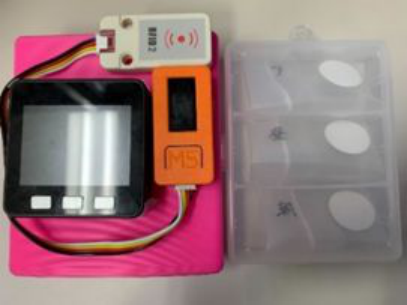
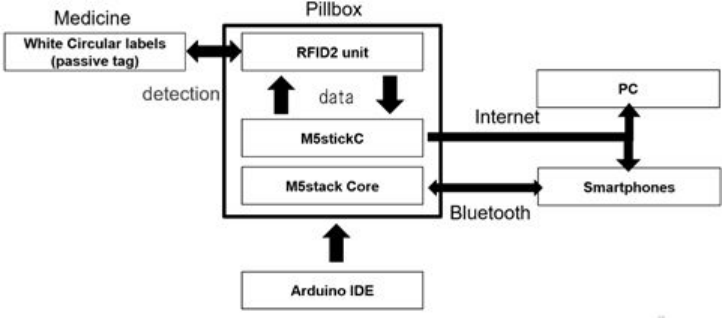
Figure 1: Overall view of the smart pillbox (CFP).Figure 2: System block diagram.
An empirical evaluation was executed, juxtaposing a time-fixed notifica- tion mechanism with a Bluetooth connectivity-based alert system, triggered upon range disconnection, to ascertain the superior methodology in amelio- rating the likelihood of neglecting the dispenser. A survey was disseminated to eight participants engaged in the study. Of these, seven concurred that the Bluetooth connectivity approach was commensurate with, if not superior to, the prescheduled notification technique, implying that instantaneous alerts may be more congenial for users. Finally, methods to reduce human error in prospective memory were investigated. The cause of human error in prospec- tive memory is due to busy lifestyles, and the use of external memory aids such
Development of a Smart Pillbox With Passive RFID 215
as reminders has been shown to be effective. Visual reminders can also help to remind people to take their medication at the same time (Al-Shammary, 2015). In addition, users need to be aware of the importance of the medica- tion in order to make it a habit. Communication with a health professional is essential to understand the importance of medication. It is said that improv- ing medication adherence with the doctor in charge can reduce prospective memory errors (Paul, 2001).
Critical Functions of Smart Pillbox After exploring and narrowing down the needs so far, the critical functions of the smart pillbox in this study were defined. As for the pillbox itself (see Figure 1), based on the measurement results of the detection range of the two RFID units, a passive tag is attached to the separate box that holds the bag in which the medicines are packaged, and each tag is detected by storing it in the smart pillbox, and a sliding system is realised. The proposed smart pill- box uses a passive RFID system, which contributes to a smarter and smaller pillbox through smooth identification of medicines. The aim of this study is to improve inappropriate medication taking by preventing forgotten and mistaken medicines and forgetting to take the pillbox. There are three pos- sible ways of preventing forgotten and incorrectly taken medicines: first, by notifying the user; second, by warnings from the medicine box; and third, by improving medication adherence: the first and second are done to make the user aware of inappropriate medication; the third is to build a good relation- ship with the doctor or pharmacist so that the patients themselves understand the disease and the medicines. These methods are implemented in the Smart Pillbox. Our smart pillbox has the ability to send notifications to users on LINE using passive RFID to manage and identify the medicines. Alerts from the pillbox were realised by turning on the LEDs of the M5stickC mounted on the smart pillbox. Improved medication adherence was achieved by recording inappropriate medication use on a Google Spreadsheet and sending a notifi- cation to the doctor or pharmacist by sending it to slack. From the study of a method to prevent forgetting to take the pillbox, a Bluetooth connection with a smartphone was used (see Figure 2). A passive RFID tag was attached to a bag containing a packet of medicines that were supposed to be taken after breakfast, with the identification number 1. Similarly, the lunch dose was designated as 2 and the dinner dose as 3.
EXPERIMENTAL DESIGN A rigorous investigation was undertaken to scrutinize prospective memory’s role in enhancing medication adherence utilizing both normal and smart pillboxes. A cohort of eight undergraduates in their twenties, all of whom had prior experience with medication intake but none with a smart pillbox, were enlisted for participation. The primary objective was to discern if a smart pillbox could attenuate medication discrepancies in neophytes initiat- ing medication. The experimental design incorporated both a background task and a prospective memory task, echoing the Einsteinian paradigm for enhanced variable control (Einstein, G. O., 1990). The background task was
216 Hirayama and Misaki
constructed as a non-congruent decision-making activity, as it is instrumen- tal in examining spontaneous recollection in prospective memory (Imai, H., 2007). Explicitly, quartets of images were concurrently showcased, and par- ticipants adjudicated incongruities in meaning or concept. This background task spanned 60 trials, practice sessions excluded, and was compartmen- talized into three sets of 20 trials. The prospective memory task mandated participants to retrieve medicine from the pillbox during the third set. With the normal pillbox, no mnemonic cues were provided. Conversely, with the smart pillbox, a recall cue was presented. For the purposes of this investiga- tion, normal and smart pillboxes are defined as a pillbox without notification and a pillbox with notification, respectively.When performing the task, par- ticipants were asked to explain the function of the smart pillbox and then to take out the medication.
Table 1. Experimental design.
Table available in the original PDF paper.
Participant group A Participant group B The first experiment Don’t receive notification using Normal Pillbox Receive notification using Smart Pillbox The Second experiment
Receive notification using Smart Pillbox
Don’t receive notification using Normal Pillbox
Table 2. Relationship between the two experiments and the prospective memory task.
Table available in the original PDF paper.
First Experiment
Second Experiment (8 persons) (8 persons)
1 3
Performing a prospective memory task 7 5 Failure to perform a prospective memory task
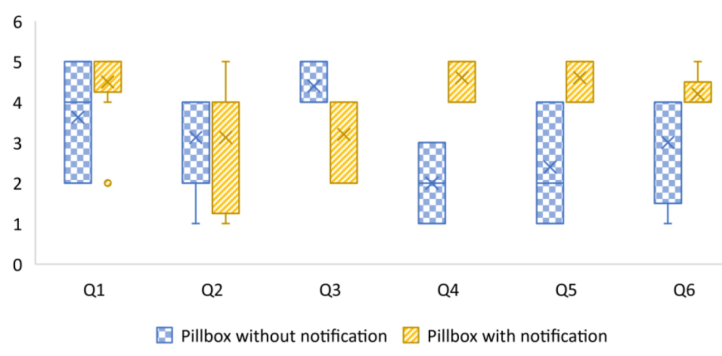
The independent variable was bifurcated into the presence or absence of mnemonic cues. The dependent variable comprised the accuracy percent- age of prospective memory task recall. To gauge behavioral modifications, participants underwent sequential experimental conditions. For counterbal- ance, half of the participants, designated as Group A, were initiated under the no-cue condition, whereas the other half, Group B, commenced with the cue-provided condition (see Table 1). Subsequent to the experimental phase, participants were subjected to a semi-structured survey and interview. The survey encompassed two inquiries (Q1-Q2) addressing the prospective memory task and an additional four queries (Q3-Q6) assessing the pillbox. It’s imperative to acknowledge that all feedback was encapsulated within a five-tier Likert scale, ranging from 1 (strongly disagree) to 5 (strongly agree).
RESULT
In the evaluative metrics of the prospective memory task, the pillbox without notification, yielded a performance rate of 62.5% (5 out of 8 participants).
Development of a Smart Pillbox With Passive RFID 217
In contrast, the pillbox with notification, manifested an 87.5% rate (7 out of 8 participants). During the first experimental phase, 62.5% (5 out of 8) exhib- ited cognizance of the prospective memory task within the first and second sets of the background task. In a subsequent assessment, 87.5% (7 out of 8) demonstrated awareness during the first two sets of the background task, whereas only half (50% or 4 out of 8) were conscious of the prospective mem- ory task during the third set. Five participants who performed the prospective memory task and used both a pillbox without notification and a pillbox with notification were included in the analysis. Data derived from the ques- tionnaire (see Figure 3) underwent statistical scrutiny utilizing the Wilcoxon signed-rank test. Within the purview of this research, wherein juxtapositions between the ratings of normal and smart pillboxes were undertaken, a p-value less than 0.05 was deemed statistically significant in a two-tailed test.
Figure 3: Result of questionnaire: Q1-Q2 is a prospective memory task questionnaire. Q3-Q6 is a questionnaire about the pillbox. Q1) Were you aware of the prospec- tive memory task in group 3 of the background task? Q2) Were you aware of the prospective memory task in groups 1 and 2 of the background task? Q3) Is the pillbox portable? Q4) Do you think the pillbox will help you remember to take your medi- cation? Q5) Do you think the pillbox will improve communication with an attending physician? Q6) Would you like to use this pillbox in real life?
Noteworthy distinctions were not evident between the ratings of the two dispensers in Q4 (Z = −2.03, p = .042, r = −.909), Q3 (Z = −1.7, p = .09, r = −.76), and Q5 (Z = −1.91, p = .056, r = −.856). However, for Q6 (Z = −1.7, p = .09, r = −.759), the disparities were statistically signif- icant. During the in-depth interviews, a unanimous preference for the smart pillbox over its normal counterpart was discerned among respondents. How- ever, reservations surfaced regarding the potential augmentation in weight and dimensions attributable to the RFID system’s integration. While the reminder functionality proves efficacious in mitigating prospective memory lapses, amplifying user cognizance through the incorporation of auditory and vibrational alert modalities is recommended. Leveraging machine learning to predict medication intake timings aligned with an individual’s daily rhythm,
218 Hirayama and Misaki
and subsequently auto-adjusting alert schedules, might prove beneficial. in this investigation, a solitary individual exhibited a propensity to depend on the reminder alerts. in the pillbox without notification, a significant 62.5% (5 out of 8) remained oblivious to the absence of reminders. Conversely, within the context of the pillbox with notification, 75% (6 out of 8) were unaware of the notification. Furthermore, all seven participants who trialed the smart pillbox expressed an inclination to incorporate RFID technology in their pillbox.
DISCUSSIONS While the embedded reminders in experiment enhanced success in dimin- ishing prospective memory errors, a notable 75% of participants remained oblivious to these prompts, with many relying predominantly on their innate recollection capabilities. Notably, a participant who intended to lean on the reminder became ensnared by the background task, overlooking the prompt and subsequently neglecting the prospective memory task. This evi- dence posits that the reminders weren’t the paramount factor in diminishing prospective memory errors. As participants who failed in the first experiment endeavored to rely on self-recollection in the second trial, their propensity to be aware of the prospective memory task during the preliminary segments of the background task was amplified in the latter experiment. It’s conceiv- able that two more participants failed the prospective memory task during the second experiment due to overestimation of their mnemonic prowess, having succeeded previously (see Table 2). The empirical outcomes from the prospective memory task infer that an inflated confidence in one’s mnemonic capacities stands as a potential catalyst for prospective memory lapses. Given the pronounced disparities in gauging medication adherence amelioration by deploying the smart pillbox, its pivotal functionalities—namely user alerts, medication logging, and clinician notifications—might be instrumental in diminishing prospective memory errors and bolstering medication adher- ence. Further, the consensus underscoring the augmentation of auditory and tactile alert systems underscores the quintessence of multi-sensory feedback in enhancing user awareness, thereby mitigating diminishing prospective memory errors. This intimates that an enriched tactile feedback system could potentially truncate everyday prospective memory errors by thwart- ing sensory information obstruction. The proposition of automated reminder adjustments insinuates that synchronizing medication intake reminders with actual intake timings could be pivotal in diminishing prospective memory errors. This hypothesis is grounded in the idea that while reminders are inscribed as novel prospective memories upon arrival, a deluge of ancillary information is concurrently assimilated. The interviews also suggest that the sliding method of using the smart pillbox is an effective way of exploiting the short range of passive RFID. This is seen as a good combination that exploits the characteristics of passive RFID to respond to fast tag movement.
CONCLUSION
The use of passive RFID to develop a smart pillbox to support prospective memory and medication adherence was investigated. Following an intricate
Development of a Smart Pillbox With Passive RFID 219
delineation of the requisites for a smart pillbox, a prototype was metic- ulously crafted and subsequently assessed via a semi-structured evaluative instrument, coupled with an empirical study targeting prospective mem- ory augmentation pertinent to medication adherence in both normal and smart pillboxes. The empirical evidence posits that reminders weren’t the paramount factor in diminishing prospective memory errors, but paradox- ically may exacerbate such discrepancies through engendering an unwar- ranted self-assuredness in an individual’s mnemonic prowess. A smart pillbox with a sliding scale system using passive RFID could help reduce prospective memory errors and improve medication adherence, and could potentially improve inappropriate medication use. In addition, multisensory feedback and reminders can reduce prospective memory errors. However, the smart pillbox must have a feature that encourages the user to use and need the smart pillbox. In the future, conducting user studies on people who need to con- sume medications daily will be necessary. In addition, synchronization with a device that can monitor user behavior in real-time is necessary to further improve medication adherence.
ACKNOWLEDGMENT
We gratefully acknowledge the support of the collaborative research project between Kogakuin University and Tokyo Medical University in conducting this research.
REFERENCES
Ando, Ito, Tanaka et al. (2018). “Current status and background factors of residual medication in type 2 diabetes: a questionnaire-based cross-sectional study.” Diabetes 61(6), 375–381. Corey, McCall., Branden, Maynes., Ning, J. Zhang. (2010). “RMAIS: RFID-
Based Medication Adherence Intelligence System”, 32nd Annual International Conference of the IEEE EMBS Buenos Aires, Argentina, August 31–September 4. Edmond, P. H. C. (2019). “A Pilot Study to Evaluate the Acceptability of Using a Smart Pillbox to Enhance Medication Adherence Among Primary Care Patient”, International Journal of Environmental Research and Public Health. Einstein, G. O., & McDaniel, M. A. (1990). Normal aging and prospective mem-
ory. Journal of Experimental Psychology: Learning, Memory, and Cognition, 16(4), 717–726. Faiz, M., Hasanuzzaman, Xiaodong, Y., YingLi T., Qingshan L., Elizabeth C. (2013).
Monitoring activity of taking medicine by incorporating RFID and video analysis. Netw Model Anal Health Inform Bioinforma 2:61–70. Imai, H., Ishii, Y. (2007). “Features of Spontaneous Remembering of Prospective Memory: Investigation by A Task-Content Oriented Experimental Paradigm”, Science reports of Tokyo Woman’s Christian University, Volume 58, Issue 1, pp. 139–160, Date of issue 2007–09. Japan Pharmaceutical Association. (2017). “Current Status and Challenges of the
Electronic Medication Record Book”.
220 Hirayama and Misaki
Jennifer, I., Urte, S., Claudia, K., Barbara, H., Lukas, Z., Edouard, B., Robert, T. (2016). “Prospective and retrospective memory are differentially related to self-rated omission and commission errors in medication adherence in multimor- bidity”, Applied Neuropsychology: Adult, Volume 24, Issue 6, pp. 505–511. Matsumoto, Takuya., Nakashima, Shota., Kitazono, Yuhki. (2013). “Proposal
of New Medication Sensor to Prevent Forgetting to Take Medicine”, The 1st IEEE/IIAE international Conference on Intelligent Systems and Image Processing. Ministry of Health, Labour and Welfare. (2018). “Online Medication Guidance”. Naveen, K., Surya, N. P., Preethi, P., Rajesh, K. K. (2019). “IoT Based Hybrid System
for Patient Monitoring and Medication”, EAI Endorsed Transactions on Pervasive Health and Technology 05 2019–08 2019, Volume 5, Issue 19, e1. Nihon Chouzai Co., Ltd. (August 21, 2014). “Survey of Attitudes About Leaving Prescription Drugs Untaken”: https://www.nicho.co.jp/corporate/newsreleas e/11546/ Paul, M. Cox., Steven, D’Amato., Debra, J. Tillotson. (2001). “Reducing Medication
Errors”, American Journal of Medical Quality, Volume 16, Issue 3. R. Al-Shammary, D. Mousa, S. E. Esmaeili. (2018). “The Design of Smart Medicine Box”, 26th Iranian Conference on Electrical Engineering. Sakineh, S. I., Asghar, E., Ebtesm, S., Ali, S. (2017). “Developing the Medication
Reminder Mobile Application “Seeb”“ ACTA Inform Med. 2017 JUN; 25(2): 108–111. Tao, Z., Zhaohua, L., Xuejiao, C., Weixi, X. (2015). “Intelligent Medicine Box Monitoring and Management System,” International Conference on Computer Science and Mechanical Automation. Yamanaka, Ryo. (2006). “Why people forget to take their medicines: Human error
in prospective memory,” Hokkai-Gakuen University Management Review, 3(3/4): 127–130.
LISTED IN THE AHFE DIGITAL BOOKSTORE CATALOGUE
Explore the complete digital volume
Emerging Technologies in Healthcare and Medicine
Read this individual research paper free through the original publisher, or explore the full digital proceedings book.
ISBN 978-1-958651-92-6
Explore this ISBN in the AHFE Bookstore ↗Listed in the July 2026 bookstore catalogue; search by ISBN to confirm current availability · Digital book purchase optional