Kiersten Muenchinger (2025). Consumer Perceptions of Product Recyclability for Extended Producer Responsibility (EPR). In: Ergonomics In Design and Kansai Engineering. AHFE Open Access, vol. 170, pp. 226–232. https://doi.org/10.54941/ahfe1006184
As new Extended Producer Responsibility (EPR) policies take effect this year, the demand for recyclable products compatible with municipal recycling systems is growing. In response, recycling programs are being streamlined and communications about product recycling is increasing. Companies that sell products across multiple states will need to prioritize materials that are widely accepted and easily processed within these evolving systems. At the same time, consumers will be expected to take a more active role in identifying and properly recycling the products they use. This research explores how consumers understand and evaluate recyclability. Participants were presented with sets of six drinking cups, each made from a different material: various polymers, aluminum and glass. The materials used in the cups were derived from petroleum, corn, sugar, trees, ore, and sand. Participants assessed the cups based on six qualitative design strategies for sustainability, including recyclability. The study compares perceived sustainable attributes across the different materials and highlights the interplay between material composition and consumer perceptions of recyclability. A key finding reveals that plant-based polymers are often perceived as more recyclable than petroleum-based polymers. These insights can inform product design and policy implementation aimed at improving recycling outcomes and consumer engagement.
Increasing global concern regarding waste products and materials has led to the development of Extended Producer Responsibility (EPR) policies. These policies aim to shift the responsibility for end-of-life product management from municipalities to producers, encouraging more sustainable product design and waste management practices. In the United States, Oregon is set to implement the first EPR law in July 2025 (Oregon DEQ, 2024), marking a significant step towards systemic change in recycling programs. This initiative is not isolated; sixteen other states in the US (Sustainable Packaging Coalition) are pursuing similar policies. EPR policies in the United States follow on policies that have been in practice in the European Union since the 1994 directive on packaging and packaging waste (European Union). These policies predominantly target food product packaging, including beverage
Consumer Perceptions of Product Recyclability for Extended Producer Responsibility 227
containers, encompassing a wide range of materials such as aluminum, glass, high-density polyethylene (HDPE), other polymers, metals, and composites.
Effective EPR systems rely on the active participation of all stakeholders, including producers, municipalities, and consumers. Therefore, understanding how consumers perceive the recyclability of different materials is crucial. Consumer perception plays a vital role in the success of recycling programs, as it influences their behavior and participation. However, rapid advancements in science and policy related to recycling and sustainability have led to confusion and diverse interpretations among individuals. Confusion about the benefits of recycling and the products and materials that can be recycled can result in individuals developing practices that may not align with official recycling guidelines. For example, the 2020 State of Curbside Recycling Report states that approximately 17% of material collected for recycling by weight is not recyclable and can contaminate other recyclables in the collection system (Mouw). Tseng and Hung (2017) highlighted the gaps that can exist between user expectations and perceptions of product sustainability, emphasizing the need for clearer communication and education.
To bridge this gap, it is essential to understand the emotional and cognitive factors that influence consumer perceptions. Kansei engineering, which focuses on measuring individuals’ emotional reactions to specific product attributes (Nagamachi, 1995), provides a valuable framework for this purpose. By uncovering subconscious consumer perceptions, Kansei studies can reveal insights that might otherwise be overlooked (Kang, 2011). This approach can be instrumental in developing product specifications that resonate with consumers’ understanding of recyclability and in designing effective information campaigns to promote better recycling practices. This study aims to leverage Kansei engineering principles to investigate consumer perceptions of the recyclability of various materials used in beverage containers, thereby informing the implementation and effectiveness of EPR systems in Oregon and beyond.
METHODS
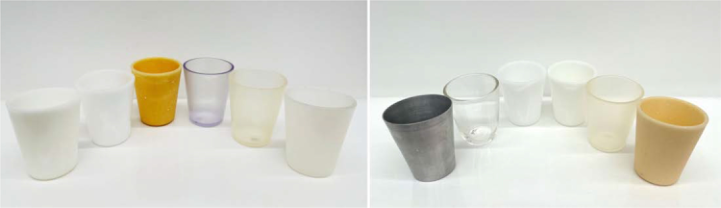
Two sets of six cups were developed and used as prompts for study participants (Figure 1). Each cup was custom-fabricated specifically for this research to ensure consistency and control over material properties and dimensions. The materials and their derivations are detailed in Table 1. Cup Set 1 was designed to represent currently available “sustainable” polymer options, and Cup Set 2 included materials that are either widely recyclable today or expected to be recyclable in the near future.
Table 1: Sample cup materials listed as viewed in Figure 1 left to right.
Table available in the original PDF paper.
Cup Name Material Derivation Cup Set 1 CUP 10 High Density Polyethylene (HDPE) Sugar CUP 3 High Density Polyethylene (HDPE) Petroleum
Continued
228 Muenchinger
Table 1: Continued Cup Name Material Derivation
Table available in the original PDF paper.
CUP 11 30% Cellulose + 70% Polypropylene (PP) Trees + Petroleum CUP 9 Copolyester Petroleum CUP 7 Polylactic Acid (PLA) Corn CUP 5 Polypropylene (PP) Petroleum Cup Set 2 CUP 1 Aluminum Rock ore CUP 4 Glass Sand CUP 3 High Density Polyethylene (HDPE) Petroleum CUP 10 High Density Polyethylene (HDPE) Sugar CUP 7 Polylactic Acid (PLA) Corn CUP 11 30% Cellulose + 70% Polypropylene (PP) Trees + Petroleum
Figure 1: Cup Set 1 (left) and Cup Set 2 (right).
Study surveys were conducted in person using the digital Qualtrics survey platform. The physical cups were distributed to the participants, providing the closest proximity of presentation (Schütte et al., 2023) for their assessment.
Participants were asked to rank each cup on six word pairs designed to target qualitative strategies of sustainable design. The word pairs are: Lasting – Degradable; Delicate – Durable; Harmless – Toxic; Natural – Artificial; Raw – Finished; Recyclable – Waste. The span of the semantic space in the domain of product sustainability (Schütte et al., 2004) is described by these word pairs. These word pairs address sustainable material selection strategies (Graedel and Allenby: 240) (Lewis and Gertsakis: 86–87). Scores were recorded using slider bars on a scale of 1–7, recorded to the tenth.
Two hundred seventy-six people participated in the Kansei cups ranking study using Set 1, and two hundred three people participated in the study using Set 2.
RESULTS
In the study of all polymer cups (Cup Set 1), the cups made with polymers derived from plants were perceived to be more recyclable than cups made
Consumer Perceptions of Product Recyclability for Extended Producer Responsibility 229
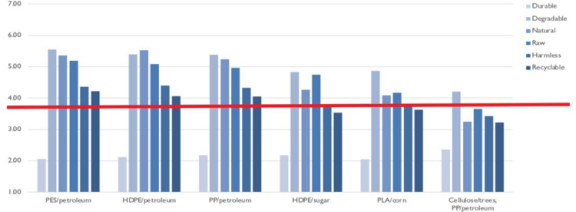
with polymers derived from petroleum (Muenchinger, 2022). In Figure 2, the darkest bar of each group is the Recyclable bar. The plant-based polymer cups are the three on the right side of the chart, and these all have lower Recyclable bars than the petroleum-based polymers on the left side of the chart. Shorter bars generally indicate a stronger perception of sustainability; 1=Recyclable, 7=Waste.
Figure 2: Average sustainability rankings of Cup Set 1 polymer cups.
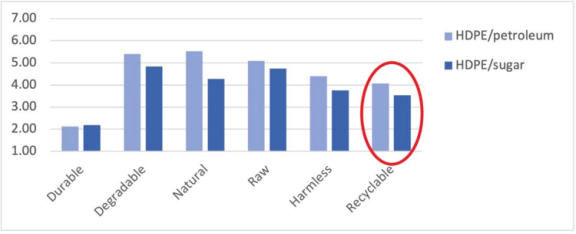
The most direct comparison is of the two High Density Polyethylene cups. The sugar-derived HDPE cup is perceived as more Recyclable than the petroleum-derived HDPE cup, as seen in Figure 3. This difference is statistically significant (alpha level = 0.05) (Muenchinger, 2022).
Figure 3: HDPE derived from petroleum and HDPE derived from sugar.
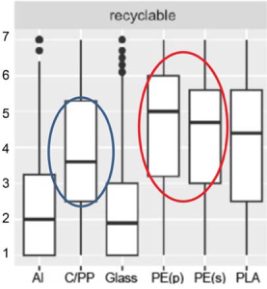
While the all-polymer study showed tightly clustered perception scores, the mixed-material study (Cup Set 2) displayed more variation, but supported findings in the polymer study. As in the all-polymer study, the sugar-based HDPE is perceived on average to be more recyclable than the petroleum- based HDPE (Muenchinger, 2024). This is seen in the box and whisker chart in Figure 4 highlighted with the red oval.
Figure 4 also shows that the composite cellulose/polypropylene cup, highlighted by the blue oval, has a stronger perception of recyclability than the other polymer cups. This result is consistent with the result from the all-polymer cup study. In Figure 2 the cellulose/polypropylene cup has the strongest perception of recyclability in the set of six polymer cups.
230 Muenchinger
Figure 4: Mixed-material Cup Set 2, including aluminum, cellulose/polypropylene, glass, HDPE from petroleum, HDPE from sugar and polylactic acid cups comparison on the Recyclable sustainability category.
The aluminum and the glass cups are seen as the most recyclable in this set. The long whiskers above the aluminum and glass boxes do show, however, that there isn’t absolute agreement about the recyclability of these materials.
DISCUSSION AND CONCLUSION This study highlights a strong alignment between consumer perceptions of recyclability and the actual reclaimability of aluminum and glass. These materials benefit from well-established municipal collection systems and state-level bottle deposit programs, which reinforce public understanding of their recyclability. With aluminum packaging achieving a 35% recycling rate overall and a 50% rate for beverage containers, and glass bottles reaching a 31% recycling rate (U.S. EPA, 2024), these materials are both practically and perceptually well-positioned for success in Extended Producer Responsibility (EPR) frameworks.
In contrast, polymers – despite being widely used – do not benefit from the same level of consumer confidence in their recyclability. This perception gap presents a challenge for EPR systems, which rely on consumer participation for effective material recovery. Interestingly, the U.S. recycling rate for HDPE bottle containers is 29% (U.S. EPA, 2024), only slightly lower than that of glass, suggesting that actual recyclability does not always align with public perception. This discrepancy underscores the importance of not only improving recycling infrastructure but also addressing the psychological and visual cues that influence consumer behavior.
The study’s findings suggest that plant-based polymers, such as sugar- derived HDPE, are perceived as more recyclable than petroleum-based polymers. This perception may stem from vague associations with “natural” or “eco-friendly” materials. Given that HDPE is already a target material for recovery and methane reduction in Oregon’s EPR planning (Oregon DEQ, 2015), promoting plant-based HDPE could enhance both consumer engagement and material recovery rates. Notably, sugar-based HDPE was rated lower in Durability than petroleum-based HDPE (in Figure 2,
Consumer Perceptions of Product Recyclability for Extended Producer Responsibility 231
Durability is the lightest bar on the left side of each material group) – an attribute that may paradoxically increase willingness to recycle, as consumers may be more willing to discard items they perceive as less durable.
Another compelling insight comes from the composite cellulose- polypropylene cup, which was consistently rated as highly Recyclable (Figures 2 and 4) despite the actual lack of recycling infrastructure for composite polymers. Visually, this cup stands out from the others due to its mottled texture and warm coloration, in contrast to the more uniform and cooler-toned appearance of the other samples. These distinctive visual characteristics: rough texture and warm hue, have been identified by Karana (2012) as influential in shaping perceptions of greater material sustainability. This suggests that visual and tactile design elements can significantly shape consumer assumptions about recyclability and indicate that such cues may be strategically employed in product design to positively influence consumer behavior and promote environmentally responsible actions such as recycling.
These results have implications for product designers, polymer developers and policymakers. Designers may incorporate visual cues that align with consumer expectations of recyclability, which can encourage participation in recycling programs. Polymer developers may invest in bio-based polymers and promote their public perceptions in recyclability in addition to other environmental benefits. Policymakers should consider not only the technical recyclability of materials but also how they are perceived by the public. Educational campaigns could help bridge the gap between perception and reality.
This research is limited by the diversity of its student-heavy participant pools and the specific set of materials tested. Future research could focus on materials specified in EPR policies, application of colors and textures, and include a more diverse participant pool to validate these findings. Longitudinal studies could explore how perceptions evolve over time with changes in the adoption of EPR policies, municipal infrastructure, and public awareness campaigns.
ACKNOWLEDGMENT
These studies were conducted with support from the University of Oregon, including the 2013 AAA Dean’s Award. Special thanks to Charlie Holden for their outstanding research assistance and to Cameron Mulder for statistical analysis. Acknowledgement given to Chat GPT, Copilot and Gemini AI tools for editing.
REFERENCES
European Union. (n.d.). European Parliament and Council Directive 94/62/ EC of 20 December 1994 on packaging and packaging waste. Retrieved May 20, 2025, from https://eur-lex.europa.eu/legal-content/EN/TXT/ ?uri=celex%3A31994L0062. Graedel, T. T., Allenby, B. R. (1995). Industrial Ecology. Englewood Cliffs, NJ: Prentice-Hall. Kang, N.-G. (2011). Design approach to improve Kansei Quality based on Kansei
Engineering. IntechOpen.
232 Muenchinger
Karana, E. (2012) Characterization of ‘natural’ and ‘high-quality’ materials to improve perceptions of bio-plastics. Journal of Cleaner Production. 37, 316–325. Lewis, H., Gertsakis, J. (2001). Design + Environment: A Global Guide to Designing
Greener Goods. Sheffield: Greenleaf Publishing Limited. Mouw, S. (2020) The Recycling Partnership. 2020 State of Curbside Recycling. Retrieved May 20, 2025, from https://recyclingpartnership.org/wp- content/uploads/dlm_uploads/2020/02/2020-State-of-Curbside-Recycling.pdf. Muenchinger, K. (2022). Material derivation affects the perception of sustainability in polymer products. Proceedings of the 9th International Conference on Kansei Engineering and Emotion Research. Barcelona. Muenchinger, K. (2024). Expressed material derivations influence perceptions of
product sustainability. Proceedings of the 10th International Conference on Kansei Engineering and Emotion Research. Taichung. Nagamachi, M. (1995). Kansei Engineering: A new ergonomic consumer- oriented technology for product development. International Journal of Industrial Ergonomics. 15, 3–4. Oregon DEQ. (2024) Retrieved May 15, 2025, from https://www.oregon.gov/deq/ recycling/pages/modernizing-oregons-recycling-system.aspx. Oregon Department of Environmental Quality. (2015, January). Plastics recovery
assessment [PDF]. https://www.oregon.gov/deq/FilterDocs/plasticRecovery.pdf Schütte, S. T. W., Eklund, J., Axelsson, J. R. C. and Nagamachi, M., (2004). Concepts, methods and tools in Kansei engineering. Theoretical Issues in Ergonomics Science, 5(3), pp. 214–231. Schütte, S., Lokman, A. M., Coleman, S. and Marco-Almagro, L., (2023). Unlocking
Emotions in Design. 1st ed. Books on Demand. Sustainable Packaging Coalition. (n.d.). Extended Producer Responsibility (EPR). Retrieved May 15, 2025, from https://epr.sustainablepackaging.org/. Tseng, S.-C., & Hung, S.-W. (2013). A framework identifying the gaps between customers’ expectations and their perceptions in green products. Journal of Cleaner Production, 59, 174–184. U.S. Environmental Protection Agency. (2024, August 27). Aluminum: Material-specific data. EPA.gov. Retrieved May 15, 2025, from https:// www.epa.gov/facts-and-figures-about-materials-waste-and-recycling/aluminum- material-specific-data. U.S. Environmental Protection Agency. (2024, August 27). Glass: Material-specific
data. EPA.gov. Retrieved May 15, 2025, from https://www.epa.gov/facts-and- figures-about-materials-waste-and-recycling/glass-material-specific-data. U.S. Environmental Protection Agency. (2024, August 27). Plastics: Material-specific data. EPA.gov. Retrieved May 15, 2025, from https://www.epa.gov/facts-and- figures-about-materials-waste-and-recycling/plastics-material-specific-data.
LISTED IN THE AHFE DIGITAL BOOKSTORE CATALOGUE
Explore the complete digital volume
Ergonomics In Design and Kansai Engineering
Read this individual research paper free through the original publisher, or explore the full digital proceedings book.
ISBN 978-1-964867-46-5
Explore this ISBN in the AHFE Bookstore ↗Listed in the July 2026 bookstore catalogue; search by ISBN to confirm current availability · Digital book purchase optional