Sylvia Guillory, Anna Jane Brown, Dawn Debrodt, Chad Peltier, Jeffrey Bolkhovsky (2025). Cognitive and Task Predictors of Naval Submarine School Academic Performance: A Pilot Study. In: Human Error, Reliability, Resilience, and Performance. AHFE Open Access, vol. 173, pp. 50–60. https://doi.org/10.54941/ahfe1006281
Retaining highly qualified and trained service members (SMs) is critical for maintaining the readiness of the U.S. military to execute its mission. Unplanned losses, related to SM termination before completing their first contract, harm readiness and incur unanticipated expenses. Improved prediction of a SM’s academic performance during initial skills training could improve operational outcomes by reducing SM separations related to poor grades. Cognitive assessments that evaluate skills specific to military occupational specialties may help predict training performance, yield opportunities for customized intervention, or guide the selection of SMs to jobs that match their cognitive skills and abilities. We compared three machine learning algorithms (linear discriminate analysis [LDA], K-Nearest Neighbors [KNN], and Support Vector Machine [SVM]), which classified the initial skills training scores of 22 SMs as low (score cut-off < 75%) or high (score cuff-off >85%) on five separate exams administered during military ascension training, using performance on a ten-task cognitive assessment battery. The battery measured neurocognitive domains of attention, visual learning, working memory, abstraction, and vigilance. The cut-off scores characterized the lower and upper performance range. The resulting models exhibited modest predictive capabilities in classifying academic exam performance, with recall and precision performance in the 50th and 60th percentile. Only the KNN and SVM models exhibited better-than-chance classification performance (p < .001). Separately, correlational analyses found that performance on a simulated sonar task accounted for 31% of the variance in academic performance. The findings of this study imply that future research should add these promising cognitive measures to aid in screening and help more students achieve academic success.
Retaining service members (SMs) is important for maintaining the readiness of the United States military and its missions. A Department of Defense (DoD) report found that almost 140,000 active duty enlisted SMs separated from the military in 2020 (U.S. Department of Defense, 2021). SMs of particular interest are those who separated prior to the completion of their first-term of enlistment, a number which has been a growing in the Navy since the 1980s
Cognitive and Task Predictors of Naval Submarine School Academic Performance 51
and 1990s (Cymrot & Parcell, 2000). (The first-term encompasses bootcamp, initial skills training, and fleet assignment). There have been reports that approximately 20% of new recruits across all branches of the military do not complete their first-term (Marrone, 2020).
Factors contributing to SMs’ separation vary widely, from social and economic stressors to incompatibility with their occupational specialty. Unfortunately, exact figures on the scope of first-term academic attrition are not available, as these data are not published. However, one analysis showed that 31% of attrition in the first six months of service were due to performance problems, of which academic capacity was one category (U.S. Government Accountability Office, 2000).
First-term attrition during or following initial skills training is a concern due to the direct expenses related to replacing and training recruits (Marrone, 2020). Enlisted SMs receive skill or technical training based on their designated occupation specialty (e.g., Sonar Technician, Hospital Corpsman, etc.) at an initial training school. In the Navy, this is called Accession School (“A-school”). The technical knowledge A-school students learn is assessed by their performance on written unit tests and demonstration of skills during hands-on tasks. Recruits are required to pass unit tests to go on to their next duty station. Unit test scores are conceptually similar to the grading system used in schools in the United States in which academic achievement is predictive of occupational status (Strenze, 2007).
Given the high investment in training new recruits, tools that can identify early predictors of academic achievement in A-school may be cost- and time effective for reducing first-term attrition and improving academic performance. While pinpointing the exact scope of academic-related attrition may not be possible, data that show a significant correlation between cognitive ability (measured by the Armed Services Vocational Aptitude Battery [ASVAB]) and first-term attrition suggest the importance of cognitive aptitude to military success (Brown et al., 2019; Buddin, 2005). Prior research demonstrated that cognitive abilities, including general intelligence (Schmidt & Hunter, 2004) and working memory (Higgins et al., 2007), are among the best predictors of job performance (Dunnette, 1976; Hunter, 1986; Kanfer, 1990). Moreover, the greater the disconnect between cognitive ability and the cognitive job requirements, the higher the probability of job turnover (Maltarich et al., 2010). Higher compatible matches between a service member and their military specialty are more likely to result in completion of initial training in the Navy (Department of Navy, 2012).
The ASVAB is used to inform job classification, with the U.S. military having demonstrated its relationship to job proficiency (Martin et al., 2020). However, ASVAB scores may not accurately reflect which cognitive abilities are necessary for success during academic training, making it difficult to distinguish between the students who will succeed and those who may require additional assistance. Researchers have found limitations of the ASVAB in measuring problem solving, processing speed, or attentional control (Hambrick et al., 2023; Held et al., 2014; Martin et al., 2020). Specifically, measuring air traffic controller trainees’ processing speed and spatial ability added significant incremental validity to the ASVAB for predicting academic
success and attrition during training (Brown et al., 2019). Augmenting the ASVAB with additional neurocognitive tests to capture cognitive aspects not well represented on the ASVAB, such as attentional control, psychomotor, and spatial abilities, may provide greater insights into the unique needs of each military trainee both during and after their academic training.
The first aim of this study was to investigate the predictive value of basic cognitive domains and processes in differentiating high and low academic performance during A-school training at the Naval Submarine School (NAVSUBSCOL), especially those with an expected rate of sonar technician (submarines) using supervised machine learning classification models.
The second aim of the study was to explore the relationship between academic performance of those students that completed initial training and their behavioral performance on a simulated sonar task. The simulated sonar task was developed to investigate operator performance under various controlled environmental scenarios to supply greater insights into cognitive processes during a complex task with military relevance (Peltier et al., 2024). The value of the simulated sonar task, if it can predict NAVSUBSCOL student academic achievement—i.e., a reflection of a student’s knowledge and practical application—would further validate the simulated sonar task as able to capture the key cognitive components necessary for the execution of a sonar technician’s duties. In short, understanding why military personnel are successful in their early military training can help with developing strategies to predict and prevent unplanned losses and enhance overall military effectiveness.
METHOD
Participants Participants were 22 individuals (mean age: 20.91 years, SD = 3.12) recruited from the Naval Submarine School (NAVSUBSCOL) in Groton, Connecticut. Only male participants volunteered for this study (males comprise 79.1% of Navy members). All participants started the study in the initial month of their first stage in technical training for their specific military occupation specialty and were tested prior to receiving any formal training in sonar. Participants were compensated $20.00 per hour, with data collection completed in approximately two hours. Of the 22 participants recruited, all (100%) gave an expected rate of sonar technician. Procedures were approved by the Naval Submarine Medical Research Laboratory (NSMRL) Institutional Review Board (IRB, protocol number: NSMRL.2022.0015). All participants signed informed consent.
Procedure Following informed consent, participants completed a demographic questionnaire and a cognitive assessment battery (CAB) followed by the sonar simulator task. The tasks were administered using a 15.6′′ Dell Precision 7550 laptop. During the sonar simulator task, participants used over-the-ear headphones and the computer’s volume was set to 50%.
Cognitive and Task Predictors of Naval Submarine School Academic Performance 53
Cognitive Assessment Battery The CAB consisted of ten tasks that were performed in a fixed order as determined by the software which considers it the standard order of administration with this battery and the CAB assessed performance in different cognitive domains (Basner et al., 2015). The tasks assessed were: sensory motor speed (motor praxis task [MPT]); spatial learning and memory (visual object learning task [VOLT]); working memory (N-Back); concept formation (abstract matching [AMT)); spatial orientation (line orientation task [LOT]); emotion identification (emotion recognition [ERT]); abstract reasoning (matrix reasoning [MRT]); complex scanning and visual tracking (digit symbol substitution [DSST]); risky decision-making (balloon analog risk task [BART]); and vigilant attention (psychomotor vigilance task [PVT]). Stimulus presentation was controlled by the NASA Cognition software application. Responses were recorded with a mouse and the laptop’s keyboard. All tasks featured a brief practice before the test except the VOLT and BART. It took approximately 30 minutes to complete the CAB.
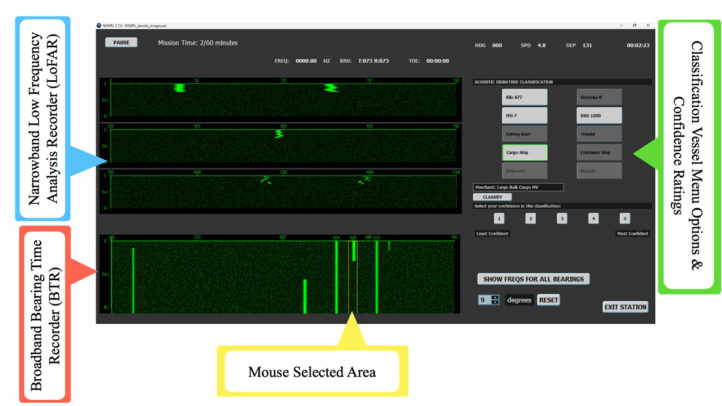
Military-relevant Experimental Paradigm An unclassified sonar simulator software application was used as a military- relevant task (Peltier et al., 2024). The task simulates some sonar technician duties, with an interface consisting of three window panels: a broadband trace recorder (BTR), a low frequency analysis recorder (LoFAR), and a menu option consisting of vessel tactical groups and submission responses (Figure 1). Participants were instructed to scan and search the BTR for signals. After detecting a signal, they had to click the area to highlight the signal. When highlighted, a signals’ signature would display on the LoFAR panel and participants would hear the audio associated with that vessel type. In the LoFAR, a vessel signature consisted of a combination of six different frequencies that uniquely defined a vessel type. Using a paper guide containing the signature definitions for each vessel type, participants were asked to judge the spatial locations of each component frequency of the signature to signal to determine which vessel type best matched. Participants then selected and submitted the vessel type from the menu panel and rated their confidence in their classification on a scale of 1 (least confident) to 5 (most confident). The application controlled the stimulus timing and recorded responses.
Participants were given time to familiarize themselves with the sonar simulator interface in a 20-minute practice scenario. Participants then completed a 60-minute test scenario in which they were expected to detect 144 vessels and classify each as belonging to one of the following four vessel types: Kilo-887, Zumwalt DDG-1000, FFG-7 Oliver Perry class, or large bulk cargo MV. The vessel types were balanced, with 36 of each vessel type appearing in the scenario. Each vessel was visible for 120 seconds. On average, 2.4 vessels were visible per minute. The vessels in the scenario appeared in a fixed order such that the time and bearing location of the signal appearance were pre-defined and the same across participants. Vessel placement in the scenario required that no signal could appear at the same
bearing and in enough of the same time frame to overlap with another vessel. The strength or intensity of the visual signal ranged from Levels 1 to 6 (40, 60, 80, 100, 120, and 140 decibels [dB]) with an ambient background noise of 40 dB. For each increment in the signal strength level the width of the signal increased by one pixel, and the saturation of the color component of the signal changed by ±11%. Only vessel types that appeared in the scenario were available for participants to select from the classification menu options.
Figure 1: Sonar simulator application graphical user interface. Bottom window panel (framed in red) contains the broadband bearing time recorder (BTR). The participant selects signals (vertical green lines) using the mouse to capture signals over an area (framed in yellow) that filters the top three window panels of the narrowband low frequency analysis recorder (LoFAR) display (framed in blue). Vessel types are displayed on the right. After a participant selects a vessel type and a signal is present at the location, the “Classify” button is enabled. When a response is submitted, the confidence rating option becomes visible.
Navy School Academic Performance Academic performance was measured with exams completed during the participant’s first stage in technical training for their specific military occupation specialty at NAVSUBSCOL. Students completed five paper-and- pencil exams (Exam I-V). Exam scores ranged on a scale of 0 to 100 percent, such that 100 indicated a perfect score and 0 indicated the poorest achievement. Exam V was a comprehensive test covering materials from Exam I through IV.
Data Analysis Cognitive Assessment Battery pre-processing: The NASA Cognition application provided standardized scores for each CAB test. The standardized score ranged from 0 (the lowest possible performance) to 1000 (the highest
Cognitive and Task Predictors of Naval Submarine School Academic Performance 55
possible performance). The standardized score was dependent on both speed and accuracy, such that an individual must be both fast and accurate to get a perfect score. Two participants were excluded from CAB analysis for having an incomplete session. The standardized scores were used as predictors or features in the machine learning prediction models of exam performance.
Navy School Exam pre-processing: NAVSUBSCOL exams (Exam I-V) were used as the outcome variable in the prediction model. During NAVSUBSCOL, an exam was re-taken if a student scored less than 70%, and the average score across all attempts was used as the final score for that exam. NAVSUBSCOL did not provide scores for eight participants on Exam I. Five participants did not have an Exam V as they did not complete the sonar technician training. Exam scores were transformed into low- or high-performance categories, with cutoffs capturing the exam performance within the top and bottom third of the score distribution, which created similar sized groups of low and high exam performance. Low performance was defined as an exam score less than 75% and high performance was a score greater than or equal to 85%. Scores between 75–85% were not included in the machine learning models analysis.
Comparing performance across cognitive tasks: Using the previously mentioned low- and high-performance thresholds to categorize scores, group differences in CAB feedback scores were tested using linear mixed models with ‘group’ as a fixed factor and ‘participant’ as a random effect. The α level was p = .05 with 2-tailed testing, and analyses were conducted with R Statistical Software version 4.4.1 (Team, 2020) with the nlme (version 3.1-164) package. Exploratory analyses results were not corrected for multiple comparisons.
Machine learning models: Three machine learning classification algorithms were applied to predict academic performance category: linear discriminant analysis (LDA), support vector machine (SVM, linear kernel), and k-nearest neighbors (KNN). The ten CAB standardized scores were used as the predictor variables and academic performance on the exams I-V (low, high) comprised the outcome variable.
The dataset was split with 70% designated as the training set and 30% as the test set. During training, model evaluation was carried out using leave- one-out cross-validation to minimize overfitting and to assess the predictive capabilities of the models. For five separate iterations, the models were trained and tested on randomly sampled sets, producing five sets of results which were then aggregated to account for the exclusion of data points from the training set. Performance of the models was measured using an accuracy, precision, recall, F1-score and receiver operator curve–area under the curve (ROC-AUC).
To determine whether the performance attained from the trained models was not the result of chance, the models were compared to a random model using a permutation test. To simulate a random model, the assignment of the outcome variable (exam performance) was randomly shuffled (n = 1000 permutations) to the corresponding CAB features. Then, the proportion of permutations that were more extreme than the observed accuracy was
calculated as the p-value, such that minimum proportion was p < .001 (i.e., from 1/1000). Data processing and analysis were performed in R Statistical Software version 4.4.1 (Team, 2020) with the caret (version 6.0-94) package.
Sonar Simulator Task Relationship to Academic Achievement: A second aim of this study was to evaluate the relationship between a participant’s performance on the sonar simulator task and their NAVSUBCOL final grades. Correlations were performed between the sonar performance measure (total errors = [miss errors + misclassification errors + incomplete error]/possible responses [identifying all 144 vessels]) and the Exam V percentage score. Exam V was used as it was the comprehensive exam and consisted of students that completed A-school. Miss errors comprised errors where the participant failed to classify a signal. This could be due to not identifying a signal or not selecting the signal within the 120 seconds allotted. Misclassification errors occurred when participants did not correctly identify the vessel and an incomplete error occurred when a participant selected a vessel to classify but did not submit the response. Data analysis was performed in SPSS version 23 (IBM Corp) with Pearson correlations and the α level was p = .05 with 2-tailed testing. As exploratory analyses, results were not corrected for multiple comparisons.
RESULTS
Comparing Performance Across Cognitive Tasks CAB performance is shown in Table 1. The CAB line orientation task (LOT) differed by A-School exam performance group, such that the high exam group performed better than the low exam group (p = .016). No other CAB task significantly differentiated between high and low academic performance.
Table 1: Cognitive assessment battery performance and linear mixed model summary.
Table available in the original PDF paper.
Mean Performance (SE) Task Overall Low High p-value
Machine Learning Models The different metrics to evaluate the performance of the models and establish their effectiveness are summarized in Table 2. The models yielded similar
Cognitive and Task Predictors of Naval Submarine School Academic Performance 57
recall (average: 58%) with the KNN performing the highest (60.4%) of the three models tested, suggesting it can identify cases of low and high performance, which is critical to ensuring that individuals needing intervention are not overlooked. However, the presence of false positives as indicated by precision (58.5%) implies that some individuals in the low performance groups might be incorrectly classified as high performers and vice versa, underscoring the need for instructors to monitor academic progress and whether SMs are learning the academic materials. All three models scored similarly in the mid to high.5 range on the F1 measure, indicating average performance in which a score of one indicated perfect precision and recall and a zero signified a trade-off between precision and recall. The average ROC-AUC values (average: 65.8%) suggest that the models performed only slightly better than a random classifier. However, the accuracy of the KNN (65.08%) and SVM (65.70%) models were significantly higher than the accuracy of the chance model, p < .001, while the accuracy of the LDA model (64.50%) was not significantly different from a chance model (average accuracy: 49%) performance (p = .201)
Sonar Simulator Task Relationship to Academic achievement There was a significant correlation between target sonar simulator task performance (mean proportion error: 0.607; SD: 0.17) and A-School academic performance (mean Exam V score: 81.8%; SD: 8.36%) such that as academic scores increased the errors on the simulator task decreased (r = −.561, p = .019).
CONCLUSION
This study explored the efficacy of different machine learning models in identifying students at the high and low end of the academic performance spectrum through performance on a battery of cognitive tests. Of the three prediction models, the K-Nearest Neighbors and Support Vector Machine models performed above chance. However, these models exhibited only modest predictive capabilities with recall and precision in the 50th and 60th percentile. Nonetheless, the results highlighted how important specific cognitive domains can be for success during initial training as a sonar technician and assessed the potential translation of academic achievement of students and their performance on a simulated sonar task. Future work should focus on refining these models, possibly by integrating additional types of behavioral and non-performance measures such as measures of motivation and personality, to further improve predictive accuracy
and reduce false positives and ensure the models complement traditional academic methods.
The line orientation task (LOT) was found to differentiate low and high exam performance on its own. The LOT probes the domain of visuospatial ability. Visuospatial ability include abilities related to properties of spatial perception, spatial visualization, and mental rotation (Buckley et al., 2018). Visuospatial ability has been linked through correlational evidence to general competence of academic achievement in science, technology, engineering, and mathematics (STEM) disciplines (Hodgkiss et al., 2018; Höffler, 2010). This pattern aligns with the results, as the exams administered during A-School for sonar technicians involve STEM topics, testing knowledge in areas of physics and mathematics.
Performance on a simulated sonar task was significantly correlated with academic achievement such that as academic scores increased, the errors on the simulator task decreased. The sonar task may have incremental predictive validity over the ASVAB in predicting initial training success, suggesting it may be used in addition to the ASVAB to identify those at risk of academic struggle and potentially costly attrition for sonar technicians.
The use of machine learning models to analyze cognitive performance capabilities and patterns has promise for improving the academic performance of students by identifying early students who may need extra help and instruction. The results from this study emphasize the potential of these models to serve as effective tools in academic settings, aiding in the early detection of lower performing students. However, the potential risk of misuse of the prediction should be considered. A model used for deciding who should enter a program has the potential for creating a population that would be increasingly biased towards individuals currently in A-School and not those who could be in A-School.
Several limitations of this study are worth noting. First, the generalizability of these findings cannot be assumed. The sample size used for this study was relatively small and all males. Although the majority of current NAVSUBSCOL students are male, the proportion of females has been increasing. There is a need to examine whether these predictive models function the same for both males and females. Further development of machine learning models is needed to validate that these results are a consistent measure of A-school performance. Moreover, a larger data pool will allow higher discriminability across exams, meaning that we can model each exam separately as these exams emphasize different topics. Lastly, the academic outcomes were low and high academic performance. While differentiating between these outcomes demonstrates the promise of this method, none of the relatively lower performers were at a failure level that would have resulted in their dismissal and attrition. Determining whether these tools predict A-school failure would be useful.
As a tactical strategy of promoting military readiness, identifying cognitive factors or task performance predictive of A-School performance can better equip instructors in their teaching strategy, enhancing the relationship between the service member’s occupation selection and their cognitive capacities.
Cognitive and Task Predictors of Naval Submarine School Academic Performance 59
ACKNOWLEDGMENT
The views expressed in this paper are those of the authors and do not necessarily reflect the official policy or position of the Department of the Navy, Department of Defense, nor the U.S. Government. The study protocols were approved by the Naval Submarine Medical Research Laboratory Institutional Review Board in compliance with all applicable Federal regulations governing the protection of human subjects (protocol: NSMRL.2022.0015). This work is supported by the Military Operational Medicine Research Program under funding work unit number F2005. Some authors are military service members and employees of the U.S. Government. This work was prepared as part of their official duties. Title 17 U.S.C. §105 provides that “Copyright protection under this title is not available for any work of the United States Government.” Title 17 U.S.C. §101 defines a U.S. Government work as a work prepared by a military service member or employee of the U.S. Government as part of that person’s official duties.
REFERENCES
Basner, M., Savitt, A., Moore, T. M., Port, A. M., McGuire, S., Ecker, A. J., Nasrini, J., Mollicone, D. J., Mott, C. M., McCann, T., Dinges, D. F., & Gur, R. C. (2015). Development and Validation of the Cognition Test Battery for Spaceflight. Aerosp Med Hum Perform, 86(11), 942–952. https://doi.org/10.3357/AMHP.4343.2015 Brown, N., Foroughi, C., Coyne, J., Sibley, C., Olson, T., & Myrick, S. (2019).
Predicting attrition and performance in navy and marine corps air traffic control school. (Ed.), ˆ(Eds.). Proceedings of the Human Factors and Ergonomics Society Annual Meeting. Buckley, J., Seery, N., & Canty, D. (2018). A heuristic framework of spatial ability: A review and synthesis of spatial factor literature to support its translation into STEM education. Educational Psychology Review, 30(3), 947–972. Buddin, R. J. (2005). Success of first-term soldiers: The effects of recruiting practices
and recruit characteristics. Rand Santa Monica, CA. Cymrot, D., & Parcell, A. (2000). Quantity and Quality of Attrition. Center for Naval Analyses. Department of Navy. (2012). RIDE measures of effectiveness (OPNAV N132). Dunnette, M. D. (1976). Aptitudes, abilities, and skills. Handbook of industrial and
organizational psychology, 473–520. Hambrick, D. Z., Burgoyne, A. P., Altmann, E. M., & Matteson, T. J. (2023).
Explaining the Validity of the ASVAB for Job-Relevant Multitasking Performance: The Role of Placekeeping Ability. J Intell, 11(12). https://doi.org/10.3390/jintelli gence11120225 Held, J. D., Carretta, T. R., & Rumsey, M. G. (2014). Evaluation of tests of perceptual speed/accuracy and spatial ability for use in military occupational classification. Military Psychology, 26(3), 199–220. Higgins, D. M., Peterson, J. B., Pihl, R. O., & Lee, A. G. M. (2007). Prefrontal
cognitive ability, intelligence, Big Five personality, and the prediction of advanced academic and workplace performance. J Pers Soc Psychol, 93(2), 298–319. https: //doi.org/10.1037/0022-3514.93.2.298
Hodgkiss, A., Gilligan, K., Tolmie, A., Thomas, M., & Farran, M. (2018). Spatial cognition and science achievement: The contribution of intrinsic and extrinsic spatial skills from 7 to 11 years. British Journal of Educational Psychology, 88(4), 675–697. Höffler, T. (2010). Spatial ability: Its influence on learning with visualizations—a
meta-analytic review. Educational Psychology Review, 22, 245–269. Hunter, J. E. (1986). Cognitive ability, cognitive aptitudes, job knowledge, and job performance. Journal of vocational behavior, 29(3), 340–362. Kanfer, R. (1990). Motivation and individual differences in learning: An integration
of developmental, differential and cognitive perspectives. Learning and Individual Differences, 2(2), 221–239. Maltarich, M., Nyberg, A., & Reilly, G. (2010). A conceptual and empirical analysis of the cognitive ability–voluntary turnover relationship. Journal of applied psychology, 95(6), 1058. Marrone, J. (2020). Predicting 36-month attrition in the US military. Rand
Corporation, 1–90. Martin, J., Mashburn, C. A., & Engle, R. W. (2020). Improving the validity of the Armed Service Vocational Aptitude Battery with measures of attention control. Journal of Applied Research in Memory and Cognition, 9(3), 323–335. Peltier, C., Guillory, S., Bolkhovsky, J. B., Gever, D., Berger-Debrodt, D., & Diaz, K.
(2024). Performance During a Task that Simulates Passive Sonar Operator Duties Under Conditions of Varying Workloads. Journal of Military Medicine, Warfighter Supplemental. Schmidt, F. L., & Hunter, J. (2004). General mental ability in the world of work: occupational attainment and job performance. J Pers Soc Psychol, 86(1), 162–173. https://doi.org/10.1037/0022-3514.86.1.162 Strenze, T. (2007). Intelligence and socioeconomic success: A meta-analytic review
of longitudinal research. Intelligence, 35(5), 401–426. Team, R. C. (2020). RA language and environment for statistical computing, R Foundation for Statistical. Computing. U.S. Department of Defense. (2021). 2020 Demographics report: Profile of the
military community. https://download.militaryonesource.mil/12038/MOS/Repo rts/2020-demographics-report.pdf U.S. Government Accountability Office. (2000). Defense acquisitions: Improvements needed in military space systems’ planning and education. https://www.gao.gov/ assets/t-nsiad-00-102.pdf
LISTED IN THE AHFE DIGITAL BOOKSTORE CATALOGUE
Explore the complete digital volume
Human Error, Reliability, Resilience, and Performance
Read this individual research paper free through the original publisher, or explore the full digital proceedings book.
ISBN 978-1-964867-49-6
Explore this ISBN in the AHFE Bookstore ↗Listed in the July 2026 bookstore catalogue; search by ISBN to confirm current availability · Digital book purchase optional