Federica Polo, Vishal Rana, Kousay Abid, Daraneekorn Supanti (2025). Bridging Technology and Academia: A Qualitative Exploration of GenAI Integration in GCC Higher Education. In: Human Factors, Business Management and Society. AHFE Open Access, vol. 176, pp. 270–280. https://doi.org/10.54941/ahfe1006324
The integration of Generative Artificial Intelligence (GenAI) in higher education institutions within the Gulf Cooperation Council (GCC) region is fundamentally reshaping organizational paradigms and human-AI collaboration (Al-Emran et al., 2020; Zawacki-Richter et al., 2019). This qualitative study introduces a nuanced interpretive framework for strategic AI integration, exploring its transformative potential across pedagogical innovation, research methodologies, and administrative optimization. By situating this analysis within the unique sociocultural and technological context of the GCC region, we address a significant gap in the literature on GenAI adoption in non-Western academic settings (Selwyn, 2019). Employing an interpretive phenomenological approach, our study utilizes in-depth interviews and narrative analysis to provide a contextually grounded understanding of institutional adaptations to GenAI technologies. We examine classroom dynamics, student engagement mechanisms, research workflow optimization, and curricular development, addressing the complex interplay between technological advancement and deeply rooted academic traditions (Popenici & Kerr, 2017). While acknowledging the efficiency gains of GenAI, we critically investigate the challenges of maintaining academic rigor and mitigating potential risks to established scholarly practices (Bostrom & Yudkowsky, 2018). Our analysis reveals that the adoption of GenAI technologies in GCC higher education institutions is characterized by a complex interplay of cultural, institutional, and technological factors. Drawing on institutional theory (DiMaggio & Powell, 1983) and the technology acceptance model (Davis, 1989), we argue that successful GenAI integration in this context requires a nuanced understanding of the region's unique institutional logics and cultural values. The study identifies key challenges, including concerns about the erosion of traditional pedagogical approaches, fears of academic dishonesty, and apprehensions about the impact of AI on academic job security (Selwyn et al., 2020). Simultaneously, we uncover significant opportunities for GenAI to enhance educational practices, such as bridging language barriers, facilitating personalized learning, and enhancing research capabilities (Holmes et al., 2019). The proposed framework synthesizes technological innovation with fundamental academic values, offering actionable insights for implementing GenAI technologies responsibly within the unique context of GCC higher education institutions. By providing the first comprehensive framework tailored to the GCC region's specific academic context, our research makes a significant contribution to understanding AI integration in higher education, particularly in non-Western settings (M Alshater, 2022). This study offers a valuable tool for researchers, policymakers, and practitioners seeking to navigate the challenges and opportunities of AI integration in diverse educational contexts.
The rise of generative artificial intelligence (GenAI) has initiated transformative changes across global higher education, reshaping pedagogical approaches, administrative processes, and research methodologies (Chiu, 2024). GenAI has become a pivotal tool, enabling educators to automate routine tasks, personalize learning experiences, and foster creativity in problem-solving (Chiu et al., 2023). Its capabilities have opened new avenues for innovation in education, offering transformative potential that can enhance both efficiency and academic excellence (Daghestani et al., 2020). However, our understanding of GenAI adoption in higher education remains limited due to two notable gaps. The first pertains to the need for a comprehensive exploration of how AI-driven advancements
Bridging Technology and Academia: A Qualitative Exploration of GenAI Integration 271
impact the roles, responsibilities, and pedagogical practices of academics (Parker, 2024) - what we refer to as the practical realities of their work. Additionally, while GenAI holds significant potential to deliver personalized, flexible, and efficient educational outputs, its theoretical underpinnings remain underexplored (Sharples, 2023). This includes its influence on teaching, research, and administrative duties, particularly through the lens of faculty members’ lived experiences with the tensions, challenges and success factors associated with GenAI adoption.
The second gap pertains to the contextual perspective, particularly in regions beyond Western contexts, where the effects of AI-driven advancements may manifest differently (Ekundayo et al., 2024). This gap arises primarily from the scarcity of localized, context-specific studies that address the practical and ethical implications of GenAI for higher education faculty. Further empirical research is critical, given that the implications of GenAI adoption may vary significantly across regions due to diverse socio-cultural, technological, and institutional landscapes (Aladwani et al., 2024). This issue is especially relevant for GCC countries, which are rapidly advancing in digital transformation and positioning themselves as hubs for technological advancement. Their proactive efforts offer fertile ground for realizing GenAI’s transformative potential (Fadlelmula & Qadhi, 2024).
Thus, this study seeks to address these gaps by first examining the multifaceted impact of GenAI on higher education faculty, with a specific focus on their lived experiences. To achieve this, we ground our analysis in the Technology Acceptance Model (TAM), examining challenges, benefits and success factors associated with Gen AI integration. Second, we explore how GenAI reshapes faculty roles in teaching, research, and administration while considering the socio-cultural and institutional contexts that influence these dynamics. Third, by situating the investigation within the GCC region, we highlight the unique regional opportunities and challenges posed by GenAI in a rapidly digitizing landscape.
To do so, we rely on contextual analysis to examine how institutional norms, regulatory environments, and socio-cultural factors shape the adoption and integration of GenAI in higher education. Empirically, our goal is to develop a comprehensive framework that synthesizes technological innovation with fundamental academic values, emphasizing the need for a culturally and institutionally nuanced approach to GenAI adoption. The study is guided by the following research questions: How do faculty in GCC higher education navigate the practical realities— both challenges and benefits—of integrating GenAI into teaching, research, and administrative tasks?
In what ways do the institutional and socio-cultural context of the GCC shape the adoption and integration of GenAI in higher education?
GENERATIVE AI IN HIGHER EDUCATION, TRENDS AND APPLICATION The integration of GenAI in higher education represents one of the most transformative developments in contemporary academia (Verhoeven &
Rana, 2023a), comparable to the advent of the Internet and the introduction of Learning Management Systems (LMSs), both of which similarly redefined the educational landscape by reshaping how knowledge is accessed, delivered, and managed (Al-Emran et al., 2020). Globally, institutions are leveraging GenAI tools to revolutionize teaching, learning, and administrative processes (Zawacki-Richter et al., 2019, Verhoeven & Rana, 2023b). GenAI enables personalized learning by adapting content to individual student needs, fostering engagement, and improving knowledge retention (Chakroun, et al., 2019; Verhoeven & Rana, 2023c), while also introducing challenges related to fundamentally altering traditional approaches to learning and the assessment of learning outcomes (Yan et al., 2024). Applications, such as AI-driven tutoring systems and automated grading tools, have streamlined pedagogical practices and reduced workload for educators while enhancing the student experience (Luckin et al., 2020), yet raising questions about the reliability, equity, and academic integrity of AI-mediated assessments.
Beyond pedagogy, GenAI is transforming research methodologies. AI- powered tools assist researchers in analyzing datasets, generating hypotheses, and even drafting scholarly articles, while also raising concerns about the ethical implications of AI-generated research, the potential for over-reliance on automation, and challenges in ensuring the originality and rigor of scholarly work (Chiu, 2024). In administrative functions, GenAI optimizes processes like admissions, student support, and resource management, contributing to institutional efficiency (Zawacki-Richter et al., 2019). The technology is also bridging linguistic and accessibility gaps, making education more inclusive by providing translation services and content tailored to diverse learners (Alshater, 2022). However, the adoption of GenAI varies significantly across regions, influenced by factors such as technological infrastructure, regulatory frameworks, and institutional readiness (Jin et al., 2025). Western countries have led the charge in integrating AI into their educational systems, supported by robust investments in technology and innovation ecosystems. Meanwhile, non-Western regions, including the GCC countries, are beginning to explore the potential of GenAI, albeit within distinct socio-cultural and institutional contexts (Fadlelmula & Qadhi, 2024). Despite its growing prominence, research on GenAI in higher education remains in its early stages, focusing largely on technical aspects and potential benefits, with limited attention to socio-cultural challenges like resistance to change, academic integrity concerns, and its impact on faculty roles (Selwyn, 2021). The adoption of GenAI by faculty members in non- Western academic contexts reflects a complex interplay of socio-cultural, institutional, and technological influences. Although previous studies have acknowledged the role of context in technology adoption, few have explicitly operationalized its dimensions, leaving a gap in understanding how these factors impact GenAI in higher education (Ekundayo et al., 2024). To frame this investigation, the Technology Adoption Model (TAM) (Davis, 1989) is employed as a foundation framework to assess how faculty perceptions of GenAI’s perceived usefulness (PU) and perceived ease of use (PEOU) influence adoption decisions. Grounded in cognitive and behavioral theories,
Bridging Technology and Academia: A Qualitative Exploration of GenAI Integration 273
TAM posits that PU and PEOU are critical determinants of technology acceptance (Venkatesh & Davis, 2000), with empirical studies confirming their relevance in educational contexts (Grani´c & Maranguni´c, 2019). However, to account for the complexity of the institutional realities of higher education, TAM is integrated with Institutional Theory (Dimaggio & Powell, 1983). Institutional theory emphasizes how organizational norms, coercive pressures (e.g., policy mandates), and mimetic isomorphism (e.g., peer benchmarking) shape technology adoption (Teo et al., 2008). This synthesis addresses critiques of TAM’s individual-centric focus by incorporating socio- cultural dynamics, such as institutional legitimacy and cultural expectations (Czerniewicz & Brown, 2013).
METHODOLOGY
Research Design and Data Analysis This study employs a qualitative design grounded in an interpretive phenomenological approach (IPA) (Smith et al., 2021) to explore the lived experiences of faculty members integrating GenAI into their academic roles within the GCC. IPA is particularly well-suited for this research as it facilitates an in-depth examination of how individuals interpret complex phenomena such as the interplay between technological innovation and deeply rooted academic traditions- in their unique socio-cultural and institutional settings. The study employed purposive sampling (Suri, 2011) to identify faculty actively engaged in GenAI integration across teaching, research, and administrative functions. Participants were drawn from a higher education institution in GCC region, ensuring a contextually relevant sample that reflects the unique challenges and opportunities in this area. This targeted selection allowed for the inclusion of both early adopters and individuals encountering significant obstacles, thus providing a rich spectrum of experiences to inform the study’s aims. Twelve faculty members, from Assistant to Full Professor, participated in the research.
Data collection was conducted through semi-structured interviews. These interviews allowed participants to share their experiences, perceptions, and challenges regarding GenAI adoption openly and flexibly. Interviews were conducted using an interview guide and lasted between 40 and 60 minutes. The narrative data were analyzed using a detailed iterative process that involved coding: each transcript was read multiple times to identify significant phrases and emerging themes related to participants’ experiences with GenAI. Followed by thematic analysis through which codes were grouped into broader themes, such as “efficiency gain”, “pedagogical advancement”, and “institutional adaptation gaps”. The interpretive nature of IPA allowed for a comprehensive understanding of participants’ experiences, highlighting both individual and systemic factors influencing GenAI adoption. This methodology provided the depth and contextual richness necessary to address the study’s research questions.
FINDINGS AND DISCUSSION The integration of GenAI in GCC higher education institutions is shaped by the interplay of individual perceptions and institutional dynamics, as framed by the TAM and Institutional theory. Findings are presented using three interconnected themes: efficiency gains, pedagogical advancement, and institutional adaptation gaps.
Efficiency Gain Faculty adoption of GenAI was strongly driven by its alignment with TAM’s core constructs: perceived usefulness (PU) and perceived ease of use (PEOU). Faculty highlighted dramatic reductions in task completion times. For example, one participant noted, “Before using AI, it took me at least two weeks to refine a case study to a usable format. Now I can generate a solid first draft in an afternoon”, Another described how GenAI streamlined problem-solving in design thinking courses, freeing up time to focus on critical thinking and innovative solutions: “…allowing more focus on critical thinking and solutions”, reinforcing PU’s role in freeing cognitive resources for higher-order tasks (Davis, 1989).
GenAI’s PEOU further catalyzed adoption by lowering barriers to task execution. Faculty described how intuitive tools simplified complex or repetitive work, with one educator stating, “Now I don’t fear complex, repetitive tasks because I know I have tools to aid me and make it seamless”. This ease of use empowered faculty to experiment with GenAI for diverse tasks, such as drafting emails and improving slide content for teaching. For some faculty members, GenAI’s adoption stemmed from necessity. One participant explained, “I started using AI in November 2022 purely for survival. We were severely understaffed, and AI saved me from spending 800 hours on course creation for three senior-level courses.” This practical application aligns with TAM’s emphasis on PU: when users perceive technology as critical to overcoming challenges (e.g., understaffing), adoption becomes inevitable (Venkatesh & Davis, 2000). By addressing both PU and PEOU, GenAI has not only streamlined workflows but also boosted confidence among faculty, enabling a shift from administrative labor to pedagogical innovation.
Pedagogical Advancement Recent studies suggest that the integration of generative AI into higher education transcends mere operational efficiency to fundamentally enhance teaching practices and student learning outcomes (Davis, 1989; Grani´c & Maranguni´c, 2019). Faculty are increasingly repositioning AI as a cognitive partner, one that transforms the instructor’s role from traditional lecturing to facilitating dynamic, student-centered learning environments. As one instructor remarked, “Integrating generative AI into my course design has transformed my role from a traditional lecturer to a facilitator of learning. GenAI acts as a cognitive partner, helping me design lessons that are both engaging and reflective of real-world challenges.”
Bridging Technology and Academia: A Qualitative Exploration of GenAI Integration 275
This perspective aligns with the Technology Acceptance Model’s (TAM) assertion that perceived usefulness (PU) and perceived ease of use (PEOU) significantly shape technology adoption, extending beyond utilitarian functions to support pedagogical innovation (Davis, 1989; Grani´c & Maranguni´c, 2019). Moreover, embedding AI into curricular activities has fostered an environment that encourages experimentation and inquiry-based learning. One educator detailed: “By embedding GenAI into my curriculum, I’ve created an environment where students are encouraged to experiment and explore. This approach not only explains complex concepts but also cultivates critical thinking and problem-solving skills essential for them.”
This experiential use of AI aligns with contemporary pedagogical theories that advocate for active, student-driven inquiry (Ouyang & Jiao, 2021). The hands-on interaction with AI tools facilitates a deeper understanding of content through real-time experimentation and reflective practice. Collaborative learning is similarly enhanced by the integration of generative AI. Faculty report that group projects utilizing AI not only democratize access to information but also stimulate critical dialogue and collaborative inquiry, “Working with GenAI on group projects has really changed the game. It’s not just about getting answers, students now come together to dive into the AI’s insights, which leads to lively debates and really pushes them to think outside the box. It’s amazing to see how these discussions help everyone grasp the material on a much deeper level.”
This collaborative use highlights how high PEOU can foster an interactive classroom culture, promoting critical discussion and knowledge co-construction among students (Venkatesh & Davis, 2000). In creative disciplines, particularly within design thinking courses, generative AI serves as a vital bridge between theory and practice. One educator explained, “In my design thinking courses, generative AI has been instrumental in bridging theory with practice. It serves as a sandbox for innovation, where students can prototype ideas, test hypotheses, and iterate on creative solutions, all within a supportive, technology-enhanced framework.”
This reflective practice demonstrates the evolving nature of pedagogical strategies in response to technological advancements, supporting a model of adaptive learning environments that address diverse learner profiles (Davis, 1989; Grani´c & Maranguni´c, 2019). In sum, the integration of generative AI into higher education not only supports the cognitive and operational facets of teaching but also fosters innovative, collaborative, and inquiry- based pedagogical practices. By acting as a cognitive partner, GenAI catalyses both experiential learning and continuous pedagogical adaptation, marking a significant advancement in educational practice.
Institutional Adaptation Gaps While institutional leaders increasingly acknowledge AI’s relevance, a shift reflecting mimetic isomorphism (DiMaggio & Powell, 1983) as global trends pressure GCC universities to modernize, this awareness has yet to translate into actionable frameworks. As one participant remarked, “I see progress in terms of leaders talking about AI, but the usage is still at a
personal level without clear institutional policies.” This statement stresses the disconnect between symbolic adherence to technological trends (Institutional Theory) and practical support for adoption (TAM). Such a gap mirrors findings by Selwyn (2016), who critiques institutions for prioritizing “techno- optimism” over systemic reforms. In the absence of cohesive policies or training programs, faculty perceive GenAI’s ease of use (PEOU) as low since they lack the institutional resources necessary to navigate both technical and pedagogical complexities independently. These conditions not only amplify cognitive load but also reduce perceived usefulness (PU) and foster resistance (Grani´c & Maranguni´c, 2019). Notably, participants called for institutional agreements with AI providers to ensure equitable access, a demand reflecting coercive pressures (Teo et al., 2008) that could help standardize adoption pathways.
Faculty have also expressed concerns about GenAI’s potential to erode critical thinking. One participant cautioned, “I do not want anybody to surrender their critical thinking to a machine.” This concern highlights a tension between TAM’s emphasis on utility and the institutional mandate to uphold academic rigor. While AI tools may enhance efficiency (i.e., high PU), their unregulated use risks undermining the intellectual autonomy central to higher education’s mission (Zawacki-Richter et al., 2019). To address these risks, participants have adopted adaptive strategies, such as cross-verifying AI outputs with trusted sources. As one educator explained, “I critically evaluate AI-generated information by cross-checking it with reliable sources, analysing its logic, and questioning inconsistencies to maintain accuracy and credibility.” This practice aligns with Czerniewicz and Brown’s (2012) concept of agentic habitus, wherein individuals negotiate technological integration within existing institutional constraints. However, this personal agency remains insufficient without structured training. Faculty thus demanded workshops to align AI use with critical pedagogy, a need that reflects TAM’s assertion that training enhances both PEOU and PU (Venkatesh & Davis, 2000).
Early institutional responses to GenAI focused primarily on curbing misuse (e.g., plagiarism detection). Yet, participants reported a growing shift toward responsible integration. One participant observed, “Last year we were figuring out ways to limit and identify students’ usage; now the university is aware of the relevance of GenAI and is looking for ways to integrate it.” Another participant emphasized the forward-looking role of AI, stating, “AI will push institutions to prioritize critical thinking and ethical use, ensuring that both students and educators use AI responsibly.” These observations mirror normative pressures (DiMaggio & Powell, 1983), as accreditation bodies and peer institutions increasingly frame AI as a pedagogical tool rather than a threat. The transition from reactive measures to proactive, responsible integration signals an evolving institutional mindset.
Ethical concerns persist, however, particularly around data privacy and algorithmic bias. Participants stressed the need for clear guidelines on responsible use: “I feel more confident using AI if backed by institutional policies and clear guidelines on its ethical and effective use.” This call for governance echoes Ouyang and Jiao’s (2021) argument for AI frameworks
Bridging Technology and Academia: A Qualitative Exploration of GenAI Integration 277
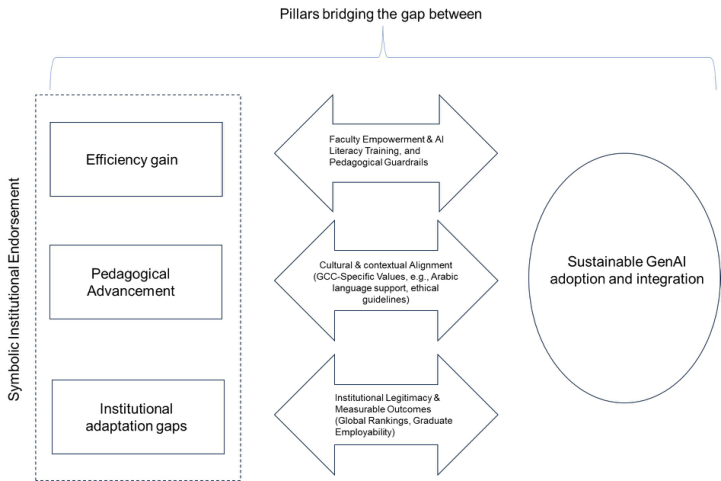
that balance innovation with accountability. In GCC contexts, where cultural values prioritize collective welfare, such policies must also address localized ethical norms, including data sovereignty and inclusivity (Romanowski et al., 2022). To reconcile these tensions, GCC institutions must adopt a glocalized framework that harmonizes global AI innovations with regional cultural and institutional priorities (see Figure 1). This approach rests on three pillars: (1) empowering faculty through targeted AI literacy training while establishing pedagogical guardrails (e.g., AI-augmented rubrics) to preserve academic rigor, thereby enhancing PU and PEOU (Venkatesh & Davis, 2000); (2) aligning AI tools with GCC-specific values, such as Arabic-language capabilities and ethical guidelines reflecting collectivist norms (Romanowski et al., 2022); and (3) demonstrating AI’s role in advancing institutional legitimacy through outcomes like global rankings and graduate employability (Segbenya et al., 2023). Each pillar is designed to bridge the gap between symbolic institutional endorsement and the practical, sustainable integration of GenAI into teaching and learning practices.
Figure 1: Toward a glocalized framework for GenAI adoption in GCC region.
CONCLUSION
In conclusion, the integration of GenAI in GCC higher education is marked by significant opportunities and persistent challenges. Faculty reports indicate that GenAI’s high perceived usefulness (PU) and perceived ease of use (PEOU) (Davis, 1989; Venkatesh & Davis, 2000) drive substantial efficiency gains. As participants noted, accelerated task completion and
reduced cognitive load have allowed educators to redirect their efforts from routine administrative tasks to fostering innovative, inquiry-based learning environments. Such transformations highlight GenAI’s role as a cognitive partner, enhancing pedagogical practices and facilitating collaborative problem solving (Grani´c & Maranguni´c, 2019).
Conversely, findings reveal notable institutional adaptation gaps. Despite the widespread symbolic acknowledgment of AI’s relevance, the absence of cohesive policies and structured training programs remains a critical barrier, reflecting a disconnect between institutional rhetoric and practical support (DiMaggio & Powell, 1983; Selwyn, 2021). Faculty concerns regarding the potential erosion of critical thinking (Zawacki-Richter et al., 2019) and the ethical implications of unregulated AI use (Ouyang & Jiao, 2021; Romanowski et al., 2022) further compound these challenges. In response, participants advocated for targeted interventions such as institutional agreements with AI providers and comprehensive training workshops, aligning with calls to enhance both PU and PEOU.
Thus, bridging the gap between symbolic endorsement and practical, sustainable integration necessitates a glocalized framework. This framework must empower faculty through tailored AI literacy training, align AI tools with regional cultural norms, and demonstrate institutional legitimacy through measurable outcomes (Teo et al., 2008; Czerniewicz & Brown, 2012).
REFERENCES
Aladwani, H. N., Hamad, L. and Aladwani, J. N., 2024. Educational Outcomes, Job Needs, and the Labor Market in the Era of Artificial Intelligence in the Gulf Countries. Kurdish Studies, 12(1), pp. 3347–3383. Al-Emran, M., Mezhuyev, V. and Kamaludin, A., 2020. Towards a conceptual model
for examining the impact of knowledge management factors on mobile learning acceptance. Technology in Society, 61, p. 101247. Alshater, M., 2022. Exploring the role of artificial intelligence in enhancing academic performance: A case study of ChatGPT. Available at SSRN 4312358. Bostrom, N. and Yudkowsky, E., 2018. The ethics of artificial intelligence. In
Artificial intelligence safety and security (pp. 57–69). Chapman and Hall/CRC. Chiu, T. K., 2024. The impact of Generative AI (GenAI) on practices, policies and research direction in education: A case of ChatGPT and Midjourney. Interactive Learning Environments, 32(10), pp. 6187–6203. Chiu, T. K., Xia, Q., Zhou, X., Chai, C. S. and Cheng, M., 2023. Systematic literature
review on opportunities, challenges, and future research recommendations of artificial intelligence in education. Computers and Education: Artificial Intelligence, 4, p.100118. Czerniewicz, L. and Brown, C., 2013. The habitus of digital “strangers” in higher education. British Journal of Educational Technology, 44(1), pp. 44–53. Daghestani, L. F., Ibrahim, L. F., Al-Towirgi, R. S. and Salman, H. A., 2020. Adapting
gamified learning systems using educational data mining techniques. Computer Applications in Engineering Education, 28(3), pp. 568–589. Davis, F. D., 1989. Perceived usefulness, perceived ease of use, and user acceptance of information technology. MIS quarterly, pp. 319–340.
Bridging Technology and Academia: A Qualitative Exploration of GenAI Integration 279
DiMaggio, P. J. and Powell, W. W., 1983. The iron cage revisited: Institutional isomorphism and collective rationality in organizational fields. American sociological review, 48(2), pp. 147–160. Ekundayo, T., Khan, Z. and Chaudhry, S. A., 2024. ChatGPT’s Integration in
GCC Higher Education: Bibliometric Analysis of Trends. Educational Process: International Journal, 13(3), pp. 69–84. Fadlelmula, F. K. and Qadhi, S. M., 2024. A systematic review of research on artificial intelligence in higher education: Practice, gaps, and future directions in the GCC. Journal of University Teaching and Learning Practice, 21(06). Grani´c, A. and Maranguni´c, N., 2019. Technology acceptance model in educational
context: A systematic literature review. British Journal of Educational Technology, 50(5), pp. 2572–2593. Chakroun, B., Miao, F., Mendes, V., Domiter, A., Fan, H., Kharkova, I., Holmes, W., Orr, D., Jermol, M., Issroff, K. and Park, J., 2019. Artificial intelligence for sustainable development: synthesis report, mobile learning week 2019. Jin, Y., Yan, L., Echeverria, V., Gaševi´c, D. and Martinez-Maldonado, R., 2025.
Generative AI in higher education: A global perspective of institutional adoption policies and guidelines. Computers and Education: Artificial Intelligence, 8, p. 100348. Luckin, R., Cukurova, M., Kent, C. and Du Boulay, B., 2022. Empowering educators to be AI-ready. Computers and Education: Artificial Intelligence, 3, p. 100076. Ouyang, F. and Jiao, P., 2021. Artificial intelligence in education: The three
paradigms. Computers and Education: Artificial Intelligence, 2, p. 100020. Parker, B. D., 2024. Considering the Impact of AI on the Professional Status of Teaching. The Clearing House: A Journal of Educational Strategies, Issues and Ideas, 97(6), pp. 233–236. Romanowski, M. H., 2022. The idolatry of accreditation in higher education:
Enhancing our understanding. Quality in Higher Education, 28(2), pp. 153–167. Segbenya, M., Bervell, B., Frimpong-Manso, E., Otoo, I. C., Andzie, T. A. and Achina, S., 2023. Artificial intelligence in higher education: Modelling the antecedents of artificial intelligence usage and effects on 21st century employability skills among postgraduate students in Ghana. Computers and Education: Artificial Intelligence, 5, p. 100188. Selwyn, N., 2021. Education and technology: Key issues and debates. Bloomsbury
Publishing. Sharples, M., 2023. Towards social generative AI for education: theory, practices and ethics. Learning: Research and Practice, 9(2), pp. 159–167. Smith, J. A., Larkin, M. and Flowers, P., 2021. Interpretative phenomenological
analysis: Theory, method and research. Suri, H., 2011. Purposeful sampling in qualitative research synthesis. Qualitative research journal, 11(2), pp. 63–75. Teo, T. S., Srivastava, S. C. and Jiang, L. I., 2008. Trust and electronic government
success: An empirical study. Journal of management information systems, 25(3), pp. 99–132. Venkatesh, V. and Davis, F. D., 2000. A theoretical extension of the technology acceptance model: Four longitudinal field studies. Management science, 46(2), pp. 186–204. Verhoeven, B. and Rana, V., 2023a. Knowledge work and the role of higher education
in an AI era [online]. Verhoeven, B. and Rana, V., 2023b. How to design teaching and learning through an AI-centred course [online].
Verhoeven, B. and Rana, V., 2023c. How to use generative AI creatively in Higher Education [online]. Yan, L., Greiff, S., Teuber, Z. and Gaševi´c, D., 2024. Promises and challenges of
generative artificial intelligence for human learning. Nature Human Behaviour, 8(10), pp. 1839–1850. Zawacki-Richter, O., Marín, V. I., Bond, M. and Gouverneur, F., 2019. Systematic review of research on artificial intelligence applications in higher education–where are the educators?. International Journal of Educational Technology in Higher Education, 16(1), pp. 1–27.
LISTED IN THE AHFE DIGITAL BOOKSTORE CATALOGUE
Explore the complete digital volume
Human Factors, Business Management and Society
Read this individual research paper free through the original publisher, or explore the full digital proceedings book.
ISBN 978-1-964867-52-6
Explore this ISBN in the AHFE Bookstore ↗Listed in the July 2026 bookstore catalogue; search by ISBN to confirm current availability · Digital book purchase optional