Divya Harshini Dhavala, Sofia Ingegno, Gabe Gutierrez, Debra Satterfield (2025). Expressions of Alamelu: A Cultural Narrative Enhanced with Technology. In: The Human Side of Service Engineering. AHFE Open Access, vol. 182, pp. 64–73. https://doi.org/10.54941/ahfe1006407
Expressions of Alamelu, is an interactive multimedia performance introducing non-Indian audiences to Kuchipudi, a classical Indian dance form. Through the use of generative AI imagery and multimedia elements, we aimed to create an engaging, curiosity-sparking experience that deepens appreciation for this traditional art form. The aim of this project was to develop a culturally informed performance that employed innovative storytelling techniques. Data collected through surveys and interviews indicated that audiences placed high value on sensory engagement, educational components, and clarity of narrative. However, the findings also highlighted a major barrier: many participants experienced difficulties in understanding the performance due to insufficient familiarity with its cultural context. Surveys and interviews conducted with cultural enthusiasts revealed a preference for sensory engagement, education, and storytelling, while identifying existing engagement obstacles, such as lack of context and understanding. Concerns regarding the overshadowing of technology were also noted. To address these challenges, several design solutions were integrated: • Projection Mapping: Utilizing projection mapping, we overlaid cultural information on various items typically found in Indian altars. Enabling audiences to gain insights into the symbolic significance of each item. • Narration and Visual Guides: Upon entry into the exhibition space, storytelling slides and narration guide pamphlets complemented the performance to ensure accessibility without diluting authenticity. • Generative AI: Leveraging the most recent advancements in machine learning, we developed an interactive image generation model that translates dancers’ movements into real-time visual representations of song lyrics. This approach provides a form of visual captioning that clarifies how the dancers’ motions symbolically illustrate the song’s content. Utilizing the British Design Council’s double diamond framework to define the problem, conduct user research, prototype solutions, and implement the final performance exhibition. The interdisciplinary team combined expertise in exhibition design, emerging digital technologies, and cultural heritage to create a human-centered, immersive exhibition experience that was open to the public. The project culminated in a one-day exhibition with three performances. With over 70 participants in attendance, the post-event survey revealed overwhelmingly positive responses: Sensory engagement and cultural understanding were highly rated, with many attendees praising the seamless blending of tradition and technology; Generative AI imagery was widely appreciated, especially for its ability to provide context while maintaining the integrity of the dance ; Suggestions included making the experience more immersive with additional visuals and interactive behind-the-scenes elements showcasing AI processes. Attendees described the event as unique, visually stunning, and culturally enriching. Key takeaways included the importance of balancing innovation with tradition and the potential of multimedia elements to make cultural performances accessible to broader audiences.This project demonstrates how technology can enhance cultural storytelling without overshadowing its essence, fostering a deeper appreciation of heritage among diverse audiences. It also highlights the value of interdisciplinary collaboration and human-centered design in crafting memorable experiences.Sources: American Alliance of Museums. “Learning from the Double Diamond: How Divergent and Convergent Thinking Can Improve Collaboration and Problem-Solving in Museums.” American Alliance of Museums, 5 Apr. 2024, www.aam-us.org/2024/04/05/learning-from-the-double-diamond-how-divergent-and-convergent-thinking-can-improve-collaboration-and-problem-solving-in-museums/. Accessed 25 Apr. 2024, Dholia, Esha. “(Cultural) Identity Crisis: The Internet & The Indian Diaspora.” American University Electronic Theses and Dissertations, 2024, https://www.jsr.org/hs/index.php/path/article/view/2594. Accessed 15 May 2024, Derda, Izabela, and Zoi Popoli. “Developing Experiences: Creative Process behind the Design and Production of Immersive Exhibitions.” Museum Management and Curatorship, vol. 36, no. 4, 2021, pp. 384-402, Design Council. “The Double Diamond.” Design Council, www.designcouncil.org.uk/our-resources/the-double-diamond/. Accessed 1 May 2024, Google AI Edge. “Mediapipe.” GitHub, 2023, https://github.com/google-ai-edge/mediapipe, Madsen, Kristina Maria, and Mia Falch Yates. Stability AI. “sd-turbo: Next-Generation Generative AI Model.” Hugging Face, 2023, https://huggingface.co/stabilityai/sd-turbo.cumulo-autumn. “StreamDiffusion.” GitHub, 2023, https://github.com/cumulo-autumn/StreamDiffusion.
The aim of this project was to develop a culturally informed performance that employed innovative storytelling techniques. Data collected through surveys and interviews indicated that audiences placed high value on sensory engagement, educational components, and clarity of narrative. However, the findings also highlighted a major barrier: many participants experienced difficulties in understanding the performance due to insufficient familiarity with its cultural context. Surveys and interviews conducted with cultural enthusiasts revealed a preference for sensory engagement, education, and storytelling, while identifying existing engagement obstacles, such as lack of context and understanding. Concerns regarding the overshadowing of technology were also noted.
To address these challenges, several design solutions were integrated.
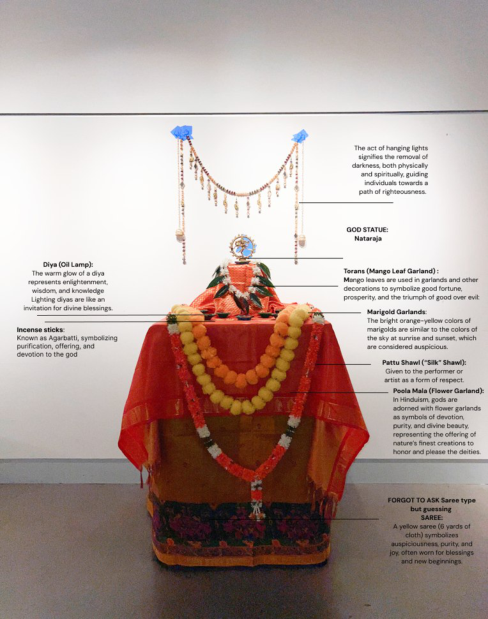
Projection Mapping: Enhancing Cultural Understanding Technical Implementation The projection mapping component of “Expressions of Alamelu” utilized Lightform technology to create an informative digital overlay on traditional Indian altar items. Our implementation began with Lightform’s structured light scanning, which created a precise digital map of the altar’s physical
Expressions of Alamelu: A Cultural Narrative Enhanced With Technology 65
topography. This scanning allowed the system to recognize the unique shapes and dimensions of each ritual object.
Using Light form Creator software, we developed custom visual content for each altar item, including animations, textual information about symbolic significance, and visual highlights. The software’s masking tools allowed us to precisely control which surfaces received projections. We carefully calibrated projection brightness against ambient lighting to ensure visibility without overwhelming the natural appearance of the altar items.
Figure 1: Projection mapping sketch.
Visual and Educational Impact The projection mapping enhanced both the visual presentation and educational value of the Indian altar display. The technology transformed static objects into dynamic storytelling elements with subtle animations and highlighting effects that revealed cultural context.
The projected content used a color palette and visual style that complemented the traditional aesthetics of the altar items. By overlaying information directly onto objects, we eliminated the disconnect that occurs when visitors must alternate between viewing artifacts and reading separate explanatory texts.
Figure 2: Dancer offering incense sticks in front of the altar, setting up the performance atmosphere.
The educational content was strategically layered to accommodate different levels of visitor engagement, with essential information immediately visible and deeper cultural context revealed through animations. Visitor feedback confirmed the effectiveness of this approach, with attendees reporting enhanced understanding of the altar items’ significance.
This implementation of Light form projection mapping demonstrates how technology can enhance cultural presentations while respecting tradition and improving accessibility for diverse audiences.
Narration and Visual Guides: Upon entry into the exhibition space, storytelling slides and narration guide pamphlets complemented the performance to ensure accessibility without diluting authenticity.
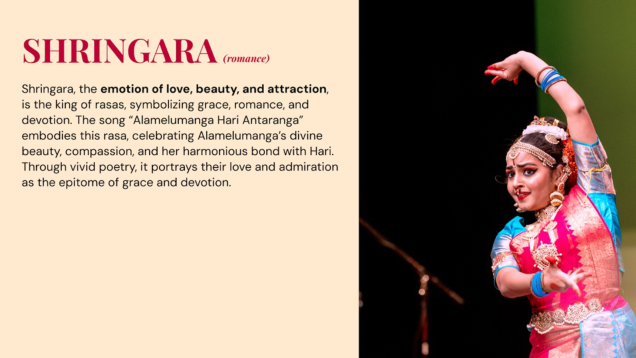
Storytelling Slides As the audience entered the gallery, a TV projected four slides introducing key aspects of the performance. These slides provided context on Kuchipudi, the classical Indian dance form; Goddess Alamelu, the central figure of the performance; Navarasa, the nine emotions depicted in the song; Annamacharya, the composer of the piece; and Shringara Rasa (the emotion of romance), the theme of the performance. Each slide contained a brief description and played automatically, serving as the audience’s first introduction to the performance’s theme, setting, and cultural significance.
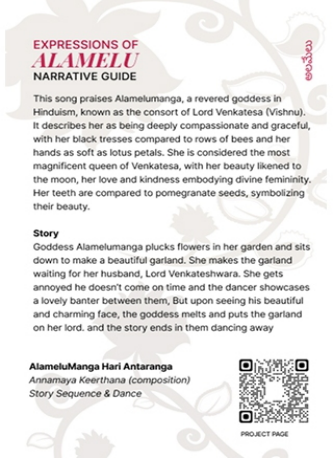
Narrative Guide This guide provided a brief description of the song the dancer would perform, along with the story portrayed in the lyrics. It also included a QR code linking to a project page. Serving as a physical reference, the guide helped keep the audience engaged while the dancer explained the song. As she demonstrated key movements, the audience was able to follow along, transforming their role from passive observers to active participants before and after the performance.
Expressions of Alamelu: A Cultural Narrative Enhanced With Technology 67
Figure 3: TV slide design example.
The story of Alamelumanga in the guide was an accurate English translation of the Telugu lyrics composed by Annamacharya. Expressions of Alamelu is inspired by the song, AlameluManga Hari Antaranga. The guide explained: “This song praises Alamelumanga, a revered goddess in Hinduism and the consort of Lord Venkatesa (Vishnu). She is depicted as deeply compassionate and graceful, with her black tresses compared to rows of bees and her hands as soft as lotus petals. As the most magnificent queen of Venkatesa, her beauty is likened to the moon, and her love and kindness embody divine femininity. Her teeth, compared to pomegranate seeds, symbolize their beauty.”
The performance brought this story to life: Goddess Alamelumanga plucks flowers in her garden and sits down to weave a beautiful garland, awaiting the arrival of her husband, Lord Venkateshwara. When he arrives late, she playfully expresses her annoyance, creating a delightful exchange between them. However, upon seeing his charming face, she softens, places the garland around his neck, and the performance concludes with the couple joyfully dancing together.
The song “Alamelumanga Hari Antaranga” primarily embodies the Shringara rasa. It highlights the divine beauty and elegance of Alamelumanga (the heroine) and her intimate connection with Hari (the hero). Through poetic descriptions of her physical grace, compassionate nature, and harmonious relationship with Hari, the song portrays love and admiration in its most divine and aesthetic form. The emotions evoke a blend of Sambhoga Shringara—celebrating the union of the divine couple—and a sense of awe (Adbhuta) at her radiance and charm.
By providing both translation and cultural context, the guide bridged the gap between the audience and the dancer, removing potential barriers to understanding for those who may have been previously unfamiliar with this
song and its importance. The introductory slides ensured that the audience was well-prepared for the performance. As they took their seats, they were no longer uncertain about what to expect, allowing them to fully immerse themselves in the interactive storytelling experience. The conscious decisions to include these visual aids, provide a sensory and digital experience of Projection Mapping on the Altar, the mannequin set up were to help place an otherwise out of context performance into context without isolating the audience while maintaining cultural authenticity of the art form.
Figure 4: Narrative guide.
GENERATIVE AI: TRANSLATING MOVEMENT INTO VISUAL NARRATIVES Generative AI
Leveraging the most recent advancements in machine learning, we developed an interactive image generation model that translates dancers’ movements into real-time visual representations of song lyrics. This approach provides a form of visual captioning that clarifies how the dancers’ motions symbolically illustrate the song’s content.
Implementation Methodology The generative AI component of “Expressions of Alamelu” translated Kuchipudi dance into visual representations through a time-synchronized system. We created a table of lyrical translations from the song “AlameluManga Hari Antaranga,” with each line of Telugu lyrics translated into English and organized chronologically within the performance timeline.
Using TouchDesigner as our framework, we integrated Stream Diffusion for real-time image generation. The system triggered specific prompts at
Expressions of Alamelu: A Cultural Narrative Enhanced With Technology 69
predetermined moments corresponding to the song’s lyrics. For example, when lyrics described “hands as soft as lotus petals,” this description was fed as a prompt to generate imagery representing this comparison.
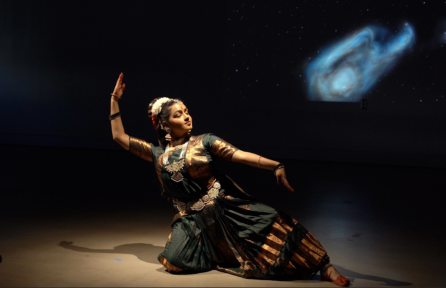
We incorporated MediaPipe’s pose tracking to capture the dancer’s movements as visual input to the diffusion process. This created the illusion that the dancer was drawing the generated images with her movements. As she moved across the performance space, her silhouette influenced how the AI-generated imagery evolved on screen.
The setup required precise timing calibration between the audio track, dancer’s movements, and prompt delivery. Our custom TouchDesigner interface allowed real-time adjustments during rehearsals to ensure visual elements synchronized with both musical progression and choreography.
Visual and Educational Impact The generative AI significantly enhanced the visual appeal and educational value of the performance. By creating visual translations of lyrical content, we made the cultural narrative accessible to audiences unfamiliar with Kuchipudi or Telugu language.
The system created a dynamic backdrop that evolved with the performance, transforming the stage into an immersive storytelling environment. Generated imagery complemented traditional Kuchipudi aesthetics while adding contemporary visual elements that resonated with modern audiences.
From an educational perspective, the AI component bridged cultural and linguistic gaps. Audience surveys showed that visual representations improved narrative comprehension without dividing attention between performance and explanatory text.
The educational impact was particularly evident during culturally specific moments. When the dance referenced Hindu mythology or used traditional mudras, the generated imagery provided contextual clues that helped audiences connect these elements to their cultural significance. The technology was implemented with attention to cultural respect, with visual elements designed to complement rather than overshadow the traditional dance performance. This balance achieved our goal of using technology to bridge cultural understanding while preserving traditional practice.
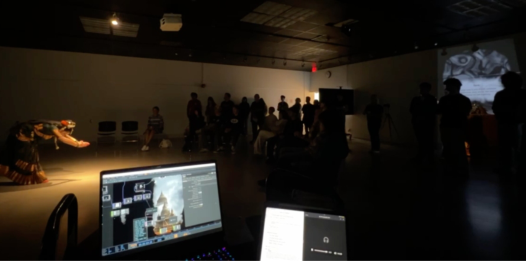
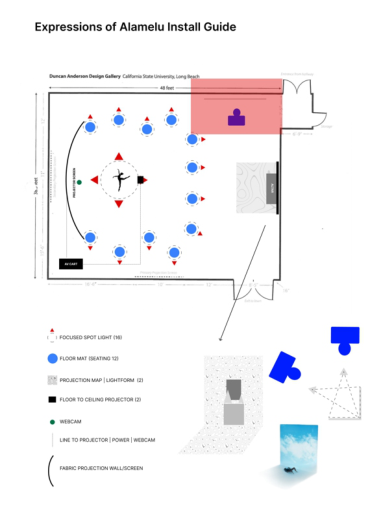
Figure 5: Dancer depicts Indian gods, AI visualizes deity as a universe.Figure 6: Behind the scenes of the TouchDesigner AI visuals, gallery set up and our live audience.Figure 7: Gallery setup floorplan.
METHODOLOGY
Utilizing the British Design Council’s double diamond framework to define the problem, conduct user research, prototype solutions, and implement the final performance exhibition. The interdisciplinary team combined expertise in exhibition design, emerging digital technologies, and cultural heritage to create a human-centered, immersive exhibition experience that was open to the public.
Expressions of Alamelu: A Cultural Narrative Enhanced With Technology 71
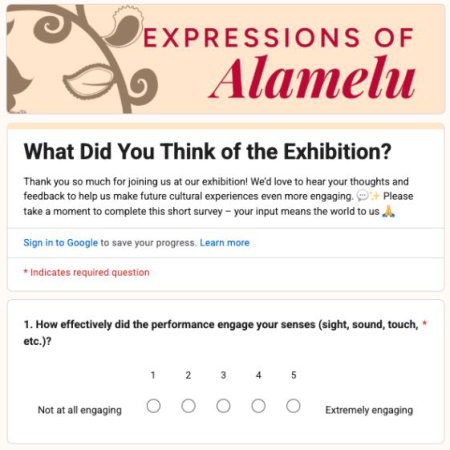
RESULTS & DISCUSSION To understand the success and audience’s engagement with our interactive exhibition design, our team chose to conduct a post-performance survey. We included QR codes with the survey link and had them scan it on their way out from the exhibition space. Our team wanted to understand the audience’s comprehension and overall experience of Expressions of Alamelu. The primary goal of the survey was to evaluate how well the performance conveyed the story, the physical and digital guides aiding with placing the cultural context and how effectively technology complemented the storytelling and finally, the overall immersion of the audience.
Survey Question Objectives: Our team asked the following questions to the audience:
1. How effectively did the performance engage your senses (sight, sound, touch, etc.)? (Rate on a 1 - 5 scale, 5- Extremely Engaging 1-Not at all Engaging) 2. How well did the performance enhance your understanding and appreciation of Kuchipudi dance? (Rate 1 - 5 scale, 5-Extremely Well 1-Not at all) 3. How complementary was the use of technology (e.g., visuals, audio, or interactive elements) to the storytelling? (Rate 1 - 5 scale, 5-Highly Complementing Well 1-Very Distracting) 4. How helpful were the projections in enhancing your understanding of Kuchipudi dance and its cultural context? (Rate 1 - 5 scale, 5-Extremely Helpful 1-Not helpful at all) 5. How interested are you in attending similar performances that blend traditional culture with modern technology? (Rate 1 - 5 scale, 5-Extremely Interested Well 1-Not interested at all) 6. Any final thoughts? We’d love to hear your unique takeaways, favorite moments, or suggestions! (Short Answer).
The questions were designed using a mixed methods approach, combining quantitative and quantitative questions. The survey was conducted digitally for ease of data collection and accessibility. The questions had Likert scale questions and one open-ended question. The project culminated in a one-day exhibition with three performances. With over 70 participants in attendance, the post-event survey revealed overwhelmingly positive responses:
Sensory engagement, site, sound, touch, and smell, and cultural understanding were highly rated, with many attendees praising the seamless blending of tradition and technology.
Generative AI imagery was widely appreciated, especially for its ability to provide context while maintaining the integrity of the dance.
Suggestions included making the experience more immersive with additional visuals and interactive behind-the-scenes elements showcasing AI processes.
– 3 people specifically highlighted the impact of AI-generated visuals. For example, one attendee stated, “I love love loved the AI images following the dancer! I’ve never seen anything like it.” – 5 people expressed strong overall enthusiasm for the performance, with one respondent exclaiming, “Such a fantastic performance!!” – 2 people suggested enhancements to interactive elements, such as making the altar more engaging. One attendee noted, “I did think the altar could be more interactive to improve the experience, but it was still beautiful and intriguing.”
Figure 8: Post-performance survey google form.
CONCLUSION
Attendees described the event as unique, visually stunning, and culturally enriching. Key takeaways included the importance of balancing innovation with tradition and the potential of multimedia elements to make cultural performances accessible to broader audiences. We found in our post event survey over 90% of participants felt the performance engaged the senses (sight, sound, touch, etc.), further with audience members indicating that they felt the technology used in the exhibition (visuals, audio, or interactive elements) was complimentary to the storytelling of rather than distracting, and finally nearly all attendees said they would be interested you in attending similar performances that blend traditional culture with modern technology. This project demonstrates how technology can enhance cultural storytelling without overshadowing its essence, fostering a deeper appreciation of heritage among diverse audiences. It also highlights the value of interdisciplinary collaboration and human-centered design in crafting memorable experiences.
Expressions of Alamelu: A Cultural Narrative Enhanced With Technology 73
ACKNOWLEDGMENT
We would like to extend our thank you to our team members, Kathy Lin & Cameron Romeis for their support. A huge shoutout to the design department at CSULB for being a supportive and collaborative staff in helping us design this interactive exhibition.
REFERENCES
American Alliance of Museums. “Learning from the Double Diamond: How Divergent and Convergent Thinking Can Improve Collaboration and Problem-Solving in Museums.” American Alliance of Museums, 5 Apr. 2024, www.aam-us.org/2024/04/05/learning-from-the-double-diamond-how- divergent-and-convergent-thinking-can-improve-collaboration-and-problem- solving-in-museums/. Accessed 25 Apr. 2024. American Alliance of Museums. “Museum Facts & Data.” American Alliance
of Museums, www.aam-us.org/programs/about-museums/museum-facts-data/ #_edn28. Accessed 25 Apr. 2024. Cumulo-autumn. “StreamDiffusion.” GitHub, 2023, https://github.com/cumuloautumn/StreamDiffusion. Dholia, Esha. “(Cultural) Identity Crisis: The Internet & The Indian Diaspora.”
American University Electronic Theses and Dissertations, 2024, https://www.jsr. org/hs/index.php/path/article/view/2594. Accessed 15 May 2024. Derda, Izabela, and Zoi Popoli. “Developing Experiences: Creative Process behind the Design and Production of Immersive Exhibitions.” Museum Management and Curatorship, vol. 36, no. 4, 2021, pp. 384–402. Design Council. “The Double Diamond.” Design Council, www.designcouncil.org.
uk/our-resources/the-double-diamond/. Accessed 1 May 2024 Google AI Edge. “Mediapipe.” GitHub, 2023, https://github.com/google-ai-edge/ mediapipe. Madsen, Kristina Maria, and Mia Falch Yates. “Mapping and Understanding
the Potentials of Co-Creative Efforts in Museum Experience Design Processes.” Academic AAU, Akademisk Kvarter; Quarter Research from the Humanities, vol. 23, 2021, pp. 123–139. Sampada Silicon Andhra. “About Us.” https://sampada.siliconandhra.org/. Accessed 15 May 2024. Shilpa Darivemula, MD, MS, Sriya Bhumi, MBA, and Jenn Pamela Chowdhury,
MS. “Rehumanizing Clinical Language Through Classical Indian Dance.” AMA Journal of Ethics, vol. 23, no. 3, Mar. 2021, pp. E276-280, doi: 10.1001/ amajethics.2021.276. Accessed 15 May 2024. Shivalingappa, Shantala. “Why I Dance.” Dance Magazine, Jan. 2022, https:// www.dancemagazine.com/why_i_dance_shantala_shivalingappa/. Stability AI. “sd-turbo: Next-Generation Generative AI Model.” Hugging Face,
2023, https://huggingface.co/stabilityai/sd-turbo. Sun, Hongxia, and Xiong Wang. “Research on Digitalization of Museum Exhibition Design Based on Image Emotional Semantics.” Journal of Applied Science and Engineering, vol. 26, no. 5, 2022, pp. 739–746.
LISTED IN THE AHFE DIGITAL BOOKSTORE CATALOGUE
Explore the complete digital volume
The Human Side of Service Engineering
Read this individual research paper free through the original publisher, or explore the full digital proceedings book.
ISBN 978-1-964867-58-8
Explore this ISBN in the AHFE Bookstore ↗Listed in the July 2026 bookstore catalogue; search by ISBN to confirm current availability · Digital book purchase optional