Momoka Muto, Wonseok Yang (2025). Relationship between Planning and Ownership in the experience of using products. In: Interdisciplinary Practice in Industrial Design. AHFE Open Access, vol. 183, pp. 19–29. https://doi.org/10.54941/ahfe1006423
The development of online platforms has significantly changed how consumers use products, particularly in secondary distribution markets such as secondhand market services and auction websites. Consumers’ resale behaviors in these markets have become diversified, with previous studies categorizing these behaviors based on product condition and whether the sale is planned. While these studies confirm the utility of planning, few have focused on changes in the sense of Ownership between purchase and resale. This research examines differences in the sense of Ownership by identifying when and how Ownership changes, depending on whether product experience is planned in online secondary distribution. To investigate consumers’ experiences with products in C2C services, we utilized the consumer resale behavior model by Chu et al. (2007) and conducted a questionnaire survey. The results indicated that the types of products sold differed depending on the behavior. Additionally, a second survey was administered to the same 102 participants, exploring the timing of planning and changes in Ownership based on products they had previously traded. These findings suggest that there are differences in the sense of Ownership for each behavior type, and Ownership changes depending on whether the product was used before. This research highlights the importance of Ownership in consumer behavior, offering insights for improving product loyalty and increasing user engagement with products that have high resale value. By understanding these shifts in Ownership, businesses can better cater to consumer needs and encourage more sustainable consumption patterns.
The development of online platforms has also brought about a significant evolution in the consumers’ experiences of using products. The ease of buying and selling has shifted the traditional use of products from an experience based on a short-term consumption experience (Yamamoto, 2021). In addition, the short-term experience of use has diversified purchasing behavior in online secondary distribution markets, such as second-hand market services and auction websites, with particular attention being paid to planned purchasing behavior that anticipates the recovery of profits through resale. According to Chu et al. consumers’ awareness of the resale value of a product can influence their purchasing behavior in the primary distribution
market, such as their purchasing experience in the primary distribution market, experience using the product when they own it, storage behavior, and purchasing behavior in the secondary distribution market. Chu et al. suggested that consumers’ awareness of resale prices influences many aspects, such as purchases in primary distribution, use experience during Ownership, and storage behavior. Their research found that for products whose quality does not deteriorate easily, such as video games, demand in the primary and secondary distribution markets is antagonistic after some time has passed since the product was sold (Ishihara and Ching, 2019). A shorter duration of product experience also decreases the consumers’ attachment to the product (Bandhi and Eckhardt, 2017). The accompanying issue of reduced brand benefits arises from decreased loyalty and willingness to pay. Chu et al. classified consumer resale behavior by product status and planned sales, as shown in Table 1. They found that users who had planned resale in advance were more willing to purchase in the temporary distribution market (Chu, 2007). Although this confirms the utility of planning, few studies have focused on the change in the sense of Ownership between the purchase and resale of a product (Mowen, 1995)(Lastovicka and Fernandez, 2005)(Rassuli and Harrell, 1990). This research examines the differences in the sense of Ownership by identifying changes in the sense of Ownership and the timing of these changes, depending on whether the product experience is planned in the online secondary market.
Table 1: Taxonomy of consumer online resale behavior (adapted from Baxter, 2017).
Table available in the original PDF paper.
Unused Products Used Products
Planned Resale Resale of Extra Purchase Resale After Temporary Ownership Unplanned Resale Unintentional Purchase Disposition
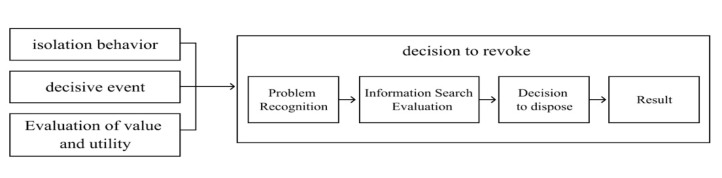
Psychological Factors in Dispositional Behavior Roster revealed that consumer disposition behavior is triggered by psychological effects, such as “isolation behavior,” “decisive events,” and “evaluation of value and utility,” followed by a “disposition decision.” (Roster, 2001). Figure 1 combines Roster’s model of consumer dispositional behavior with Hanson’s disposition decision-making process. Isolation behavior is the psychological factor of hiding a product out of sight or keeping it away when the product is undesirable (Roster, 2001) (Hanson, 1980). A decisive event is a situational factor due to a determined event, such as a physical or psychological change or migration. Finally, the evaluation of value and utility is the target factor that determines the decision to change to a new product based on a comparison of the value and utility when using the product. The research also revealed that people who are unattached to objects are not reluctant to dispose of them whereas those who are attached to objects take certain actions, such as keeping or donating them (Colter and Ligas, 2003). The disposal of products that are closely related to the person or self with such an attachment to an object may involve psychological distress that prevents them from taking disposal actions and may lead to a cooling-off
Relationship Between Planning and Ownership in the Experience of Using Products 21
period (Trudel, Argo, and Meng, 2016). People tend to choose second-hand market services and recycling activities to alleviate psychological distress.
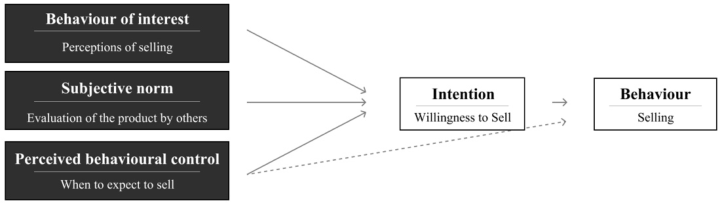
Resale Behavior Process Based on the Theory of Planned Behavior In his theory of planned behavior, Ajzen explained the relationship between attitudes and behavior using the following model (Ajzen, 1991). Attitudes toward an action imply the consequences of carrying out a particular action (Ito, 1997). The “principal norm” is the concept of one’s own inferences about how the behavior will be evaluated by others (Ito, 1997). The “sense of control over the behavior” refers to how difficult one perceives the behavior to be in carrying it out (Ajzen, 2005). A schematic representation of the above theoretical concepts as they apply to resale behavior is shown in Figure 2. We focused on these three items because we believe that these concepts of the theory of planned behavior can be used as perspectives for analyzing diversified resale behavior.
Figure 2: Impact of digitalization at each stage of the consumption process.
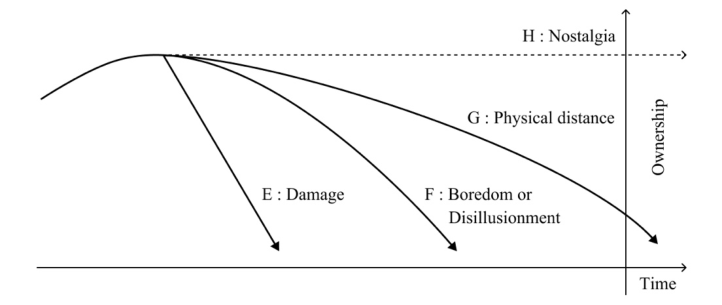
Differences in Sense of Ownership During Disposal Behavior Dispossessing is the process of psychologically releasing an object. This phenomenon occurs when a person judges that an object continues to exist psychological even if it has been physically disposed of; if the object is special or evokes a certain memory. Baxter et al. identified the trends in the effects related to the disengagement of a sense of Ownership based on qualitative research and developed four pathways (Baxter and Childs, 2017). This model is illustrated in Figure 3. Line H represents nostalgia for average objects. Nostalgic individuals tend to be mindful of retaining an object, even if it
22 Muto and Yang
is physically broken. Line G is caused by the physical distance between the object and the user, and the sense of Ownership decreases as the distance increases. Line F declines as the user feels negative emotions, such as boredom or disillusionment, toward the object. Finally, Line E implies a situation in which a motive is suddenly no longer fulfilled and may be the result of a psychological change, such as damage to the object or a new identity for the user. Thus, the sense of Ownership can change depending on various factors. Therefore, in this research, we focused on a new factor, that is, planning, to examine the differences in the sense of Ownership. Based on these results, we believe that encouraging resale awareness at the right time can improve the experience of use.
Figure 3: Disengagement from a sense of psychological Ownership and its pathways.
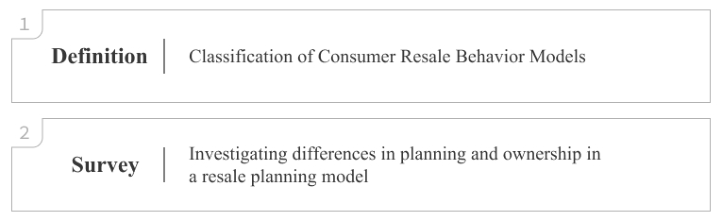
RESEARCH METHOD In this research, the following steps were taken to determine the effect of planning on the sense of Ownership in resale behavior (see Figure 4).
Figure 4: Research process.
Step1: Classification of Consumer Resale Behavior Models In order to clarify the influence of the sense of Ownership on the presence of planning, we classified consumer resale behavior into four patterns based
Relationship Between Planning and Ownership in the Experience of Using Products 23
on “planning” and “degree of product use”. The following describes the four patterns of resale behavior model proposed by Chu et al. and their contents.
1. Resale of Extra Purchase
This is a pattern in which the products sold were unused and held with the intention of selling. This behavior includes the case where a customer buys brand-name clothes overseas but decides to sell them for some reason. 2. Resale After Temporary Ownership The seller has used the item sold, and has held on to it with the intention of selling it someday. This behavior includes, for example, “I used my school textbooks with the intention of selling them someday”. 3. Unintentional Purchase
In this case, the products sold were unused and the seller did not intend to sell them, but did. This behavior includes, for example, “I found some clothes that I bought on impulse but never wore and decided to sell them”. 4. Disposition This is a pattern in which the seller has used the item sold and sold it even though he/she did not intend to sell it. This behavior includes, for example, “I had a picture book, but I sold it to organize my room”.
Step2: Investigating Differences in Planning and Ownership in a Resale Planning Model In this research, a questionnaire was administered to determine the difference between planning and Ownership in resale behavior. The subjects were 102 people who had used a secondhand market service and had operated as sellers. Subjects were asked to select one product they had traded in the past that corresponded to the behavior they had indicated in the pre-survey, and a questionnaire was administered to measure “product overview,” “planning,” and “sense of Ownership”. The questions were as follows (see Table 2).
Table 2: Survey questions.
Table available in the original PDF paper.
Category Questionnaire Basic Information Product Genres Sold Fashion products/ Cosmetics, beauty/ Home electronics, electronics/ Toys, hobby products, sports/ Books, music, games/ Interior, furniture, miscellaneous products/ others () Basic Information Selling Price Planning How long have you been thinking about reselling the product? 1. Even before the product is purchased. 2. Immediately after purchasing the product 3. Immediately after owning and using the product 4. Sometime after owning and using the product 5. After the product is no longer used for some reason Planning What research did you do when selling? (Please answer from first to third place) 1. Market price 2. Trend and time of sale 3. Number of similar products on the market and their price range 4. Availability of demand 5. Commission and expenses for resale 6. Product Description 7. No
Continued
24 Muto and Yang
Table 2: Continued Category Questionnaire
Table available in the original PDF paper.
Planning How do you feel others would rate this product? Ownership How attached did you feel to the product? Ownership What is the degree to which you feel you “own” this product when you sell it? Ownership How satisfied are you with this product?
The questionnaire items related to planning were reinterpreted from the theory of planned behavior in Ajzen. Focusing on the three items attributed to behavioral intentions, namely “sense of control over behavior,” “attitude toward behavior,” and “subjective norm,” the questions were “when did you plan your resale behavior?,” “what type of research did you conduct to resell this product?,” and “how do you feel others will evaluate this product? (Ajzen, 1991).
Items related to sense of Ownership were reinterpreted from the items of the Japanese version of the Psychological Ownership Scale developed by Iseki et al. (2022) and the sense of Ownership scale developed by Walasek et al. (2005). The overall Cronbach’s alpha coefficient for the reliability of the three items was 0.78, indicating internal consistency.
RESULTS
Results on Consumer Resale Behavior Models
Table 3 shows the results of classifying the resale behaviors of the 102 participants. When multiple behaviors were applicable, they were considered as multiple responses. The lowest number of participants (n = 22) corresponded to Pattern 1: “Resale-oriented behavior.” Patterns 2 and 3 did not significantly differ from each other, with approximately 40 respondents each. Pattern 4, that is, “did not intend to sell at first but ended up selling,” had the highest number of participants (n = 67). Regarding the product genres for each behavior pattern, a tendency to sell “toys, hobby products, and sporting products” for Pattern 1; “books, music, and games” for Patterns 2 and 4; and “fashion products”for Pattern 3 was observed. This suggests that items, such as books and games, which do not easily deteriorate and are used for a long duration, tend to be retained with no intention of selling while toys and clothes are considered items intended for sale owing to factors, such as outgrowing things and changes in hobbies.
Table 3: Number of survey subjects and product genres.
Table available in the original PDF paper.
Pattern Subjects Product Genres
1. Resale of Extra Purchase 22 Toys, hobby products, sports 2. Resale After Temporary Ownership 44 Books, music, games 3. Unintentional Purchase 40 Fashion products 4. Disposition 67 Books, music, games
Relationship Between Planning and Ownership in the Experience of Using Products 25
Results on Investigating Differences in Planning and Ownership in a Resale Planning Model An analysis of the results obtained from the survey is described below (see Figure 5).
Figure 5: Analysis contents.
Figure available in the original PDF paper.
Based on the survey results, a statistical analysis was conducted to determine the relationship between planning and resale behavior. First, the Shapiro–Wilk test was conducted to confirm the normality of the data. The results showed that W = 0.800, p < 0.0001, indicating that the data deviated from the normal distribution in a statistically significant manner (Table 4). Therefore, we used the Wilcoxon test, a nonparametric test in which “resale behavior pattern” and “when did you start trying to sell?” was applied as the independent variable and dependent variable, respectively. Findings indicated a predominant difference in resale awareness for each resale behavior pattern (see Table 5). In addition, a Dunn test on the merged ranks was conducted to clarify whether there were differences in the trends among the resale behavior patterns. Figure 6 shows that “Disposition,” which corresponds to behavior pattern 4, considerably differs from all the other behavior patterns. In addition, behavior pattern 3, that is, “Unintentional Purchase,” was found to be superior to behavior pattern 1, “Resale of Extra Purchase,” in the same category of unused products. Finally, regarding the item “whether the product is evaluated by others,” which was set as a “subjective norm,” there was no significant difference between patterns, and it was evident that all participants selected and sold products that were evaluated to some extent.
Table 4: Normality test.
Table available in the original PDF paper.
Shapiro-Wilk W P (Prob > W) 0.80 p < 0.0001
Table 5: Relationship between resale behavior and planning.
Table available in the original PDF paper.
Wilcoxon Chi-Square Value Degrees of Freedom P (Prob > ChiSq) 62.84 3 p < 0.0001
Table 6: Comparison of all pairs of relationships in planning.
Next, to examine the relationship between “resale behavior patterns” and “survey content,” a cross tabulation was performed and a chi-square test was conducted. Weighting was applied owing to sample size bias, and Pearson’s chi-square test results showed no significant relationship between the resale behavior patterns and the survey content (χ2 = 6.765, degrees of freedom = 18, p = 0.9920). Table 7 shows the calculated percentages of the survey content selected as the top three items, regardless of the behavior pattern. It was found that “market research” was the most frequently surveyed content as the top three items. Next were “number of similar products on display and price range”and “existence of demand,” which were selected by more than 50% of the respondents. This clearly indicates that the contents of the survey at the time of sale are not considered only in terms of behavioral patterns at the time of resale.
Table 7: Percentage of survey content.
Table available in the original PDF paper.
7. No
1. Market Price
2. Trend and Time of Sale
4. Availability of Demand
6. Product Description
3. Number of Similar Products
5. Commission and Expenses for Resale
83 % 34% 69% 51% 29% 1% 31%
Finally, as indicated by Analysis 1, a statistical analysis was conducted to determine whether differences in the sense of Ownership in resale behavior were present. Since the results of the Shapiro–Wilk test from Table 8 were non-normally distributed, we used the Kruskal–Wallis test with “resale behavior pattern” as the independent variable and “sense of Ownership scale” as the dependent variable. The results showed that there was a predominant difference in resale behavior for all Ownership measures (see Table 9). This indicates that there is a difference in the sense of Ownership trend for each resale behavior. Therefore, to clarify whether there was a difference in the tendencies among resale behavior patterns, we conducted a Dunn test on the merged ranks. Results showed that for “attachment,” behavior patterns 1 and 4 were superior in all patterns. The same results were also observed for “possessions” in the same combination of patterns. The number of combinations that had a significant difference in “Satisfaction” decreased. These findings indicate that Pattern 1 in which the respondents did not use the product and were conscious of selling it tended to have a lower sense of Ownership than the other patterns. However, Pattern 2, which used a product with an awareness of selling it, yielded the same Ownership utility as Patterns 3 and 4, which did not assume selling. This suggests that
Relationship Between Planning and Ownership in the Experience of Using Products 27
differences in the experience of use may have a significant impact on the sense of Ownership.
Table 8: Normality test.
Table available in the original PDF paper.
Shapiro-Wilk W P (Prob > W) Questionnaire 1 0.86 p < 0.0001 Questionnaire 2 0.89 p < 0.0001 Questionnaire 3 0.87 p < 0.0001
Table 9: Relationship between resale behavior and planning.
In the resale behavior patterns identified in this research, differences were found in the sense of Ownership of the sold products. In addition, in resale behavior in second-hand market services, while differences in the tendency of “attitude toward behavior” in the theory of planned behavior existed, no differences in what was emphasized in any of the behavioral patterns regarding “sense of control over behavior” and “subjective norm” were noted. We consider that in the second-hand market service, there is no difference in the two items included in the theory of planned behavior because users trade products that they assume will sell and can freely set the price range and products. In addition, since the user’s experience in using the product affects the sense of Ownership toward the product, it was suggested that a genre that is not used frequently, such as “hobby products,” may not easily increase the utility of the sense of Ownership. Therefore, we believe that encouraging users to use the products while giving them the freedom of resale may be helpful in increasing the sense of Ownership of the products as well as in increasing loyalty and the number of users of products with a high resale value.
REFERENCES
Ajzen, I. (1991). “The theory of planned behavior,” Organizational Behavior and Human Decision Processes, 50(2), 179–211. Ajzen, I. (2005). Attitudes, Personality and Behavior (2nd ed.). Open University Press/McGraw-Hill. Retrieved from https:// psicoexperimental.files.wordpress.com/2011/03/ajzeni-2005-attitudes- personality-andbehaviour-2nd-ed-open-university-press.pdf (accessed November 6, 2018). Bardhi, F., & Eckhardt, G. M. (2017). “Liquid consumption,” Journal of Consumer
Research, 44(3), 582–597. Baxter, W., & Childs, P. (2017). “Designing circular possessions,” in: Chapman, Jonathan (Ed.), Routledge Handbook of Sustainable Product Design. pp. 391–404. Routledge. doi: 10.4324/9781315693309. ch. 26. Chu, H., & Liao, S. (2007). “Exploring consumer resale behavior in C2C online auctions: Taxonomy and influences on consumer decisions,” Academy of Marketing Science Review, 11(3). Coulter, R. A., & Ligas, M. (2003). “To Retain or To Relinquish: Exploring the
Disposition Practices of Packrats and Purgers,” Advances in Consumer Research, 30, 38–43. Hanson, J. W. (1980). “A Proposed Paradigm for Consumer Product Processes,” The Journal of Consumer Affairs, 14(1), 49–67.
Relationship Between Planning and Ownership in the Experience of Using Products 29
Ishihara, M., & Ching, A. T. (2019). “Dynamic demand for new and used durable products without physical depreciation: The case of Japanese video games,” Marketing Science, 38(3), 392–416. Ito, H. (1997). “Psychological factors influencing the trend of remaining unmarried:
Using the theory of planned behavior,” Japanese Journal of Social Psychology, 12(3), 163–171. Lastovicka, J. L., & Fernandez, K. V. (2007). “Extending Generalizations about the Disposition of Meaningful Possessions to Buyers with a Shared Self,” in: Craig- Lees, M., Gregory, G., & Davies, T. (Eds.), Advances in Consumer Research Asia Pacific 7. Duluth, MN: Association for Consumer Research. Mowen, J. C. (1995). Consumer Behavior (4th ed.). N. J.: Prentice-Hall. Rassuli, K. M., & Harrell, G. D. (1990). “A New Perspective on Choice,” in:
Advances in Consumer Research, 15, M. Goldberg, G. Gorn, & R. Pollay (Eds.), Provo, UT: Association for Consumer Research, pp. 734–744. Roster, C. A. (2001). “Letting Go: The Process and Meaning of Dispossession in the Lives of Consumers,” Advances in Consumer Research, 28, 425–430. Sasaki, K., Iseki, S., & Kitagami, S. (2019). “Development of the Japanese version of
the psychological Ownership scale,” in: Proceedings of the 83rd Annual Meeting of the Japanese Psychological Association, Ritsumeikan University Osaka Ibaraki Campus, September 11–13, 2019. J-STAGE, published September 26, 2020. Trudel, R., Argo, J. J., & Meng, M. D. (2016). “The recycled self: Consumers’ disposal decisions of identity-linked products,” Journal of Consumer Research, 43(2), 246–264. Walasek, L., Matthews, W. J., & Rakow, T. (2015). “The need to belong and the
preference for owned over unowned objects,” Personality and Social Psychology Bulletin, 41(1), 47–60. Yamamoto, A. (2020). “The Impact of the Secondary Market on Purchasing in the Primary Market,” Marketing, 40(2), 29–41. https://doi.org/10.7222/ marketing.2020.046 Yamamoto, A. (2021). “A Conceptual Research on Temporary Ownership Behavior,”
Read this individual research paper free through the original publisher, or explore the full digital proceedings book.
ISBN 978-1-964867-59-5
Explore this ISBN in the AHFE Bookstore ↗Listed in the July 2026 bookstore catalogue; search by ISBN to confirm current availability · Digital book purchase optional