Charles Kwaku Ata Hanu, Michael D Dzandu, Hayford Amegbe, Buddhi Pathak (2025). 'Adapting ergonomics and human factors in remote work for employee well-being: A conceptual study. In: Social and Occupational Ergonomics. AHFE Open Access, vol. 190, pp. 65–72. https://doi.org/10.54941/ahfe1006598
Purpose: The shift from the traditional face-to-face to remote working requires that both employers and employees to adapt their environments to ensure alignment with the demands of remote work. This includes leveraging digital technologies, infrastructure, tools, systems, and content to enhance employees’ effectiveness and well-being. Given permanence of remote and hybrid work following the widespread adoption during the COVID-19 pandemic, it is essential to identify ergonomic factors that support employee well-being and productivity in these settings. While existing studies have identified ergonomic factors in various contexts few have specifically on remote work. Furthermore, the ergonomic elements affecting the well-being of remote employees remain underexplored, and theoretical frameworks in this area are scarce. Therefore, this study seeks to explore the ergonomic factors that need adapting to ensure employee well-being and effectiveness when working remotely and to develop a conceptual framework for future studies.Methodology: This study adopted a qualitative approach. Data was sourced from electronic databases such as Scopus and Web of Science. From a systematic literature search, 36 relevant articles were analysed using content analysis techniques.Results: The study identified cognitive, physical, and organizational ergonomic factors that require adaptation in remote work environments to enhance employee performance and well-being. Findings highlight the critical role of ergonomic adjustments in home office setups, including their impact on safety, comfort, ease of use, and productivity. These factors contribute significantly to workforce well-being and overall satisfaction. Additionally, the study revealed a lack of theory-driven approaches in existing research on ergonomics and remote work. A conceptual framework was developed, proposing hypothesized relationships between key constructs for empirical testing and validation.Conclusion: This study provides valuable insights into the adoption of ergonomically sound remote working environments for employees. It provides recommendations for organizations seeking to enhance their remote work policies with an emphasis on ergonomics to promote a healthier and more productive remote workforce.Implications: The study highlights the need for future research to validate the proposed conceptual framework across diverse contexts and settings. Such validation will enhance the generalizability of findings on ergonomics and remote work, further advancing knowledge in this domain.Keywords: Remote working, ergonomics, employee wellbeing, technology adaption, home office design, occupational health.
The extensive adoption of remote and hybrid work models has transformed the traditional workplace. This shift necessitates re-evaluation of ergonomic and human factors influencing employee well-being and performance. While remote work affords greater flexibility, autonomy, and work-life balance (Choudhury et al., 2021; de Macêdo et al., 2020; Ferrara et al., 2022; Gomes, 2021; Wang et al., 2021), it also presents challenges related to workspace design, cognitive load, and organizational support, which can undermine productivity, job satisfaction, and long-term health (Adisa et al., 2023; Keightley et al., 2023). Issues such as prolonged screen exposure, inadequate workstation setups, and blurred work-life boundaries contribute to musculoskeletal discomfort, digital fatigue, and psychological strain (Oakman et al., 2020; Nakrošien˙e et al., 2019; Wodajeneh et al., 2022). As remote work becomes the norm in many sectors, adapting ergonomic principles to these evolving conditions is crucial for sustaining workforce engagement and preventing long-term health risks.
Traditionally, ergonomics research has focused on structured office environments, emphasizing physical comfort, injury prevention, and performance optimization (Vink et al., 2006; Vischer, 2007; Dzandu et al., 2023). However, the shift to remote work has led to diverse and often suboptimal home office setups, where employees must manage ergonomic conditions with varying levels of organizational support (Cruz- Ausejo et al., 2023; Wodajeneh et al., 2023). The increasing reliance on digital communication and self-regulation has also heightened the relevance of cognitive ergonomics, which examines information processing demands and mental workload (Kalakoski et al., 2020; Kiran, 2020; Koirala and Maharjan, 2022). Additionally, organizational ergonomics, which focuses on work design and social dynamics, is essential in addressing the isolation and collaboration challenges inherent in remote work (Kowalski and Makowiec- Dabrowska, 2023). Despite these insights, limited research has synthesized these dimensions to provide a comprehensive understanding of remote work ergonomics.
Research shows that poorly adapted ergonomic conditions in remote settings are associated with increased physical discomfort, reduced work engagement, and heightened stress (Charalampous et al., 2019; Kowalski and Makowiec-Dabrowska, 2023). Employees lacking appropriate furniture, display screens, and adjustable seating report higher incidences of musculoskeletal disorders (Shariat et al., 2021). Similarly, excessive cognitive demands from prolonged virtual interactions, multitasking, and constant digital notifications contribute to cognitive overload and burnout (Kiran, 2020; Koirala and Maharjan, 2022). While organizations have introduced virtual wellness programs and flexible work schedules to support remote employees (Kamala et al., 2025; Reznik et al., 2021; Wodajeneh et al., 2023), there is a lack of systematic integration of ergonomic principles into remote work policies. Moreover, research specifically addressing remote work ergonomics remains scarce, and theoretical frameworks in this area are underdeveloped.
To address these gaps, this study explores the ergonomic factors that need adapting to ensure employee well-being and performance in remote work setting and to develop a conceptual framework for future studies that would inform workplace policies and practices. Through the integration of theoretical perspectives with practical applications, this research contributes to discussions on occupational health, digital work transformation, and sustainable workforce management in remote work setting.
METHODOLOGY
This study took an interpretative orientation. As a qualitative study, document analysis method (Neuendorf and Kumar, 2015) is employed to identify the ergonomic factors that impact the adaptation of remote working to achieve employee wellbeing and performance. The use of document analysis helps uncover current issues from a varied but related documents on a subject (Neuendorf and Kumar, 2015). Document analysis method has
Adapting Ergonomics and Human Factors in Remote Work for Employee Well-Being 67
been used in similar qualitative studies such as Keles, McCrae, and Grealish (2020) and Asamoah, Dzandu, and Klapalová (2022).
Data was sourced from electronic databases such as Scopus, EBSCO, Google Scholar and Web of Science. The data analysed include existing publications relevant to ergonomics, remote working and employee wellbeing and performance. The databases were queried using appropriate search strings. For example, the search query used in Scopus was – (“remote or human and factor” AND “remote and working” AND “employee and wellbeing or performance”). This was filtered to include only journal and conference proceeding published in English language, giving a total of 55 documents. After similar searches were conducted on other databases, and subsequent elimination of duplicates, a total of 49 documents were analysed using content analysis techniques. NVivo software was used to code the contents of the documents to arrive at the results for the study.
RESULTS
The study identified cognitive, physical, and organizational ergonomics (Wilson, 2000) factors that require adaptation in remote work environments to enhance employee performance and well-being (Table 1). The following definitions are used to categorise the identified factors into relevant groups. Cognitive ergonomics was defined to include factors that influences mental workload, stress, and job engagement, focusing on how perception, memory, and decision-making interact with work environments (Wilson, 2000; Parasuraman and Hancock, 2001). Physical ergonomics addresses factors that affect comfort, fatigue, and overall health, directly impacting long-term performance (Dul & Weerdmeester, 2008; Karwowski, 2005). Organizational ergonomics pertains to the optimization of sociotechnical systems, including workplace policies, structures, and culture, which influence motivation, retention, and teamwork (Hendrick & Kleiner, 2002; Carayon, 2006). These classifications provide a structured approach to understanding how ergonomic factors collectively shape employee well-being and productivity in remote and hybrid work environments.
Table 1: Categorization of ergonomic factors and their impact on employee well-being and performance.
Table available in the original PDF paper.
Ergonomic Category
Key Factors Effect on Employee Well-being
Effect on Employee Performance
Source (Author, Year)
Cognitive - Technostress from
- Increased stress and
- Increased work Aguilar-Rodríguez
excessive ICT use (−) - Cognitive load from
burnout (−) - Reduced
et al. (2023); Ingusci et al. (2021)
engagement when stressors are managed (+) - Higher productivity
remote work and digital tools (−) - Job autonomy and
psychological well-being (−) - Work engagement self-regulation (+) - Emotional labor and when employees have autonomy and control (+) maintained through supportive policies (+)
conflict management strategies (−)
Continued
Table 1: Continued Ergonomic Category Key Factors Effect on Employee Well-being
Table available in the original PDF paper.
Effect on Employee Performance
Source (Author, Year)
- Increased physical
- Decline in Larrea-Araujo et al.
Physical - Lack of ergonomic strain (−) - Fatigue and health
performance due to discomfort. - Improved focus and
(2021); Chatterjee et al. (2022); Nguyen (2021)
office furniture (e.g., chairs) (−) - Increased sitting time risks. - Restorative benefits from nature reduce stress (+)
engagement when physical needs are met (+)
and screen exposure. (−) - Poor work environment (e.g., working in bedroom) (−) - Access to natural
spaces (+) Organizational - Work-life balance and
- Increased well-being
- Enhanced task Othman et al. (2009);
boundary management (+) - Social job resources
with positive organizational culture (+) - Reduced turnover
performance with strong leadership and support (+) - Counterproductive
Parent-Rocheleau and Parker (2022); Szczepa´nska and Woszczyna (2023)
work behaviours reduced through effective internal policies (+)
NB: (+) = positive effect, (−) = negative effect Findings underscore the critical role of ergonomic adjustments in home office setups, including their impact on safety, comfort and productivity. These factors contribute significantly to workforce well-being and overall satisfaction. Additionally, the study revealed a lack of ergonomics theory- driven approaches in existing research on ergonomics and remote work. A conceptual framework is developed, proposing general relationships between key constructs for empirical testing and validation.
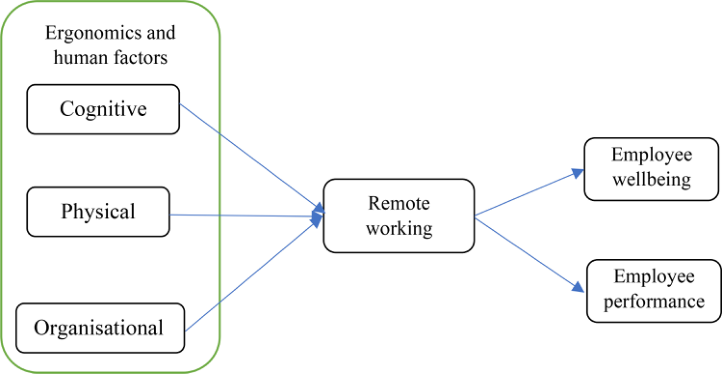
Figure 1: Proposed conceptual model.
The proposed conceptual model posits that ergonomics, and human factors impact how employees adapt remote working to ensure their well- being for optimal performance. Consequently, the following propositions are made:
Adapting Ergonomics and Human Factors in Remote Work for Employee Well-Being 69
Proposition 1: Cognitive ergonomics and human factors will have an influence on employees’ adoption of remote working.
Proposition 2: Physical ergonomics and human factors will have an influence on employees’ adoption of remote working.
Proposition 3: Organisational ergonomics and human factors will have an influence on employees’ adoption of remote working.
Proposition 4: Remote working adoption will have an impact on employees’ wellbeing.
Proposition 5: Remote working adoption will have an impact on employees’ job performance.
THEORETICAL AND PRACTICAL IMPLICATIONS This study advances the discourse on remote work ergonomics by integrating cognitive, physical, and organizational ergonomics into a unified framework that explains their combined influence on employee well-being and performance. While prior studies has examined these dimensions in isolation, they were primarily grounded in Job Demands-Resources theory (Ingusci et al., 2021; Szczepa´nska and Woszczyna, 2023), Technology Acceptance Model (Aguilar-Rodríguez et al., 2023; Othman et al., 2009), Work-Life Flow Theory (Chatterjee et al., 2020; Nguyen, 2021), and Socio-Technical Systems (STS) Theory (Parent-Rocheleau and Parker, 2022). However, these studies often lack ergonomics specific theory-driven approach to understanding remote work adaptation. This study addresses this gap by integrating ergonomic and well-being theories to propose a conceptual framework for future empirical validation. In doing so, it contributes to theory-building in digital work transformation and occupational health, laying the foundation for future research on the intersection of ergonomics and remote work sustainability.
Practically, this study proposes ideas for optimizing remote work environments through structured digital detox strategies, ergonomic home office support, and organizational interventions that enhance well-being and productivity. Employers should limit virtual meeting hours, subsidize ergonomic furniture, and promote asynchronous work to reduce cognitive and physical strain. Additionally, fostering psychological safety, virtual team-building, and mentorship programs can mitigate workplace isolation. Policymakers should update occupational health regulations to include remote work ergonomics standards, ensuring employees receive adequate support in flexible work arrangements.
CONCLUSION
This study integrates ergonomic and well-being theories to explain how cognitive, physical, and organizational ergonomics influence employee well-being and performance in remote work environments. It proposed conceptual framework, which serves as a foundation for future empirical
research to guide organizations and policymakers in developing evidence- based ergonomic policies that promote sustainable workforce well-being, engagement, and productivity in the increasing remote working environment.
ACKNOWLEDGMENT
The authors would like to acknowledge Rabat Business School, International University of Rabat, Morocco, for providing partial funding in support of this research.
REFERENCES
Adisa, T. A., Ogbonnaya, C., and Adekoya, O. D. (2023). Remote working and employee engagement: A qualitative study of British workers during the pandemic. Information Technology and People, Volume 36 no. 5. Aguilar-Rodríguez, I. E., Bernal-Torres, C. A., Artieda-Cajilema, C. H., and
Tapia-Andino, G. F. (2023). Smart working and base technologies in corporate performance: New directions in emerging firms. Asia Pacific Management Review, Volume 28 no. 3. Asamoah, C. A., Dzandu, M. D., and Klapalová, A. (2022). The Antecedents of Consumer Online Shopping Usage in an Emerging Economy: A Conceptual Study. In 7th International Conference on Finance and Economics (ICFE 2022). Carayon, P. (2006). Human factors of complex sociotechnical systems. Applied
Ergonomics, Volume 37 no. 4. Charalampous, M., Grant, C. A., Tramontano, C., and Michailidis, E. (2019). Systematically reviewing remote e-workers’ well-being at work: A multidimensional approach. European Journal of Work and Organizational Psychology, Volume 28 no. 1. Chatterjee, S., Chaudhuri, R., and Vrontis, D. (2022). Does remote work flexibility enhance organization performance? Moderating role of organization policy and top management support. Journal of Business Research, Volume 139. Choudhury, P., Foroughi, C., and Larson, B. (2021). Work-from-anywhere: The
productivity effects of geographic flexibility. Strategic Management Journal, Volume 42 no. 4. Cruz-Ausejo, L., Copez-Lonzoy, A., Vilela-Estrada, A. L., Valverde, J. J., Bohórquez, M., and Moscoso-Porras, M. (2023). Can working at home be a hazard? Ergonomic factors associated with musculoskeletal disorders among teleworkers during the COVID-19 pandemic: A scoping review. International Journal of Occupational Safety and Ergonomics, Volume 29 no. 4. de Macêdo, T. A., Cabral, E. L., Silva Castro, W. R., de Souza Junior, C. C., da Costa Junior, J. F., Pedrosa, F. M., da Silva, A. B., de Medeiros, V. R., de Souza, R. P., Cabral, M. A., and Másculo, F. S. (2020). Ergonomics and telework: A systematic review. Work, Volume 66 no. 4. Dul, J., & Weerdmeester, B. (2008). Ergonomics for beginners: A quick reference
guide. CRC Press. Dzandu, M. D., Hatsu, S., & De Cesare, S. (2023). Remote working and task innovativeness–an integrated resource based view and antecedent-behaviour- consequence perspective. Information Systems Frontiers, 1-24. Ferrara, B., Pansini, M., De Vincenzi, C., Buonomo, I., and Benevene, P.
(2022). Investigating the role of remote working on employees’ performance and well-being: An evidence-based systematic review. International Journal of Environmental Research and Public Health, Volume 19 no. 19.
Adapting Ergonomics and Human Factors in Remote Work for Employee Well-Being 71
Gomes, C. C. (2021). Remote Work: The Need of Human Factors and Ergonomics to Improve Human Health and Wellbeing. In Advances in Ergonomics in Design: Proceedings of the AHFE 2021 Virtual Conference on Ergonomics in Design, July 25–29, 2021, USA (pp. 951–958). Springer International Publishing. Hendrick, H. W., and Kleiner, B. M. (2002). Macroergonomics: An introduction to
work system design. Santa Monica, CA: Human Factors and Ergonomics Society. Ingusci, E., Signore, F., Giancaspro, M. L., Manuti, A., Molino, M., Russo, V.,... and Cortese, C. G. (2021). Workload, techno overload, and behavioral stress during COVID-19 emergency: The role of job crafting in remote workers. Frontiers in Psychology, Volume 12. Kalakoski, V., Selinheimo, S., Valtonen, T., and others. (2020). Effects of a cognitive
ergonomics workplace intervention (CogErg) on cognitive strain and well-being: A cluster-randomized controlled trial. BMC Psychology, Volume 8 no. 1. Kamala, V., Yamini, S., and Gajanand, M. S. (2025). Ergonomic risks affecting the performance of work-from-home employees in IT industry: A comprehensive analysis. International Journal of Productivity and Performance Management, Volume 74 no. 2. Karwowski, W. (2005). Ergonomics and human factors: The paradigms for science,
engineering, design, and management. Ergonomics, Volume 48 no. 5. Keightley, S., Duncan, M., and Gardner, B. (2023). Working from home: experiences of Home-Working, Health Behavior and Well-being during the 2020 UK COVID-19 Lockdown. Journal of Occupational and Environmental Medicine, Volume 65 no. 4. Keles, B., McCrae, N., and Grealish, A. (2020). A systematic review: the
influence of social media on depression, anxiety, and psychological distress in adolescents. International Journal of Adolescence and Youth, Volume 25 no. 1. Kiran, D. R. (2020). Ergonomics and work study. Work Organization and Methods Engineering for Productivity, Butterworth-Heinemann, pp. 219–232. Koirala, R., and Maharjan, K. (2022). Cognitive ergonomics on employee wellbeing:
A literature review. The Journal of Economic Concerns, Volume 13 no. 1. Kowalski, K., and Makowiec-Dabrowska, T. (2023). The influence of remote work on ergonomics and work satisfaction. Scientific Papers of Silesian University of Technology. Organization and Management Series, Volume 178. Larrea-Araujo, C., Ayala-Granja, J., Vinueza-Cabezas, A., and Acosta-Vargas, P.
(2021). Ergonomic risk factors of teleworking in Ecuador during the COVID- 19 pandemic: A cross-sectional study. International Journal of Environmental Research and Public Health, Volume 18 no. 10. Nakrošien˙e, A., Buˇci¯unien˙e, I., and Goštautait˙e, B. (2019). Working from home: Characteristics and outcomes of telework. International Journal of Manpower, Volume 40 no. 1. Nguyen, M. H. (2021). Factors influencing home-based telework in Hanoi (Vietnam)
during and after the COVID-19 era. Transportation, Volume 48 no. 6. Oakman, J., Kinsman, N., Stuckey, R., Graham, M., and Weale, V. (2020). A rapid review of mental and physical health effects of working at home: How do we optimise health? BMC Public Health, Volume 20, 1–13. Parasuraman, R., and Hancock, P. A. (2001). Adaptive control of mental workload.
IEEE Transactions on Systems, Man, and Cybernetics, Part A: Systems and Humans, Volume 31 no. 6. Parent-Rocheleau, X., and Parker, S. K. (2022). Algorithms as work designers: How algorithmic management influences the design of jobs. Human Resource Management Review, Volume 32 no. 3.
Reznik, J., Hungerford, C., Kornhaber, R., and Cleary, M. (2022). Home-based work and ergonomics: Physical and psychosocial considerations. Issues in Mental Health Nursing, Volume 43 no. 10. Vink, P., Koningsveld, E. A., and Molenbroek, J. F. (2006). Positive outcomes of
participatory ergonomics in terms of greater comfort and higher productivity. Applied Ergonomics, Volume 37 no. 4. Vischer, J. C. (2007). The effects of the physical environment on job performance: towards a theoretical model of workspace stress. Stress and health: Journal of the International Society for the Investigation of Stress, Volume 23 no. 3. Wang, B., Liu, Y., Qian, J., and Parker, S. K. (2021). Achieving effective remote
working during the COVID-19 pandemic: A work design perspective. Applied Psychology, Volume 70 no. 1. Wilson, J. R. (2000). Fundamentals of ergonomics in theory and practice. Applied Ergonomics, Volume 31 no. 6. Wilson, J. R. (2000). Fundamentals of ergonomics in theory and practice. Applied
Ergonomics, Volume 31 no. 6. Wodajeneh, S. N., Azene, D. K., Abebe, B. B., Sileyew, K. J., and Dadi, G. T.
(2023). Ergonomic risk factors analysis in remote workplace. Theoretical Issues in Ergonomics Science, Volume 24 no. 6.
LISTED IN THE AHFE DIGITAL BOOKSTORE CATALOGUE
Explore the complete digital volume
Social and Occupational Ergonomics
Read this individual research paper free through the original publisher, or explore the full digital proceedings book.
ISBN 978-1-964867-66-3
Explore this ISBN in the AHFE Bookstore ↗Listed in the July 2026 bookstore catalogue; search by ISBN to confirm current availability · Digital book purchase optional