Yan Zhan, Yin Han, Jiandong Wei, Zhongguo Xu (2025). Urban-Rural Synergy Pathways: Exploring Human-Factor in Multifunctional Utilization of Urban Farmland Based on Rural Push-Pull Theory. In: Human Factors in Architecture, Sustainable Urban Planning and Infrastructure. AHFE Open Access, vol. 191, pp. 172–182. https://doi.org/10.54941/ahfe1006621
In the context of ecological civilization construction, China's urbanization has officially entered its latter stage, highlighting the increasing contradiction between construction land and farmland protection. The nation has implemented the strictest farmland protection policies ever, mandating the preservation of the 1.8 billion-mu farmland red line in terms of both quantity and quality. Currently, the intertwined distribution of cities and farmland is commonplace, characterized by fragmented layouts and inefficient production. Furthermore, urban farmland areas generally suffer from crude management and low efficiency, leading to prominent issues of farmland conversion to non-agricultural and non-grain uses. Most farmland remains neglected, exhibiting a state of "scattered, disorganized, poor quality, and underdeveloped." In reality, these urban farmlands are closely linked to urban spaces and residents, possessing not only conventional production value but also substantial ecological, social, landscaping, and cultural humanistic service values yet to be unleashed.This study, grounded in the rural push-pull theory, innovatively establishes an inverse urbanization population attraction analysis model. It defines the synergistic connotations of three objective factors—policy push, business pull, and development resistance—in the composite utilization of urban farmland. Furthermore, it constructs a quantitative evaluation framework of "evaluation system-influencing factors." Empirical analysis based on this framework elucidates the internal logic of attracting urban populations to participate in consumption and production through composite utilization of urban farmland, revealing the interactive relationships between these three influencing factors and human behavior.Taking Ningbo ,China, a typical representative of the Yangtze River Delta urban agglomeration, as a case study, this research employs in-depth stakeholder interviews, questionnaires, and field surveys. The primary investigation targets include urban residents, farmers, government personnel, and farmland managers. Over 30 interviews were conducted, with 580 questionnaires distributed and 426 valid responses collected. The collected data were utilized for empirical analysis.The results indicate that: (1) Composite utilization of urban farmland necessitates the deep integration of functions, spaces, industries, and cultures to address issues in policy, management, and development. Through optimized policy management, coordinated urban-rural resource allocation, and innovative business philosophies, coordinated urban-rural development can be achieved. (2) Urban farmland leverages production to exert functional value, appends agricultural, cultural, and tourism elements to provide emotional value, and facilitates offline entertainment and online purchasing to create brand value. These three values complement each other, attracting urban populations and thereby promoting resource flows and population migration between cities and villages.This study explores the human factor mechanisms in the composite utilization of urban farmland. By enhancing the value of urban farmland and facilitating urban-rural resource and population flows through land circulation and income distribution mechanisms, it aims to increase farmers' incomes and promote sustainable, coordinated urban-rural development.
As global urbanization accelerates, urban agriculture gains global academic and practical attention. Urban farmland, a critical component of urban agriculture, plays multifaceted roles in sustainable urban development. Multifunctional agriculture theory posits four core functions: production (Cardillo et al., 2023), ecology, landscape-culture, and economy (Zhong et al., 2017). Studies propose a “Composite Utilization Model” leveraging agricultural multifunctionality via technological innovation and policy frameworks (Li et al., 2012), forming a synergistic mechanism to address urban land constraints and support global city-building.
Global arable land faces dual pressures from urban expansion and agricultural transformation, exacerbating de-farming and de-fooding. Research indicates urbanization will permanently loss 3.3% of high-quality farmland globally (d’Amour et al., 2017), with Asian peri-urban areas
Urban-Rural Synergy Pathways: Exploring Human-Factor in Multifunctional Utilization 173
losing 1.2–3.6% annually (Seto et al., 2012). Economic incentives for non-agricultural conversion accelerate global urban farmland shrinkage by 2.1% yearly (Thebo et al., 2014). Meanwhile, agricultural workforce aging and youth migration cause “human desertification,” leaving 38% of peri-urban farms worldwide succession-deficient (Graeub et al., 2016). This dual crisis jeopardizes food supply resilience and severs urban-rural ecological/cultural ties.
Urban farmland research, drawing on multifunctional agriculture and urban green infrastructure theories, has advanced two key directions: integration of composite utilization patterns and urban-rural spatial integration. Existing studies have constructed a multifunctionality framework, analyzed spatial drivers of industrial integration, and developed evaluation systems. However, critical challenges remain: research gaps in urban built-up areas, limitations of urban-rural dichotomy thinking, and diminishing policy marginal benefits. Thus, there is an urgent need to transcend traditional perspectives, prioritize urban farmland research, and explore market-policy hybrid protection models.
In this context, this study develops an Urban Farmland Attractiveness Model integrating planned behavior theory and an innovative ‘counter- urbanization’ push-pull framework. By analyzing policy drivers, operational strategies, and development constraints, the model transcends the urban- rural binary divide. Using Ningbo as a case, it uncovers stakeholder interactions through qualitative interviews and consumer surveys, aiming to inform sustainable urban-rural integration.
LITERATURE REVIEW
Analysis of Related Concepts The Concept of “Urban Farmland” Farmland, or arable land, is defined as land suitable for crop cultivation. As the core carrier of urban agriculture, urban farmland is closely linked to urban systems and residents. This study defines urban farmland as agricultural land located within 10 km of urban built-up areas, integrating production, living, and ecological functions to serve urban needs through high-efficiency, multifunctional, and sustainable practices (Yang, 2022).
This paper synthesizes national and international research and defines urban farmland as farmland that is closely associated with urban space and residents, and is located within 10 kilometers of a built-up area and its periphery.
Concept of Composite Utilization of Agricultural Land Compound utilization of farmland refers to the integration and optimization of the multiple functions of farmland in the development of urban agriculture, in order to improve the efficiency of land use and the comprehensive benefits of agriculture (Wu et al., 2023). In the context of urban farmland, it refers to the overlaying of composite functions such as agriculture, industry, culture,
tourism and commerce on the basis of guaranteeing the food production function of farmland.
Literature Analysis Urban farmland, as a key component of urban agriculture, lacks a fully mature theoretical system. However, building upon related urban agriculture research, the academic community has established two primary research directions: xintegrating production, ecological, landscape-cultural, and economic functions through technological innovation and policy support (Zhu, 2000); ypromoting urban-rural spatial harmony via urban planning integration (Zhong et al., 2017). While existing studies provide foundational insights for rural development, practical implementation strategies remain underdeveloped.
Existing studies span three dimensions: domain-level exploration emphasizes expanding farmland functions under urban- rural synergy, highlighting roles in food security, ecological buffering, cultural memory, and recreational space while fostering resilient urban-rural interfaces (Zhang et al., 2023); content-level analysis focuses on multifunc- tionality realization through spatial-location-driven industrial integration and proposes cultural-tourism strategies to activate leisure-education values (Yang and Liu, 2022; Wu et al., 2022); methodological innovation employs empirical quantification (e.g., AHP) to construct composite utilization evaluation systems, enabling functional value quantification and spatial visualization to address limitations of traditional qualitative research (Li et al., 2023).
While existing studies provide foundational insights into farmland composite utilization, gaps remain in three key areas:
1. Research scope: Domestic studies primarily focus on peri-urban farmland (Kong et al., 2024), leaving urban built-up area farmland under-explored. 2. Theoretical perspective: Farmland is often perceived as a rural domain, creating an urban-rural binary divide, with limited exploration of its role as a “third space” for reconciling urban-rural value conflicts. 3. Existing studies primarily focus on macro constraint mechanisms, forming a comprehensive policy framework (Lin et al., 2018). However, accelerating urbanization and market-driven siphoning of arable land have diminished the marginal effectiveness of protection policies (Lu, 2022), leaving challenges that cannot be resolved solely through macro interventions.
THEORETICAL FRAMEWORK People-Centered Evaluation System
Farmland evaluation, critical for national security, remains an academic focus. To explore urban farmland’s appeal to consumers/producers, this study employs a tourism psychology lens to analyze behavioral drivers. In response to diversified academic trends, developing a satisfaction evaluation
Urban-Rural Synergy Pathways: Exploring Human-Factor in Multifunctional Utilization 175
system integrating consumer and producer perspectives addresses research gaps while offering practical and theoretical contributions.
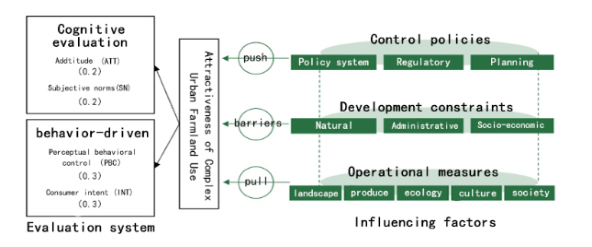
Based on the results of previous research, this paper mainly refers to the theory of planned behavior and divides the evaluation system into two levels: “cognitive evaluation” and “behavioral drive”.
Analysis of Factors Affecting the Attractiveness of Compounding Utilization New Endogenous Development Theory Criticizing the marginalization of the countryside as a result of neo- liberal globalization, it emphasizes that local development should be based on the synergy of “endogenous dynamics” (e.g., indigenous knowledge, social capital) and “external resources” (e.g., policy support, technology diffusion) (Ray, 1999). Combined with the results of previous theoretical research, this paper summarizes the new endogenous development theory into two major components: “endogenous drive” and “exogenous linkage”.
Urban farmland compound utilization relies on endogenous drive and exogenous linkages for sustainable development. By embedding “local subjectivity” to activate rural resources and creativity while adopting “external linkage”strategies to align with urban demand and national market integration.
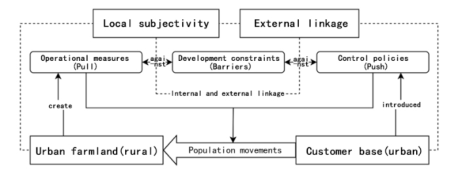
Rural Push and Pull Theory Concepts The “rural push-pull theory,” adapted from Lee’s (1966) population migration framework, explains rural-urban labor flows through dynamic interactions of origin pushes, destination pulls, and intermediate barriers (Lee, 1966). This study transcends the traditional rural-urban binary by redefining push-pull dynamics within cities, positioning urban farmland as a counter-flow “third space.” Innovatively combining new endogenous development theory, we construct a “Reverse Urbanization Push-Pull Model” that reinterprets pulls, resistances, and thrusts to reverse urban-rural resource flows.
The pull, resistance and thrust are interpreted as management measures, development constraints and control policies respectively, and the “Reverse Urbanization Rural Push-Pull Theory Model” is constructed as shown in Figure 1.
Figure 1: A theoretical model of the push-pull of the reverse urbanized countryside (author’s own drawing).
Regulatory Policy Influences Control policies in urban farmland research encompass planning, protection, utilization, and management. They exert a “catch-up effect” on multifunctional agriculture development, with precise location decisions and technology investment as critical determinants (Ren, 2023). This paper summarizes the influencing factors of urban farmland control policies into three items: policy system, control mechanism and planning implementation.
Factors Affecting Operational Measures Farmland management relies on the value of compound utilization (Zhang et al., 2023; Xiong et al., 2021) (production, ecology, landscape and other functions), and based on the guarantee of production functions, the management measures are summarized into five factors: landscape enhancement, production increase, ecological protection, cultural implantation, and social communication, so as to promote sustainable and diversified utilization of arable land.
Development Constraints Farmland development is not only constrained by internal resistance, but also faces multiple challenges from external resistance.
Internal resistance:Natural environment issues. These are mainly characterized by land resource degradation, water scarcity, climate change and loss of biodiversity (Lal, 2015).
External resistance:Agricultural multifunctionality is affected by multiple economic, social and environmental factors (Yan et al., 2024; Li et al., 2024; Qiao et al., 2024). Based on the existing research results, the two main factors can be summarized as administrative support and socio-economic factors.
Theoretical Modeling This paper proposes a theoretical model as shown in Figure 2, based on the urban farmland composite use with cognitive evaluation and behavioral drive as criteria:
Figure 2: Modeling the attractiveness of complex urban farmland use (author’s own drawing).
Urban-Rural Synergy Pathways: Exploring Human-Factor in Multifunctional Utilization 177
Scale Design Following the preliminary survey, supplementary adjustments were made to the measurement questions, leading to the final questionnaire.The scales were presented on a 5-point Likert scale. In the survey design, the farmland attractiveness evaluation system focuses on two dimensions: cognitive evaluation and behavioral drive, as outlined in Table 1. The farmland attractiveness scale questionnaire incorporates three sub-dimensions and 11 survey items developed based on interview data, as detailed in Table 2.
Table 1: Farmland attractiveness evaluation system source: author’s own production.
Table available in the original PDF paper.
Dimension Latent Variable Source Weight
0.2
Cognitive evaluation Attitude (ATT) Ajzen, I. (1991) Subjective norm(SN) 0.2 Behavior-driven Perceptual-behavioral control (PBC) 0.3 Consumer intent(INT) 0.3
Purpose of the Scale Empirical Analysis of Factors Influencing the Value of Urban Farmland Level 1 Level 2 Scale Items Criteria
Control policy Policy regime / Regulatory Evaluation through interviews
mechanism
Score on a scale of
Planning Do you think the farmland is implement
only performing a productive function?
1–5 from “very poor” to “very good” Would you like to participate
in the investment of this farmland?
Business measure Landscape
Does the farmland fit your Enhancement aesthetic?
Increased The farmland uses certain production
measures to make the crops grow better, harvest more?
Ecological The farmland uses certain protection
measures to protect the ecosystem?
Cultural Can you feel the farming implantation
culture in this farmland?
Does this farmland do the integration of industry and research?
Social exchange Is socializing appropriate on that farmland?
Continued
Table 2: Continued Purpose of the Scale Empirical Analysis of Factors Influencing the Value of Urban Farmland
Table available in the original PDF paper.
Level 1 Level 2 Scale Items Criteria Development Socio-economic Inadequate funding for this Ditto 1–5 scoring constraints
farmland
(negative) The farmland is little known
Natural There is environmental environment
pollution on this farmland
Administrative Evaluation through interviews / support
RESEARCH DATA ANALYSIS This paper mainly adopts the quantitative research method to explore and analyze the attractiveness model of urban farmland composite utilization: taking 100 pieces of urban farmland in Ningbo City as the research object, through the questionnaire scale setup for the evaluation system related data statistics, combining each element of the countryside push-and-pull theory to determine the variables and setup the path relationship, so as to establish the structural equation model for the empirical test and analysis.
In this study, the multi-stage sampling method was used and the sample size was calculated according to the simple random sampling formula n = (Z α 2)2π(1−π) E2 , After setting the confidence level at 95% and the margin of error (E) at 3%, The sample size was calculated to be 1068 and expanded to 1100. Finally, 1082 valid questionnaires were returned, and the following data analysis is carried out on the 1082 data.
Reliability and Validity Tests Firstly, the study was subjected to reliability and validity tests t and the results are tabulated as follows.
Table 3: Reliability and validity analysis table.
Table available in the original PDF paper.
Variable Cronbach Factor KMO Item Count Control policy 0.887 0.876 3 Development constraints 0.836 0.859 3 Business measure 0.918 0.773 5 Totally 0.815 0.816 11
According to Tables 3, it can be concluded that the data from the questionnaire passed the reliability and validity tests and is suitable for validated factor analysis.
Setting Up Structural Equation Modeling Structural equation modeling (SEM) requires normality assumptions, so this study tested skewness/kurtosis to assess data distribution. Based on
Urban-Rural Synergy Pathways: Exploring Human-Factor in Multifunctional Utilization 179
established criteria (skewness <1, kurtosis <7), questionnaire data met normality requirements (skewness <1, kurtosis 0.2–1). Using Amos 29.0, confirmatory factor analysis (CFA) with a multifactor oblique model validated the hypothesized framework: CIN/DF = 3.819, RMSEA = 0.078, IFI = 0.879, TLI = 0.863, CFI = 0.821. Fit indices indicated acceptable model-data alignment, supporting the urban farmland composite value indicator system. Drawing on push-pull theory, the study hypothesizes pathways through which control policies, development constraints, and operational measures influence composite utilization value.
H1: Control policies have a positive effect on the value of composite utilization, i.e., a push effect.
H2: Development constraints have a negative impact on the value of composite utilization, i.e., resistance effect.
H3: Operating measures have a positive effect on the value of composite utilization, i.e., a pull effect.
Before analyzing the structural equation modeling, the model fitness test needs to be conducted, and this study mainly uses the chi-square degrees of freedom ratio, RMSEA, IFI, TLI, and CFI to conduct the test.
Table 4: Composite utilization value model fitness test.
Table available in the original PDF paper.
Norm Reference Standard Actual Results CIN/DF 1–3 is excellent, 3–5 is good 2.816 RMSEA <0.05 is excellent, <0.08 is good 0.078 IFI >0.9 is excellent, >0.8 is good 0.849 TLI >0.9 is excellent, >0.8 is good 0.854 CFI >0.9 is excellent, >0.8 is good 0.851
According to Table, it can be seen that all the fitting indices used in this study meet the requirements and reach the good standard. Therefore the results of this analysis can show that the composite utilization value model is fitted relatively well and has a good fit.
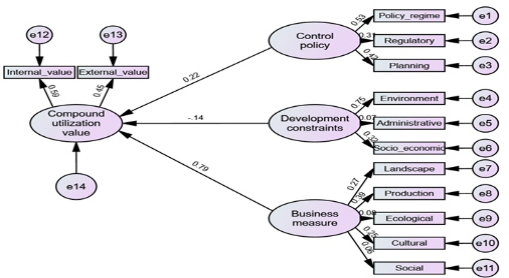
Results of the Study After passing the fitness test, the structural equation model is plotted using Amos and the normalized model results are as follows.
Table 5: SEM path relationship test results.
Table available in the original PDF paper.
Path Relationship Estimate S.E. C.R. P Compound <--- Control policy 0.218 7.462 1.749 * utilization value
Compound
<--- Development
−0.142 8.865 −1.658 *
utilization value
constraints
Compound
<--- Business
0.792 59.532 2.399 ***
utilization value
measure
Figure 3: Composite utilization value model run results chart.
The path relationship hypothesis was tested based on the results of the model run. Comprehensive Table results, management measures exert a significant positive impact on composite utilization value (C.R. > 1.96, p < 0.05 at 95% confidence level), with the largest direct effect among tested factors. This underscores the critical role of proactive management strategies in enhancing urban farmland value through human intervention.
From the results of structural equation modeling, the hypotheses of the influence paths are valid, and the coefficients of each path are highly significant, indicating that the theoretical model can pass the empirical test in terms of control policies, development constraints, and operational measures, and therefore can be based on the theoretical model in the process of the composite use of urban farmland to make suggestions and recommendations.
CONCLUSION
A study of 100 urban farms in Ningbo found skewed distribution dominated by low-value farmland. Farmland value is significantly influenced by policy thrust and operational pulls, with operational-driven composite use having the greatest impact. The integration of agricultural production, science education, and leisure tourism emerges as a key future trend, highlighting the need to explore compatible development pathways to enhance multifunctional value.
Based on the new endogenous development theory and rural push-pull theoretical framework, this paper proposes a systematic enhancement path for the composite utilization of urban farmland, with the following specific conclusions.
1. Policy optimization: Reinforcing “thrust” driven mechanisms Cross-sectoral collaboration in special planning explores a “point land + permanent basic farmland” supply model to unlock industrial potential. Differentiated incentives (tax breaks, subsidies) and dynamic regulations facilitate land transfer toward refined management rights operations, activating market innovation and reducing policy dependency.
Urban-Rural Synergy Pathways: Exploring Human-Factor in Multifunctional Utilization 181
2. Value Enhancement: Building a “Three-Stage Value” Operation System From a marketing perspective, the “Integrated Value Proposition” of urban farmland can be operationalized through three dimensions: Functional Value: Relying on technological empowerment (IoT, blockchain traceability) and infrastructural innovation to optimize supply chain efficiency and guarantee production sustainability; Emotional value: Through the customization of crowd-level scenes (e.g. healing farming, parent-child education) and the design of immersive experiences (AR narratives, themed activities), the company has created a high-premium model of “rural life trafficking”; Brand value: linking geographical indication certification and city culture IP, building a layered brand matrix of “public - high-end - public welfare”, and strengthening market penetration by combining cross-border co-branding and content co-creation. 3. Cracking the resistance: Multidimensional solutions to development constraints
Funding mechanism: Innovative PPP models, financial products and blockchain traceability technology to attract social capital and reduce market risks; Public participation: Promote the formation of a multi- party sharing mechanism through publicity, education and community building; Planning and implementation: Optimizing spatial layout and ecological renovation to improve the suitability of farmland innate conditions.
This study transcends the urban-rural binary divide by redefining push-pull dynamics, positioning urban farmland as a “third space” to reconcile urban- rural value conflicts and offering a new paradigm for farmland protection and sustainable urbanization.
REFERENCES
Cardillo, C., Cimino, O., Rosa, D. M. et al. (2023) ‘The evolution of multifunctional agriculture in Italy’, Sustainability, 15(14). d’Amour, C. B., Reitsma, F., Baiocchi, G. et al. (2017) ‘Future urban land expansion
and implications for global croplands’, Proceedings of the National Academy of Sciences of the United States of America, 114(34), pp. 8939–8944. Graeub, B. E., Chappell, M. J., Wittman, H. et al. (2016) ‘The state of family farms in the world’, World Development, 87, pp. 1–15. Kong, W., Wang, X., Zhou, J. et al. (2024) ‘The impact of land supply behavior on
the development of new quality productive forces: A three-dimensional empirical analysis based on land supply structure, price, and mode’, China Land Science, 38(7), pp. 51–62. Lal, R. (2015) ‘Restoring soil quality to mitigate soil degradation’, Sustainability, 7(5), pp. 5875–5895. Lee, E. S. (1966) ‘A theory of migration’, Demography, 3, pp. 47–57. Li, C., Zhang, F., Zhu, T. et al. (2012) ‘Analysis of land use spatial reconstruction under the planning and regulation of basic farmland protection areas’, Transactions of the Chinese Society of Agricultural Engineering, 28(16), pp. 217–224, I0009.
Li, Q., Wang, W., Cui, Y. et al. (2024) ‘The logical framework and network form of multi-subject collaborative governance in the overall land comprehensive improvement from the perspective of organizational relations’, Journal of Natural Resources, 39(4), pp. 912–928. Li, Z. et al. (2023) ‘Evaluation of agricultural green development level based on
entropy weight TOPSIS model: A case study of Southern China’, Journal of Natural Resources, 38(4), pp. 889–902. Lin, J., Liu, S. and Li, J. (2018) ‘Logic and path of cultivated land protection in territorial spatial planning’, China Land Science, 32(7), pp. 1–8. Lu, M. (2022) ‘Urban-rural land misallocation and efficiency loss’, Economic
Research Journal, 57(3), pp. 45–60. Qiao, W., Li, C., Dai, L. et al. (2024) ‘Research progress and prospects on the coupling of rural regional multifunctional evolution and land use transformation’, Journal of Geographical Sciences, 43(6), pp. 1556–1571. Ray, C. (1999) ‘Endogenous development in the era of reflexive modernity’, Journal
of Rural Studies, 15(3), pp. 237–250. Ren, Y., Yang, J., Zhang, Z. et al. (2023) ‘Urbanization in Chinese counties: Differences in the spatial matching of population and land and influencing factors’, China Land Science, 37(12), pp. 92–103. Seto, K. C., Güneralp, B. and Hutyra, L. R. (2012) ‘Global forecasts of urban
expansion to 2030 and direct impacts on biodiversity and carbon pools’, Proceedings of the National Academy of Sciences of the United States of America, 109(40), pp. 16083–16088. Thebo, A. L., Drechsel, P. and Lambin, E. F. (2014) ‘Global assessment of urban and peri-urban agriculture: Irrigated and rainfed croplands’, Environmental Research Letters, 9(11). Wu, B. et al. (2022) ‘Optimization strategies for rural tourism interpretation systems’,
Acta Geographica Sinica, 77(5), pp. 1234–1245. Wu, C., Chen, B., Huang, X. et al. (2023) ‘Research on the near and remote driving mechanisms of cultivated land use change: A case study of the Yangtze River Economic Belt’, Journal of Geographical Sciences, 42(11), pp. 3003–3019. Xiong, C., Zhang, Y., Wang, Y. et al. (2021) ‘Evaluation and zoning management and
control of the multiple functions of cultivated land in China’, Chinese Journal of Land Science, 35(10), pp. 104–114. Yan, J., Pu, J. and Xia, F. (2024) ‘Innovatively allocating land elements to ensure the development of new quality productive forces: Theoretical logic, basic modes and path mechanisms’, China Land Science, 38(7), pp. 1–11. Yang, Q. (2022) ‘Promoting development of urban-rural integration by urban
agriculture’, Bulletin of Chinese Academy of Sciences, 37(2), pp. 246–255. Yang, R. and Liu, R. (2022) ‘The evolution of urban agricultural functions and their synergy-trade-off relationships in the Pearl River Delta urban agglomeration area’, Geographical Research, 41(7), pp. 1995–2015. Zhang, F. et al. (2023) ‘Current situation and trends of urban agriculture development in China’, Geographical Research, 42(4), pp. 881–895. Zhang, Y., Long, H., Chen, S. et al. (2023) ‘The development of multifunctional
agriculture in farming regions of China: Convergence or divergence?’, Land Use Policy, 127 Zhong, Y., Liu, L., Liu, X. et al. (2017) ‘Research on agricultural multifunctional evaluation and functional zoning: A case study of Hunan Province’, Chinese Journal of Agricultural Resources and Regional Planning, 38(3), pp. 93–100. Zhu, L. (2000) ‘Strengthening the basic position of agriculture and adhering to the
national policy of sustainable development: A review of Professor Li Runtian’s new book Sustainable Development of Agriculture in Henan’, Acta Geographica Sinica, 55(2), p. 253.
LISTED IN THE AHFE DIGITAL BOOKSTORE CATALOGUE
Explore the complete digital volume
Human Factors in Architecture, Sustainable Urban Planning and Infrastructure
Read this individual research paper free through the original publisher, or explore the full digital proceedings book.
ISBN 978-1-964867-67-0
Explore this ISBN in the AHFE Bookstore ↗Listed in the July 2026 bookstore catalogue; search by ISBN to confirm current availability · Digital book purchase optional