Ning Li, Guofang Wang, Jing Fang (2025). Construction of Fitz's Law Model for Ship Operator in Long Voyage. In: Human-Computer Interaction & Emerging Technologies. AHFE Open Access, vol. 195, pp. 202–208. https://doi.org/10.54941/ahfe1006238
The long voyage of ships has the characteristics of quarantine closed, 24-hour continuous duty and long voyage to distant sea.The state of long voyage will affect the operator's operation ability, and then affect the operation performance in the process of human-computer interaction.As a result, the human-computer interaction task that can be completed under conventional conditions may not be completed in the long voyage state.However, the existing Fitz's law model lacks the consideration of the long voyage state, which leads to errors in the calculation of human-computer interaction performance.Therefore, based on the original Fitz's law model, this paper designs an experiment to collect the steering parameters under the condition of 90 days long voyage. Eight ship operators were selected to collect the data of operating parameters. The model of parameter change rule of operator's Fitts law in the state of 90 days long voyage is constructed.The model can be used to calculate the execution time of human-computer interaction tasks for each day in the 90-day long voyage state.
In the process of human-computer interaction of ship operator, the operator usually needs to click on a fixed target. Such as buttons, windows, menu items, etc., on a computer display. The Fitt’s Law simulates the execution process of the human-computer interaction control behavior (Card, English, & Burr, 1978; Li, Zhou, Zhang, et al., 2020; 王毅et al., 2020). See the formulas (1) and (2) for details.
According to the Fitt’s Law, the movement time MT is a linear function of the difficulty index ID.
Equation reproduced from the original PDF.
Where a and b are constants, ID is difficulty index.
Construction of Fitz’s Law Model for Ship Operator in Long Voyage 203
Where D is the distance from the current point to the target, and W is the width of the target.
Li et al. (2020) constructed the operator Fitt’s Law in the conventional state and updated the parameters and in the existing Fitt’s Law. Considering the special long voyage working condition and quarantine closed working environment of the ship operator, the operator’s own ability will change, which will lead to the change of the operator’s operate ability. The parameters a and b may change in the long voyage state, but the existing research does not give the change law of the parameters a and b in the long voyage state. It limits the calculation of human-computer interaction performance in long voyage state.
Based on the above background, this paper designs a 90-day long voyage operation parameter measurement experiment. The experimental data of the operator’s operation in the state of long voyage are collected, and the variation model of the parameters a and b in the Fitt’s Law is constructed. Furthermore, the Fitt’s Law model of the operator under the condition of 90 days long voyage is constructed.
EXPERIMENTAL EQUIPMENT In terms of experimental environment, a cabin with quarantine, closed and long voyage environment was built. The subjects can work, eat and sleep independently in the cabin. After the subjects entered the cabin, the cabin was closed for 95 days until the end of the experiment, during which the subjects did not leave the cabin, so as to simulate the closed and long voyage environment of the quarantine as far as possible. In order to ensure the stability of the objective conditions of the experiment, the light environment, sound environment, temperature and humidity in the experimental cabin are all simulated as the typical environment of the ship. In the working area, the light environment is 60 Lux, the temperature is 23 ∼25
C, and the noise is 55 dB. The parameters remain unchanged under the adjustment of the experimental cabin control system.
In terms of experimental equipment, the experimental equipment includes the host, display, mouse and keyboard of the display and control equipment of the ship command and control system. The display area of the screen is 52.71 × 29.65 cm, and the display resolution is 1600 × 1200 dpi.
PARTICIPANTS In terms of subject selection, the subjects are 20 simulated operators of ship command and control system, who have practical experience in ship command and control system. The subjects signed the informed consent of the experiment after professional training and training, all of them have reached the qualified standard after examination. It has the conditions to carry out formal experiments. The 20 subjects included 12 males and 8 females, with an average age of (30.2 ± 4.1) years and an average working life of (5.4 ± 0.8) years. Corrected visual acuity is above 1.0, right handedness.
OPERATION PARAMETER MEASUREMENT EXPERIMENT IN LONG VOYAGE CONDITION The long voyage experiment lasted for a total of 95 days, and eight experiments were carried out according to the experimental task arrangement. The data acquisition process of each experiment was carried out on the 4th, 16th, 31st, 43rd, 58th, 70th, 80th and 95th days after the start of the mission.
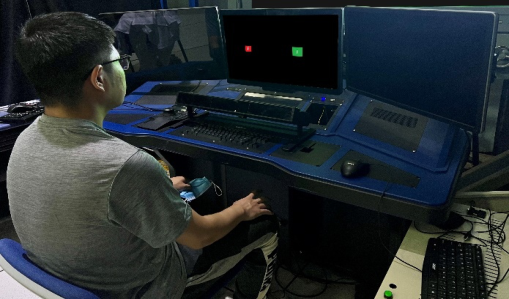
Experimental Process In this experiment, subjects are required to complete two click tasks. First, the target width W is unchanged, and the target distance D is changed. Second, the target distance D is unchanged and the target width W is changed. The subjects is required to use the mouse to click the two icons “E” and “F” on the display interface of the monitor, as shown in Figure 1.
Figure 1: Parameter measurement experiment of operation control model.
Considering that the conventional single operation distance of a ship command and control system is usually between 100 and 300 pixels (Li, Chen, Feng, & Huan). The size of the system icon design is generally between 10 and 40 pixels (Li, Zhou, Shi, et al., 2020), and the experiment sets the variables as D 100, 150, 200, 250, 300 pixels (the distance of “E” and “F”, which appear randomly on the screen), will be set to 10, 20, 30, 40 pixels (size of “E” and “F”, square shape). Therefore, the experiment involves five target distance D and four target width W intersection combinations, totaling 20 kinds. Where ID = 3.95, 3.39, 3.00, 2.46 correspond to different and combinations.
After the start of the experiment, click the two icons “E” and “F” in turn on the display interface of the monitor. Each D and W combination was randomly executed for 5 times, and each subject clicked 100 times. The experimental procedure was to record the time between the two clicks of “E” and “F” under each combination. It was further analyzed whether there was a significant difference in click time between the same ID but different combinations. According to the results of pre-experiment analysis,
Construction of Fitz’s Law Model for Ship Operator in Long Voyage 205
there is no significant difference in click time between the same ID and different combinations. In view of reduce that influence of fatigue caused by long operation time on the experimental result as much as possible, The combination with the same difficulty coefficient only retains the one with the largest distance, and the final experiment retains 14 combinations.
Experimental results (1) Analysis of basic data for parameter measurement of operation control model in long voyage state
First, the mean and standard deviation of all the data collected in each of the eight experiments were calculated. Data with more than 3 times of standard deviation are eliminated and replaced by the mean value. The mean and standard deviation of the operation time of each of the 8 subjects in each experiment under 14 ID gradients were calculated in turn. Secondly, 8 pairs of parameters (Ta,Tb) (representing the parameters a and b in the Fitt’s Law respectively) of 8 subjects in each experiment were obtained by linear fitting. The mean value (M) and standard deviation (SD) are shown in Table 1 and Table 2, respectively. The long voyage time (t) is shown in the table; Finally, 8 pairs of parameters of 8 subjects in each experiment were fitted by polynomial. Combined with the Fitz’s Law, and the model of the change of the parameters Ta and Tb are further constructed.
Table 1: Parameter Ta of 8 operators after 8 times of experimental fitting in the long voyage state.
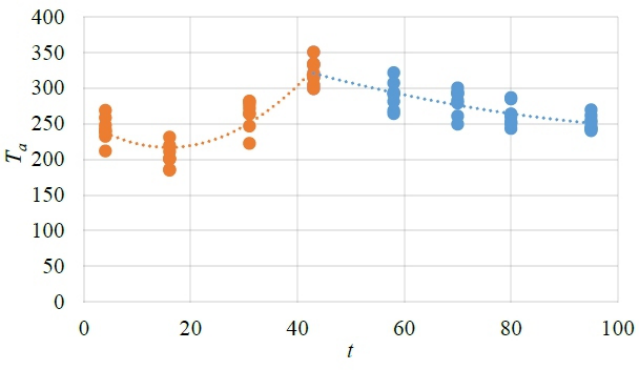
(2) The change model of the long voyage state parameter Ta For Ta, taking the long voyage time(t) as the independent variable. In Table 1, the 8 parameters of 8 subjects in each experiment were used as dependent variables (64 points in total) for polynomial fitting. Considering the change law of the data itself and the fitting coefficient, the final fitting is carried out in a segmented way. The data were divided into two stages with the forty-third day as the dividing point for fitting (P < 0.05). The results are shown in Figure 2 using a quadratic polynomial fit before and after 43 days (R2 = 0.83 and 0.71, respectively).
Figure 2: Change model of Ta.
The maximum absolute error of fitting is 6.14%, and the average absolute error is 2.3%. Ta ϕpla(t) = 1.485 ∗10−1 ∗t2 −4.702t + 254.099, 0 < t ≤43 1.233 ∗10−3t2 −3.045t + 428.826, 43 < t ≤90 (3)
Where ϕpla(t) is the change model of the operator’s control parameters in the long voyage state, and t is the time of the long voyage (days).
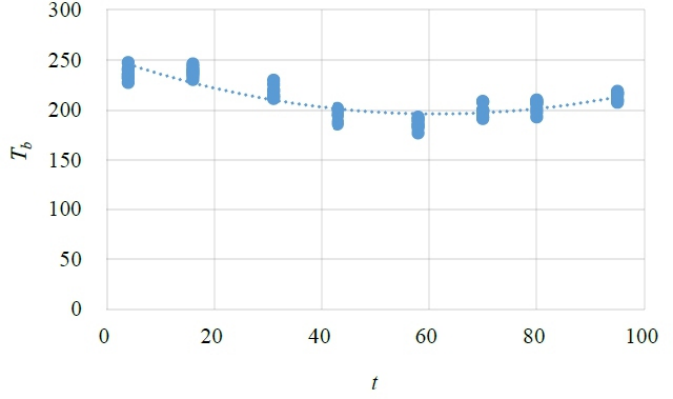
(3) The change model of long voyage state Tb. For Tb, taking the long voyage time (t) as the independent variable. In Table 2, 8 parameters of 8 subjects in each experiment were used as dependent variables (64 points in total) for polynomial fitting. Considering the change rule of the data itself and the fitting coefficient (R2 = 0.76). The quadratic polynomial fitting is finally selected, and the results are shown in Figure 3. The change model ϕplb(t) of Tb in the long voyage state is shown in formula (4), the maximum fitting error is 5.49%, and the mean absolute error is 2.65%. t ϕplb(t) = 1.507 ∗10−2t2 −1.850t + 252.763 (4)
Where ϕplb(t) is the change model of the operator’s control parameter. Tb in the state of long voyage, and t is the time of the long voyage (days).
(4) Operator’s Fitts’ law model under long voyage condition.
Construction of Fitz’s Law Model for Ship Operator in Long Voyage 207
Figure 3: Tb change model in long endurance state.
According to formula (3), formula (4) and formula (2), the control time ϕTmm(t) in the long voyage state can be obtained:
1.485 ∗10−1 ∗t2 −4.702t + 254.099
+
1.507 ∗10−2t2 −1.850t + 252.763
Equations and mathematical formulas are available in the original paper PDF.
(5)
ϕTmm(t) =
log2(D/W + 0.5), 0 < t ≤43
1.233 ∗10−3t2 −3.045t + 428.826
+
1.507 ∗10−2t2 −1.850t + 252.763
Equations and mathematical formulas are available in the original paper PDF.
log2(D/W + 0.5), 43 < t ≤90
Where ϕTmm(t) represents the control time (ms), t is the time of the long voyage (days), D is the moving distance, W is the target width.
CONCLUSION OF THE EXPERIMENT The exist research does not give the change rule of the parameter a and b in the Fitt’s Law under long voyage condition. In this paper, the 90-day long voyage operation parameter measuring experiment is carried out, and the operator’s operation experimental data are collected. The change model of parameters a and b in the Fitt’s Law is constructed, and the Fitt’s Law model of operators in the 90-day long voyage state is further constructed. For the same interactive task, the above model can calculate the operation time of each day under the condition of long voyage, which provide important support for that human-computer interaction design of the ship command and control system.
ACKNOWLEDGEMENT
This work was supported in part by the National Defence Pre-Research Foundation under Grant 3020904040301.
REFERENCES
Card, S. K., English, W. K., & Burr, B. J. J. E. (1978). Evaluation of mouse, ratecontrolled isometric joystick, step keys, and text keys for text selection on a CRT. 21(8), 601–613. Li, N., Chen, X., Feng, Y., & Huan, J. Human-computer Interaction Cognitive
Behavior Modeling of Command and Control Systems. IEEE Internet of Things Journal, 2021, 1–14. Li, N., Zhou, T., Shi, J., Chen, Z., Huang, J., & Feng, Y. (2020). Research on Eye Movement Parameters of Command and Control System Operator Based on Emma Model. Paper presented at the International Conference on Applied Human Factors and Ergonomics. Li, N., Zhou, Y., Zhang, B., Liu, Q., Huang, J., & Feng, Y. (2020). Research on
the Parameters of Human-Machine Interaction of Command and Control System Operator Based on Fitts Law. Paper presented at the International Conference on Applied Human Factors and Ergonomics. Wang Yi, Lv Jian, You Qian, Zhao Zeyu, Yan Baoming, & Zhu Shuman. (2020).
A Virtual Reality Arbitrary Shape Selection Model Based on Fitts’ Law. Computer Applications, 40(11), 3320–3326.
Read this individual research paper free through the original publisher, or explore the full digital proceedings book.
ISBN 978-1-964867-71-7
Explore this ISBN in the AHFE Bookstore ↗Listed in the July 2026 bookstore catalogue; search by ISBN to confirm current availability · Digital book purchase optional