Jona Karg, Frank Ritz, Petra Maria Asprion (2025). Propensity Matters – An Empirical Analysis on the Importance of Trust for the Intention to Use Artificial Intelligence. In: Human Interaction and Emerging Technologies (IHIET 2025). AHFE Open Access, vol. 197, pp. 171–181. https://doi.org/10.54941/ahfe1006710
There is a growing need for scientific knowledge about the extent to which the results of artificial intelligence (AI) and the effects of its use can be considered trustworthy. Accordingly, user experience can lead to trust in AI being too low or too high, which could result in its misuse. Especially as trust is considered subjective and could be seen as a heuristic, which in turn would speak in favor of the importance of trust in AI, as the underlying algorithm is not transparent to the user in so-called black-box models. In this context, the call to enhance the transparency of such models to increase trust seems contradictory. There is no common theory, but Lee and See's (2004) model of trust in automation is often used as a basis for research, since automation can be seen as the foundation of AI. However, it remains unclear whether this model can be adapted to AI. Therefore, this study investigates which factors influence trust in AI in the context of ChatGPT and how this affects the intention to use. On this basis, a conceptual path model was derived and tested using path analysis. Data were collected from 105 students using validated questionnaires. The empirical path model shows the expected positive influences, with one exception. In addition, the results emphasize that the role of the propensity to trust is central. Furthermore, the significant influence of trust on intention to use is weaker than supposed. While the results largely align with existing assumptions, they simultaneously introduce new insights.
The importance of Artificial intelligence (AI) and its corresponding algorithms, which are used in data processing and interpretation is growing (Shin, 2021). Indeed, even minor incidents have been demonstrated to be capable of engendering a loss of trust (Hendrycks & Mazeika, 2022). Since, even minor incidents pose threats that can lead to a loss of trust (Amodei et al., 2016). Consequently, the trustworthiness of AI is increasingly being discussed (Lewis & Marsh, 2022). Trust is regarded as a pivotal
element in the acceptance and efficacy of AI systems (Hoffman et al., 2023). The decision to trust can be regarded as the intention to use (Razin & Feigh, 2023) and, consequently, it is considered to strongly influence the successful implementation and utilization of AI systems (Hoffman et al., 2023). Whereby an inappropriate level of trust can result in disuse if too low and in misuse if too high (Lee & See, 2004).
A discourse has emerged surrounding the enhancement of the reliability of AI systems and the promotion of users’ trust in them (Lewis & Marsh, 2022). For instance, the European Commission’s High-level Expert Group on AI felt compelled to write a guideline on how to develop trustworthy AI systems (Lewis & Marsh, 2022). Furthermore, a plethora of guidelines have been established to address the trustworthiness of AI systems (Jäger et al., 2025). It is assumed that people will have more trust in an AI technology whose algorithm is transparent and explainable (Choung et al., 2022). Accordingly, the explainability of AI is discussed under the term explainable AI (XAI, Hoffman et al., 2023). The notion of trust in AI has recently emerged as a pivotal area of research interest (Bedué & Fritzsche, 2022). This focus is primarily driven by the recognition that trust plays a crucial role in comprehending the ramifications of the increasing interaction with AI systems (Montag et al., 2023). However, the extent to which the current understanding of trust can be transferred to the context of AI remains unclear (Shin, 2021), since AI systems capabilities go beyond that (Langer et al., 2023). This is due to the fact that the capacity of AI to function autonomously introduces novel risks and uncertainties (Choung et al., 2022), leading to the position, that trust in AI differs considerably from trust in more established technology (Chi et al., 2021).
Utilizing ChatGPT, this study endeavors to enhance the comprehension of trust in opaque machine learning (ML) algorithms – referred to as black-box models (Rai, 2020) – and the relevance of transparency whereas ML describes an AI’s capacity to learn from data without direct human intervention (Hendrycks et al., 2023). Concretely, the present study is dedicated to exploring the factors that influence trust in AI and the subsequent impact of trust on the intention to use AI.
Understanding of Trust Trust can be defined as the attitude that a trustee will help to achieve the goals of a trustor in a situation characterized by uncertainty and vulnerability (Lee & See, 2004). In this respect, making oneself vulnerable as a trustor means taking a risk (Mayer et al., 1995). Thus, trust is the willingness to take a risk, whereby trust behavior corresponds to taking a risk. This definition is supplemented with the perspective that the possibility for the trustor to monitor or control the trustee is absent. Therefore, concepts such as confidence and predictability should be distinguished from trust. Although confidence, similar to trust, refers to expectations that can be disappointed, the latter would first require accepting the risk in relying on a trustee, whereby, confidence encompasses aspects of control. In contrast, some counter that the theoretical and practical value of the distinction between
Propensity Matters – An Empirical Analysis on the Importance of Trust 173
trust and confidence is questionable (Siegrist, 2019). In addition, while both predictability and trust can be considered mechanisms for mitigating uncertainty, trust goes beyond the meaning of predictability (Mayer et al., 1995). In particular, the latter does not imply a willingness to make oneself vulnerable and thus take a risk. Thereby, trust is important in the increasing technological complexity, serving as a mechanism to reduce complexity (Lee & See, 2004). Trust can be understood as a heuristic (Lewis & Marsh, 2022) that enables humans to accurately assess the trustworthiness of a trustee (Hoff & Bashir, 2015). Trust simplifies decision-making in situations of uncertainty (Siegrist, 2019) and to substitute for control where direct observation is not feasible (Lee & See, 2004).
The Relevance of Trust in Technology Trust is a relevant construct for describing the human-machine interaction and is considered essential for the intention to use (Lee & See, 2004). People tend to rely on a system that they trust and reject systems that they do not trust. Moreover, the decision to trust a system can be interpreted as an intention to use (Razin & Feigh, 2023). Accordingly, trust is becoming increasingly relevant due to the growing prevalence of automated systems for personal use, and this may be crucial for the success of the next generation of computer technologies. In this regard, automation refers to technologies that actively select data, convert information, make decisions or control processes (Lee & See, 2004). Therefore, the AI chatbot ChatGPT can be considered as such a system.
At present, there are several conceptual models of trust in AI that are based on trust in automation, but they are rarely studied empirically, resulting in the lack of a theory on trust in AI (Solberg et al., 2022). In addition, trust was implemented in the Technology Acceptance Model 2 (TAM-2; Choung et al., 2022) besides the established factors of ’perceived usefulness’ and ’perceived ease of use’ to provide a better understanding of the intention to use and acceptance of AI systems.
Some people are more inclined to trust than others (Lee & See, 2004). This tendency is called propensity to trust and differs from person to person, depending on their respective developmental experiences, personality traits, and cultural backgrounds (Körber, 2019). Consequently, trust depends on the one hand, on how much a person relies on the system due to their willingness and experience in the context of the respective situation or task (Gebru et al., 2022). On the other hand, it is shaped by how well the system performs the task and how effectively it conveys information about it. Thus, trust is affected not only by the trustor’s propensity but also by the trustworthiness of the trustee (Mayer et al., 1995).
Trustworthiness is characterized by how well the system performs the task and how effectively it communicates information about it (Gebru et al., 2022). Trust is therefore closely linked to the reliability of the system (Körber, 2019). In particular, the predictability and reliability of the system are relevant aspects that influence trust (Hoff & Bashir, 2015). Moreover, the trustworthiness of a system is divided into the three dimensions of
performance, process and purpose. Performance refers to the behavior of the system and encompasses past and current interactions with it (Lee & See, 2004). This factor includes aspects such as reliability, predictability and ability and can be compared to robustness. Thus, trust is based on the system usefulness and reliably achieving the user’s goals, depends on the tasks and the results (Hoff & Bashir, 2015). In contrast, process includes the perception that the algorithms are appropriate for the situation and able to achieve the user’s goals (Lee & See, 2004). Thus, this factor is not based on specific actions, but rather on the stability and integrity of the system. A user will trust a system if its algorithms can achieve the set goals but are also comprehensible. However, algorithms of powerful systems are sometimes complex and therefore complicated to understand. Finally, the factor of purpose can be understood as trust in the developers of these systems (Hoff & Bashir, 2015), thus it expresses the perception that the developers of the system want to do good to the users (Körber, 2019) and can be understood as benevolence (Lee & See, 2004).
The Importance of Trust in AI AI encompasses systems that make predictions, recommendations or decisions and can sometimes act autonomously (OECD, 2019). The degree of autonomous action varies depending on the specific AI application, which in some cases minimizes the need for human control, thereby creating uncertainties and risks (Choung et al., 2022). However, contemporary AI systems are limited to capabilities in specific task areas, which precludes a generalization of this so-called narrow AI (Lewis & Marsh, 2022). ChatGPT, a chatbot based on ML algorithms (Taecharungroj, 2023) and therefore a black-box model, can be understood as such a system. Black-box models are to become glass-box models through XAI (Rai, 2020).
XAI describes a class of systems that provide insights into how an AI system makes decisions and predictions and carries out its actions. It can also be seen as a concept that provides explanations for the decisions made by an AI system in order to create trust in the system (Gebru et al., 2022). In turn, a lack of transparency can affect people’s trust in AI systems and ultimately lead to rejection. According to Shin (2021) it has also shown that explanations in AI systems lead to more user trust in the results of their algorithms. In this context, trust is often limited to rules, guidelines, or explainability, although it can also be categorized as an emotional reaction and should not be reduced to these aspects (Tschopp & Ruef, 2020). Consequently, it is assumed that the established constructs regarding technology and humans can also be applied in the context of AI (Langer et al., 2023). Solberg et al. (2022) posit that the perceived trustworthiness of the AI System is attributed to affect trust. Accordingly, performance, process – which can be understood as perceived transparency – and purpose are regarded as predictors of trust in AI. Beyond that, it can be stated that the propensity to trust exerts a direct effect on trust in AI. Furthermore, trust is regarded as being strongly associated with the intention to use an AI system (Bedué & Fritzsche, 2022).
Propensity Matters – An Empirical Analysis on the Importance of Trust 175
METHOD
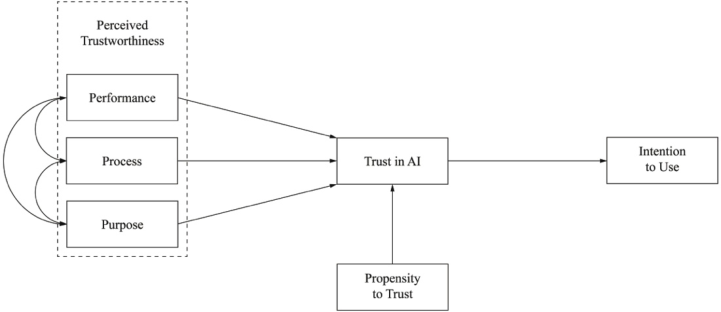
This study examines whether (H1) the perceived trustworthiness and (H2) the propensity to trust exerts a positive influence on trust in AI. Subsequentially it was examined whether (H3) trust in AI has a significant impact on the intention to use AI. On the basis, a path model of trust in AI (see Figure 1), referenced to Lee and See’s (2004) trust in automation model and the models of Solberg et al. (2022) and Körber (2019) was conceptualized. Additionally, the model was extended by intention to use as the endogen variable. Since it is the most popular AI system (Conte, 2024), ChatGPT was chosen as unit of analysis. Thus, a minimum of experience with the system is necessary to be able to measure trust adequately (Siegrist, 2019). The sample was drawn during lectures of a bachelor’s program in Business Information Technology at a Swiss University. This convenience sample was considered sufficient, since it serves the purpose to evaluate the conceptual path model in a first step. Thus, it limits the possibility of generalization. The anonymous survey was created online in the German language. At the beginning, the purpose of the study was explained, this was followed by information about the voluntary nature of the survey and the data processing, which required electronic consent before participation.
Figure 1: Conceptual path model on trust in AI, extended by intention to use (adapted from Lee and See, 2004).
Sample and Measures The cross-sectional study includes a sample of N = 114 participants. One participant was removed from the sample because all items were answered with the mean scale value of “3”. In addition, four subjects were excluded because several items on the path model variables remained unanswered. For participants with only one missing value for the subscales, the median was used to replace the missing value. Two participants stated that they had no experience with ChatGPT, and another two did not answer this item. These four subjects were also excluded from the analysis, since a lack of experience with ChatGPT was defined as a hard exclusion criterion, otherwise the
quality of the data in relation to the measure of trust would be questionable (Siegrist, 2019). Thus, N = 105 participants were considered for the data analysis. With one exception, the participants of the study were students (n = 104). There were n = 54 men and n = 51 women among the participants. In addition, n = 12 participants did not provide their age; the remaining n = 93 subjects were on average M = 22.09 years old (SD = 3.98).
All variables, relevant for the path model were collected metric using a five-point Likert scale from “1 – strongly disagree” to “5 – strongly agree” using reliable questionnaires. Due to this and the fact, that the assessing of the reliability would not have been conclusive for the small sample size (Bujang et al., 2018), a factor analysis and measurement of internal consistency was not carried out. In line with previous studies (Hoffman et al., 2023), the German-language Trust in Automation Questionnaire (Körber, 2019) was adapted to measure trust in AI. The questionnaire’s comprises conceptual subscales measuring trust in automation were adapted to the context of ChatGPT. Thereby, the six items of Reliability/Competence conceptualize performance, the four items of Understanding/Predictability process, and the two items of Intention of Developers purpose. In addition, the two items of Trust in Automation represent the factor trust in AI, and the three items of Propensity to Trust were used to measure the equally named factor. To measure intention to use, the four items of the subscale behavioral intention of non-users of a TAM-2 questionnaire (Choung et al., 2022) were adapted from English and interpreted according to the purpose.
Data Analysis The data analysis was carried out using R (R Core Team, 2022). Before the actual analysis, the scales of negative items were reversed. Subsequently, the mean values were calculated from the individual items of the respective scales as new variables. In accordance with the conventions of Cohen (1992), the significance level for the data analysis was set at p =.05. Furthermore, the effect size was assessed according to the same conventions. The hypotheses were tested using the path analysis, since an adequate statistical power for a structural equation model (SEM) could not be expected with the present sample size (Kim, 2005). Conversely, the integration of the intention to use rendered the conceptual model too complex to employ a multiple linear regression analysis. To analyze the path model the r-package lavaan (Rosseel, 2012) was used. To test the prerequisites, the endogenous variables were first assessed for their linearity, multivariate and univariate normal distribution. When testing the multivariate normal distribution, the Mardias test resulted in a significant result for skewness (p < .001), indicating a violation of this assumption. Furthermore, according to the Shapiro-Wilk test, there was a violation of the univariate normal distribution, since significant results were obtained for the endogenous variables trust (p = .002) and intention to use (p < .001). Likewise, the QQ plot indicated that the multivariate normal distribution was not given. Accordingly, the model fit was evaluated using robust fit indices based on the standard error.
Propensity Matters – An Empirical Analysis on the Importance of Trust 177
The path model fit of the conceptual model to Trust in AI was first tested using a combination of robust fit indices recommended by Hu and Bentler (1999), with use of the respective cut-off values: Comparative Fit Index (CFI > .95), Standardized Root Mean Squared Residual (SRMR < .08), and Root Mean Squared Error of Approximation (RMSEA < .06). Whereby these indices (CFI = .667, SRMR = .188, RMSEA = .248) indicated an inadequate fit of the data regarding the conceptual path model. This made a model re-specification necessary, whereby the modification indices were consulted for the integration of additional paths. In each case, the path was chosen that seemed conceptually meaningful and yielded the greatest estimated significant improvement of the model fit. This resulted in three model re-specifications until an adequate model fit (CFI = 1.0, SRMR = .038, RMSEA < .001) was achieved. After this stepwise process, three paths were added to the re-specify the path model.
RESULTS
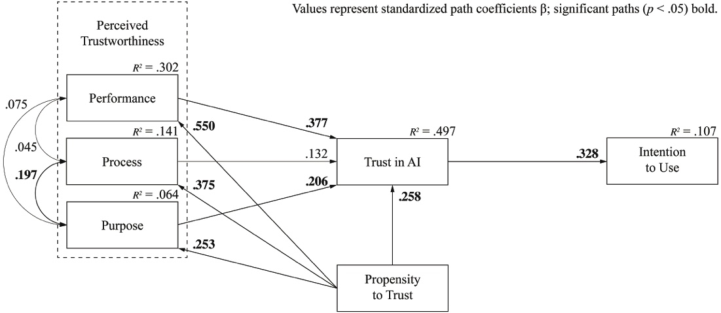
The re-specified path model (see Figure 2) encompasses 16 of the potential 20 parameters (df = 4) and its complete results are listed in Table 1. The data demonstrates that the paths from performance, process, purpose, and propensity to trust to the mediator trust in AI together explain 49.7% of the variance. In addition, 10.7% of the variance of the endogenous variable intention to use can be attributed to the direct path from trust in AI. Finally, the paths from propensity to trust to the variables of perceived trustworthiness explain performance 30.2%, process 14.1%, and purpose 6.4% of the variances.
Figure 2: Empirical path model on trust in AI and its effect on the intention to use.
The direct correlations between the mediator Trust in AI with performance (β = .377, p < .001), and purpose (β = .206, p = .022) at medium effect size, as well as propensity to trust (β = .258, p = .048) at small effect size prove to be significant. However, this does not apply with process (β = .132, p = .106). In addition, the trust in AI shows a small significant
direct correlation (β = .328, p < .001) with the variable intention to use. The paths added to the path model as part of the re-specification, from propensity to trust to performance, with a large effect size (β = .550, p < .001), to purpose, with a medium effect size (β = .375, p < .001), and to process, with a small effect size (β = .253, p = .039), are all significant. Among the coefficients of perceived trustworthiness, only a small effect between process and purpose is significant (β = .197, p = .030). Those between performance and process (β = .045, p = .674) respective performance and purpose (β = .075, p = .477), on the other hand, are not significant.
Table 1: Path coefficients and explained variance of the empirical path model (N = 105).
Table available in the original PDF paper.
β p 95 % CI R2 Performance →Trust in AI .377 <.001 * [.200,.553] .497 Process →Trust in AI .132 .106 [-.028,.292] Purpose →Trust in AI .206 .022 * [.030,.382] Propensity to Trust →Trust in AI .258 .048 * [.003,.512] Trust in AI →Intention to Use .328 <.001 * [.138,.517] .107 Propensity to Trust →Performance .550 <.001 * [.376,.723] .302 Propensity to Trust →Process .375 <.001 * [.167,.583] .141 Propensity to Trust →Purpose .253 .039 * [.013,.492] .064 Performance ↔Process .045 .674 [-.126,.194] Process ↔Purpose .197 .030 * [.017,.334] Purpose ↔Performance .075 .477 [-.106,.227]
DISCUSSION
This study examined the factors that influence trust in AI in the context of ChatGPT, as well as the subsequent impact of trust on the intention to use AI, based on an empirical path model on trust in AI. Contrary to hypothesis 1 only performance and purpose as factors of perceived trustworthiness, but not process, revealed a statistical influence on trust in AI. At the same time, is this consistent with those of Langer et al. (2023). This is remarkable given that process, with its related aspects of transparency and explainability is attributed a high relevance in the context of XAI (Shin, 2021). It could be explained by the fact that ChatGPT is a black-box model whose functioning is not comprehensible to users (Rai, 2020). However, given the conception of trust as a heuristic (Lewis & Marsh, 2022), the question arises as to whether XAI does have any pertinence in the context of trust. Furthermore, the results – contrary to the assumptions of several other studies, e.g. Shin (2021) and Gebru et al. (2022) – indicate that neither understandability nor its absence influences trust. This, in turn, seems reasonable regarding ChatGPT as a black-box model.
As assumed in hypothesis 2, propensity to trust also influences trust in AI, although its influence turned out to be smaller than that of performance. In addition, the re-specification of the path model suggests that the propensity to trust also directly influences the three factors of perceived trustworthiness.
Propensity Matters – An Empirical Analysis on the Importance of Trust 179
These effects are similarly strong as the direct influence on trust in AI. In conclusion, these factors are not only determined by the system, but also by the user.
In line with hypothesis 3, an influence of trust in AI on the intention to use was also identified. However, a strong correlation as assumed was not evident. This raises the question, if other factors like perceived usefulness and perceived ease of use, but also predictability and especially confidence, which should be distinguished from trust (Mayer et al., 1995), have a more relevant influences on the intention to use. Therefore, it is possible that the importance attributed to trust in AI may be overstated.
Further research should be conducted in which the adequate trustworthiness of several AI systems is examined and compared to determine whether explainability, which is not given in black-box models, is nevertheless relevant in glass-box models. If so, this would indicate that it is not trust that has been measured, but a related construct. In addition, the re-specification of the model indicates that propensity to trust is a far more central factor than previously assumed. These relations, as well as the factor itself, should therefore be examined in further research. Finally, it should also be questioned whether the current focus on trust in AI is appropriate, or whether confidence would be the more adequate construct. Moreover, the results of this study suggest that the emphasis in developing trustworthy AI systems should be shifted away from explainability and XAI, to the reliability and performance of the AI system.
LIMITATIONS In order of the construct of trust to be relevant, there need to be a risk associated for the trustor (Mayer et al., 1995). Whereby it seems conceivable that the risk regarding the use of ChatGPT is too low for trust to become effective due to the chosen operationalization. This, in turn, could explain the low influence of trust on the intention to use. Furthermore, the stepwise re-specification of the path model led to an increase in the quality criteria (Hu & Bentler, 1999), but at the same time meant that the significance of the paths could no longer be interpreted unambiguously, which calls the applicability of the construct of trust even more into question. In addition, although the AI system was defined with ChatGPT, despite the recommendation (Langer et al., 2023), its tasks were not specified for this study. Consequently, ChatGPT may have been rated as useful for certain tasks and less useful for others, which could have influenced the measurement of the intention to use. Consequently, it is questionable whether trust in AI can serve as a global construct for the overall technology or even a specific system.
CONCLUSION
The results of this study supporting the position that established constructs of trust cannot be fully applied to trust in AI (Chi et al., 2021). In contrast to earlier findings, e.g. Shin (2021) and Gebru et al. (2022), the users’ self- reported understanding of the functionality of the AI system had no influence
on trust. At the same time, the results indicate that trust could be less critical to the success of AI systems than previously assumed. Furthermore, the results suggest that the perceived trustworthiness of the AI system, like trust in AI, is directly influenced by the users’ propensity to trust. This indicates that the direct influence of the system and thus of the developing organization on its trustworthiness is potentially less significant for the perception of trustworthiness than the disposition of the individual trustor. Finally, the question arises of whether trust is the correct construct for predicting the intention to use AI.
ACKNOWLEDGMENT
This paper is based on the results of a master’s thesis research and the study did not receive any funding. The master’s thesis was supervised by Prof. Dr. Frank Ritz and Prof. Dr. Yanik Sterchi in cooperation with Prof. Dr. Oliver Bendel and the Digital Trust Competence Center (digitaltrust- competence.ch).
REFERENCES
Amodei, D., Olah, C., Steinhardt, J., Christiano, P., Schulman, J., & Mané, D. (2016).
Concrete Problems in AI Safety. Bedué, P., & Fritzsche, A. (2022). Can we trust AI? An empirical investigation of trust requirements and guide to successful AI adoption. Journal of Enterprise Information Management, 35(2). Bujang, M. A., Omar, E. D., & Baharum, N. A. (2018). A Review on Sample
Size Determination for Cronbach’s Alpha Test: A Simple Guide for Researchers. Malaysian Journal of Medical Sciences, 25(6). Chi, O. H., Jia, S., Li, Y., & Gürsoy, D. (2021). Developing a formative scale to measure consumers’ trust toward interaction with artificially intelligent (AI) social robots in service delivery. Comput. Hum. Behav., 118. Choung, H., David, P., & Ross, A. (2022). Trust in AI and its Role in the Acceptance
of AI Technologies. International Journal of Human–Computer Interaction, 39(9). Cohen, J. (1992). A power primer. Psychological Bulletin, 112(1). Conte, N. (2024, January 24). Ranked: The Most Popular AI Tools. Visual Capitalist: https://www.visualcapitalist.com/ranked-the-most-popular-ai-tools/. Gebru, B., Zeleke, L., Blankson, D., Nabil, M., Nateghi, S., Homaifar, A., & Tunstel,
E. (2022). A Review on Human–Machine Trust Evaluation: Human-Centric and Machine-Centric Perspectives. IEEE Transactions on Human-Machine Systems, 52(5). Hendrycks, D., & Mazeika, M. (2022). X-Risk Analysis for AI Research. Hendrycks, D., Mazeika, M., & Woodside, T. (2023). An Overview of Catastrophic AI Risks. Hoff, K. A., & Bashir, M. (2015). Trust in Automation: Integrating Empirical
Evidence on Factors That Influence Trust. Human Factors, 57(3). Hoffman, R. R., Mueller, S. T., Klein, G., & Litman, J. (2023). Measures for explainable AI: Explanation goodness, user satisfaction, mental models, curiosity, trust, and human-AI performance. Frontiers in Computer Science, 5. Hu, L., & Bentler, P. M. (1999). Cutoff criteria for fit indexes in covariance structure
analysis: Conventional criteria versus new alternatives. Structural Equation Modeling A Multidisciplinary Journal, 6(1).
Propensity Matters – An Empirical Analysis on the Importance of Trust 181
Jäger, J., Karg, J., Asprion, P. M., & Misyura, I. (2025). The Digital Trust Radar – A structured collection and analysis of global AI guidelines. In T. Ahram, A. Lopez Arquillos, J. Gandarias, & A. Morales Casas (Eds.), AHFE (2025) International Conference (Vol. 161). AHFE International. Kim, K. H. (2005). The Relation Among Fit Indexes, Power, and Sample Size in
Structural Equation Modeling. Structural Equation Modeling a Multidisciplinary Journal, 12(3). Körber, M. (2019). Theoretical Considerations and Development of a Questionnaire to Measure Trust in Automation. In S. Bagnara, R. Tartaglia, S. Albolino, T. Alexander, & Y. Fujita (Eds.), Proceedings of the 20th Congress of the International Ergonomics Association (IEA 2018). Springer International Publishing. Langer, M., König, C. J., Back, C., & Hemsing, V. (2023). Trust in Artificial
Intelligence: Comparing Trust Processes Between Human and Automated Trustees in Light of Unfair Bias. Journal of Business and Psychology, 38(3). Lee, J. D., & See, K. A. (2004). Trust in Automation: Designing for Appropriate Reliance. Human Factors, 46(1). Lewis, P. R., & Marsh, S. (2022). What is it like to trust a rock? A functionalist
perspective on trust and trustworthiness in artificial intelligence. Cognitive Systems Research, 72. Mayer, R. C., Davis, J. H., & Schoorman, F. D. (1995). An Integrative Model of Organizational Trust. The Academy of Management Review, 20(3). Montag, C., Kraus, J., Baumann, M., & Rozgonjuk, D. (2023). The propensity
to trust in (automated) technology mediates the links between technology self- efficacy and fear and acceptance of artificial intelligence. Computers in Human Behavior Reports, 11. OECD. (2019). Artificial intelligence in society. OECD Publishing. R Core Team. (2022). R: A Language and Environment for Statistical Computing.
R Foundation for Statistical Computing, Vienna. https://www.r-project.org/ Rai, A. (2020). Explainable AI: From black box to glass box. Journal of the Academy of Marketing Science, 48(1). Razin, Y. S., & Feigh, K. M. (2023). Converging Measures and an Emergent Model:
A Meta-Analysis of Human-Automation Trust Questionnaires. Rosseel, Y. (2012). lavaan: An R Package for Structural Equation Modeling. Journal of Statistical Software, 48(2). Shin, D. (2021). The effects of explainability and causability on perception, trust,
and acceptance: Implications for explainable AI. International Journal of Human- Computer Studies, 146. Siegrist, M. (2019). Trust and Risk Perception: A Critical Review of the Literature.
Risk Analysis, 41(3). Solberg, E., Kaarstad, M., Eitrheim, M. H. R., Bisio, R., Reegård, K., & Bloch, M.
(2022). A Conceptual Model of Trust, Perceived Risk, and Reliance on AI Decision Aids. Group & Organization Management, 47(2). Taecharungroj, V. (2023). “What Can ChatGPT Do?” Analyzing Early Reactions to the Innovative AI Chatbot on Twitter. Big Data and Cognitive Computing, 7(1), 35. Tschopp, M., & Ruef, M. (2020). AI & Trust -Stop asking how to increase trust in AI.
LISTED IN THE AHFE DIGITAL BOOKSTORE CATALOGUE
Explore the complete digital volume
Human Interaction and Emerging Technologies (IHIET 2025)
Read this individual research paper free through the original publisher, or explore the full digital proceedings book.
ISBN 978-1-964867-73-1
Explore this ISBN in the AHFE Bookstore ↗Listed in the July 2026 bookstore catalogue; search by ISBN to confirm current availability · Digital book purchase optional