Bruno Giesteira, Tiago Alves (2025). Towards the Design of Transformation: a Review of Transformative VR Experiences. In: Human Interaction and Emerging Technologies (IHIET 2025). AHFE Open Access, vol. 197, pp. 315–325. https://doi.org/10.54941/ahfe1006724
Within the context applied to Virtual Reality research, the present work focuses on a literature review within the emerging field of Transformative Experience Design: a domain in interaction design that aims to create experiences fostering self-actualization and self-transcendence and which relates directly to the ideas of the sublime or awe. The methodological Preferred Reporting Items for Systematic Reviews and Meta Analyses (PRISMA) Statement was used to conduct the current review. The scientific multidisciplinary databases used for the search were SCOPUS and Web of Science. The initial search resulted in the collection of a total of 448 articles from the two aforementioned databases, of which 408 were included after the English language criterion had been applied. After eliminating duplicate studies, 304 articles remained. Here, the initial screening phase was based on reading the respective abstracts and titles, and from this excluding noticeably irrelevant studies based on the inclusion/exclusion criteria, resulting in a total of 71 articles. Of these, and after the full-text reading, 49 papers were considered eligible for inclusion in this research context.The work focuses on studies that have adopted a strongly empirical, phenomenological and qualitative approach to the creation and evaluation of transformative experiences in VR, with the purpose of finding out not only how these are being created, but also which are the main factors that enable a transformative dimension in this type of experiences. Indeed, VR seems to be explored through it´s particular phenomenological affordances as a means to advance the two fundamental dimensions of Transformative Experience Design: perceptual vastness, on one hand, and need for accommodation, on the other.Concerning the first dimension of perceptual vastness in VR experiences, different properties stood out. Firstly, the typology of the perceptual stimuli used was found to be mainly concealed between the representation of natural scenarios, and, most importantly, Earth´s view from outer space. It was also noted that environments that present an almost exaggeratedly extensive structure and where greater horizontality prevails are those that, according to this data, appear to have the best chance of fostering awe. Rather more interestingly, it has been revealed that the design of spaces and paths that present a dynamic and dramatic structure is where the sensations of awe are most prevalent, based, above all, on a feeling of surprise.On the other hand, the more epistemic dimension of need for accommodation appears to be based upon the exploration of paradoxical, supernatural, uncanny elements, mainly founded on the violation of the laws of reality and that beg for the accommodation within our current mental schemata. Truly, VR design allows for a complete inversion of these laws, and the use of fantastic and unreal elements thus finds fertile soil to then develop an experience that is deeply transformative.These results are then systematized and discussed, and further possibilities are then suggested within this context.
The present work focuses on a literature review within the emerging field of Transformative Experience Design (TED): a domain in interaction design that aims to create experiences that foster self-actualization and self- transcendence. Introduced by Gaggioli (2016), this framework is built on the premise that certain experiences can induce lasting changes in an individual’s self-perception, personality, beliefs, and values, being defined as unique and extraordinary events that provoke both emotional and epistemic expansion (Gaggioli, 2016).
Central to this discussion is the study of awe: a complex emotion that blends amazement, admiration, fear and humility (Chirico and Gaggioli, 2018; Gaggioli, 2016; Keltner and Haidt, 2003; Yaden et al., 2019). Awe is conceptually linked to the philosophical notion of the sublime, which was extensively elaborated by Kant (1790) and Burke (1767) within the domain of aesthetics. Kant (1790) distinguishes between the mathematical sublime - experiences of vastness that exceed our perceptual capacities - and the dynamical sublime - experiences that challenge our cognitive limitations and evoke a need for accommodation. In contrast, Burke (1767) emphasizes the somatic aspects of the sublime, associating it with visceral responses such as terror, pain, or a bodily paralysis when confronted with overwhelming stimuli.
Both concepts share common themes of belonging, elevation, and the active engagement of imagination (Clewis et al., 2022), and the concept of transformative experiences shares common particularities with phenomena such as self-transcendence, peak experiences, and mystical encounters (Chirico et al., 2022; Kitson et al., 2020).
Gaggioli (2016) is a leading proponent of Transformative Experience Design, idealizing a “perturbation experiment” approach that deliberately destabilizes users’ existing frames of reference to stimulate a restructuring of meanings and beliefs. Here, Virtual Reality (VR) is highlighted as a particularly promising medium for facilitating transformative experiences (Gaggioli, 2016). VR’s unique phenomenological characteristics - such as its ability to engender a profound sense of presence, to allow users to adopt alternative embodied perspectives, and to create environments that defy the conventional laws of physics (Gaggioli, 2016) - can stimulate both the mathematical and dynamical aspects of the sublime. This, in turn, can provoke significant emotional and epistemic shifts as users adjust to new, unfamiliar paradigms.
Despite these promising insights, several questions remain open. Therefore, the review calls for a deeper investigation into the contexts, methodologies, and applications through which VR is utilized to maximize transformative experiences.
MATERIALS AND METHODS
The methodological Preferred Reporting Items for Systematic Reviews and Meta Analyses (PRISMA) Statement was used to conduct the current review. The scientific multidisciplinary databases used for the search were SCOPUS and Web of Science. The only implemented filter was related to the English language. Thus, the search combinations were the following: Scopus:
(TITLE-ABS-KEY (“transformative experience design” OR “awe” OR “sublime” OR “self-transcenden*” OR “self transcenden*” OR “transcenden*” OR “peak experienc*” OR “mystical experienc*” OR “spiritual experienc*” OR “transformative experienc*”) AND TITLE-ABS-KEY (“virtual reality” OR “VR”)) AND (LIMIT-TO (LANGUAGE, “English”)).
Web of Science: (TS=(“transformative experience design” OR “awe” OR “sublime” OR “self-transcenden*” OR “self transcenden*” OR “transcenden*” OR “peak experienc*” OR “mystical experienc*” OR “spiritual experienc*” OR “transformative experienc*”) OR AK = (“transformative experience design” OR “awe” OR “sublime” OR “self-transcenden*” OR “self transcenden*” OR “transcenden*” OR “peak experienc*” OR “mystical experienc*” OR “spiritual experienc*” OR “transformative experienc*”)) AND (TS =(“virtual reality” OR “VR”) OR AK=(“virtual reality” OR “VR”)).
Towards the Design of Transformation: A Review of Transformative VR Experiences 317
The first part of the search index concerns terms related to the different theoretical concepts already mentioned, and that highly relate to the concept of transformative experiences and it’s transcendental valence. The second part includes terms and words related to the dimension of virtual reality. This search string followed a search based on title, keywords, and abstract, in order to filter out works that had these terms as fundamental pillars of their texts.
It was decided not to include works that addressed VR in a superficial way and that were inherently theoretical, with the aim to base the study on practical implementations of VR technology in this context. On the other hand, studies that did not apply procedures to evaluate transformative experiences with participants were not included, since without this it is not possible to effectively verify which factors foster this type of experience. Since the body of theory is still quite recent, the decision was made to incorporate different types of documents available in the search, avoiding the risk of excluding important contributions in this study’s scope.
The initial search resulted in the collection of a total of 448 articles. After eliminating duplicate studies, 304 articles remained. Here, the initial screening phase was based on reading the respective abstracts and titles, and from this excluding noticeably irrelevant studies based on the inclusion/exclusion criteria previously listed, resulting in a total of 71 articles. Of these, and after the full-text reading, 49 papers were considered eligible for inclusion in this research context.
RESULTS
This section reports on the different factors considered important in the experience of transformative experiences in the studies collected.
Key Formal Elements of Awe: Perceptual Vastness Indeed, and as previously mentioned, the experience of awe and the sublime can be viewed from two distinct but complementary dimensions: of perceptual vastness (Keltner and Haidt, 2003) or mathematical sublime (Kant, 1790); and of need for accommodation (Keltner and Haidt, 2003) or dynamical sublime (Kant, 1790).
In this first section we’ll discuss some properties related to this first dimension of perceptual vastness. Perhaps the most prominent category among these is the use of natural VR environments, ranging from settings such as forests (Chirico et al., 2017; Hao et al., 2024; Ito et al., 2024; Ochadleus et al., 2023; Quesnel and Riecke, 2018; Urban and Bossaller, 2024), mountains (Chirico et al., 2017; Mancuso et al., 2024; Otsubo et al., 2024; Rauhoeft et al., 2015), seas and huge waves (He et al., 2024; Mancuso et al., 2024), or even awe-inspiring phenomena such as the aurora borealis (McPhetres, 2019; Miller et al., 2023). One particularly paradigmatic example was the view of Earth from outer space - a setting that has been repeatedly shown to foster the Overview Effect and evoke feelings of a “small- self” (Chirico et al., 2024, 2018; Kahn and Cargile, 2021; Lin et al., 2024; Liu et al., 2022; Miller et al., 2023; Quesnel and Riecke, 2018; Song et al., 2023).
318 Giesteira and Alves
An interesting case is presented by Chirico et al. (2021), which highlighted the emotional potency of natural environments in evoking the sublime - characterized by a blend of vastness and fear, due to an inherent sense of potential existential threat – when compared to an art-based scenario that provided a more controlled, safer experience. This observation is consistent with earlier results from Chirico et al. (2018), in which a high snow mountains stimulus, while highly effective at eliciting awe, also induced significant negative effects due to fear. Similarly, He et al. (2024) reported that the vastness of virtual elements such as the moon, huge waves, and intense interplay of sound can convey terror, aligning with Burke’s (1767) concept of the sublime, where perceived danger is a crucial factor.
Another important dimension to here emphasize is related to environment design itself, and how the experience of space plays a vital role in fostering sensations of the sublime and awe. Rauhoeft et al. (2015) revealed that that visual access to expansive vistas is a key determinant in the perception of vastness. Complementing these findings, Han et al. (2024) found that large environments were specifically associated with heightened awe, reinforcing the notion that exposure to unusually expansive spaces (reminiscent of cathedrals, large conference halls, or auditoriums) can evoke a profound sense of awe. Similarly, Chirico et al. (2018) demonstrated that neutral environments (with a circular navigation path) elicited a form of disorientation and monotony, whereas a scene depicting a vast panorama near a cliff evoked a kind of disorientation based on the perception of awe, danger and fascination, thus further constructing upon Burke’s ideas (Chirico et al., 2018).
Most interestingly, one of this study’s environment featured high snow mountains that were enclosed by high stones that obstructed the view for the user. However, by following the path of stones, one is presented with a beautiful and unexpected panorama of the snow-capped picks that causes a heightened sense of awe (Chirico et al., 2018). In the same study, researchers introduced a forest environment with a similar path design that guided the user to a waterfall hidden behind the trees, and which was assimilated as a special case of surprise (Chirico et al., 2018).
A parallel study by Otsubo et al. (2024) suggested two things: that the embodied quality of a first-person perspective intensified the profoundness of awe, and, most curiously, that the design of a path that begins with an enclosed construction which (almost in a narrative way) progressively evolves into a greater openness until a kind of grand revelation of a vast environment, presents itself as a quite rich awe-inducing factor (Chirico et al., 2018; Otsubo et al., 2024). This suggests that dramatic spatial changes can, indeed, intensify awe responses. In fact, this valence of surprise seems also pivotal in the dimension of need for accommodation.
Key Reflexive Elements of Awe: Need for Accommodation Concerning the second dimension of awe proposed by Keltner and Haidt (2003) and Kant (1790), the need for accommodation valence is, indeed, characterized by a prominent influence of cognition on an effort to adapt
Towards the Design of Transformation: A Review of Transformative VR Experiences 319
the current mental schemata of oneself according to the incoming stimuli: to unknown information.
The nature of the stimuli is, however, quite different from the verified in perceptual vastness (Otsubo et al., 2024). Feelings of enlightenment, for example, were registered in He et al. (2024) as a way to foster awe. In fact, the own medium of VR could be a factor that demands need for accommodation, thanks to its particular phenomenological affordances and its ability to disregard the constraints of our empirical reality - namely, the laws of everyday logic (Gaggioli, 2016).
However, need for accommodation can be an especially hard aspect to work upon, due to factors such as exaggerated increment of information - like when the level of terror is too high (He et al., 2024) - or when there’s a repetition of exposure to the same awe inducing stimulus, which leads to a decrease on novelty and need for accommodation (Ochadleus et al., 2023). Nevertheless, awe differentiates itself from other knowledge emotions like curiosity and wonder (McPhetres, 2019), being related to much more grandiose experiences and affordances.
In this context, paradoxical elements emerge as a key strategy. For instance, Chirico et al. (2018) point out that VR’s capacity to simulate paradoxical phenomena is instrumental in generating the need for cognitive accommodation. This finding is reinforced by subsequent work (Chirico et al., 2024), which observed that the more a VR scenario departs from real- world equivalence, the greater the sense of awe experienced by participants. In parallel, Lin et al. (2024) report that participants found supernatural awe content to be more enjoyable, arousing, and suspenseful than natural stimuli. Urban and Bossaller (2024) further elaborate on this by showing that environments imbued with uncanny characteristics - for example, a forest with bent trees - create a larger knowledge gap, thereby intensifying the experience of awe. The underlying principle is that paradoxicality implies an inherent impossibility, thus disrupting existing mental schemata with phenomena that defy straightforward cognitive processing.
This disruption is achieved through the introduction of fantastic, unreal, and magical elements, almost as a form of theophany. Adam and Frewen (2024) illustrate this with examples such as a dark sphere encircled by planets (evoking the imagery of a black hole), spirit animals, or the ability to write words in mid-air, which successfully fostered awe and mystical experiences in users. Particularly, Urban (2022) emphasizes that incorporating fantastical elements is crucial for evoking awe in VR environments.
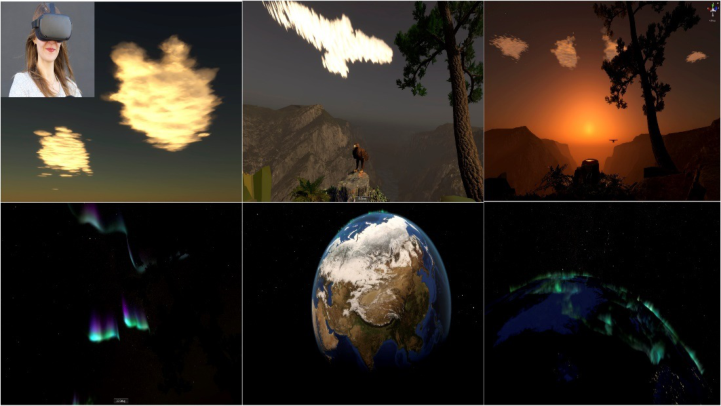
A prime example of this approach is demonstrated in Awedyssey, by Miller et al. (2023). This experience is designed to progressively intensify surrealism: starting in a dark environment lit by a campfire, users witness shape-shifting clouds that transform into animal forms, experience the overwhelming presence of Mars as it grazes the atmosphere, and eventually undergo a journey that lifts them from Earth into space. This narrative, structured in progressive layers of surreal events, challenges established mental models, thereby mandating a deep cognitive accommodation and evoking powerful feelings of awe and the sublime. Liu et al. (2022) crafted an environmental narrative that takes participants on a similar transformative
320 Giesteira and Alves
journey. Quesnel and Riecke (2018) tested design factors that leverage “magical realism”: a deliberate violation of real-world expectations in order to foster curiosity, imaginative immersion, and a suspension of disbelief.
Figure 1: Images retrieved from the experience of Awedyssey by Miller et al. (2023).
These experiences are intimately linked with the idea of obscurity as introduced by Keltner and Haidt (2003) and Burke (1767): the difficulty our minds face when trying to fully grasp sublime phenomena, thus demanding continuous cognitive engagement and re-interpretation of these uncanny elements. Here, the integration of symbolic/metaphoric elements appears particularly potent in capturing the dimensions of obscurity. Ito et al. (2024) and Collar and Eve (2020) provide compelling examples of VR-mediated ritualistic journeys (whether through a sacralised pilgrimage or a mountaintop sacrificial rite, respectively) that evoke powerful feelings of awe, humility, and reverence. These symbolic atmospheres are often challenging to replicate in the physical world, thereby underscoring VR’s unique potential in redefining the boundaries of transformative experience design.
Additionally, the analysed studies reveal an ambivalent paradigm between agency and contemplation in eliciting sublime VR experiences. For instance, Quesnel and Riecke (2017) demonstrated with an interactive flying demo that VR can induce awe. Miller et al. (2023) further integrated gaze-based interactions to study this. Glowacki et al. (2020) had participants adopt a “mudra pose”to generate light, reinforcing bodily engagement. Fauville et al. (2024) found that a lack of interactive agency disrupted the feeling of presence. In Quesnel and Riecke (2018), a balance was struck between agency and a guided narrative, thus allowing free exploration of the environment while maintaining a structured storyline that fostered both active engagement and reflective immersion.
Towards the Design of Transformation: A Review of Transformative VR Experiences 321
However, Chirico et al. (2018) suggested that while interactivity enhances bodily presence, it may also introduce a degree of uncertainty that may detract from the experience of awe. Similar views are presented in Kahn and Cargile (2021) and Liu et al. (2022), where the latter developed a “HeadJoystick” interface that offered an embodied flying experience aimed at increasing users’ sense of control and freedom. Paradoxically, this heightened agency reduced the intensity of awe when compared to a standard hand controller, which promoted a more peaceful and contemplative state. This finding resonates with Keltner and Haidt’s (2003) and Burke’s (1767) arguments on awe being elicited by feelings of powerlessness. Indeed, Miller et al. (2023) highlighted that while some participants experienced the VR scenarios as meditative and contemplative, others craved greater freedom to explore, thus underscoring that interactivity should be considered within the broader experiential design and not in isolation.
DISCUSSION AND CONCLUSION This section serves to draw up some reflections on the diverse topics covered so far, and to propose future developments from these.
Highlighted Elements Deriving from this review’s different findings, VR seems to be explored through its particular phenomenological affordances as a means to advance two fundamental dimensions of Transformative Experience Design: perceptual vastness and need for accommodation.
Concerning the first dimension of perceptual vastness (Keltner and Haidt, 2003), different properties stand out in the elicitation of the latter. Firstly, the typology of perceptual stimuli was mainly concealed between the representation of natural scenarios, and, most importantly, Earth’s view from outer space. The latter is here deemed prototypical, since it presents a special potential to apply the Overview effect and the sense of small-self, two quite successful methods of eliciting awe experiences. Additionally, it was noted that environments that present an almost exaggeratedly extensive structure (Hao et al., 2024; Rauhoeft et al., 2015) are those that, according to the data, appear to have the best chance of fostering awe. However, and rather more interestingly, it has been revealed that the design of spaces and paths that present a dynamic and dramatic structure, which guides the user in a progressive opening up to the revelation of an incredibly extensive environment, is where the sensations of awe are most prevalent, particularly based on a feeling of surprise (Chirico et al., 2018; Otsubo et al., 2024). This opens up the possibility of using architectural elements and the dynamics of spaces to foster transformative experiences that explore the elicitation of awe and the sublime.
On the other hand, the more epistemic dimension of need for accommodation appears to be more complex to work with, predominantly due to the variety of factors and properties drawn from the different studies.
Nevertheless, it is aforethought that, indeed, the exploration of paradoxical, supernatural, uncanny elements represent the main way to
322 Giesteira and Alves
develop a need for accommodation, mainly focusing on disrupting the laws of reality (Gaggioli, 2016) which, therefore, begs for the accommodation of these abnormal stimuli within our current mental schemata. Thus, the use of fantastic and unreal elements finds fertile soil to then develop a magical experience that can make use of symbols, metaphors, gestures, ritualistic structures, mysterious and magnanimous elements in order to implement mystical and transformative experiences. Furthermore, the potential of VR as an interactive medium also opens up a deep perspective upon the fostering of sublime experiences, since it is not yet clear if the sense of either agency or contemplation, of powerfulness or powerlessness duly stimulates the theorized feeling of awe.
In this way, the different elicitors here listed and their respective impact on the cultivation of transformative experiences serve as preliminary ways to further develop this framework.
Reflections and Future Developments A critical perspective on these results thus allows for the proposal of elements to be further explored in the future development of this theoretical current.
As a first step, the incorporation of areas such as architecture, spatial design and spatial phenomenology should be urged. The potential to create dramatic spatial design dynamics that successfully fostered sensations indicative of awe and the sublime was notable in these studies. Furthermore, narrative valences were barely explored in the studies analysed. In fact, it remains to be seen how the narrative has implications for the user’s experience, particularly in terms of need for accommodation. Moreover, the issue of interaction during the experience is still prevalent, thus emphasizing the necessity to continue to assess this matter. For this, it is here proposed a special consideration of Burke’s (1767) work in the creation of these interactions, namely through the introduction of somaesthetic dimensions (Shusterman, 2012) as catalysing elements of a truly corporeal transformation. Finally, the consideration of symbolic factors proves to be particularly suitable for fostering transformative experiences, specially from the philosophical perspective of Carl Jung (1971), Gaston Bachelard (1996) and Gilbert Durand (1964): where the symbol is seen as a basic element of imagination that encourages the infinite expansion of consciousness on the search for the multiple meanings it evokes, thus urging for a constant transcendental exercise based on a sense of mystery and obscurity (both effective elements to elicit a need for accommodation).
Thus, this study creates an appeal for what Glowacki et al. (2020) baptize as numedelic experiences: experiences that, based on VR’s adequate embodied and phenomenological affordances, can stimulate a real transformation in the individual’s body, mind and spirit through the theoretical and practical principles of the sublime, aiming, ultimately, to foster a greater sense of personal well-being.
Towards the Design of Transformation: A Review of Transformative VR Experiences 323
REFERENCES
Adam, S., Frewen, P., 2024. Mystical Experiences in Virtual Reality. Psychology of Consciousness: Theory Research, and Practice. https://doi.org/10.1037/ cns0000396 Bachelard, G., 1996. Poetica do devaneio. Burke, E., 1767. A Philosophical Enquiry into the origin of Our Ideas of the Sublime
and Beautiful. Chirico, A., Borghesi, F., Yaden, D. B., Pizzolante, M., Sarcinella, E. D., Cipresso, P., Gaggioli, A., 2024. Unveiling the underlying structure of awe in virtual reality and in autobiographical recall: An exploratory study. Scientific Reports 14. https:// doi.org/10.1038/s41598-024-62654-3 Chirico, A., Cipresso, P., Yaden, D. B., Biassoni, F., Riva, G., Gaggioli, A., 2017.
Effectiveness of Immersive Videos in Inducing Awe: An Experimental Study. Scientific Reports 7. https://doi.org/10.1038/s41598-017-01242-0 Chirico, A., Clewis, R. R., Yaden, D. B., Gaggioli, A., 2021. Nature versus art as elicitors of the sublime: A virtual reality study. PLOS ONE 16, e0233628. https:// doi.org/10.1371/journal.pone.0233628 Chirico, A., Ferrise, F., Cordella, L., Gaggioli, A., 2018. Designing Awe in
Virtual Reality: An Experimental Study. Frontiers in Psychology 8. https://doi.org/ 10.3389/fpsyg.2017.02351 Chirico, A., Gaggioli, A., 2018. Awe: “More than a feeling.”Humanistic Psychologist 46, 274–280. https://doi.org/10.1037/hum0000098 Chirico, A., Pizzolante, M., Kitson, A., Gianotti, E., Riecke, B. E., Gaggioli, A.,
2022. Defining Transformative Experiences: A Conceptual Analysis. Frontiers in Psychology 13. https://doi.org/10.3389/fpsyg.2022.790300 Clewis, R. R., Yaden, D. B., Chirico, A., 2022. Intersections Between Awe and the Sublime: A Preliminary Empirical Study. Empirical Studies of the Arts 40, 143–173. https://doi.org/10.1177/0276237421994694 Collar, A. C. F., Eve, S. J., 2020. Fire for Zeus: using Virtual Reality to explore
meaning and experience at Mount Kasios. World Archaeology 52, 521–538. https://doi.org/10.1080/00438243.2021.1920458 Durand, G., 1964. A imaginação simbólica. Edições 70. Fauville, G., Voski, A., Mado, M., Bailenson, J., Lantz-Andersson, A., 2024.
Underwater virtual reality for marine education and ocean literacy: Technological and psychological potentials. Environmental Education Research. https://doi.org/ 10.1080/13504622.2024.2326446 Gaggioli, A., 2016. Transformative experience design. Human Computer Confluence: Transforming Human Experience Through Symbiotic Technologies. Glowacki, D., Wonnacott, M., Freire, R., Glowacki, B., Gale, E., Pike, J., de Haan, T., Chatziapostolou, M., Metatla, O., ACM, 2020. Isness: Using Multi-Person VR to Design Peak Mystical Type Experiences Comparable to Psychedelics. Presented at the Proceedings of the 2020 CHI Conference on Human Factors in Computing Systems (CHI’20). https://doi.org/10.1145/3313831.3376649 Han, E., DeVeaux, C., Hancock, J. T., Ram, N., Harari, G. M., Bailenson, J. N.,
2024. The influence of spatial dimensions of virtual environments on attitudes and nonverbal behaviors during social interactions. Journal of Environmental Psychology 95. https://doi.org/10.1016/j.jenvp.2024.102269 Hao, S., Zhang, L., Hou, R., Lau, S. S. Y., Lau, S. S. Y., 2024. Research on the physiological and psychological impacts of extraordinary nature on emotions and restorative effects for young adults. Journal of Environmental Psychology 97. https://doi.org/10.1016/j.jenvp.2024.102345
324 Giesteira and Alves
He, Z., Fan, M., Guo, X., Zhao, Y., Wang, Y., 2024. “I Feel Myself So Small!”: Designing and Evaluating VR Awe Experiences Based on Theories Related to Sublime. Presented at the Proceedings - 2024 IEEE International Symposium on Mixed and Augmented Reality, ISMAR 2024, pp. 564–573. https://doi.org/ 10.1109/ISMAR62088.2024.00071 Ito, E., Kono, S., Tanisho, K., Kawanishi, T., 2024. Does understanding of pilgrimage
routes elicit idealised emotional experiences through virtual reality walking? Rural Society. https://doi.org/10.1080/10371656.2024.2439156 Jung, J. (Editor), Carl G. (Editor), von Franz, M. L. (Editor), Freeman, 1971. Man and his Symbols, 5th ptg. ed. Aldus Books Limited. Kahn, A. S., Cargile, A. C., 2021. Immersive and Interactive Awe: Evoking Awe
via Presence in Virtual Reality and Online Videos to Prompt Prosocial Behavior. Human Communication Research 47, 387–417. https://doi.org/10.1093/hcr/ hqab007 Kant, I., 1790. Critique of the power of judgment. Cambridge University Press. Keltner, D., Haidt, J., 2003. Approaching awe, a moral, spiritual, and aesthetic emotion. Cognition and Emotion 17, 297–314. https://doi.org/10.1080/ 02699930302297 Kitson, A., Stepanova, E. R., Aguilar, I. A., Wainwright, N., Riecke, B. E.,
2020. Designing mind (set) and setting for profound emotional experiences in virtual reality. Presented at the DIS 2020 - Proceedings of the 2020 ACM Designing Interactive Systems Conference, pp. 655–668. https://doi.org/10.1145/ 3357236.3395560 Lin, J.-H. T., Lee, Y.-H., Yang, J.-W., Cook, C., 2024. Helping others and improving myself: The effects of natural- and supernatural-based awe in virtual reality. Computers in Human Behavior 156. https://doi.org/10.1016/j.chb.2024.108193 Liu, P., Stepanova, E. R., Kitson, A., Schiphorst, T., Riecke, B. E., 2022. Virtual
Transcendent Dream: Empowering People through Embodied Flying in Virtual Reality. Presented at the Conference on Human Factors in Computing Systems - Proceedings. https://doi.org/10.1145/3491102.3517677 Mancuso, V., Borghesi, F., Chirico, A., Bruni, F., Sarcinella, E., Pedroli, E., Cipresso, P., 2024. IAVRS-International Affective Virtual Reality System: Psychometric Assessment of 360
Images by Using Psychophysiological Data. Sensors 24. https://doi.org/10.3390/s24134204 McPhetres, J., 2019. Oh, the things you don’t know: Awe promotes awareness of
knowledge gaps and science interest. Cognition and Emotion 33, 1599–1615. https://doi.org/10.1080/02699931.2019.1585331 Miller, N., Stepanova, E., Desnoyers-Stewart, J., Adhikari, A., Kitson, A., Pennefather, P., Quesnel, D., Brauns, K., Friedl-Werner, A., Stahn, A., Riecke, B., ACM, 2023. Awedyssey: Design Tensions in Eliciting Self-transcendent Emotions in Virtual Reality to Support Mental Well-being and Connection. Presented at the Designing Interactive Systems Conference, DIS 2023, pp. 189–211. https:// doi.org/10.1145/3563657.3595998 Ochadleus, C., Kirby, C., Scollon, C. N., 2023. It’s awe-fully unfamiliar: The effect
of familiarity on awe within a virtual reality setting. Frontiers in Psychology 14. https://doi.org/10.3389/fpsyg.2023.1096283 Otsubo, H., Marquardt, A., Steininger, M., Lehnort, M., Dollack, F., Hirao, Y., Perusquía-Hernández, M., Uchiyama, H., Kruijf, E., Riecke, B., Kiyokawa, K., 2024. First-Person Perspective Induces Stronger Feelings of Awe and Presence Compared to Third-Person Perspective in Virtual Reality. Presented at the ACM International Conference Proceeding Series, pp. 439–448. https://doi.org/ 10.1145/3678957.3685753
Towards the Design of Transformation: A Review of Transformative VR Experiences 325
Quesnel, D., Riecke, B. E., 2018. Are you awed yet? How virtual reality gives us awe and goose bumps. Frontiers in Psychology 9. https://doi.org/10.3389/ fpsyg.2018.02158 Quesnel, D., Riecke, B. E., 2017. Awestruck: Natural interaction with virtual
reality on eliciting awe. Presented at the 2017 IEEE Symposium on 3D User Interfaces, 3DUI 2017 - Proceedings, pp. 205–206. https://doi.org/10.1109/ 3DUI.2017.7893343 Rauhoeft, G., Leyrer, M., Thompson, W. B., Stefanucci, J. K., Klatzky, R. L., Mohler, B. J., 2015. Evoking and assessing vastness in virtual environments. Presented at the Proceedings - SAP 2015: ACM SIGGRAPH Symposium on Applied Perception, pp. 51–54. https://doi.org/10.1145/2804408.2804425 Shusterman, R., 2012. Thinking through the body. Cambridge University Press. Song, J. Y., Klebl, C., Bastian, B., 2023. Awe promotes moral expansiveness
via the small-self. Frontiers in Psychology 14. https://doi.org/10.3389/ fpsyg.2023.1097627 Urban, A., 2022. How Does Awe Fuel Information Seeking? A Mixed-methods, Virtual Reality Study. Proceedings of the Association for Information Science and Technology 59, 818–820. https://doi.org/10.1002/pra2.737 Urban, A., Bossaller, J. S., 2024. Exploring enigmas: Information seeking after
exposure to virtual reality awe elicitors. Journal of the Association for Information Science and Technology 75, 789–806. https://doi.org/10.1002/asi.24882 Yaden, D. B., Kaufman, S. B., Hyde, E., Chirico, A., Gaggioli, A., Zhang, J. W., Keltner, D., 2019. The development of the Awe Experience Scale (AWE-S): A multifactorial measure for a complex emotion. The Journal of Positive Psychology 14, 474–488. https://doi.org/10.1080/17439760.2018.1484940
LISTED IN THE AHFE DIGITAL BOOKSTORE CATALOGUE
Explore the complete digital volume
Human Interaction and Emerging Technologies (IHIET 2025)
Read this individual research paper free through the original publisher, or explore the full digital proceedings book.
ISBN 978-1-964867-73-1
Explore this ISBN in the AHFE Bookstore ↗Listed in the July 2026 bookstore catalogue; search by ISBN to confirm current availability · Digital book purchase optional