Anoek Adank, Rosanne Bloemraad, Dave Van Kann, Steven Vos (2025). Reflective practice in primary physical education: developing context-specific tools and design considerations to support physical education teachers. In: Human Systems Engineering and Design (IHSED2025): Future Trends and Applications. AHFE Open Access, vol. 198, pp. 357–367. https://doi.org/10.54941/ahfe1006789
Primary school physical education (PE) plays a pivotal role in fostering active lifestyles by promoting enjoyment of physical activity and supporting the development of skills, knowledge, and attitudes essential for lifelong engagement. However, delivering enjoyable PE lessons to all children remains complex, given the varying abilities, interests, and needs among children. One way to address these challenges is through reflective practice, wherein teachers critically evaluate their lessons, using feedback from their pupils, identifying areas for improvement, exploring alternative teaching strategies, testing them and reflecting on the outcomes. Despite its benefits, consistent and systematic reflection remains uncommon among primary school PE teachers.Technological tools are promising for supporting teachers in reflective practices. While applications like lesson recording software, feedback tools, and e-portfolios have gained traction in secondary and tertiary education, they often fail to meet the specific needs of primary school PE teachers and children. This paper addresses this gap by exploring design considerations for tools that support context-sensitive reflective practice of primary school PE teachers, aiming to improve teaching quality and better align lessons with children’s needs for PE enjoyment. A user-centered, iterative research-through-design approach was applied to develop a tangible feedback device for children and a digital mock-up reflection tool for teachers. We combined PE lesson observations, focus groups, reflective questionnaires, user-testing, and evaluation. Stakeholders, including primary school PE teachers, pre-service PE teachers, children and design researchers, collaboratively explored the challenges and practical needs surrounding feedback and reflective practices in primary school PE settings. Findings indicated a preference for a tangible, portable, battery-powered feedback device for children capable of offline operation to ensure usability during PE lessons. The device should facilitate easy and anonymous data collection, secure data storage and reliable data transfer. Iterative design cycles enhanced usability, resulting in an intuitive, robust and child-friendly device incorporating press buttons and smiley-face indicators as response labels. Feedback questions were adapted to children’s linguistic levels, ensuring alignment with teaching practices that foster children’s PE enjoyment. In parallel, teachers expressed a preference for a digital, web-based reflection platform to facilitate systematic reflection. A mock-up was developed in Figma, guiding teachers through structured reflection phases using prompts and templates. It supported accessible and time-efficient activities, including PE lesson evaluation, searching PE teaching resources, collaborating with peers via an online community platform, and creating action plans for future lessons. The reflection prototype was also integrated with the tangible feedback tool, facilitating seamless data transfer and enabling teachers to configure feedback. Visualizations of children feedback data were presented in an accessible format, and the tool allowed teachers to store, and archive resources such as recorded lessons, peer-assessments, self-assessments and articles, while ensuring efficient documentation, security, privacy, and easy navigation. The findings led to design consideration for primary school PE-specific feedback and reflection tools, highlighting their potential to improve children’s PE experiences and support teachers’ professional development. The study emphasizes the importance of understanding the PE context and collaborating with teachers and children when designing such tools.
Physical inactivity and sedentary lifestyles have become significant global health concerns (World Health Organization, 2022). Primary school physical education (PE) plays a vital role in fostering active lifestyles by providing enjoyable experiences that help children develop the skills, knowledge, and attitudes necessary for lifelong engagement in physical activity (Whitehead, 2020). However, delivering enjoyable and effective PE lessons for all children is challenging, due to the diverse needs, abilities, and interests among children, as well as the complexities of the PE context.
An effective way to help teachers recognize and respond to children’s needs, while improving their practice, is through deep, critical reflection. This involves teachers (i) evaluating past lessons to assess their teaching strategies and impact on pupils’ learning, (ii) identifying areas for improvement, (iii) exploring alternative teaching strategies, (iv) implementing these strategies in future lessons, and (v) reflecting again (Korthagen and Nuijten, 2022). Feedback from children is crucial in this process, especially during the initial phase, by helping teachers identify teaching aspects that need adjustment to better meet children’s needs and interests (Rollett et al., 2021). Additionally, interactions with colleagues through critical questioning and collaborative discussions can support the exploration of new strategies to improve teaching (Murphy et al., 2021).
Despite recognizing the benefits, many teachers do not engage deeply in the full reflection cycle. Primary school PE teachers often reflect internally, without systematic and structured use of various reflection methods, such as self-reflection questionnaires, video feedback, logbooks and discussions. Furthermore, they rarely gather feedback from children or explore alternative strategies based on evaluations, independently or with others (Iannucci and Parker, 2022). Barriers to critical reflection include lack of time, inadequate reflective skills, and insufficient methods to integrate feedback from children into the reflection process (Jaeger, 2013; Korthagen and Nuijten, 2022).
Technology offers a promising solution to these challenges by making critical reflection more accessible and efficient. Digital tools such as video analysis, feedback platforms, e-portfolios, and online forums are increasingly applied in secondary and tertiary education and have been well-received by teachers (Prieto et al., 2020). Integrating such tools into a context-specific reflection toolkit could support primary school PE teachers in reflecting more critically and fostering their professional growth.
This study applied a user-centred, iterative, research-through-design approach to establish design considerations for primary school PE-specific feedback and reflection tools. It involved collaboration with design researchers, primary school PE teachers, and children and included methods such as lesson observations, focus groups, reflective questionnaires, and prototyping and testing of a tangible feedback device and a digital mock-up reflection tool.
UNDERSTANDING NEEDS AND CHALLENGES IN THE PRIMARY SCHOOL PE-CONTEXT To gain a deeper understanding of the primary school PE context and develop design recommendations for a reflection toolkit including a feedback tool, several methods were conducted from January 2022 to June 2023 All participating PE teachers gave verbal permission. For all children participating in our study children’s willingness and written parental consent were obtained.
Observations To understand the PE context and explore how and when primary school teachers evaluate their PE lessons with pupils, two researchers independently
Reflective Practice in Primary Physical Education 359
analyzed recordings (audio and video) of 24 PE lessons taught by 24 primary school teachers from 10 different primary schools in the south of the Netherlands. The children involved were aged 8–12 years. The findings revealed limited opportunities for feedback collection during the 50-minute lessons, with no time allocated afterward. Lessons were packed with activities, often noisy and involved constant movement, and objects such as balls. In line with previous studies (Iannucci and Parker, 2022) teachers rarely evaluated their lessons with pupils. When they did, it mainly involved brief questions about which activities they enjoyed most, with little to no further questioning.
Focus Groups A focus group consisting of seven primary school PE teachers (five male and two female) and one researcher explored their perspectives on fostering children’s PE enjoyment and identified essential teaching practices for delivering enjoyable PE lessons. The results showed that all teachers recognized the importance of ensuring enjoyable PE lesson experiences for every child. However, they reported that they do not consistently prioritize this during lessons and expressed uncertainty about whether all children have enjoyable experiences. The identified teaching practices categorized into key dimensions that foster enjoyment were consistent with findings from prior research, including studies grounded on motivational theories (Morgan, 2017; Beni et al., 2019) and those involving children’s perspectives (Adank et al., 2023).
A second focus group, involving 10 primary school PE teachers (6 male and 4 female), led by the same researcher explored the current use of reflective practices. While teachers acknowledged the value of reflection in enhancing teaching, they reported rarely engaging in structured, and systematic reflective practices. They often evaluate on their lessons mentally but rarely collect feedback from peers and pupils or engage in discussions with colleagues about their teaching practices. Although teachers expressed curiosity about children’s PE experiences and their enjoyment needs, they expressed not knowing how to approach this and what specific questions to ask, which prevent them from gathering feedback.
At the end of the lesson, I sometimes ask pupils if they enjoyed todays’ PE class, why and which activity was most instructive [teacher 8]. I’m unsure how to ask for feedback or what questions to use [teacher 3]. I would like more objective insight into my pupils’ PE experiences [teacher 7].
Teachers also cited time constraints and a lack of resources as barriers to critical reflection. Concerns were reported about gathering feedback from children during PE lessons; teachers emphasizing the need for minimally disruptive methods that encourage children to provide anonymous and honest responses.
Questionnaire To assess teachers’ reflective thinking and practices, the Reflective Thinking of Teachers Questionnaire (Choy et al., 2019), translated into Dutch, was
administered to 10 primary school PE teachers (6 male, 4 female). This questionnaire contained 32 statements rated on a 5-point Likert Scale (5 ‘strongly agree’, 1 ‘strongly disagree’), along with two open-ended questions the use of reflective practices and the challenges they encounter. The results aligned with those obtained from the focus groups. Teachers’ levels of reflective thinking varied from intermediate to advanced. Although teachers frequently evaluate their lessons mentally and are open to feedback from pupils and colleagues, they do not engage in consistent, systematic reflective practices. Lack of time was identified as a significant barrier to critical reflection.
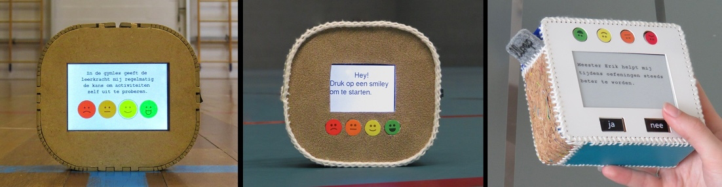
PROTOTYPING The information gathered through observations, focus groups and questionnaire informed the prototyping of a feedback (see Figure 1) and reflection tool (see Figure 2). Findings emphasized the importance of collecting pupil feedback during PE lessons in a way that minimizes disruption. In response, the proposed feedback tool should be tangible, portable, battery-powered, shock-resistant and offline-operable. It must be child-friendly and support independent use by pupils in PE settings, allowing them to respond to feedback questions efficiently and with a minimal interruption to lesson flow. Feedback questions should focus specifically on teaching practices that enhance pupils’ PE enjoyment, be limited in number, and designed to allow for quick, autonomous responses.
A web-based reflection platform is proposed, offering structured activities to guide teachers through reflection phases, ensuring an easy and time and place independently use. The platform should integrate with the tangible feedback device to import pupils’ feedback data and to generate relevant feedback questions. The tool should have functionalities for adding, storing and archiving information and resources for structured organized reflection. In addition, the platform must feature an intuitive design with clearly understandable elements, minimizing time spent on navigation and tool use.
Prototyping and Testing the Tangible Feedback Device Iteration 1. From initial paper sketches, a low-fidelity prototype was developed using an MDF casing (12 × 10.5 × 4 cm) with a 3.5-inch touch screen, sized for children to hold and read. Feedback questions were formulated, derived from literature, on children’s PE enjoyment (Morgan, 2017; Adank et al., 2023). Informed by literature on obtaining children’s feedback (Punch 2002; Fargas-Malet et al., 2010; Rollett et al., 2021), the questions were designed to be short, clear, closed-ended, adapted to the language skills of 8- to 12-year-olds. The questions were answered by touching one of four smiley faces on a 4-point Likert scale (ranging from red to green).
Fifteen industrial design students, two experts in industrial design, and two PE teacher educators reviewed this prototype during a demo day. They found the tool’s size appealing and the smileys recognizable. However, they suggested a more PE-related design, improved screen resolution, and increased interactivity.
Reflective Practice in Primary Physical Education 361
Iteration 2. The second prototype used a smaller, high-resolution e-paper screen with separate press smiley buttons for improved control. The MDF casing was covered with faux leather inspired by sports balls. Usability, understandability, and likability were tested with 155 primary school children individually during PE lessons. In addition, their PE teachers (N = 2) were asked about their first experiences using the tool and their opinions on the feedback questions.
Children liked the look and feel of the prototype, but some struggled with pressing buttons, particularly those unfamiliar with game consoles. Most children understood the feedback questions, except for one negatively phrased item. It took children about three minutes to answer the feedback questions, with Grade-5 children needing more time than older children, likely due to their reading ability. Teachers appreciated the tool’s ease of use and the privacy it ensured for children’s feedback.
During a workshop at a national PE conference, 25 PE teachers reviewed and assessed the feedback questions, provided suggestions for improvement or additional questions, and indicated their preferences for feedback data representation. They responded positively to the feedback questions and expressed interest in the ability to zoom in on specific teaching dimensions with yes/no questions. Additionally, they preferred a clear, non-judgmental visualization of children’s feedback data.
Iteration 3. The final prototype featured a larger 3.7-inch e-paper screen for improved readability. Answer buttons were positioned on the top, with yes/no buttons and the 4-point Likert scale buttons on opposite sides for clarity. The buttons required less pressure, improving usability. The casing (12 × 10 × 4.5cm) was updated for safety and ease of use, and the cover was redesigned to have a more PE-related look. The negatively phrased feedback question was rephrased positively, and one additional question was included. Ten industrial designers and two PE teacher educators reviewed the prototype, finding the design coherent with the PE context and intuitive to use.
Figure 1: Iteration 1, 2 and 3 of the feedback tool prototype.
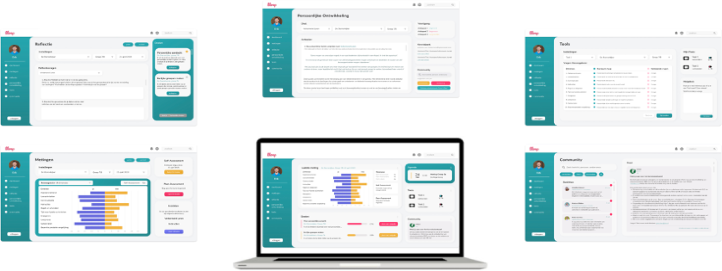
Prototyping, Testing and Evaluating the Digital Reflection Platform A mock-up of a digital reflection tool was developed in Figma (www.figma.com), structured around Korthagen reflection cycle (Korthagen and Nuijten, 2022). Using Chat-GPT-generated data for graphs, it guided teachers through a four-step reflection process. The first page,
“Measurement,” displayed feedback from pupils (collected with the tangible feedback tool), peer-assessments and self-assessments. The second page, “Reflection,” included evaluation questions to help teachers critically analyze their lessons and set goals for improvement. The third page, “Action Plan,” outlined steps for learning new teaching strategies, collaborating with colleagues in an online community, and creating an action plan for implementing strategies in future lessons. The fourth page facilitated peer collaboration. Additional features include a personal dashboard to managing settings, viewing feedback, and accessing action plans, along with a secure login page and a tool configuration page for customizing feedback questions for the tangible feedback tool. All pages had a consistent layout with an intuitive left sidebar menu for navigation.
Usability was evaluated through two one-to-one semi-structured online interviews with PE teachers, a focus group with eight primary school PE teachers, and an interview with two pre-service PE teachers. Participants received a brief introduction and walkthrough of the Figma prototype. They were asked about their ability to complete a set of proposed activities and to identify any issues or suggestions for improvement. Additionally, participants discussed the tool’s ease of use, clarity, intuitiveness and perceived usefulness based on the System Usability Scale (Brooke, 2013).
Reviewers generally expressed positive feedback regarding the tool, highlighting its facilitation for structured reflection, and enhancement of pedagogical knowledge, aiming to improve PE lessons and meet the diverse needs of children. The integration with the physical feedback tool, particularly its use of children’s feedback as a starting point for reflection, was highly valued. Teachers appreciated the tool’s flexibility, which allowed for selective engagement with content. The online community was perceived as a valuable resource for sharing experiences and strategies. The tool was also considered beneficial for demonstrating professional development efforts to others, such as the school board, and for pre-service PE teachers to track their progress and engage in constructive feedback discussions with supervisors.
The bar chart highlights areas of improvement, and the reflection questions helped me define the issue and create a plan to improve my teaching [Teacher 1]. The tool offers all the necessary options. It provides insights, solutions, and help set and achieve goals [Teacher 3].
However, several concerns and recommendations were raised, particularly regarding the time required for regular use. Most teachers preferred a closed, invitation-only online community, with the option to share documents (e.g. lessons plans). They suggested incorporating an information icon, via a brief animation or written text, to clarify the purpose and method of each of the reflection activities. Regarding the action plan, most teachers preferred a few concise questions to motivate them to consider actions for future lessons and how and when to evaluate these actions. Additionally, some teachers recommended a feature to set reminders within the platform for evaluating these actions. They also valued supplementary information, such
Reflective Practice in Primary Physical Education 363
as brief explanations, articles or links about teaching strategies that enhance children’s PE enjoyment. Furthermore, they recommended an archive feature within the platform for storing lesson plans, evaluations and other valuable resources. Teachers also questioned whether school managers would support the platform costs and raised privacy concerns about sharing and storing sensitive data.
I was excited about the platform, but some activities need to be shorter to fit my schedule [Teacher 6] I would like to create my own group to collaborate with [Teacher 5] It should be easy and secure to share and store information [Teacher 4] I should add suggestions for improvement, like links to helpful articles or websites [Teacher 5]
Figure 2: Architecture of the reflection tool mock-up based on Korthagen’s reflection cycle.
DISCUSSION
Using an iterative, research-through-design approach, we explored the development of a tangible feedback tool, and a digital reflection tool aimed at encouraging primary school PE teachers to collect feedback from pupils and reflect on their teaching practices. We collaborated with both children and teachers to gain insight into the needs related to feedback and reflection in PE settings and to develop and refine prototypes.
Feedback and Reflection in a PE Context The feedback tool enabled children to provide feedback on teaching practices they perceived as essential for PE enjoyment. Children engaged both enthusiastically and seriously, demonstrating understanding of the questions and a sense of feeling heard. They were able to use the tool’s intuitive, game- like interface autonomously and anonymously within a short timeframe during PE lessons. The tangible nature of the tool integrated seamlessly into the PE environment, minimizing distractions typically associated with mobile devices, while maintaining both privacy and visibility. Its mobility also empowered children to choose when and where to give feedback, enhancing their sense of agency and engagement.
Teachers acknowledged the value of integrating both the tangible feedback and digital reflection tools to understand children’s needs and improve their teaching pedagogies accordingly. They showed strong commitment to ideating, exploring, and reviewing technological solution for supporting and facilitating teacher reflection. The digital reflection prototype was appreciated for its clear visualizations of feedback data, guided reflection questions, collaborative chat function, and access to pedagogical resources. These features enabled continuous access to feedback and facilitated structured reflection. Familiarity with digital platforms contributed to a smooth integration process. In a traditionally conservative PE context, this incremental, low-cost approach using familiar technologies enhances the likelihood of adoption (Norman and Verganti, 2014).
Based on the findings from the research process, a set of design principles and considerations was formulated to guide the development of both the tangible feedback and digital reflection tools. Four overarching design principles were established to guide the development of both the tangible feedback and digital reflection tools: (i) efficiency and practicality, (ii) ease of use and intuitive interaction, (iii) clarity and relevance, and (iv) safety and privacy. For each principle, specific design considerations were identified through engagement with children and teachers during the iterative design process.
For the tangible feedback tool, the principle of efficiency and practicality was addressed by ensuring that the tool was portable, battery-powered, and capable of operating offline, enabling seamless integration in the PE lessons.
The feedback process was streamlined through a limited set of questions to allow for quick completion, while data collection, storage, and transfer mechanisms were designed to be straightforward and robust. To meet the principle of ease of use and intuitive interaction, the tool was constructed using shock-resistant and sturdy materials, with a design that was both child- friendly and visually aligned with the PE environment. Its physical form allowed children to hold it comfortably with both hands and interact through familiar actions, such as pressing buttons, supporting independent and confident use. Regarding clarity and relevance, the feedback content focused specifically on teaching practices that contribute to children’s enjoyment of PE. Questions were short, simple, positively phrased, and closed-ended, using Likert-scale response options to ensure comprehensibility and ease of interpretation by young users. Finally, under the principle of safety and privacy, the tool was designed to enable children to provide anonymous feedback in a secure manner. Data handling processes ensured information protection during both storage and transfer, reinforcing children’s sense of trust and honesty in the feedback process.
For the digital reflection tool, the same four principles informed its design. In terms of efficiency and practicality, the tool was implemented as a web-based platform that supported quick and easy reflection activities. It enabled teachers to document reflections efficiently and add supplementary materials (such as recorded lessons, self-evaluations, peer feedback, and relevant articles) which could be stored and archived for ongoing professional development. To ensure ease of use and intuitive interaction, the tool allowed
Reflective Practice in Primary Physical Education 365
teachers to customize the feedback questions presented in the tangible tool and facilitated seamless connection for importing and exporting data between both tools. Additionally, it presented visualized feedback data in a clear, easily interpretable format and included features for collaborative reflection, promoting peer learning among teachers. The principle of clarity and relevance was operationalized through structured reflection phases that guided teachers from lesson evaluation to deeper pedagogical analysis. Reflection prompts helped structure this process, ensuring relevance to the specific context of PE teaching. Lastly, safety and privacy were ensured by incorporating robust digital safeguards to protect sensitive data and maintain user confidentiality throughout the reflection process.
Together, these principles and associated considerations form a framework for designing tools that are meaningful, contextually appropriate, and practically usable in primary PE settings. They provide a foundation for future development of feedback and reflection tools aimed at enhancing teaching quality through teacher and pupil collaboration.
Challenges and Limitations Despite the positive reception of the toolkit, several challenges remain. For the tangible feedback tool, the cost of developing and maintaining the physical tool raises concerns regarding viability and feasibility. While shifting to a tablet or smartphone-based app could reduce these costs, it may compromise the physical interaction that fosters engagement and may introduce distractions. A careful balance between practicality and educational effectiveness is therefore required.
Further improvements of the toolkit are needed to ensure its capacity to promote more frequent and systematic reflection. School-related barriers, such as a lack of support for using child feedback and reflection, or personal beliefs (e.g., assuming teachers already understand children’s needs), may hinder adoption (Avidov-Ungar and Eshet-Alkalai, 2011). Additionally, teacher-centred approaches may reduce motivation to engage in reflective practices. Mitigating these barriers is crucial for embedding reflection in daily teaching practices.
Future Work and Implications This study focused on developing prototypes for feedback and reflection tools in PE. However, it did not assess the long-term impact on teachers’ reflective practices or resulting changes in their teaching. The study involved small participant groups and short-term testing, limiting the generalizability of findings regarding the toolkit’s effectiveness over time. Future research should investigate the long-term impact of the toolkit on teacher reflection and teaching quality and assess whether integrating feedback leads to improvements in teaching outcomes.
To embed reflective practice more deeply into professional development, PE teacher education should offer opportunities for pre-service teachers to practice feedback-based reflection. School leaders should also support teachers with time and resources to engage in reflective practices. In this
study, co-designing and prototype testing with children and teachers ensured that the toolkit aligned with their needs. Future work should continue to emphasize this collaborative approach to design and encourage designers to immerse themselves in the PE context and collaborate closely with end-users. The toolkit and design considerations from this study can inspire future tools for both primary and secondary PE settings.
CONCLUSION
This study explored the development of a tangible feedback tool and a digital reflection tool aimed to support primary school PE teachers in gathering pupils’ feedback and reflecting on their teaching. The toolkit supports a step-by-step, continuous feedback loop that empowers children to share their perspectives and assists PE teachers in improving their teaching practices. We collaborated with primary school children and PE teachers to understand the PE-specific needs. Our findings suggest that children are motivated to provide feedback when the process is clear, enjoyable, and anonymous, while teachers value tools that are intuitive and time-efficient. Our work offers actionable insights for future design of feedback and reflection tools tailored to specific education contexts, such as PE lessons in primary school.
ACKNOWLEDGMENT
The authors thank all children, PE teachers and colleagues for their valued support.
REFERENCES
Adank, A. M., Van Kann, D. H. H., Borghouts, L. B., Kremers, S. P. J. and Vos, S. B. (2023) ‘That’s what I like! Fostering enjoyment in primary physical education’, European Physical Education Review, 30(2), 283–301, available: http://dx.doi.org/10.1177/1356336X231205686. Avidov-Ungar, O. and Eshet-Alkalai, Y. (2011) ‘[Chais] Teachers in a world of
change: Teachers’ knowledge and attitudes towards the implementation of innovative technologies in schools’, Interdisciplinary Journal of E-Learning and Learning Objects, 7(1), 291–303. Beni, S., Ní Chróinín, D. and Fletcher, T. (2019) ‘A focus on the how of meaningful physical education in primary schools’, Sport, Education and Society, 24(6), 624–637, available: http://dx.doi.org/10.1080/13573322.2019.1612349. Brooke, J. (2013) ‘SUS: a retrospective’, Journal of usability studies, 8(2). Choy, C., Lee, M. and Sedhu, D. (2019) ‘Reflective Thinking among Teachers:
Development and Preliminary Validation of Reflective Thinking for Teachers Questionnaire’, Alberta Journal of Educational Research, 65, 37–50. Fargas-Malet, M., McSherry, D., Larkin, E. and Robinson, C. (2010) ‘Research with children: Methodological issues and innovative techniques’, Journal of early childhood research, 8(2), 175–192. Iannucci, C. and Parker, M. (2022) ‘Student Voice in Primary Physical Education:
A 30-Year Scoping Review of Literature’, Journal of Teaching in Physical Education, 41(3), 466–491, available: http://dx.doi.org/10.1123/jtpe.2021–0007. Jaeger, E. (2013) ‘Teacher reflection: Supports, barriers, and results’, Issues in teacher education, 22(1), 89–104.
Reflective Practice in Primary Physical Education 367
Korthagen, F. and Nuijten, E. (2022) The power of reflection in teacher education and professional development: Strategies for in-depth teacher learning, Routledge. Morgan, K. (2017) ‘Reconceptualizing Motivational Climate in Physical Education
and Sport Coaching: An Interdisciplinary Perspective’, Quest, 69(1), 95–112, available: http://dx.doi.org/10.1080/00336297.2016.1152984. Murphy, F., Marron, S. and Coulter, M. (2021) ‘Primary field experiences: Critical for primary generalist physical education teachers?’, European Physical Education Review, 27(4), 761–778, available: http://dx.doi.org/10.1177/ 1356336x21991188. Norman, D. A. and Verganti, R. (2014) ‘Incremental and radical innovation: Design
research vs. technology and meaning change’, Design issues, 30(1), 78–96. Prieto, L. P., Magnuson, P., Dillenbourg, P. and Saar, M. (2020) ‘Reflection for action: designing tools to support teacher reflection on everyday evidence’, Technology, Pedagogy and Education, 29(3), 279–295, available: http://dx.doi.org/10.1080/ 1475939X.2020.1762721. Punch, S. (2002) ‘Research with children: The same or different from research with
adults?’, Childhood, 9(3), 321–341. Rollett, W., Bijlsma, H. and Röhl, S. (2021) Student feedback on teaching in schools: Using student perceptions for the development of teaching and teachers, Springer Cham. Whitehead, M. (2020) ‘Aims of Physical Education’ in Learning to teach physical
education in the secondary school Routledge, 20–35. World Health Organization (2022) ‘Global status report on physical activity 2022: web annex: Global action plan on physical activity monitoring framework, indicators and data dictionary’, available: https://iris.who.int/handle/10665/ 363531.
LISTED IN THE AHFE DIGITAL BOOKSTORE CATALOGUE
Explore the complete digital volume
Human Systems Engineering and Design (IHSED2025): Future Trends and Applications
Read this individual research paper free through the original publisher, or explore the full digital proceedings book.
ISBN 978-1-964867-74-8
Explore this ISBN in the AHFE Bookstore ↗Listed in the July 2026 bookstore catalogue; search by ISBN to confirm current availability · Digital book purchase optional