Christa Tigerstedt, Susanna Fabricius (2025). Understanding generative AI's role in higher education: a teacher perspective on responsible integration of AI in business education. In: Human Systems Engineering and Design (IHSED2025): Future Trends and Applications. AHFE Open Access, vol. 198, pp. 387–395. https://doi.org/10.54941/ahfe1006792
This publication explores the potential and actual use of generative AI (GAI) in business education at Arcada University of Applied Sciences, with a particular focus on the teacher’s role in integrating GAI into course modules. Research suggests that GAI can enhance teaching and student learning by offering personalized and engaging experiences. The aim of the study is to contribute to a deeper understanding of AI in education and to promote knowledge about the responsible integration of AI into business education. A further objective is to develop teaching practices that prepare students to engage with the technology responsible in their future professional lives.We investigate teachers’ perceptions of AI and their reflections on working with it. Additionally, we describe our collaborative work on these issues over the course of a year. During spring and autumn 2024, we conducted research into our own teaching practices in relation to AI within our teaching team. In parallel, we collected data from workshops where current AI practices, tools, challenges, and educational needs were discussed.The project also provides insights into how AI can be integrated across various areas of business education and lays the foundation for future research on optimizing AI use in educational contexts.We identify challenges related to safety, bias, and academic integrity. Finally, we discuss future trends and the evolving role of teachers in an educational landscape where AI is embedded in the learning environment. A balanced use of AI is recommended, and continued work is needed to ensure responsible, reliability, and ethical integration.The publication aligns with strategic goals concerning sustainable digital solutions and responsible AI. We argue that the publication contributes to the broader discourse on high-quality, sustainable, and responsible education. Our project supports Sustainable Development Goals 4 and 11, and peer learning has been central throughout our process.
According to research, Generative Artificial Intelligence (GAI) can enhance teaching and student learning by offering personalized and engaging experiences (Pratschke, 2024; Mollick, 2023). The purpose of our
explorative research and our project “Bridging AI and Soft Skills” is to increase understanding of AI in higher education and to enhance knowledge about the responsible integration of AI in business education. The goal is also to develop teaching so that students can handle technology responsibly in their professional lives.
In this publication, we discuss how teachers view AI and how they reason while working with AI. We also describe how we have worked together with AI in the teacher team over the course of a year. During the spring and autumn of 2024, we researched our own practice in relation to our AI deployment. In parallel, we have collected data from workshops where current AI practices, tools, challenges, and educational needs have been discussed.
GENERATIVE ARTIFICIAL INTELLIGENCE IN A HIGHER EDUCATION CONTEXT Generative Artificial Intelligence (GAI) offers new opportunities that significantly impact education and learning at all levels, sectors, and professions (Mollick, 2024; SiloAI, 2024). However, educators and researchers warn of potential negative effects, such as reduced critical thinking and knowledge development (including deep learning and problem- solving). (Hilli, 2025; Freeman, 2025) due to over-reliance on AI tools. Also, less engagement and under-performance on neural, linguistic, and behavioral levels has been identified for example in relation to essay writing and LLM usage (Kosmyna et al., 2025). It will take time before GAI tools are understood on a deeper and holistic level and are effectively and ethically applied, and thus there is still a risk that misuse of these tools could negatively impact education and the learning (Kumar et al., 2024; Bastani et al., 2024; Mollick, 2024). The EU’s AI regulation classifies AI use in the education sector as high risk due to its significant impact. The regulation particularly emphasizes (regarding teaching, studies, and learning) AI systems (AI-driven tools/GAI) used to evaluate learning outcomes (assessment and grading, etc.) and AI systems used to monitor and detect prohibited behavior (e.g., cheating) among students. If AI systems and tools are used for these purposes or also for the admissions process, the AI system and/or tool should be subject to risk assessment and specific follow-up procedures or a process according to the AI regulation (EU AI Act, Annex III, 2024; Palo-Närhinen, 2024).
Strategies to Improve Business Education With AI It is highly relevant that educators (teachers) and higher education institutions understand that they have a great responsibility to ensure that AI tools are used appropriately and correctly. This means (for example) that the institution should be aware of which types of implementations are allowed, which applications are prohibited, and which integrations require additional risk assessment (Freeman, 2025; Palo-Närhinen, 2024).
The use of GAI in education brings pedagogical challenges, especially in managing ethical issues and bias. A balanced use of GAI, where each practical application is preceded by ethical considerations and values, is important
Understanding Generative AI’s Role in Higher Education 389
(Freeman, 2025; Hilli, 2025; Dwivedi et al., 2023; Southworth et al., 2023). Reliable integration into teaching should consider students’ backgrounds and contexts while providing clear value for both teachers and learners. A human-centered approach, emphasizing collaboration between humans and AI or “co-intelligence,” is crucial. AI cannot replace teachers but can complement their roles, potentially increasing the importance of physical classrooms (Mollick, 2024; Darwin et al., 2024).
It is essential to ensure that students build a strong foundational knowledge base to counteract potential cognitive ease (reduced use of one’s own thinking) caused by over-reliance on GAI tools. Teachers must ensure that students have a clear understanding of how, when, and why AI can be used. The use of AI in learning contexts often falls within a spectrum, ranging from tasks that do not require any AI involvement at all to contexts where AI is an absolute tool in a task. Without clear guidelines, students may struggle to know what is expected (Dwivedi et al., 2023; Bartucz, 2023; Mollick, 2024; Perkins et al., 2024; Hilli, 2025).
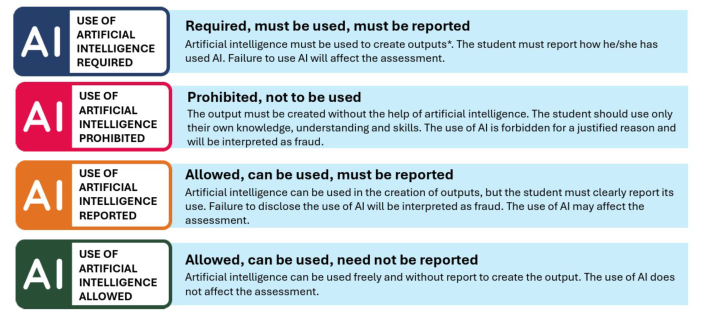
To support this need, there are frameworks such as those created by Unesco, providing guidance for teachers and learners to assess and develop their own AI competence, enabling more appropriate and ethical use (Unesco, 2024; Gruenhagen et al., 2024). Many higher education institutions have already created or adopted guidelines to integrate GAI and ensure that its use aligns with educational principles and learning objectives, as well as with overall approach at the institution. In Unesco’s framework, the human factor is emphasized along with ethical considerations and responsibility. The use of scales and thereby increased clarity can help both the teacher and the student to improve learning and to more clearly see what meaningful use and implementation of GAI in learning can be (Dwivedi et al., 2023; Bartucz, 2023; Perkins et al., 2024). ARENE, the Rectors’ Conference of Finnish Universities of Applied Sciences, has also published a recommendation on how the use of artificial intelligence can be regulated. According to their scale or the so-called traffic light model (Figure 1), we can see that AI can be used for creation and planning, i.e., we can see that ideation and creativity can be done in collaboration with AI according to these recommendations (Arene, 2024). Research also shows that students need more guidance both when it comes to how to use GAI and how to talk and inform about how GAI has been used in work. A related problem here is transparency from the educator’s side as well. Especially since hesitant and speculative collaboration with an AI can occur (Roe et al., 2024; Hilli, 2025). Interesting research in relation to this is the one by Roe et al (2024) where they provide 4 metaphors: AI is a funhouse mirror, AI is a black box, AI a map, AI is an echo chamber. These metaphors are supposed to assist the educator, the teacher, when teaching students about critical AI litearcy (CAIL) and they are aligned and can be use together with for example the Unesco framework (Roe et al., 2024).
390 Tigerstedt and Fabricius
Figure 1: Traffic light model by Arene (Arene, 2024).
Can Critical Thinking and Creativity be Improved With the Help of GAI in Higher Education?
In educational contexts, GAI tools have so far been seen as effective and appropriate for, for example, personalized learning, language control, structuring and streamlining, and concept understanding. Additionally, it seems that the lower levels of Bloom’s taxonomy (remember, understand, apply) have benefited more from the integration of AI so far (Essien et al., 2024). Kumar et al. (2024) states that GAI (ChatGPT) can improve academic integrity but may have a negative effect on interpersonal skills, which are crucial for the holistic development of soft skills. However, they argue that soft skills, such as problem-solving, digital competence, and self-directed learning, are still very essential.
Chiu et al. (2023) and Kumar et al. (2024) noted that AI tools facilitate exploratory learning through virtual labs and simulations, i.e., experiential learning. Additionally, Elim et al. (2024) found that AI can promote creativity and reflection by encouraging evaluation and questioning in learning contexts. Essien et al. (2024) argue, however, that it is currently more difficult to see how AI affects the development of creativity than critical thinking. AI is reported to promote both innovation and creativity when used correctly (Gruenhagen et al., 2024).
Regarding higher-order thinking, critical thinking, and creativity, researchers note that these can be improved with the help of AI, but the use must be carefully balanced. They also note that the more basic cognitive skills that benefit from AI can have a positive impact by freeing up time for more complex cognitive work, and therefore AI can indirectly have a positive impact on the development of, for example, critical thinking (Kumar et al., 2024; Darwin et al., 2024; Hilli, 2025). AI seems to improve critical thinking in terms of literature review, theory review, experimental design, and data analysis. Risks are seen in the form of limited individualization, the risk of creating so-called echo chambers, reliability issues, and AI’s inability to understand a variety of aspects. AI can also lead
Understanding Generative AI’s Role in Higher Education 391
to data overload, making cognitive work more challenging (Darwin et al., 2024).
METHODOLOGY
Understanding complex changes in teaching practices requires a methodological approach that captures both context and the perspectives of the actors involved. Qualitative methods are well suited for this kind of exploratory research, as they allow for an in-depth analysis of participants’ experiences and interpretations within their natural contexts (Bryman & Bell, 2017). This study therefore adopts an exploratory and qualitative research design, aiming to investigate how generative AI (GenAI) is being integrated into teaching and administration within business education, primarily at Arcada UAS.
Data collection was carried out in several phases during 2024. First, two semi-structured surveys were conducted, one directed at individual teachers, the other at teaching teams. The first survey included open-ended questions about how generative AI tools such as Gemini, ChatGPT, and Bing Edge are used in daily teaching and administrative tasks. The second survey focused on the teacher teams’ future plans regarding AI integration. The survey explored which tools and goals were foundational for continued use, what skills were seen as essential for students, and what challenges and support needs the teacher teams anticipated for the upcoming academic year.
To deepen the understanding of AI implementation, a workshop was held in September 2024 using the World Café methodology. During the workshop, teachers participated in structured group discussions on key themes such as AI in course design, ethical considerations, and the balance between AI-supported and manual elements. Participants also responded to written reflection questions presented via PowerPoint, focusing on concrete teaching examples, tool use, and the impact on student learning.
The collected material was analyzed using thematic analysis, through which recurring patterns and themes were identified in the survey responses, discussion summaries, and written reflections (Bryman & Bell, 2017).
RESULTS
The findings from this exploratory research show a multifaceted and dynamic (agile) integration of GAI within Arcada’s business education. There is wide variation in usage depending on course content, the teacher’s approach, and both technical and ethical considerations. Practical applications and attitudes toward AI are characterized by a tension between pedagogical possibilities and responsibility, requiring ongoing reflection and collegial support.
The integration of GAI tools such as ChatGPT, Copilot, DALL E, Google Gemini, and others appears to be strongly context dependent. In more creative courses, such as Marketing Communication and Brand Building, as well as Digital Commerce, AI is mainly used for ideation, content creation, and reflective analysis. Students are encouraged to use AI tools to generate communication plans or web shop content and then critically compare these
392 Tigerstedt and Fabricius
with their own team’s ideas to develop analytical capacity and creative thinking (R1, T2; R = respondent, T = Team). Here, AI is viewed as a “co-pilot” that facilitates collaboration and problem solving without replacing human learning.
In more technical courses, such as Inventory Management and Financial Analysis, AI use is more limited and focuses on supporting rather than driving the learning process. AI is primarily used to generate business cases or assist in selecting companies for analysis, while the emphasis remains on students manually applying theories and methods to consolidate core concepts. As one teacher notes: “Use of the free version of ChatGPT is limited in these kinds of analyses and calculations” (R5), highlighting the need for human understanding in technically complex tasks.
Pedagogical Benefits and Development of Soft Skills A recurring theme is that AI is perceived as contributing to the development of important soft skills, such as critical thinking, creativity, collaboration, and adaptability. Teachers emphasize that AI can support the stimulation of students’ problem solving and analytical reasoning, particularly when AI-generated results are compared with students’ own work (T1, R6). This approach, where AI functions as an educational tool rather than an answer system, is seen as a way to maintain the quality and complexity of education.
Ethical Considerations and Reflective Practice Ethical issues around AI integration are recurrent and central in several courses. Teachers express concerns about overuse and dependency on AI, especially in tasks that require originality and personal reflection (R4). To address these challenges, clear guidelines are employed requiring students to document their AI prompts and critically reflect on how AI has influenced their work (R6, T2). In courses such as the Thesis Workshop and Research Methodology, transparency in AI use is emphasized throughout the research process, for example by documenting prompts and AI-generated results to promote an ethically sustainable learning environment (T1).
Educational Needs and Collegial Support Despite AI’s potential, results show that many teachers still face challenges related to time, technical competence, and trust in the reliability of AI tools. Some teachers have not yet begun using AI due to high workloads or lack of experience (R3). Others express skepticism and prefer to create their own teaching materials to ensure content quality (R4). At the same time, there is a strong need for practical training and peer knowledge sharing. Workshops, small group sessions, and team discussions are seen as key to spreading good practices and building confidence in technology (R6).
Future Directions Plans for future AI integration suggest a move toward more systematic and strategic use of AI in both teaching and administration. In Economics, Marketing and Tourism, and Logistics, AI is planned to be used in
Understanding Generative AI’s Role in Higher Education 393
authentic tasks such as financial report analysis, contract formulation, and content production. A recurring goal is for students to learn to critically evaluate AI-generated output in relation to their own solutions (T1, T2). To facilitate this, organizational measures such as appointing “super users” and integrating AI training into work plans have been proposed (R6).
CONCLUSION
This study provides a timely insight into the evolving role of generative AI (GAI) in higher education, with a particular focus on business education at Arcada University of Applied Sciences. The findings highlight both the opportunities and challenges associated with the integration of AI in teaching and administration. Teachers have demonstrated a growing awareness of AI’s potential to enhance creativity, critical thinking, and collaboration, especially when used as a co-pilot rather than a replacement for human engagement.
Importantly, the study underscores the need for pedagogical approaches that are ethically grounded and context sensitive. This is much in line with previous research (Roe et al., 2024, Darwin et al., 2024; Hilli, 2025 etc). Educators are navigating complex decisions regarding how, when, and why to integrate AI tools into their teaching practices. This involves balancing efficiency gains with the imperative to maintain academic integrity and promote deeper learning. All this resonates well with previous research (Mollick et al., 2024; Kumar et al., 2023; Bartucz et al., 2023). Ethical considerations, particularly transparency, bias, and appropriate student use are central concerns, and they require continued institutional support and clear guidelines and this aligns well with previous researches (for example Roe et al., 2024; Kumar et al., 2024; Southworth et al., 2023 and Hilli, 2025). At the organizational level, the results suggest that successful AI integration depends not only on individual teacher initiative but also on strategic planning, collegial knowledge sharing, and the development of AI competencies across the institution. These findings support earlier insights (Mollick, 2023; Crompton & Burke, 2023). The emphasis on workshops, team discussions, and the designation of super users highlights the importance of a collaborative and reflective implementation process.
Looking forward, the findings advocate for a structured yet balanced and agile approach to AI use in education. This includes promoting student skills in evaluating AI-generated content, encouraging responsible innovation, and aligning AI use with curricular goals and professional demands. Our study contributes to a broader discourse on sustainable digital education and supports the integration of the UN’s Sustainable Development Goals, particularly in fostering quality education (SDG 4) and inclusive, ethical digital transformation (SDG 11).
GAI should be viewed not as a disruption but as an evolving collaborator in the educational process, a collaborator that requires continuous learning, ethical attention, and pedagogical creativity.
394 Tigerstedt and Fabricius
REFERENCES
Arene (2024). Ammattikorkeakoulut päivittivät tekoälysuosituksensa – yhdessä kohti pedagogisesti kestävää tekoälyn hyödyntämistä. Retrieved from: https://arene.fi/ajankohtaista/ammattikorkeakoulut-paivittivat-tekoalysuosit uksensayhdessa-kohti-pedagogisesti-kestavaa-tekoalyn-hyodyntamista. Bartucz, J. (2023). ChatGPT: Your new partner in the classroom (whether you like it
or not). Retrieved from: https://www.bartucz.com/mrbartucz/2023/09/10/chatgp t-your-new-partner-in-the-classroom-whether-you-like-it-or-not/. Bryman, A., & Bell, E. (2017). Business research methods. Oxford: Oxford University Press. Chiu, T. K. F., Xia, Q., Zhou, X., Chai, C. S., & Cheng, M. (2023). Systematic literature review on opportunities, challenges, and future research recommendations of artificial intelligence in education. Computers and Education: Artificial Intelligence, 4. doi: 10.1016/j.caeai.2022.100118. Crompton, H., & Burke, D. (2023). Artificial intelligence in higher education: The
state of the field. International Journal of Educational Technology in Higher Education, 20(1). doi: 10.1186/s41239-023-00392-8. Darwin, R., Mukminatien, N., Suryati, N., Laksmi, E. D., & Marzuki. (2024).
Critical thinking in the AI era: An exploration of EFL students’ perceptions, benefits, and limitations. Cogent Education, 11(1), 2290342. doi: 10.1080/ 2331186X.2023.2290342. Dwivedi, Y. K., Kshetri, N., Hughes, L., Slade, E. L., Jeyaraj, A., Kar, A. K., Baabdullah, A. M., Koohang, A., Raghavan, V., Ahuja, M., Albanna, H., Albashrawi, M. A., Al-Busaidi, A. S., Balakrishnan, J., Barlette, Y., Basu, S., Bose, I., Brooks, L., Buhalis, D., Carter, L., Chowdhury, S.,; Crick, T., Cunningham, S. W., Davies, G. H., Davison, R. M., Dé, R., Dennehy, D., Duan, Y., Dubey, R., Dwivedi, R., Edwards, J. S., Flavián, C., Gauld, R., Grover, V., Hu, M. C., Janssen, M., Jones, P., Junglas, I., Khorana, S., Kraus, S., Larsen, K. R., Latreille, P., Laumer, S., Malik, F., Mardani, A.,; Mariani, M., Mithas, S., Mogaji, E., Nord, J. H. O’Connor, S., Okumus, F., Pagani, M., Pandey, N., Papagiannidis, S., Pappas, I. O., Pathak, N., Pries-Heje, J., Raman, R., Rana, N., P.; Rehm, S. V., Ribeiro-Navarrete, S., Richter, A., Rowe, F., Sarker, S., Stahl, B. C., Tiwari, M. K., van der Aalst, W., Venkatesh, V., Viglia, G., Wade, M., Walton, P., Wirtz, J. & Wright, R. (2023). So what if ChatGPT wrote it? Multidisciplinary perspectives on opportunities, challenges and implications of generative conversational AI for research, practice and policy. International Journal of Information Management, 71, 102642. doi: 10.1016/j.ijinfomgt.2023.102642. Elim, Y., & Sein, E. H. (2024). Promoting cognitive skills in AI-supported
learning environments: The integration of Bloom’s taxonomy. Education 3– 13: International Journal of Primary, Elementary and Early Years Education. doi: 10.1080/03004279.2024.2332469 Essien, A., Bukoye, O. T., O’Dea, X., & Kremantzis, M. (2024). The influence of AI text generators on critical thinking skills in UK business schools. Studies in Higher Education, 49(5), 865–882. doi: 10.1080/03075079.2024.2316881. EU AI Act (2024). Regulation - EU - 2024/1689 - EN - EUR-Lex. Retrieved from:
https://eur-lex.europa.eu/eli/reg/2024/1689/oj. EU AI Act (2025). Annex III: High-risk AI systems referred to in Article 6(2).
Retrieved from: https://artificialintelligenceact.eu/annex/3/. Freeman, J. (2025). Student Generative AI Survey 2025. HEPI Policy Note 61.
Understanding Generative AI’s Role in Higher Education 395
Gruenhagen, J. H., Sinclair, P. M., Carroll, J. A., Baker, P. R. A., Wilson, A., & Demant, D. (2024). The rapid rise of generative AI and its implications for academic integrity: Students’ perceptions and use of chatbots for assistance with assessments. Computers and Education: Artificial Intelligence, 7. doi: 10.1016/ j.caeai.2024.100273. Hilli, C. (2025). Postqualitative inquiries into digital study practices in higher
education: Interplays of hesitations and speculations. Læring & Medier (LOM), 31. ISSN: 1903-248X. Kosmyna, N., Hauptmann, E., Yuan, Y., Situ, J., Liao, X-H., Beresnitzky, A., Braunstein, I., & Maes, P. (2025). Your brain on ChatGPT: Accumulation of cognitive debt when using an AI assistant for essay writing task. doi: 10.48550/ arXiv.2506.08872. Kumar, S., Rao, P., Singhania, S., Verma, S., & Kheterpal, M. (2024). Will
artificial intelligence drive the advancements in higher education? A tri-phased exploration. Technological Forecasting and Social Change, 201, 123258. doi: 10.1016/j.techfore.2024.123258. Mollick, E. (2024). Co-Intelligence: Living and working with AI. Retrieved from: https://www.amazon.com/Co-Intelligence-Living-Working-Ethan-Mollick/ dp/059371671X. Palo-Närhinen, K. (2024). How does the new EU AI Act affect the adult education sector? Retrieved from: https://elmmagazine.eu/how-does-the-new-eu-ai-act-affe ct-the-adult-education-sector/. Perkins, C., Furze, M., Roe, L., & Macvaugh, J. (2024). The Artificial Intelligence
Assessment Scale (AIAS): A framework for ethical integration of generative AI in educational assessment. Pratschke, M. B. (2024). Digital pedagogies, teaching innovation and learning design.
Cham: Springer. Roe, J., Furze, L., & Perkins, M. (2024). Funhouse mirror or echo chamber? A methodological approach to teaching critical AI literacy through metaphors. arXiv preprint arXiv:2411.14730. SiloAI (2024). Nordic State of AI – Third Edition. Retrieved from: https://www.silo
.ai/ebooks-reports/nordic-state-of-ai-third-edition. Southworth, J., et al. (2023). Developing a model for AI across the curriculum: Transforming the higher education landscape via innovation in AI literacy. Computers and Education: Artificial Intelligence, 4. doi: 10.1016/ j.caeai.2023.100127. Unesco (2024). AI competency framework for teachers. Retrieved from: https://unes doc.unesco.org/ark:/48223/pf0000391104.locale=es.
LISTED IN THE AHFE DIGITAL BOOKSTORE CATALOGUE
Explore the complete digital volume
Human Systems Engineering and Design (IHSED2025): Future Trends and Applications
Read this individual research paper free through the original publisher, or explore the full digital proceedings book.
ISBN 978-1-964867-74-8
Explore this ISBN in the AHFE Bookstore ↗Listed in the July 2026 bookstore catalogue; search by ISBN to confirm current availability · Digital book purchase optional