Christa Tigerstedt, Niklas Eriksson, Kristoffer Kuvaja-Adolfsson (2025). Customer Experience and Social Robots - an experiment in a grocery store. In: Human Systems Engineering and Design (IHSED2025): Future Trends and Applications. AHFE Open Access, vol. 198, pp. 81–90. https://doi.org/10.54941/ahfe1006764
We can expect the field of robot end-user applications to grow, and with time, we will also see more advanced and skilled humanoid robots. To ensure that this happens in a relevant, human-friendly, and sustainable way, we need to study robots and the way they can interact with humans. We need to study both the evolving technology and human behavior, i.e., the end users (customers, clients). Understanding the usefulness and potential of social and service robots requires studying them in specific real-world contexts. This paper we disucss an experiment where we investigate the deployment of a social service robot in a retail setting. More specifically we focus on customer interactions and experiences with humanoid robots in a grocery store. By investigating real-world retail contexts, the research aims to understand the practical utility and potential of social and service robots.We used structured observation top collect data and preliminary findings reveal a range of customer reactions, from joy to fear, and highlights the novelty effect, where customers take photos and follow the robot. Findings suggest that all types of users are likely to interact with the robot, though many observe it with curiosity. The paper contributes to Human-Robot Interaction (HRI) theory and suggests further long-term and also quantitative studies to enhance understanding of trust and social-emotional reactions in real-world contexts.
We can expect the field of robot end-user applications to grow, and with time, we will also see more advanced humanoid robots (Wirtz et al., 2018; Go et al., 2019; Vinoi et al., 2025). To ensure that this happens in a relevant, human-friendly, and sustainable way, we need to study robots and the way they can interact with humans in a purposeful way (Pinxteren et al., 2019). Previous research shows that we need to study HRI and experiences and how the interaction is perceived (Go et al., 2019). Leocadio et al. (2024) mean that we can see increasing in importance when it comes to making the customer service more efficient and personalized. It is of importance to study context specific real-life settings to understand the usefulness and potential for social and service robots (Blaurock et al., 2022; Leocadio et al., 2024). Hence, a central development trend is the digitalization of grocery stores. Robotics
and artificial intelligence (AI) are becoming increasingly common in a store context (Go et al., 2019). The presence of social robots in stores and shopping centres is a noticeable aspect of this phenomenon. Customers tend to feel positive about social robots, but the long-term benefits and effects of these are difficult to estimate, especially from a service and business perspective (Tigerstedt & Fabricius, 2023; Tigerstedt et al., 2023; Niemelä & Melkas, 2019). On the other hand, some individuals may perceive robots negatively, for example in relation to, fear of job loss, dehumanization, privacy intrusion, and malfunctioning that leads to poorer store experiences (Song & Kim, 2022; Fuste-Forne, 2021). In this exploratory paper the focus is not on the acceptance but rather on the understanding of the interactions and the reactions customers have in real in-store encounters with service robots. The field experiment is part of the research project DigiMAt Norden, where “Robot in the grocery store” aim of the project was to: (1) explore potential roles of customer-facing social robots in grocery stores, (2) conduct a field trial with two social robots in a grocery store in central Helsinki, Finland, for one week to find out how they interact with customers.
SERVICE ROBOTS’ TASKS AND DEPLOYMENTS IN RETAIL SETTINGS We have seen that robots have succeeded in service tasks such as entertainment, information giving, serving, reception and concierge tasks (Blaurock et al., 2022; Tigerstedt & Fabricius, 2023; Tigerstedt et al., 2024). We have also seen that robots can help in shopping scenarios if you wish to draw attention to a product (Iwamoto et al., 2022; Sakai et al., 2022).
Furthermore, in the retail sector, social robots have been utilized in malls and supermarkets to some extent, serving both as product promoters and in reception-like roles. Studies suggest that humanoid robots are effective at capturing attention. They are more successful at initiating interactions compared to touch screens, a phenomenon observed in both care and retail settings (Nakanishi et al., 2020; Iwamoto et al., 2022). It is important to identify more robot tasks that are purposeful for the customer (Wärneståhl, 2021; Song & Kim, 2022; Lu et al., 2020). Hence, it is important to investigate real-life and context specific tasks (Zhang et al., 2024), in this case retail and more specifically in in-store grocery shopping. In such contexts research confirms that robots have succeed in helping customers with information, product promotion, and guiding customers (Gauquier et al., 2023). However, consumers seem to prefer humans for a more personalized service (Blaurock et al., 2022). Depending on the task and the service context the perceived usefulness of the humanoid will vary (Zhang et al., 2024). Previous studies have however mainly focused on rather simple routine or predictable task for humanoids, and it is motivated to introduce more complex tasks, for example with an empathetic nuance and social tasks such as creating meaningful connections with customers, to see how this will be perceived (Leocadio et al., 2024; Gauquier et al., 2023). Iwamoto et al.’s. (2022) field experiment was supposed to trigger positive emotions in the
Customer Experience and Social Robots - An Experiment in a Grocery Store 83
customer and the experiment was not product oriented or location oriented by intention. They had a dancing robot to stimulate pleasant emotions among store customers. A positive impact was however observed in the sales. In another real-life experiment, Okafuji et al. (2022) concluded that service robots can perform very well with information tasks. They investigated this in a shopping mall setting and used greeting, dancing and in-trouble task (the robot behaves as if it is in trouble) for the humanoid to make people stop and listen to the information. This experiment showed that a robot succeeds just as well or better than humans with this particular task (in an experiment 5000+ interactions).
CUSTOMER EXPERIENCE WITH HUMANOIDS Social robots are perceived to impact customer interactions and both the robot’s behaviour and appearance have an impact (Nakanishi et al., 2023; Noble & Mende, 2023). In general, customers tend to prefer a robot with humanlike features, humanoids over machine like robots. They prefer robots with a polite and humanlike behaviour (Vinoi et al., 2025; Blaurock et al., 2022). There are studies where anthropomorphism and expectations as well as emotional and behavioural patterns related to a humanoid’s presence in a shopping, retail environment has been investigated. These studies have revealed that humanlike robots also have an impact on the level and amount of engagement (Nakanishi et al., 2023). If the robot is a humanoid, we can expect increased engagement (also frequency), trust, satisfaction and willingness to share information. This due to how a humanoid enhances emotional connection with the customer, i.e. builds a relationship with the human (Zhang et al., 2022.) A conversational feature for example can be a trigger for a positive experience (Gauquier et al., 2023). This was demonstrated in an experiment by Sakai et al. (2022) when they introduced a conversational recommendation of a product using humanoids and virtual robots. The experiment (272 conversations) showed that having a humanoid increased satisfaction and an agreement with the robot’s recommendation (offer etc).
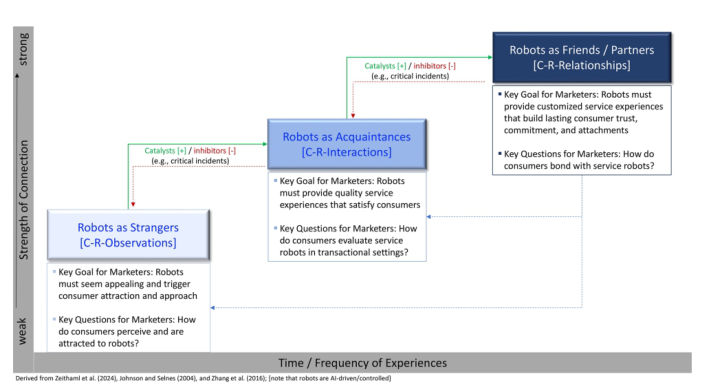
But when a humanoid becomes too humanlike the positive experience from the interaction turns and becomes negative or triggers a kind of discomfort depending on the service context. This is known as the uncanny valley effect and seen when the robot platform is over-realistic or too life-like (Zhang et al., 2024; Gauquier et al., 2023). Noble and Mende (2023) also comment on the robot platform or type of robot and how this affects the experience in different stages of the consumer phase, i.e. appearance is connected to task and perception which in turn is connected to sense of success and efficiency as well as to enhanced customer experience and service success or failure. (Noble & Mende, 2023). Customer (consumer) experience with robots over time have been illustrated in Noble and Mende (2023, 750), with a focus on the experience as a goal for the marketeer.
Above we see (Fig. 1) how the perceived difficulty of the task and the relationship evolves from ‘Robots as a Stranger’, ‘Robots as an
84 Tigerstedt
Acquaintances’ and ‘Robots as Friends or Partners’. It illustrates as well how the value of introducing a robot can be generated and evolve over time to include relationship building as a key goal in marketing.
Figure 1: Evolution of customer robot experiences by Noble and Mende (2023, 750).
The technology acceptance model (TAM) (Davis, 1989) or extensions of TAM have been used for a long time to explore how customers perceive the interaction with a social or service robot, (Park et al., 2013; Wirtz et al., 2018; Song & Kim, 2022; Vinoi et al., 2025 etc). Vinoi et al. (2025) studied the acceptance of service robots in retail and found that the acceptance was affected positively by for example conversational agility, performance expectancy, perceived anthropomorphism, immersion and interactivity.
METHOD
To gain a better understanding of customers’ reactions and interactions with humanoids in a grocery store setting we conducted a field experiment with Arcada’s humanoids Alex and Alf in spring 2024. The study was conducted in collaboration with K-supermarket Posthuset in Helsinki, Finland. More specifically we chose to conduct an observational study to gain insights into how customers experienced our humanoids. The method is useful in a particular social setting or group to observe behaviors, interactions, and practices. The method is suitable to gain novel information in areas which are not thoroughly explored (Bryman & Bell, 2017).
Data Collection Data was collected by a research group consisting of 3 researchers and 2 research assistants week 17, spring 2024, in a grocery store, K-supermarket Postitalo, in central Helsinki. The observations resulted in 19 pages of field notes from four full days of observation (∼20h). The notes were written by hand to draw less attention to the researcher during the observation.
Customer Experience and Social Robots - An Experiment in a Grocery Store 85
The observation notes were later transcribed and digitalized but kept as authentic as possible to minimize interpretations at an early stage.
The grocery store, K-supermarket, announced the presence of the researchers in social media channels and on sign in the store to make customers aware of the ongoing research (Fig. 2). For the experiment in the field, we used three use cases which we had developed together with the store manager: 1) Robot tasting station; 2) The secret offer (Fig. 2) and 3) Weekly offers (Fig. 3).
Figures 2-4: To the left: robot Amy interaction with customer, in the middle: robot Alf showing a special offer and to the right: a sign informing customers about the experiment in the grocery store.
Data Analysis For this initial analysis we did a conventional quantitative content analysis which is a good first analysis to do to later be able to proceed with a more in- depth and detailed data interpretation to strengthen and build theory (Hsieh & Shannon, 2005). The analytical process started out with neutral reading, i.e. before the identification of themes or categories. To avoid subjective bias researcher triangulation method was deployed.
RESULTS
The results in this explorative paper reflect the preliminary results of the analysis and reveal some initial themes which will be further analysed in a coming paper with the help of the Gioa method. We present the discovered themes and discuss initial results in relation to these.
Initially 42 themes where identified and here we report on 3 clustered themes: customers interaction, customer reactions, robot’s task and attributes.
The observations related to interaction revealed people seemed a bit shy to get close to the robot, i.e. to start the interaction. Many observations of how people circle around the robot and get back after some times were gathered. Most people also smiled when they saw the robot. The concrete interaction
86 Tigerstedt
was often started but interrupted at the middle due to a possible lack of interest, lack of motivation or time or due to technical obstacles of some kind. The interaction varied depending on the task of the robot. It was easy for customers to interact with the robot when it offered tastings. A more advanced interaction was the secret offer – here the customer had to actively interact more, (press buttons, follow the robot etc) and here interruptions in the interactions occurred. In many cases we saw that customers were polite and treated the robot as a social counterpart in the sense that they said thank you, tried to get it to talk more, get response etc.
The customers’ reactions theme consist of all kinds of reactions and emotions expressed in the interaction with the robot. The majority of the people (in all ages) we observed showed a positive reaction to the robot. In our data we found 18 different emotions. Emotions were expressed 1) in the interaction 2) when noticing the robot. Below we have an example from our observation notes (in Swedish, translated) (Figs. 5–6).
Figures 5-6: Extract from observation notes. Translations people sometimes seemed a bit scared when the robot started to move. And they pretended not to be the ones who triggered the movement. To the right: watching secretly from a distance. And people seemed a bit shy, surprised but happy and laughed.
Smilies and a curious expressions combined with a kind of shyness were a common observation. A feeling of playfulness was also seen in different interactions especially with the robot Amy.
We could also see that some people were surprised when the saw the robot, when it moved or when it talked. In general we can say that the movement seemed to have been unexpected by many. The movement made some people look a bit scared. We saw that people also where shy to show that they interacted with the robot or moved away quickly after they started the interaction and when the robot responded. People also look a as if they did not want others to see their interaction or them touching the robot.
Our observation of customers reactions to the robot’s attributes and task (Theme 3) reveals that it matters what task you give the robot and where the robot is placed in a store. Our smaller robot did not get the same amount of attention as the bigger one. This must be investigated more since the placement and task of the robot also differed in our experiment and cannot therefore be compared. The complexity of the task seems to have an impact on the success of the interaction and the function of the robot. People seemed to react more when the robot had a sound (speech or music) and when it moved. In our study we could see the novelty effect for example when people
Customer Experience and Social Robots - An Experiment in a Grocery Store 87
took photos of and with the robot and because of the curious expressions and way of interaction (or not interacting). Attributes like talk and movement and the embodiment seemed to make people talk back to the robot, be polite and to expect more back.
We looked at persons individual reactions but could also observe a social reaction or group behaviour in our data. We observed, on the one hand, that people wanted not to be seen when interacting with the robot but on the other hand also how people got braver when they saw someone interacting and then joined the person or group by the robot and all of a sudden we had a group of people interacting and helping each other with the interaction. We could see that if one person interacted more people were in general drawn towards the robot and wanted to check it out themselves as well.
When it comes to the attributes or features of the robot and the planned interactions and use cases in the grocery store, we noted a few things which can be useful for similar experiments:
1) Sound draws attention to the robot 2) Movement draws attention to the robot 3) A tasting task is an easy way get customers to start an interaction with a robot 4) The placement is crucial depending on the planned interaction 5) Choice of product is important: should be important for the target end user/customer 6) Technical stability and speed if response from the robot is important for continued interaction with the robot We did not notice that a specific group of customers (age, gender etc) would be interested in the robots. We noticed the peak hours in the store (lunch, after work) and that this is important to be aware of when planning similar experiments where you want many interactions and a good flow of customers.
CONCLUSION
These preliminary findings will help our further analysis and hopefully give insights to other who plan and do similar real-life experiments.
Our findings are in line with Vinoi et al. (2025), Noble and Mende (2022) and Gauquier et al. (2022) and we see that the humanoids triggered talking and a human-to-human-like interaction with the robots among the customers. Also, both the movement and the talk caused reactions and triggered interactions with the robots. Conversational elements, like in the study by Sakai et al. (2022), where seen as beneficial for the interaction and for triggering emotions.
It is crucial to plan the robot tasks well and to make them purposeful (Noble and Mende, 2023 and Zhang et al., 2024). Our experiment shows this in the interrupted interactions or loss of interest among the customers.
We can agree with Wirtz et al., (2018), Vinoi et al., (2025) and for example Iwamoto (2022) and do believe that emotional and social behaviours need to
88 Tigerstedt
be studied more to create fuller understanding of the usefulness of humanoids in real-life retail or service settings.
AUTHOR CONTRIBUTIONS Christa Tigerstedt, Primary author, correspondence, ideation and design, data collection, analysis and theory.
Niklas Eriksson, Data collection, ideation and design, preliminary analysis. Kristoffer Kuvaja-Adolfsson, Data collection, ideation and design, preliminary analysis.
REFERENCES
Antfolk, M. (2022). The possibilities for using humanoid robots as a care resource.
Doctoral dissertation. Åbo: Åbo Akademi university. Bryman, A. & Bell, E. (2017. Business Research Methods. Oxford: Oxford University Press. Blaurock, M., Caic, M., Okan, M. & Henkel, P. (2022). A transdisciplinary review
and framework of consumer interactions with embodied social robots: Design, delegate, and deploy. International Journal of Consumer Studies, Vol. 46, No. 6, 1877–1899, doi: 10.1111/ijcs.12808. Davis, F. (1989). Perceived Usefulness, Perceived Ease of Use, and User Acceptance of Information Technology. MIS Quarterly, Vol. 13, No. 3, 319–340. Fuste-Forne, F. (2021). Robot chefs in gastronomy tourism: What’s on the menu?
Tourism Management Perspectives, Vol. 37. doi: 10.1016/j.tmp.2020.100774. Gauquier de, L., Willems, K., Cao H-L., Vanderborght, B. & Brengman, M. (2023).
Together or alone: Should service robots and frontline employees collaborate in retail-customer interactions at the POS? Journal of Retailing and Consumer Services, Vol. 70. doi: 10.1016/j.jretconser.2022.103176. Go, H., Kang, M. & Suh, S. C. (2020). Machine learning of robots in tourism and hospitality: Interactive technology acceptance model (iTAM) – cutting edge. Tourism Review, Vol. 75, No. 4, 625–636. doi: 10.1108/TR-02-2019-0062. Hsieh, H-F. & Shannon, S. E. (2005). Three Approaches to Qualitative Content
Analysis Qualitative Health Research, Vol. 15 No. 9, November 2005, 1277–1288. doi: 10.1177/1049732305276687. Iwamoto, T., Baba., Nakanishi, J., Hyodo, K., Yoshikawa, Y. & Ishiguro, H. (2022).
Playful recommendations: Sales promotion that robots stimulate pleasant feelings instead of product explanation. IEEE Robotic and Automation Letters, 7(4), 11815–11822. Kabadyi, S. O’Connor, G. E., Tuzovic, S. (2020). Viewpoint: The impact of coronavirus on service ecosystems as service mega-disruptions. Journal of Services Marketing, 34(6), 809–817. doi: 10.1108/JSM-03-2020-0090. Kuvaja Adolfsson K., Tigerstedt C., Biström D., & Espinosa-leal L.(2024). Deploying
Humanoid Robots in a Social Environment. In proceedings, Smart Technologies for a Sustainable Future, 373–380. Springer. doi: 10.1007/978-3-031-61905- 2_36. Lee, M. H., 2020. How to Grow a Robot. Massachusetts: The MIT Press. Lecadio D., Guedes, L., Oliveira, J., Reis, J. & and Melãoc, N. (2024). Customer Service with AI-Powered Human-Robot Collaboration (HRC): A Literature Review. Procedia Computer Science, 232 (2024) 1222–1232. doi: 10.1016/ j.procs.2024.01.120.
Customer Experience and Social Robots - An Experiment in a Grocery Store 89
Lu, V. N., Wirtz, J., Kunz, W. H., Paluch, S., Gruber, T., Martins, A. and Patterson, P. G., 2020. Service robots, customers and service employees: What can we learn from academic literature and where are the gaps? Journal of Service Theory and Practice, 30(3), 361–391. https://doi.org/10.1108/JSTP-04-2019-0088 Nakanishi, J., Baba, J., Kuramoto, I., Ogawa, K., Yoshikawa, Y. and Ishiguro,
H., 2020. Smart Speaker vs. Social Robot in a Case of Hotel Room. In: 2020 IEEE/RSJ International Conference on Intelligent Robots and Systems (IROS), 11391–11396. Las Vegas, NV, USA: IEEE. doi: 10.1109/IROS45743.2020, 9341537. Niemelä, M., Heikkilä, P., Lammi, H. & Oksman, V. (2019). A Social Robot in a Shopping Mall: Studies on Acceptance and Stakeholder Expectations. In O. Korn (ed.), Social Robots: Technological, Societal and Ethical Aspects of Human-Robot Interaction, Human–Computer Interaction Series. https://doi.org/10.1007/978-3- 030-17107-0_7 Noble, S. M. & Mende, M. (2023). The future of artificial intelligence and
robotics in the retail and service sector: Sketching the field of consumer-robot experiences. Journal of the Academy of Marketing Science, Vol. 51 No. 4, 747–756. doi: 10.1007/s11747-023-00948-0. Okafuji, Y., Ozaki, Y., Baba, J., Nakanishi, J, Ogawa, K., Yoshikawa, Y. & Ishiguro, H. (2022). Behavioral Assessment of a Humanoid Robot When Attracting Pedestrians in a Mall. International Journal of Social Robotics, 14, 1731–1747. doi: 10.1007/s12369-022-00907-9. Park, E. & Pobil, A. P. (2013). User’s attitudes towards service robots in South Korea. Industrial Robot: An International Journal. 40/1, 77–87. doi: 10.1108/ 01439911311294273. Pinxteren van, M. M. E., Wetzels, R. W. H., Rüger, J., Pluymaekers, M. and Wetzels,
M.(2019). Trust in humanoid robots: implications for services marketing. Journal of Services Marketing, Vol. 33, No. 4, 507–518. doi: 10.1108/JSM-01-2018-0045. Sakai, K., Nakamura, Y. Yoshikawa, Y. & Ishiguro, H. (2022). Effect of Robot Embodiment on Satisfaction with Recommendations in Shopping Malls,” in IEEE Robotics and Automation Letters, Vol. 7, No. 1, 366–372. doi: 10.1109/ LRA.2021.3128233. Song, C. S. & Kim, Y-K. (2022). The role of the human-robot interaction in
consumers’ acceptance of humanoid retail service robots. Journal of Business Research, 146, 489–503. doi: 10.1016/j.jbusres.2022.03.087. Tigerstedt, C. & Fabricius, S. (2023). Humanoid robots in service contexts – insights from sessions with end users. In ICERI2023 Proceedings, 1413–1420. Tigerstedt, C., Kuvaja-Adolfsson, K. & Biström, D. (2024). Exploring the role of
social robots in elderly care: A case study. In INTED Proceedings, 3288–3295. Tondu, C., 2012. Anthropomorphism and service humanoid robots: An ambiguous relationship. Industrial Robot: An International Journal, 39(6), 609–618. Vinoi N., Shankar, A., Agarwal, R. & Alghafes, R. (2025). Revolutionizing retail:
The transformative power of service robots on shopping dynamics, Journal of Retailing and Consumer Services, Vol. 82, doi: 10.1016/j.jretconser.2024.104085. Wirtz, J., Patterson, P. G., Kunz, W. H., Gruber, T., Lu, V. N., Paluch, S. & Martins, A.
(2018). Brave new world: Service robots in the frontline. Journal of Service Management, Vol. 29, No. 5, 907–931. doi: 10.1108/JOSM-04-2018-0119.
90 Tigerstedt
Wong, A. & Wong, J. (2024). Service robots’ acceptance in museums: An empirical study using the service robot acceptance model (sRAM). Journal of Services Marketing, 38/5, 619–635. doi: 10.1108/JSM-05-2023-0183. Zhang, W., Slade, E. L., & Pantano, E. (2024). Humanlike service robots: A
systematic literature review and research agenda. Psychology & Marketing. Advance online publication. doi: /10.1002/mar.22099. Wärneståhl, P. (2021). Design av AI-drivna tjänster. Lund: Studentlitteratur.
LISTED IN THE AHFE DIGITAL BOOKSTORE CATALOGUE
Explore the complete digital volume
Human Systems Engineering and Design (IHSED2025): Future Trends and Applications
Read this individual research paper free through the original publisher, or explore the full digital proceedings book.
ISBN 978-1-964867-74-8
Explore this ISBN in the AHFE Bookstore ↗Listed in the July 2026 bookstore catalogue; search by ISBN to confirm current availability · Digital book purchase optional